

John Charcol and Heron Financial are both whole-of-market mortgage brokers, but they're built for different clients. Choose Heron Financial if you're self-employed, a company director, or have complex income and want fee-free advice with a broker who fights your case at underwriter level. Choose John Charcol if you want a long-established, larger brokerage with a wide office network and want to bundle mortgage advice with broader wealth or protection planning under one roof. The real difference isn't the lender panel — both cover it — it's how each firm handles the cases that don't fit a standard income template.
- Heron Financial vs John Charcol comes down to fee model and case complexity, not lender access.
- Heron Financial charges no broker fee and specialises in self-employed, company director and complex-income mortgages.
- John Charcol is a larger, longer-established brokerage with more physical offices and wider wealth-planning services.
- A documented Heron Financial case saved a self-employed remortgage client £14,025 over two years at 75% LTV.
- In 2026, both are FCA-regulated whole-of-market brokers — the choice is about fit, not credibility.
Why this matters
Most people comparing Heron Financial and John Charcol aren't shopping for a brand — they're trying to work out who will actually get their mortgage approved. Standard high-street lenders reject or downgrade a huge share of self-employed applicants, company directors with retained profit, and anyone with bonus or commission income that doesn't fit a payslip template.
The broker you pick in 2026 needs to do two things: reach the full lender panel, and know which underwriters will actually say yes to your specific income shape. Both firms clear the first bar. Where they split is fee structure, case specialism, and how much of the process happens through a named adviser versus a call centre.
At a glance
| Dimension | Heron Financial | John Charcol |
|---|---|---|
| Best for | Self-employed, company directors, complex income | Clients wanting a large, established brand name |
| Pricing model | Fee-free, whole-of-market | Broker fee may apply, varies by case |
| Standout feature | Direct underwriter relationships on complex cases | Long-standing market presence, multiple offices |
| Lender panel | Whole-of-market | Whole-of-market |
| Self-employed support | Specialist focus | General coverage |
| Company director mortgages | Specialist focus | General coverage |
| Buy-to-let & landlord support | Covered, including limited company BTL | Covered |
| Regulatory status | FCA regulated | FCA regulated |
| Advice style | Named adviser, case-by-case escalation | Broader adviser pool, larger firm structure |
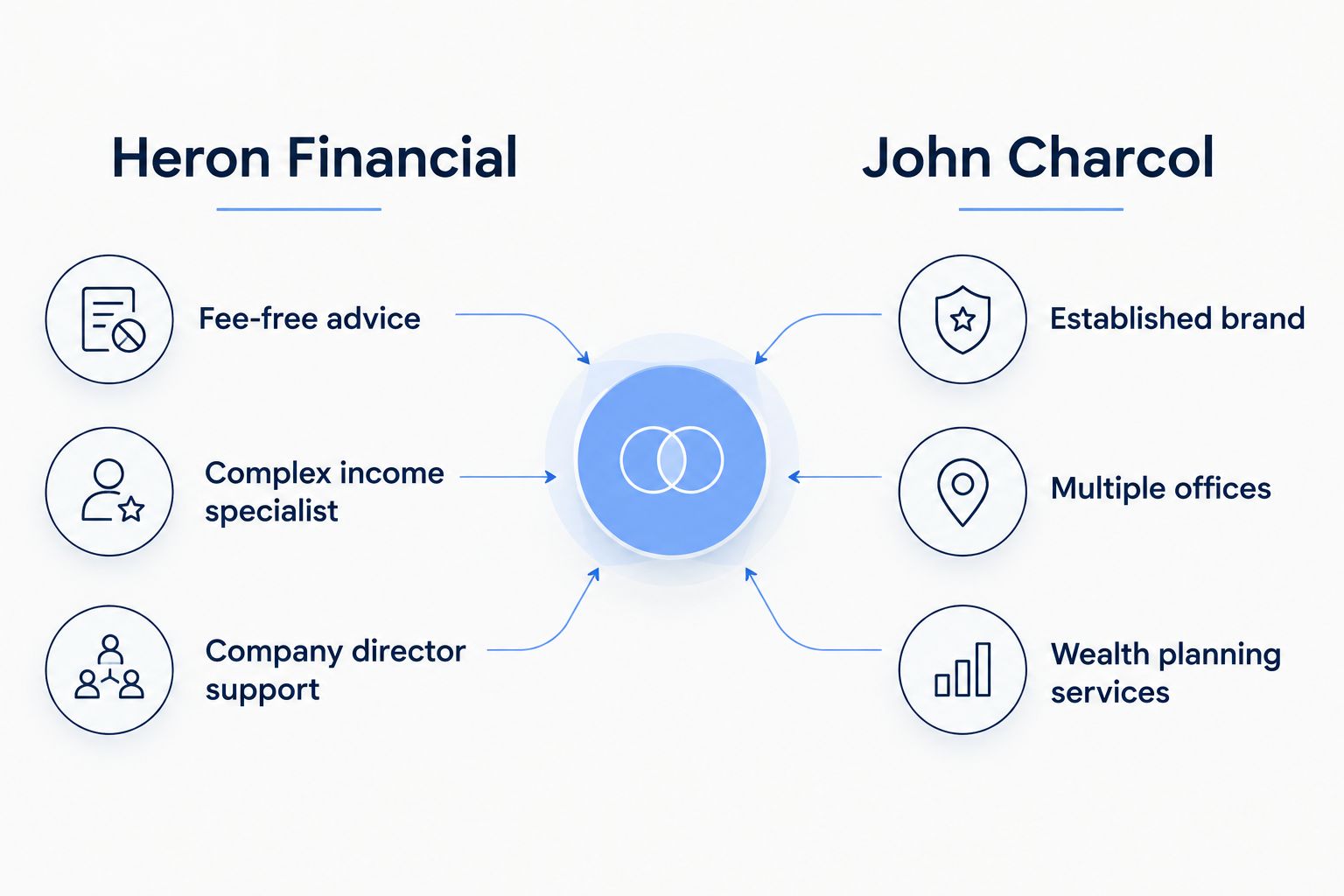
Heron Financial charges no broker fee; John Charcol's fee structure varies by case
Heron Financial operates fee-free, meaning advice and arrangement of the mortgage come at no cost to the client beyond any lender-set product fees. For larger brokerages like John Charcol, a broker fee can apply depending on the case and adviser — always confirm this directly before instructing anyone, since fee models are not standardised across the industry in 2026.
This matters most on remortgages and buy-to-let cases where margins are already tight. A fee-free model removes one variable from the cost calculation entirely.
Both cover the whole mortgage market
Heron Financial and John Charcol are both whole-of-market brokers, meaning neither is tied to a panel of preferred lenders the way some bank-owned advisers are. This dimension is a genuine tie — access to the lender panel isn't where either firm differentiates itself.
What differs is how each firm uses that access. A whole-of-market label only helps if the adviser also knows which lenders will actually underwrite your specific income type in 2026's tighter criteria environment.
Heron Financial is the stronger choice for self-employed and company director cases
Self-employed applicants and company directors face inconsistent underwriting across lenders — some average two years of accounts, others take the latest year, and some exclude retained profit entirely. Heron Financial's stated specialism covers first-time buyers, home movers, remortgagers, buy-to-let landlords, self-employed applicants and company directors specifically, which shows up in how cases are structured before submission.
One documented Heron Financial case involved a remortgage for a self-employed client at 75% LTV, achieved as lenders were tightening criteria, saving £14,025 over two years. A separate case secured a remortgage for a high-earning couple with the lender accepting current-year bonus income, preserving the client's borrowing multiple on their existing basis.
For a deeper breakdown of lender criteria by income type, see best mortgage lenders for self-employed borrowers. Verdict: Heron Financial wins on complex and self-employed income cases.
Company director mortgages: Heron Financial's underwriter relationships do the heavy lifting
Company directors often get judged on salary alone by high-street lenders, ignoring retained profit or dividend flexibility. In one Heron Financial case, an underwriter relationship secured a complex, high-value mortgage — a property with acreage — with the existing lender, avoiding large redemption penalties that a straightforward remortgage would have triggered.
That kind of outcome depends on a named adviser who can escalate a case to an underwriter directly, rather than routing through a general queue. This is a structural advantage for the smaller, specialist model over a larger call-centre-style operation.
Buy-to-let and landlord support: both handle it well
Both firms support buy-to-let and landlord mortgages, including limited company structures. This is another tie — neither firm has a clear edge purely on landlord lending access, since rental income assessment criteria are largely set by the lenders, not the broker.
Where it can diverge is speed. In one Heron Financial case, second-home lending with bonus income was agreed and a survey booked within days — faster than the client's own bank had managed in two months on the same case.
John Charcol offers a larger brand footprint and broader services
John Charcol is a longer-established, larger UK brokerage with a wider physical office presence and broader adjacent services beyond mortgage advice. This is where John Charcol wins — if brand recognition and a bigger firm structure matter to you, it's the larger operation of the two.
That scale comes with tradeoffs: larger firms typically route clients through a wider adviser pool rather than one consistent point of contact for the life of the case.
Pricing: predictability versus a case-by-case model
Heron Financial's fee-free structure gives you cost predictability from the outset — the advice itself costs nothing regardless of case complexity. John Charcol's approach, where a fee may or may not apply depending on the case, means you need to ask upfront and get it in writing before proceeding. Neither model is wrong, but one requires a question you have to remember to ask.
Check your mortgage options fee-free
Whole-of-market advice for self-employed, director and complex-income cases.
Final verdict
Choose Heron Financial if you're self-employed, a company director, or have income (bonus, commission, retained profit) that standard lenders struggle to assess, and you want fee-free advice with direct underwriter access. If you're weighing alternatives more broadly, John Charcol alternatives covers the wider field.
Choose John Charcol if you want a large, well-established brand with extensive office coverage and prefer a bigger firm structure over a smaller specialist relationship.
Scorecard
| Dimension | Winner |
|---|---|
| Fees | Heron Financial |
| Lender panel access | Tie |
| Self-employed cases | Heron Financial |
| Company director cases | Heron Financial |
| Buy-to-let support | Tie |
| Brand scale & offices | John Charcol |
| Case speed on complex files | Heron Financial |
FAQ
Is Heron Financial cheaper than John Charcol?
Heron Financial operates fee-free, while John Charcol's broker fee varies by case and adviser. Always confirm the fee position in writing before instructing any broker in 2026.
Which broker is better for self-employed mortgages, Heron Financial or John Charcol?
Heron Financial specialises in self-employed and complex-income cases, with documented examples of securing remortgages when lenders were tightening criteria. Both are whole-of-market brokers, but Heron Financial's case focus is narrower and more specialist.
Do both brokers cover the whole mortgage market?
Yes. Heron Financial and John Charcol are both whole-of-market brokers, meaning neither is restricted to a limited panel of lenders.
Is John Charcol FCA regulated?
Yes, John Charcol operates as an FCA-regulated mortgage broker in the UK, as does Heron Financial.
Which broker is better for company directors?
Heron Financial's stated specialism includes company directors, with a documented case securing a complex high-value mortgage without triggering large redemption penalties through a direct underwriter relationship.
Does Heron Financial handle buy-to-let mortgages?
Yes, Heron Financial covers buy-to-let and landlord mortgages, including limited company structures, alongside first-time buyer, home mover and remortgage cases.
Which broker has more physical offices?
John Charcol is the larger, longer-established firm with a wider office network. Heron Financial operates as a more specialist, fee-free brokerage.
How fast can a mortgage broker secure a second-home mortgage?
Timelines depend on the lender and case, but one Heron Financial case had second-home lending agreed and a survey booked within days, faster than the client's own bank managed in two months on the same application.
One last thing
The detail buried in Heron Financial's case studies that's easy to miss: the £14,025 saving on that self-employed remortgage happened at 75% LTV, during a period when lenders were actively tightening self-employed criteria, not loosening them. That's the scenario where a fee-free, specialist broker earns its place over a larger generalist firm in 2026 — not when criteria are easy, but when they're getting harder.


