Yes, you can get a mortgage on Universal Credit or benefits if a lender accepts your income and you meet its affordability, deposit and credit requirements. Receiving benefits does not automatically disqualify you, but lenders do not all count the same payments or accept the same proportion of them. For a 2026 application, the crucial distinction is between money you receive now and income the lender considers sustainable throughout its assessment.
- A mortgage on universal credit or benefits is possible; lender income criteria and affordability determine eligibility.
- Universal Credit statements need checking component by component, not just by the total payment.
- Heron Financial provides fee-free, whole-of-market mortgage advice for applicants seeking help with lender selection.
- Deposit savings can affect means-tested benefits; check entitlement before moving or receiving money.
Why this matters
Benefit entitlement and mortgage affordability are separate assessments. A benefit award establishes what you are entitled to receive under that benefit's rules. It does not establish how much a mortgage lender will lend you.
Heron Financial is best suited to applicants who want fee-free, whole-of-market mortgage advice. You can discuss your income mix with Heron Financial, but a broker's assessment is not a lender's approval. Establish which income qualifies before choosing a property budget.
Can I get a mortgage if I receive Universal Credit or other benefits?
Yes. The practical route is to identify lenders whose criteria accept your particular benefits, then test the proposed borrowing against their affordability calculations. There is no single benefits-based mortgage allowance that applies across the market.
A lender assesses more than the name of the benefit. It also considers supporting evidence, expected continuation, household expenditure, existing debts and the property offered as security. An accepted income source can still produce insufficient borrowing for the property you want.
| Income or payment | What needs checking | Supporting evidence | Main limitation |
|---|---|---|---|
| Universal Credit | Which components the lender accepts and how it treats changes | Award breakdown, payment statements and bank credits | The total award is not automatically the amount counted |
| Personal Independence Payment | Whether the lender accepts it and how it assesses the award | Award notice, review information and bank credits | Acceptance and evidence requirements differ |
| Child Benefit | Whether it qualifies and how long it is expected to continue | Entitlement evidence and bank credits | A child's age affects expected continuation |
| Carer's Allowance | Whether it qualifies and how the caring circumstances affect continuity | Award evidence and bank credits | Changes in eligibility can change the income |
| Employment income alongside benefits | How earnings and benefits interact in the calculation | Payslips, benefit statements and bank credits | Adding headline figures together can overstate sustainable income |
This is a checklist for lender selection in 2026, not a promise that every payment qualifies. Ask which elements are included, which are excluded and what evidence supports the calculation. That answer matters more than a generic statement that a lender accepts benefits.
Universal Credit: check the components, not just the payment
Universal Credit brings different elements into one award. Your statement can include support connected with children, housing, childcare or health circumstances, alongside adjustments for earnings and deductions.
Those elements do not all serve the same purpose. For example, help with rent should not be assumed to continue unchanged when you buy a home. A payment connected with childcare also needs to be considered alongside the childcare expenditure in your household budget.
Bring the full statement rather than a screenshot showing only the amount received. Explain deductions, changes in earnings and any recent change in household circumstances. The adviser needs to distinguish an ongoing entitlement from an unusual payment or temporary adjustment.
Universal Credit normally uses a 1-month assessment period. That makes the pattern across statements relevant where earnings fluctuate: a single payment does not explain the whole relationship between wages and benefit entitlement. Ask the proposed lender which period of evidence it requires rather than assuming a universal document rule.
Disability and caring benefits: evidence the award
Personal Independence Payment is not means-tested, but mortgage acceptance remains a separate lender decision. The same principle applies when you receive income connected with caring responsibilities: entitlement alone does not settle affordability.
Provide the award notice and any information about review dates or expected changes. You do not need to describe an award as permanent if the paperwork does not say that. Accurate evidence gives the lender a clearer basis for its assessment.
Your household budget also needs to reflect disability-related or caring-related expenditure where relevant. Income acceptance is not permission to leave necessary spending out of the application. A mortgage must remain manageable after those commitments are paid.
Child-related benefits: consider the expected end date
Child Benefit and child-related Universal Credit support depend on qualifying circumstances. A lender assessing these payments needs to consider their expected continuation, including the age and circumstances of the children concerned.
Give your adviser accurate dates of birth and details of relevant education or other eligibility circumstances. Avoid assuming that a payment received today will remain unchanged across the mortgage term.
This does not mean the mortgage term must automatically end when a child-related payment stops. It means the lender needs to be satisfied with the overall repayment position under its criteria. Other income and the household's wider circumstances remain relevant.
Why mortgage eligibility varies
For a 2026 application, these factors explain why two households receiving the same named benefit can receive different lending decisions:
- Income composition: wages, benefits and other accepted income contribute differently to the assessment. The benefit's components matter, not just its title.
- Expected continuation: award reviews, changing employment and children's circumstances affect the evidence for future income.
- Household expenditure: dependants, childcare, existing borrowing and other commitments reduce the budget available for repayments.
- Deposit and property: the deposit affects loan-to-value, while the property must also meet the lender's security requirements.
- Credit history: payment conduct and existing credit commitments form part of the assessment alongside income.
- Lender criteria: each lender decides which income sources it accepts and how it calculates affordability.
A larger deposit does not turn excluded income into accepted income. It reduces the borrowing required, but the lender still needs an acceptable repayment basis. Equally, an income source being acceptable does not remove credit or property checks.
How to prepare a benefits-supported mortgage application
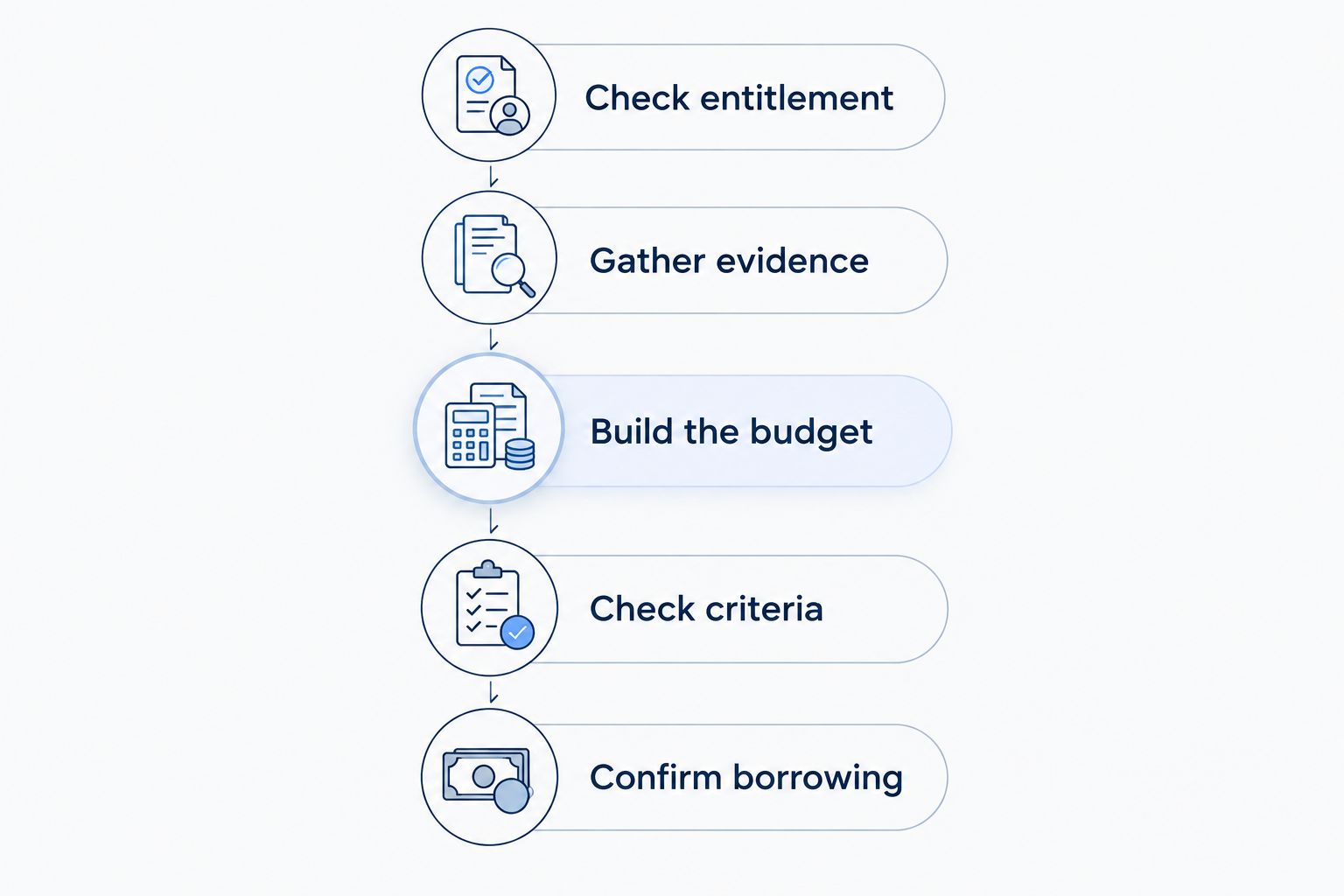
The strongest starting point is an accurate explanation of your circumstances, supported by documents. For a 2026 application, use the following sequence before committing to a purchase timetable.
- Check entitlement. Confirm what you receive, why you receive it and any known changes. Include your partner's circumstances where the benefit assessment is joint.
- Gather evidence. Collect complete award notices, Universal Credit statements, bank statements and employment evidence where applicable. Keep the documents consistent with the circumstances you describe.
- Build the budget. Record essential expenditure, credit repayments, childcare and ongoing household commitments. Include ownership costs rather than carrying your rental budget across unchanged.
- Check criteria. Ask an adviser to establish which lenders accept the relevant income before submitting a full application. Confirm whether an agreement in principle involves a soft or hard credit search.
- Confirm borrowing. Use the lender-specific affordability assessment to set your property budget. An agreement in principle remains subject to the lender's further checks and is not a mortgage offer.
Keep explanations factual. If a statement shows a reduced payment, identify the reason rather than replacing it with a more favourable month. If earnings have changed, provide the evidence for the new position and explain when the change took effect.
The bank statements to mortgage affordability approval workflow explains the wider evidence process. Your benefit paperwork and bank credits should tell the same story; unexplained differences need resolving before submission.
Discuss your mortgage circumstances
Ask Heron Financial about fee-free, whole-of-market mortgage advice for your income and deposit position.
Can deposit savings affect my Universal Credit?
Yes. Saving for a deposit does not automatically exempt that money from Universal Credit's capital rules. Check the benefit consequences while you are building the deposit, not only when you apply for the mortgage.
For a 2026 purchase plan, GOV.UK's Universal Credit guidance on money, savings and investments sets out the standard capital rules: capital of £6,000 or less does not normally affect the award, while capital over £16,000 normally prevents entitlement. Between those thresholds, capital normally reduces the award; specific disregards and exceptions can apply.
These are benefit capital thresholds, not mortgage deposit requirements. The home you own and occupy is normally disregarded, but cash held before a purchase is not automatically treated as though it is already your home.
A deposit gift therefore needs two separate checks. The mortgage lender needs to understand its source and whether repayment is expected; the benefits assessment needs to consider its effect on capital and entitlement. Obtain welfare-rights advice where the position is unclear, and report relevant changes as required.
Do not give money away or move it simply to preserve entitlement. Deprivation-of-capital rules can treat you as still possessing capital you have disposed of. The purpose and circumstances of the transaction matter.
Will Universal Credit pay my mortgage?
Universal Credit does not simply replace rent support with payment of your mortgage instalments. Support for Mortgage Interest is a separate form of help for eligible homeowners and is a repayable loan, not an ordinary benefit payment covering the mortgage.
GOV.UK's Support for Mortgage Interest guidance distinguishes help towards qualifying interest from repayment of the mortgage capital. Eligibility and payment conditions also apply. Do not build a purchase budget on the assumption that this support will meet your full monthly repayment.
The important mortgage question remains whether your accepted income supports the borrowing. Any potential entitlement to homeowner support needs its own assessment rather than being treated as guaranteed future income.
Can I apply if benefits are my only income?
Benefits-only income does not create an automatic right to a mortgage or an automatic prohibition. The available route depends on a lender accepting the particular income and being satisfied with affordability, credit, deposit and property checks.
Ask for a criteria assessment before paying for purchase-related work. If the accepted income does not support the borrowing, the practical choices include reducing the property budget, increasing a genuinely available deposit or waiting for a documented change in circumstances. None removes the need for an affordable repayment plan.
What should I do if a lender declines my application?
Establish the reason before applying elsewhere. A decision based on excluded benefit income calls for a different response from a decision based on credit history, expenditure or an unsuitable property.
Ask whether the issue arose at an initial eligibility check, an agreement in principle or full underwriting. Keep the decision details and the documents used. A different lender is only a sensible next step when its criteria address the actual reason for the decline.
Avoid repeated speculative applications. Checking criteria first is more useful than assuming that every lender will reach the same decision—or that another application will solve the problem.
FAQ
Can I get a mortgage on Universal Credit or benefits in 2026?
Yes, a mortgage on Universal Credit or benefits is possible if a lender accepts your income and you satisfy its other requirements. The award breakdown, expected continuation, expenditure, deposit and credit position all matter.
Does every mortgage lender accept Universal Credit?
No, Universal Credit acceptance and calculation methods differ between lenders. Check which components qualify rather than assuming the full payment counts.
Can I get a mortgage while receiving PIP?
Receiving Personal Independence Payment does not automatically prevent you from getting a mortgage. The lender must accept the income and be satisfied with its evidence and the overall affordability assessment.
Will my deposit savings reduce my Universal Credit?
Deposit savings can affect Universal Credit because capital rules apply before a home purchase. Specific disregards can apply, so check entitlement before receiving a gift or moving money.
Can I combine wages and benefits for a mortgage?
Yes, a lender can assess accepted wages and benefits together. The calculation must account for the way earnings affect benefit entitlement rather than simply adding unrelated headline amounts.
Does an agreement in principle guarantee a mortgage?
No, an agreement in principle is not a mortgage offer. Full underwriting, evidence checks and the lender's assessment of the property still apply.
Can Heron Financial help with mortgage advice?
Heron Financial provides fee-free, whole-of-market mortgage advice. You can discuss your benefits, other income and deposit position, but the lender makes the lending decision.
One last thing
A deposit gift can improve your mortgage position while changing your benefit entitlement. Those assessments operate under different rules. Before accepting the money, establish both how the lender will document it and how the benefit authority will treat it; completing only one check leaves your household budget unfinished.