Yes—overtime or bonus pay can increase your mortgage affordability in 2026 if the lender accepts it as sustainable, evidenced income. The increase is not automatic: the lender also checks your outgoings, existing commitments and ability to keep making repayments when variable earnings fall.
- Overtime or bonus pay can increase mortgage affordability when the lender accepts the income and its supporting evidence.
- Guaranteed payments and discretionary bonuses need different evidence; a payslip alone does not establish future entitlement.
- Compare accepted income, not just headline salary multiples, before choosing a mortgage lender.
- Heron Financial offers whole-of-market mortgage advice for borrowers whose employment income includes variable pay.
Why this matters
Your basic salary does not always tell the full story. Regular extra shifts, contractual allowances and performance-related pay can make a substantial difference to your actual earnings, but a lender does not have to treat every payment as dependable income.
The useful question is not simply whether a lender accepts bonuses. It is how that lender will assess your particular payment history. A lender that accepts a type of income can still reduce the amount used in its affordability calculation.
If your earnings also include sales-related payments, the guide to getting a mortgage using commission income covers a related assessment issue. Keep commission, overtime and bonuses separate in your application so each payment has a clear explanation.
Can I use overtime or bonus pay to increase my mortgage affordability?
Yes. A lender can include accepted overtime or bonus income alongside your basic salary when assessing a residential mortgage. Whether that produces a higher borrowing figure depends on the lender's criteria and the rest of your financial position.
The distinction is between money you have received and income the lender considers sustainable. Your documents need to explain both the payment history and the basis on which payments continue.
| Income type | Evidence that helps explain it | Main strength | Main limitation | Best suited to |
|---|---|---|---|---|
| Contractual overtime | Employment contract, payslips and employer confirmation | A documented contractual basis | The lender still assesses sustainability | Applicants with an established entitlement |
| Non-contractual overtime | Payslip history and an explanation of working patterns | Shows actual additional earnings | Extra shifts are not guaranteed | Applicants with consistent additional work |
| Contractual bonus | Contract terms, award records and payment evidence | Makes the entitlement clearer | Conditions can affect payment | Applicants with clearly defined bonus terms |
| Discretionary bonus | Award letters, payment history and employer explanation | Demonstrates past payments | Previous awards do not guarantee future awards | Applicants with an established bonus record |
These are evidence categories, not promises of acceptance. In 2026, check the selected lender's current treatment of each income component before relying on an affordability figure.
Contractual overtime: establish what is guaranteed
A contract can help distinguish required working hours from optional extra shifts. Check whether it guarantees the hours, the payment, or neither; these are different arrangements.
The advantage is a clearer explanation of your entitlement. The limitation is that a contractual reference does not remove the lender's wider affordability checks or prove that every recent payment will continue.
Best for applicants with documented overtime arrangements: provide the relevant contract wording alongside evidence of what payroll actually pays.
Non-contractual overtime: show the working pattern
Optional overtime needs a clear payment history. A lender needs to understand whether recent earnings reflect your normal working pattern or an exceptional period of extra work.
The advantage is that payslips show what you have genuinely earned. The limitation is dependence on shifts remaining available and on your ability to keep working them.
Best for applicants with regular extra shifts: explain changes in hours rather than presenting the strongest payslip as your normal monthly income.
Bonus pay: separate entitlement from expectation
A bonus letter can explain an award, but its wording matters. A confirmed payment, a target award and a discretionary scheme do not establish the same level of certainty.
The advantage of an established bonus record is that it provides evidence beyond your expectations. The limitation is that employer performance, personal targets or scheme changes can affect future payments.
Best for applicants with documented awards: provide the scheme terms and payment records together, including any conditions attached to the award.
How do I prepare overtime and bonus evidence?
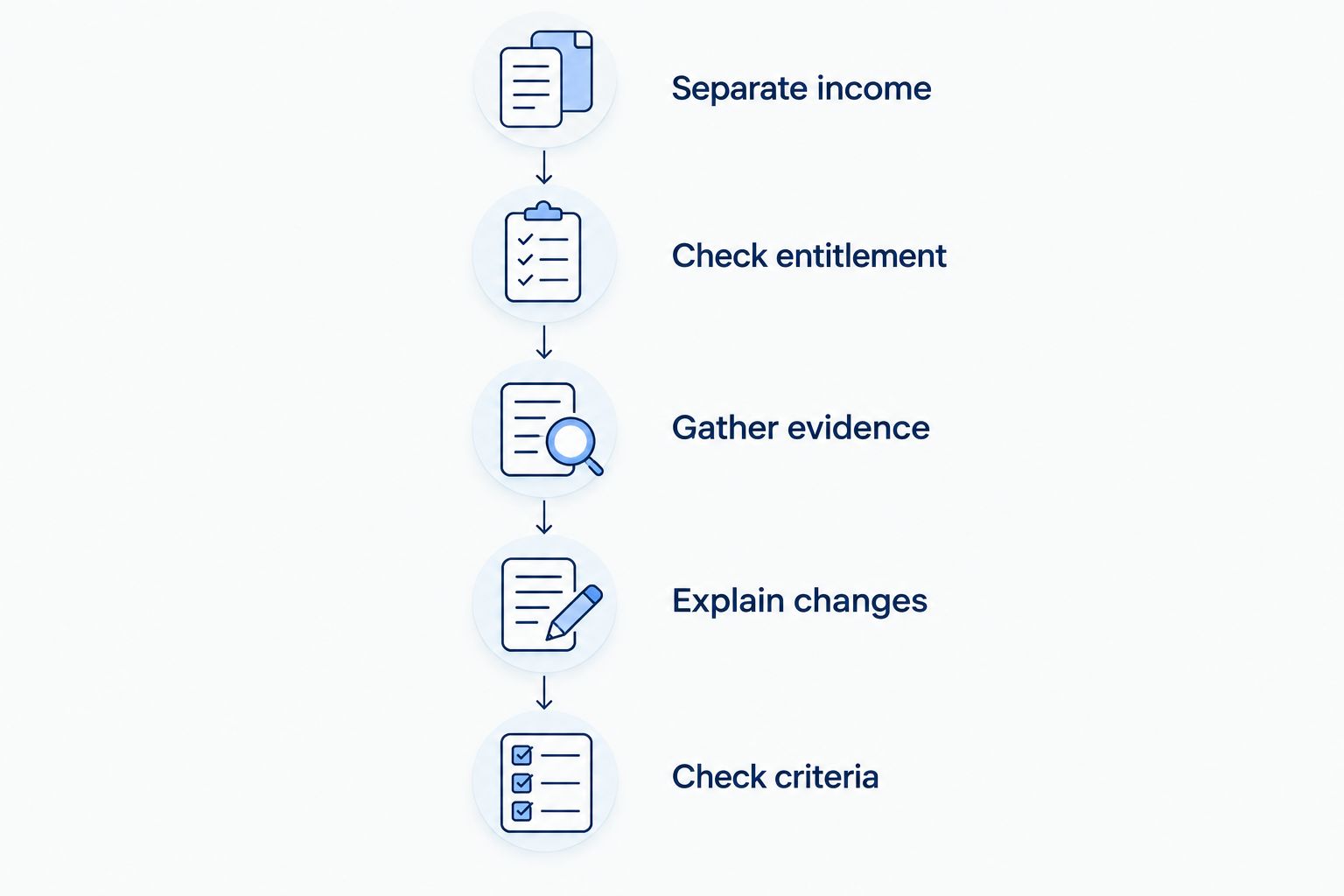
Build a consistent account of your earnings before submitting a mortgage application. The aim is not to produce the largest possible income total; it is to make the income figure accurate, explainable and suitable for the lender's assessment.
- Separate income. Identify basic salary, overtime, bonus, commission and allowances on your payslips. Do not combine everything into a salary figure that your employment contract cannot support.
- Check entitlement. Read your contract and bonus terms. Mark which payments are guaranteed, conditional or discretionary, and identify any recent changes.
- Gather evidence. Assemble the payslips, bank statements, P60 documents and award letters the lender requests. Follow its actual document requirements rather than assuming every lender asks for the same history.
- Explain changes. Record why payments rose, fell or stopped. A promotion, changed shift pattern or revised bonus scheme needs an explanation that matches the documents.
- Check criteria. Establish how the proposed lender will assess the income before treating an online calculator result as a borrowing limit.
A P60 summarises pay and tax for a tax year; it does not explain every payment's contractual status. Payslips provide more detail, while bank statements help reconcile take-home pay with money received.
For a 2026 application, use documents that meet the lender's current requirements. An employer letter can clarify an arrangement, but it does not replace other evidence unless the lender agrees.
Why the amount you can borrow varies
Two applicants with the same total earnings can receive different affordability outcomes. These factors explain why a headline income figure is not enough:
- Payment certainty. Contractual entitlement and employer discretion are different. Clear terms help establish what the income represents.
- Consistency. A steady payment pattern provides a different picture from an isolated high payment or a declining record.
- Evidence history. The lender's required documents and assessment period determine which earnings support the application.
- Employment changes. A new role, revised hours or changed bonus scheme can make older earnings less representative.
- Household commitments. Credit repayments, childcare, dependants and other expenditure affect the amount available for mortgage payments.
- Mortgage structure. The loan amount, term and repayment arrangements influence the affordability assessment alongside your income.
Compare the income the lender accepts, not just the income you earn. A larger deposit does not remove the need to demonstrate affordable repayments, and strong earnings do not cancel out substantial monthly commitments.
Your deposit and loan-to-value ratio are also separate from the assessment of variable pay. Keep both questions visible: whether the mortgage fits the property value, and whether its repayments fit your finances.
Will a bigger bonus always mean a bigger mortgage?
No. A bigger bonus does not automatically increase the amount a lender will offer, because the lender decides what income to accept and then assesses affordability.
A payment earned during an exceptional trading period does not establish that the same award will recur. Equally, a recent increase needs to be assessed in the context of your role, scheme terms and payment history.
Avoid turning your latest award into a permanent annual assumption. Give the lender the full record it requests, including lower payments, so the assessment reflects the evidence rather than a selected high point.
Can I use an unpaid bonus in my application?
An unpaid bonus is not the same as income already received. Whether it can support an application depends on the lender's criteria, the certainty of the award and the available documentation.
Distinguish an employer's confirmed award from an estimated performance target. Ask what evidence is acceptable before making a property commitment that depends on the payment being included.
If the bonus is also intended for your deposit, disclose that separately. The application needs to explain both the proposed source of deposit funds and the income supporting repayments; acceptance for one purpose does not establish acceptance for the other.
Should I wait until my next bonus is paid?
Wait only if the additional evidence serves a clear purpose under the intended lender's criteria. A future payment is not a reason to delay unless it helps resolve the actual issue in your application.
For a 2026 purchase or remortgage, first identify what is missing: proof of receipt, a longer payment history, confirmation of entitlement or an explanation of a recent change. Then check whether waiting addresses that specific gap.
Do not assume that another bonus guarantees approval. Your employment, spending, credit commitments and the lender's criteria remain part of the decision.
Check your own repayment headroom
A lender's maximum borrowing figure is not a recommendation to borrow that amount. Your personal budget needs to account for the possibility that overtime becomes unavailable or a bonus is not awarded.
Start with essential spending and the proposed mortgage payment. Then examine what happens if variable earnings fall, rather than assuming the strongest recent earnings continue throughout the mortgage.
Use these checks before settling on your borrowing target:
- Can basic salary cover essential household costs and mortgage payments?
- Which expenses depend on overtime or bonus income arriving?
- Would reduced shifts leave you using credit for ordinary bills?
- Does your budget allow for home maintenance and irregular expenses?
- Are you comfortable with the workload needed to maintain the income?
This is a budgeting exercise, not a substitute for the lender's assessment. Choose borrowing you can sustain, not simply borrowing your highest earnings can support.
If extra shifts already feel difficult to maintain, include that reality in your decision. A payment history proves past earnings; it does not oblige you to keep the same working pattern indefinitely.
When whole-of-market mortgage advice helps
Advice is useful when your borrowing depends on how a lender treats variable pay. The task is to match your documented income and wider circumstances to suitable criteria, rather than repeatedly applying on the assumption that every lender calculates affordability alike.
Heron Financial is suited to borrowers seeking whole-of-market mortgage advice where overtime or bonus pay affects affordability. Heron Financial is a UK-based, fee-free mortgage and protection brokerage serving first-time buyers, home movers and remortgagers, among other applicants.
The limit is clear: a broker cannot guarantee that a lender will accept a payment, approve an application or offer your preferred borrowing amount. The lender makes the lending decision, and whole-of-market advice does not remove its evidence requirements.
Bring your income breakdown and an honest household budget to the discussion. Ask which payments support the proposed borrowing figure and what would change if the lender excluded a variable component.
FAQ
Can overtime or bonus pay increase mortgage affordability in 2026?
Yes, overtime or bonus pay can increase mortgage affordability in 2026 if the lender accepts it as sustainable, evidenced income. Your expenditure, commitments and wider circumstances still affect the borrowing decision.
Does overtime have to be guaranteed to count towards a mortgage?
Overtime does not always have to be guaranteed, but acceptance depends on the lender's criteria and the payment evidence. Separate contractual overtime from optional shifts so the lender can assess the arrangement accurately.
Will a lender count my whole annual bonus?
A lender does not automatically count your whole annual bonus. Check how it assesses your payment history, entitlement and any conditions before relying on the full amount.
What documents should I prepare for bonus income?
Prepare the payment records, award letters and scheme terms requested by the lender. Payslips, bank statements and P60 documents provide different parts of the evidence and do not necessarily replace one another.
Can I use a bonus for my deposit as well as declaring it as income?
Disclose the bonus separately as a deposit source and an income component. The lender must assess the deposit evidence and repayment affordability; accepting the funds for your deposit does not automatically make the bonus acceptable ongoing income.
What happens if my overtime stops during the mortgage application?
Tell your broker or lender promptly if overtime stops during the application. A material income change can affect affordability, so do not rely on a borrowing figure based on earnings that no longer continue.
Can Heron Financial help if my salary includes variable pay?
Heron Financial offers whole-of-market mortgage advice to UK borrowers. Provide the evidence for your basic salary, overtime and bonuses so the advice reflects your actual income arrangements; lender approval is not guaranteed.
One last thing
Ask for the borrowing assessment to distinguish basic salary from accepted variable income. That separation shows how much your plans depend on extra shifts or future awards—and gives you a clearer basis for deciding whether the mortgage fits your working life.
Your home may be repossessed if you do not keep up repayments on your mortgage.