

Heron Financial and The Mortgage Hut both sit in the whole-of-market mortgage broker space, but they're built for different buyers. Choose Heron Financial if you're self-employed, a company director, or hold a buy-to-let portfolio and want fee-free, whole-of-market advice with direct underwriter access. Choose The Mortgage Hut if you want a large adviser network with physical branches and don't mind a broker fee attached to that reach. The rest of this comparison breaks down where each one actually wins.
- Heron Financial vs The Mortgage Hut in 2026: Heron Financial is fee-free, The Mortgage Hut typically charges a broker fee for advice.
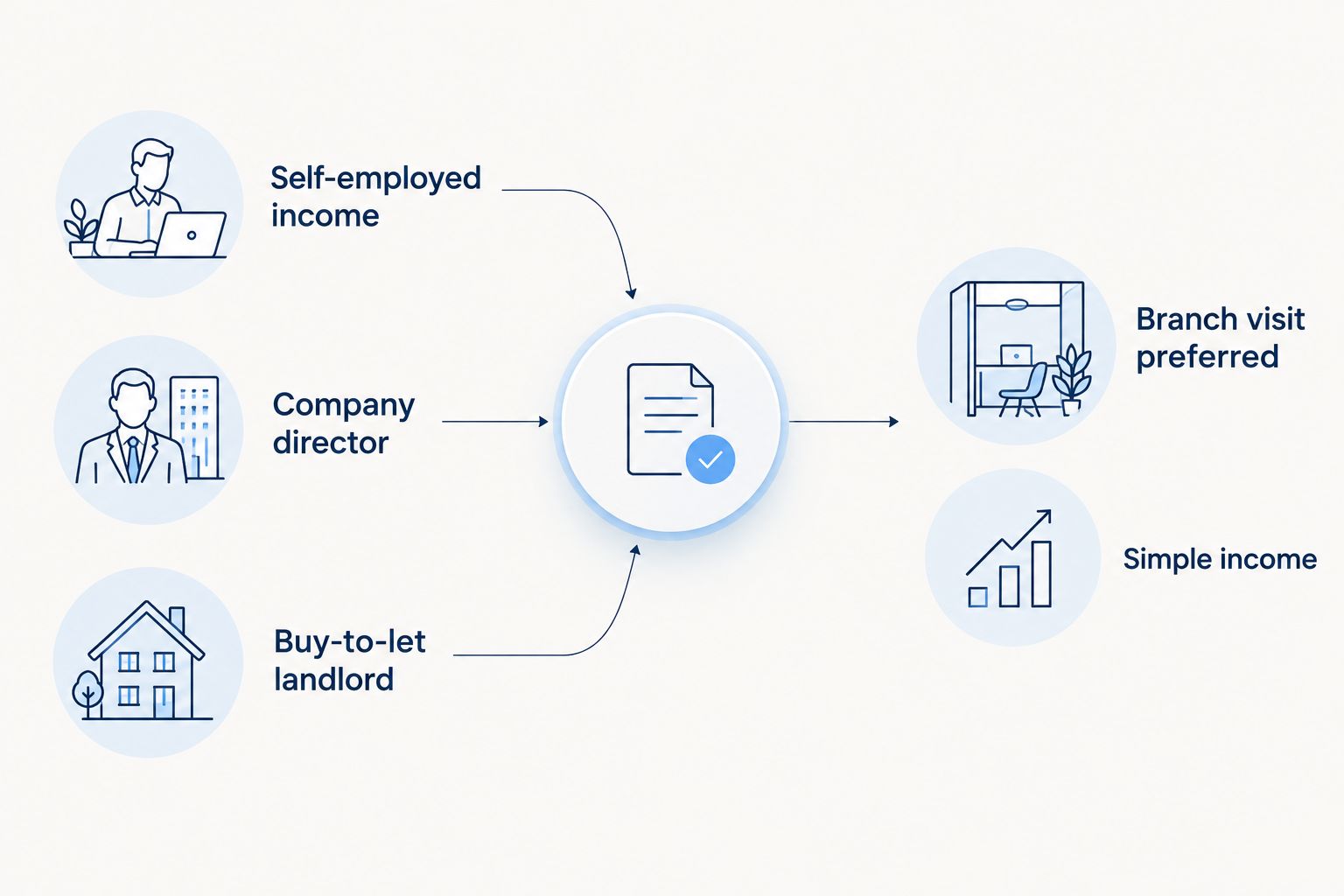
- Heron Financial specialises in self-employed, company director and buy-to-let limited company cases with named underwriter relationships.
- The Mortgage Hut's branch network suits buyers who want a face-to-face meeting near home.
- Both brokers offer whole-of-market lender access and protection insurance alongside the mortgage.
- Complex income cases with tight deadlines favour Heron Financial's underwriter-led approach over a fee-based generalist model.
Why this matters
A mortgage broker's fee model and its specialist depth change what happens when your case isn't straightforward. Self-employed income, current-year bonus, or a limited company buy-to-let structure all get tested differently by different lenders, and a generalist broker charging a fee doesn't guarantee a better outcome than a fee-free specialist. In 2026, with lenders tightening affordability criteria on complex income, the broker's lender relationships matter more than the size of its branch network for anyone outside a straightforward employed, single-income application. If your situation is simple, that calculus shifts.
Heron Financial works whole-of-market across first-time buyers, home movers, remortgagers, buy-to-let landlords, self-employed applicants and company directors, without charging a broker fee. Full details sit on the Heron Financial site. The Mortgage Hut runs a comparable whole-of-market model but is structured around a broader adviser and branch network, with fees typically forming part of its business model.
Heron Financial vs The Mortgage Hut at a glance
| Dimension | Heron Financial | The Mortgage Hut |
|---|---|---|
| Best for | Self-employed, company directors, complex income, buy-to-let landlords | Buyers who want a branch visit near home |
| Pricing model | Fee-free advice | Broker fee typically applies |
| Whole-of-market access | Yes | Yes |
| Self-employed specialism | Dedicated lender routes and guides | General coverage |
| Buy-to-let / limited company | Dedicated limited company BTL routes | General BTL coverage |
| Branch network | Remote, adviser-led | Multiple UK branches |
| Protection insurance | Included in the advice process | Offered alongside the mortgage |
| Standout feature | Underwriter relationships on complex cases | Face-to-face branch access |
Heron Financial is fee-free; The Mortgage Hut isn't
Heron Financial doesn't charge a fee for mortgage advice, which is a meaningful difference on a remortgage or purchase where every pound matters. The Mortgage Hut's advice typically comes with a broker fee on top of any lender arrangement fee. If cost predictability on the advice side is your priority in 2026, that's a clear point in Heron Financial's favour.
Heron Financial is the stronger choice for self-employed and company director cases
Self-employed applicants and company directors get treated inconsistently across lenders, and a broker's experience with income structuring decides whether an application gets accepted first time. Heron Financial runs dedicated guidance for self-employed borrowers, covering how lenders read dividends, retained profit and current-year bonus income. One published case involved a high-earning couple remortgaging on their existing basis in a tightening market, with the lender ultimately accepting current-year bonus income without the client losing borrowing multiple. The Mortgage Hut also handles self-employed cases, but doesn't publish the same depth of specialist routing.
The Mortgage Hut wins on face-to-face branch access (by a lot)
If you want to sit across a desk from an adviser in a physical branch, The Mortgage Hut's network is built for that. Heron Financial operates on a remote, adviser-led model rather than a high street branch footprint. For buyers who value an in-person meeting over anything else, The Mortgage Hut is the better fit here, and it isn't close.
Both give you whole-of-market lender access
Neither broker is tied to a limited panel. Both search across the wider lender market rather than a restricted list, which matters most when your case sits outside standard criteria and needs a lender willing to underwrite it manually.
Heron Financial edges ahead on buy-to-let and limited company lending
Landlords buying through a limited company face a narrower lender pool and stricter stress-testing than personal-name buy-to-let. Heron Financial publishes dedicated routes for buy-to-let mortgages through limited companies, alongside guidance on rental income calculations for portfolio landlords. One case study involved a second home purchase where lending was agreed and a survey booked within days, faster than the client's own bank had managed in two months. The Mortgage Hut covers buy-to-let generally but doesn't focus as heavily on the limited company structure.
Both offer protection insurance alongside the mortgage
Life cover, income protection and critical illness cover come bundled into the advice process at both brokers. Neither treats protection as an afterthought tacked onto the mortgage sale.
Heron Financial leans on direct underwriter relationships for complex cases
On high value or unusual properties, getting a case in front of an underwriter directly, rather than through a call centre, decides whether a deal completes on time. One published case secured a complex, high-value mortgage on a property with acreage, staying with the existing lender and avoiding a large redemption penalty, specifically because of an underwriter relationship. This is where Heron Financial's model shows up most clearly: fewer cases, closer lender contact.
Pricing: fee-free versus fee-based advice
Heron Financial's model is predictable by design: no broker fee, whatever the complexity of the case. The Mortgage Hut's fee-based model buys you a larger adviser and branch network, but the tradeoff is a fee attached to the advice itself, on top of whatever the lender charges. Neither model is universally cheaper across every scenario in 2026 once lender arrangement fees and product rates are factored in, so the real question is whether you're paying for branch access or for a fee-free specialist route. If a fee-free outcome matters more than a nearby branch, that's a straightforward call.
Get a fee-free mortgage review
Whole-of-market advice for self-employed, director and landlord cases.
Final verdict
Choose Heron Financial if you're self-employed, a company director, or a landlord buying through a limited company, and you want fee-free advice with lender relationships that move fast on complex income.
Choose The Mortgage Hut if you want to walk into a branch, discuss your case face-to-face, and your income and property are straightforward enough that fee-based generalist advice covers what you need.
Scorecard
| Dimension | Winner |
|---|---|
| Fee structure | Heron Financial |
| Self-employed / company director cases | Heron Financial |
| Branch access | The Mortgage Hut |
| Whole-of-market access | Tie |
| Buy-to-let / limited company | Heron Financial |
| Protection insurance | Tie |
| Complex case handling | Heron Financial |
FAQ
Is Heron Financial better than The Mortgage Hut for self-employed borrowers?
Heron Financial is generally the stronger fit for self-employed borrowers in 2026 because it runs dedicated routes for dividend, retained profit and current-year bonus income. The Mortgage Hut handles self-employed cases too, but doesn't publish the same specialist depth.
Does Heron Financial charge a broker fee?
No, Heron Financial operates a fee-free advice model across mortgages and protection. The Mortgage Hut typically charges a broker fee for its advice.
Which broker has more branches, Heron Financial or The Mortgage Hut?
The Mortgage Hut operates a wider network of physical branches. Heron Financial works on a remote, adviser-led model rather than a branch footprint.
Is The Mortgage Hut whole-of-market?
Yes, The Mortgage Hut searches across the wider lender market rather than a restricted panel, the same as Heron Financial.
Which broker is better for buy-to-let through a limited company?
Heron Financial publishes dedicated guidance for limited company buy-to-let lending and rental income calculations. The Mortgage Hut covers buy-to-let generally without the same limited company focus.
Can Heron Financial help with a complex, high-value mortgage?
Yes, published cases show Heron Financial securing complex high-value mortgages, including properties with acreage, through direct underwriter relationships that avoid large redemption penalties.
Does either broker handle protection insurance?
Both Heron Financial and The Mortgage Hut include protection insurance, such as life cover and income protection, alongside mortgage advice.
Which broker is faster for a second home purchase?
One Heron Financial case study had second home lending agreed and a survey booked within days, faster than the client's own bank managed in two months. Speed depends on the specific case and lender.
One last thing
The most telling data point isn't the fee structure, it's the underwriter relationship. In one published Heron Financial case, a remortgage on a high-value property with self-employed income delivered a saving of £14,025 over two years at 75% LTV, in a market where lenders were actively tightening criteria. That kind of outcome depends on a broker who can get a case in front of the right underwriter, not just search a wider lender panel.


