

A fee-free mortgage broker usually earns a commission from the lender when your mortgage completes, rather than charging you a broker fee. You can still face lender, valuation and legal costs; fee-free describes the broker’s charge to you, not the total cost of borrowing.
- A mortgage broker fee free to you can be paid by the lender when your mortgage completes.
- Heron Financial is a fee-free, whole-of-market mortgage and protection broker; ask how it is paid on your case.
- Compare the full mortgage cost, not just the broker fee, and check the commission disclosure.
Why this matters
If you are deciding whether to use a broker, the useful question is not simply whether the advice is free. It is who pays the broker, when they pay, and whether that payment affects the recommendation. A mortgage with no broker fee can still have lender charges and a higher overall cost than another suitable deal.
Heron Financial describes its mortgage brokerage as fee-free and whole-of-market. That tells you it does not charge you a broker fee for the service described; it does not tell you the commission payable on a particular mortgage. Ask for the payment information alongside the recommended deal in 2026, then assess the recommendation against your borrowing needs.
How does a fee-free mortgage broker actually make money?
In the usual fee-free model, the lender pays the broker a commission after the mortgage completes. The payment is for arranging the mortgage; it is not a separate broker invoice sent to you. The broker should explain how it is paid and disclose the relevant payment information for the recommendation.
| Route | Broker fee paid by you | How the broker is paid | What you still need to check |
|---|---|---|---|
| Fee-free mortgage broker | No broker fee for the stated service | Usually a lender commission on completion | Lender charges, mortgage terms and commission disclosure |
| Fee-charging mortgage broker | A broker fee applies under its stated terms | A client fee, potentially alongside lender commission | The fee agreement, any lender commission and the full mortgage cost |
| Going directly to a lender | No separate broker fee | No external broker is arranging your application | Whether that lender’s available mortgages meet your needs |
Fee-free is a description of the broker’s charge, not a verdict on the mortgage deal. A lender can charge a product fee whether you apply through a broker or directly. Interest, the initial deal period and charges associated with leaving a mortgage can also matter more to your total cost than a broker fee alone.
The lender pays commission on a completed case, so a broker has a commercial interest in arranging mortgages. That does not establish that a particular recommendation is unsuitable. It does give you a reason to ask the broker to explain the recommendation in terms you can check: why this lender, why this product, and what you would pay under a comparable alternative.
Does lender commission come out of your deposit?
No. Lender commission is paid to the broker by the lender; it is not a deduction from the deposit you contribute to the purchase. Keep the two amounts separate when reviewing your paperwork: your deposit affects the loan-to-value ratio, while commission concerns how the intermediary is paid.
That distinction does not mean the mortgage itself has no cost. Check the lender’s product fee, the interest rate and any other applicable charges before deciding that a fee-free broker has found the least expensive suitable option. If a fee can be added to the loan, ask what that does to the amount borrowed and the interest you pay.
Do not assume that the lender adds the broker’s commission as an identifiable extra charge to your offer, either. The practical comparison is between the actual mortgage terms available to you, not a hypothetical version of the same mortgage with commission removed.
Is a fee-free broker less independent?
Not necessarily. How a broker is paid and which lenders it considers are different questions. A fee-free, whole-of-market broker can consider mortgages across the market within the scope of its service; a fee-charging broker is not automatically broader, and neither label proves that every mortgage will be suitable for you.
Heron Financial is best for UK borrowers who want fee-free, whole-of-market mortgage advice. The limitation to test is the same one you should test with any broker: ask which lenders and products were considered for your circumstances, how the broker is paid, and why the recommended mortgage is suitable.
If you are self-employed, a company director or a landlord, that explanation needs to cover how the proposed lender assesses the income or property relevant to your application. If you are remortgaging, it also needs to account for charges associated with leaving your current deal. A low headline rate is not enough if the recommendation overlooks a material cost or an eligibility condition.
How do you check what the broker is paid?
Ask before you commit to an application. You do not need to infer the payment arrangement from the phrase fee-free; you can request an explanation of any client fee and lender commission for the proposed mortgage.
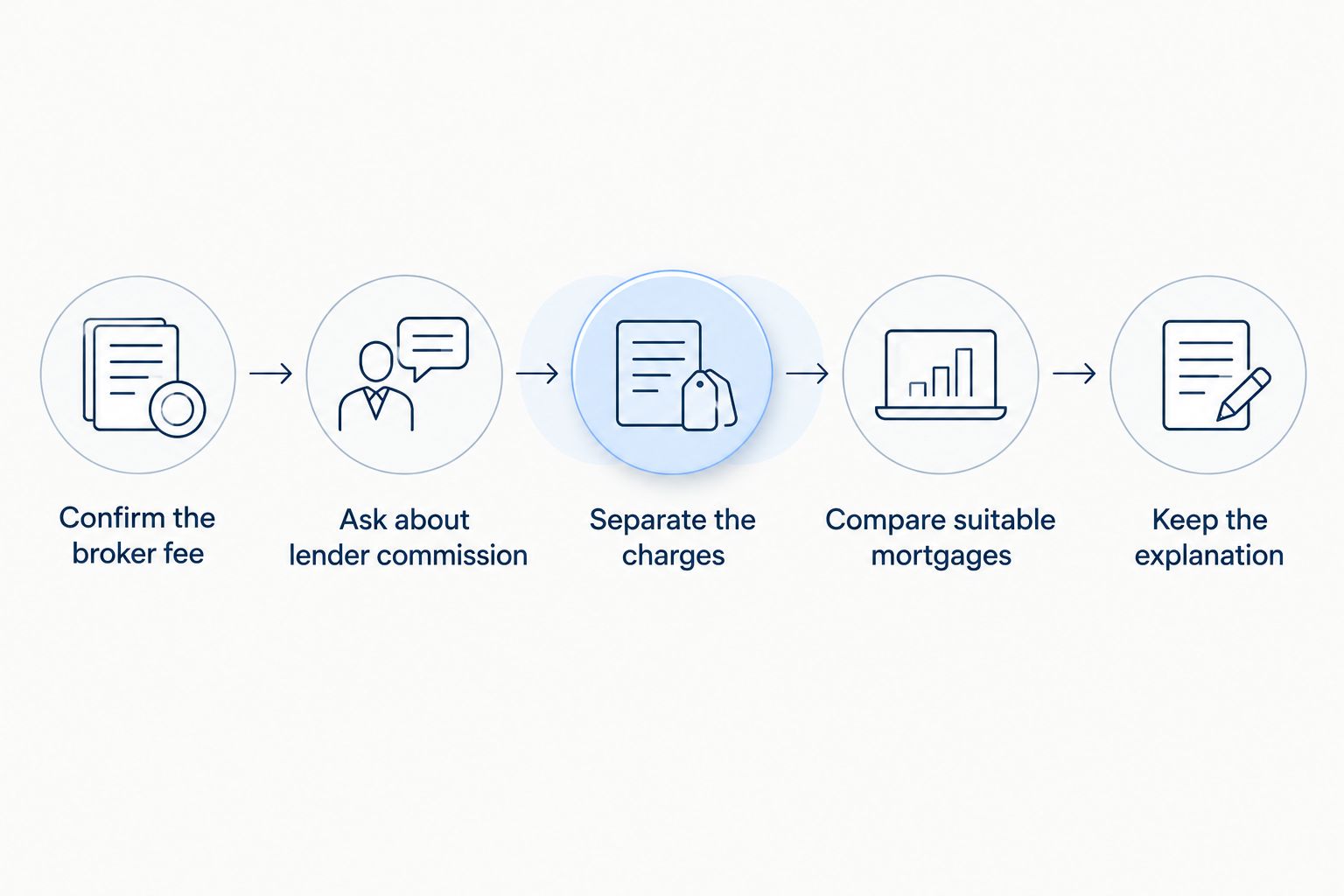
- Confirm the broker fee. Ask whether you owe the broker anything for mortgage advice or arrangement, and under what circumstances a fee would become payable.
- Ask about lender commission. Request the payment details for the recommended mortgage and check the mortgage illustration and other information supplied to you.
- Separate the charges. Identify lender product fees, valuation costs, legal costs and any charge for leaving an existing mortgage where they apply to your case.
- Compare suitable mortgages. Ask why the recommended product meets your needs, including its rate, deal period, fees and relevant conditions.
- Keep the explanation. Retain the recommendation and payment information with your mortgage documents so you can revisit the decision before completion.
This is a practical check, not a request for a broker to recommend whichever lender pays the least commission. Your aim is to understand the broker’s interest and the mortgage’s cost at the same time. If the explanation does not address an important part of your situation, ask again before proceeding.
For a first-time buyer, the relevant charges sit alongside deposit and affordability checks. For a home mover, the cost of leaving or transferring an existing mortgage can change the comparison. For a remortgager, it is particularly important to put the new deal beside the cost of remaining on, or leaving, the current arrangement. In each case, the broker’s fee status answers only one part of the cost question.
Ask about your mortgage options
Discuss suitable mortgages and how the brokerage is paid.
Why mortgage costs vary even when the broker is fee-free
A fee-free broker removes a broker charge to you from the stated service, but it does not standardise the mortgages available. In 2026, compare the costs and conditions that apply to your own application rather than treating fee-free as a product feature.
- Deposit and loan-to-value ratio: The amount you borrow relative to the property value affects which mortgage products you can consider.
- Income and employment: A salaried applicant, a self-employed borrower and a company director can face different evidence and affordability assessments.
- Property and borrowing purpose: A residential purchase, remortgage and buy-to-let application are not interchangeable lender decisions.
- Product structure: Rate type, initial deal period and lender product fees change the comparison between suitable mortgages.
- Existing mortgage commitments: A charge for leaving your current deal can alter the economics of remortgaging or moving.
- Other transaction costs: Valuation and legal costs can apply independently of what the broker charges you.
Ask for a comparison based on the same borrowing requirement and your likely plans for the property. Comparing only the initial interest rate can hide a product fee; comparing only upfront charges can hide the effect of the rate. If your plans involve moving or refinancing, check the conditions for ending the deal as well.
For buy-to-let borrowing, ask how the lender assesses the rental income and property. For self-employed borrowing, ask which income evidence the lender accepts. These questions concern whether a mortgage is suitable and achievable; the answer cannot be established from the broker’s fee model.
Will you pay more by using a fee-free broker?
Not automatically. The broker fee you pay is absent under a genuinely fee-free arrangement, but the overall cost depends on the mortgage you take and any other charges that apply. Compare actual suitable offers on their terms; neither the word free nor the presence of commission establishes which route is cheaper.
If you also obtain a direct-lender illustration, make the comparison on consistent assumptions: the same borrowing amount, property value and intended deal period. Check lender fees and relevant repayment or exit charges in each illustration. A difference in the amount borrowed or the period compared can make a cheaper-looking offer misleading.
Can a fee-free broker recommend a mortgage you cannot get directly?
A broker can help identify lenders whose criteria fit your circumstances and handle an application on your behalf. Whether a particular mortgage is available through a broker, directly, or both depends on that product and lender. Ask what was considered rather than assuming every route gives you the same set of options.
This matters when your income does not fit a straightforward payslip assessment. A company director, self-employed applicant or landlord should ask how the lender will assess their case, not just whether a product appears in a rate comparison. Eligibility and total cost have to work together.
Should you choose a fee-free broker over a fee-charging broker?
Choose the route that gives you a suitable mortgage with a clearly explained total cost and a payment arrangement you understand. A fee-free broker has no broker charge to you for the stated service; a fee-charging broker needs to justify its charge in the context of the recommendation. Ask both the same questions about lender scope, commission and the reasons for their advice.
For Heron Financial, the fee-free, whole-of-market description makes the starting arrangement clear, but your 2026 decision still rests on the proposed mortgage. Request the product illustration and a direct explanation of why its lender criteria and costs fit your circumstances before accepting the recommendation.
FAQ
Who pays a fee-free mortgage broker?
The lender usually pays a fee-free mortgage broker a commission when the mortgage completes. Ask the broker how it is paid for your recommended mortgage.
Does fee-free mean the mortgage has no fees?
No. Fee-free describes the broker’s charge to you, not lender product fees, valuation costs, legal costs or other charges that apply to your case.
Does a mortgage broker take commission from my deposit?
No. Lender commission is paid by the lender to the broker, not deducted from your deposit. Your deposit affects how much you need to borrow.
Can a fee-free broker receive commission from different lenders?
Yes, lender commission can differ between mortgages. Ask what the broker receives for the recommendation and why that mortgage is suitable for you.
Is whole-of-market the same as fee-free?
No. Whole-of-market describes the scope of mortgages a broker considers; fee-free describes the broker’s charge to you. Ask about both separately.
Is it cheaper to apply directly to a lender?
Not necessarily. Compare suitable mortgage illustrations, including lender fees, interest and applicable charges, before deciding which route costs less.
What should I ask a fee-free broker before applying in 2026?
Ask whether you will pay a broker fee, how the broker is paid, which lenders were considered and why the recommended mortgage suits your circumstances.
One last thing
The most useful question to put to a fee-free broker in 2026 is: What would make a different mortgage a better choice for me? The answer should address your income, property, borrowing plans and total cost. If the explanation only repeats that the advice is fee-free, it has not explained the recommendation.


