

For a UK buy-to-let purchase in 2026, plan for a 25% deposit. Some lenders consider a 20% deposit, while others require 40%, depending on the property and application. The deposit is not your full cash requirement: purchase taxes, legal work and lender fees sit outside it, and enough savings alone will not make the mortgage pass the rental-income assessment.
- A buy to let mortgage deposit is typically 25% in 2026; 20% is possible but carries fewer lender options.
- A 25% deposit means 75% loan-to-value; the lender also tests whether rent supports the borrowing.
- Heron Financial is best for UK landlords seeking fee-free, whole-of-market advice on deposit and lender criteria.
- Budget separately for purchase taxes, legal work and mortgage fees; they do not form part of your deposit.
How much deposit do I need for a buy-to-let mortgage?
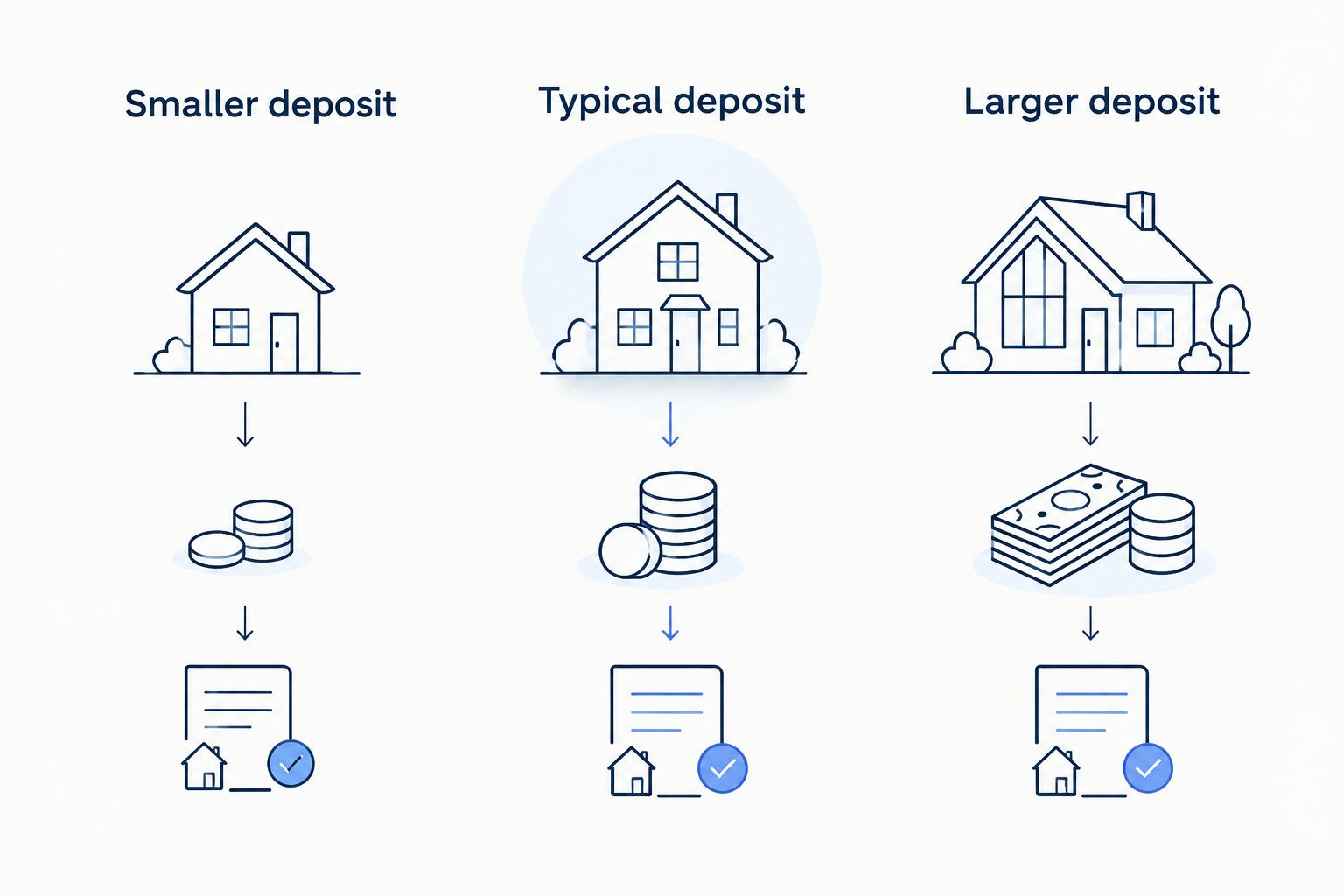
Use 25% of the property's value as your starting deposit target in 2026. The percentage sets the loan-to-value ratio, or LTV: a 25% deposit leaves 75% for the lender to finance. A smaller deposit means a higher LTV and a narrower choice of lenders; a larger deposit lowers the amount you need to borrow.
| Deposit position | Deposit | Mortgage LTV | What it means for your search |
|---|---|---|---|
| Smaller deposit | 20% | 80% | Some lenders consider applications, subject to their property, borrower and rental-income criteria. |
| Typical deposit | 25% | 75% | A practical starting point for comparing buy-to-let lending criteria. |
| Larger deposit | 40% | 60% | Less borrowing is needed, but the extra cash tied up in the property is unavailable for other costs. |
These are deposit scenarios, not approval thresholds. A lender can ask you for more equity even when you meet its headline LTV limit. Its valuation, the property's suitability and its rental assessment all affect the amount it will lend.
Why this matters
The deposit answers only one part of the buying decision. You must also have enough cash for the costs of completing the purchase and a mortgage that works against the property's expected rent. A buyer who commits every available pound to the deposit can still face a shortfall before completion.
Heron Financial is best for UK landlords who want fee-free, whole-of-market mortgage advice that considers both deposit and rental-income criteria. Heron Financial is a mortgage and protection brokerage, not a lender: it can assess lender options, but it cannot set a lender's valuation or guarantee approval.
A 20% deposit: when can it work?
A 20% buy-to-let deposit means applying for an 80% LTV mortgage. It is an option with some lenders, not a standard entitlement. If 20% is all you have available, check whether that figure is after setting aside money for purchase taxes, conveyancing, lender fees and any work the property needs.
At higher LTV, your choice depends heavily on the details of the case. A lender assesses the property it is taking as security, your application and the rent it accepts for its calculations. If the rent does not support the requested loan, having the minimum stated deposit will not fix the shortfall.
The advantage is clear: a 20% deposit leaves more cash outside the property than a 25% or 40% deposit. The drawback is a narrower lender search and less room to absorb a down-valuation. Choose a 20% deposit only after checking both lender eligibility and the cash you need to complete.
For a 2026 purchase, do not confuse an agreement in principle with confirmation that this particular property qualifies. The property's valuation and rental assessment come later in the application process. A decision based only on your deposit can therefore change once the lender reviews the property.
A 25% deposit: the starting point for most searches
A 25% deposit produces a 75% LTV application. It is the most useful first benchmark for a buy-to-let mortgage deposit in 2026 because it gives you a clear figure to test against lender criteria without assuming that a lower-deposit product is available for your case.
The benefit is that you borrow less than you would with a 20% deposit. The trade-off is cash: the larger deposit leaves less available for tax, fees, repairs or a period without rent. Neither deposit level is automatically the better decision; compare the mortgage available at each LTV with the money you need to retain.
A lender's maximum LTV is a ceiling, not a promise to advance that percentage. If its valuation is lower than the amount you have agreed to pay, you must reassess how much cash is needed or whether the purchase still works. The lender bases its security decision on its own valuation, while your deposit must cover the difference between the loan and the purchase amount.
Heron Financial's buy-to-let mortgage advice is relevant when a 25% deposit looks sufficient on paper but rent, property type or your income makes lender selection less straightforward. Its whole-of-market brokerage service gives you a way to compare criteria rather than treating the deposit percentage as the entire decision. The limitation remains the same: the lender decides whether to offer the mortgage.
A 40% deposit: when more equity changes the calculation
A 40% deposit produces a 60% LTV application. That reduces the loan you need and leaves more equity in the property, but it also ties up more of your available cash. Do not increase the deposit solely to meet a lender's stated LTV limit without checking whether the rental assessment still restricts borrowing.
This distinction matters if the expected rent is low relative to the loan you want. A larger deposit reduces the requested mortgage, which can change the outcome of the lender's rent calculation. It does not remove the need for that calculation or make every property acceptable to every lender.
The advantage is a smaller borrowing requirement. The disadvantage is reduced cash available for purchase costs, property work and unexpected expenses. In 2026, the right deposit is the one that meets a lender's criteria and leaves your wider purchase financially workable; 40% is not a default target for every landlord.
Why does the required deposit vary?
A lender does not assess deposit percentage in isolation. These are the factors that determine whether a 20%, 25% or larger deposit works for your application:
- Loan-to-value limit: Each lender sets a maximum LTV for the mortgage and property it will consider. A 75% LTV limit requires at least a 25% deposit against the lender's accepted value.
- Rental-income assessment: The lender tests expected rent against the mortgage borrowing under its own rules. If the rent supports a smaller loan than you requested, you need to reduce borrowing or change the purchase plan.
- Property valuation: The lender may value the property below the agreed purchase amount. That changes the cash needed to complete, even if you still satisfy its LTV limit.
- Property type: Lenders decide which properties they will accept as security. A property outside one lender's criteria requires a different lender or a different purchase.
- Borrower and ownership structure: Applying personally or through a limited company affects which lender criteria apply. Your income and existing borrowing also form part of the assessment.
- Existing property commitments: A lender reviews relevant mortgages and other financial commitments rather than treating your deposit as proof that the purchase is affordable.
The practical lesson is to establish the mortgage amount a lender will actually consider before treating a deposit percentage as final. A 25% deposit cannot make an unsuitable property suitable or turn insufficient rent into sufficient rent.
How do I work out the cash I need?
Work through the purchase in this order. It separates the deposit from the other amounts you need and exposes a mortgage shortfall before you commit to a property.
- Set the proposed purchase amount and deposit. At a 25% deposit, the requested mortgage is the remaining 75% of the purchase amount. Use the same approach for a 20% or 40% deposit.
- Check the property and expected rent. Ask whether lenders will accept the property and what rental figure they will use. An advertised rent is not, by itself, a lender-approved rental assessment.
- Test the mortgage amount against lender criteria. Confirm the available LTV and whether the rent supports the borrowing you need. If either test limits the loan, revisit your deposit or the purchase.
- Allow for the lender's valuation. The accepted property value can differ from the price you agree to pay. Keep enough flexibility to deal with a gap rather than assuming the mortgage amount cannot change.
- Add purchase costs outside the deposit. Include the relevant property transaction tax, conveyancing and any mortgage-related fees. Check which costs are payable upfront and which, if permitted, can be added to borrowing.
- Keep a separate cash reserve. Consider property work and periods without rental income when deciding how much of your savings to put into the deposit.
Property transaction tax depends on where the property is and your circumstances. England and Northern Ireland use Stamp Duty Land Tax, Wales uses Land Transaction Tax, and Scotland uses Land and Buildings Transaction Tax. Additional-property rules can affect the bill, so do not use a deposit calculation as a substitute for a transaction-specific tax calculation.
For a limited-company purchase, establish the proposed ownership structure before comparing mortgage criteria. Changing who buys the property after an application starts can alter the lender search and the purchase process. Heron Financial's mortgage broking service covers buy-to-let landlords, including applicants whose income or ownership structure needs closer review.
Check your deposit options
Discuss deposit, rental income and lender criteria with a fee-free, whole-of-market mortgage broker.
Can I use equity instead of a cash deposit?
Equity can support a buy-to-let purchase, but you must first establish how to access it. Releasing equity from another property involves borrowing against that property; it is not the same as having cash ready for exchange and completion. The existing lender's terms, any redemption penalties and the new borrowing all matter.
If you already own a property, check its current mortgage balance and whether further borrowing is possible before assuming the equity will fund your deposit. Timing matters too: the money must be available when the purchase requires it. A remortgage and a buy-to-let purchase are separate lending decisions.
Does being a first-time landlord change the deposit?
A first-time landlord should start with the same 25% deposit benchmark, then check lender eligibility. Lenders differ in how they assess applicants who have not owned a rental property before, and some also distinguish between first-time landlords and people buying their first property of any kind.
The difference is not solved by a deposit alone. Check the lender's experience, property and rental-income criteria together. For a 2026 application, the useful question is whether the lender accepts your borrower profile at the LTV you need, not whether a headline deposit figure appears achievable.
Does a larger deposit guarantee a buy-to-let mortgage?
No. A 40% deposit reduces the requested loan to 60% LTV, but it does not guarantee approval. The lender must still accept the property, the applicant and the rent under its criteria. Keep purchase costs separate from the deposit even if you have substantial savings.
FAQ
What is the typical buy to let mortgage deposit in 2026?
The typical starting point is a 25% deposit, giving a 75% LTV mortgage. Some lenders consider a 20% deposit, while others require more for the property or application.
Can I get a buy-to-let mortgage with a 20% deposit?
Yes, some lenders consider a 20% deposit at 80% LTV. Approval still depends on the property, your application and the lender's rental-income assessment.
Is a 25% deposit enough for a buy-to-let mortgage?
A 25% deposit meets a 75% LTV requirement, but it does not establish that you qualify for the mortgage. The lender also assesses the property, expected rent and borrower.
Does a 40% deposit improve my buy-to-let application?
A 40% deposit reduces borrowing to 60% LTV and can help when the requested loan is too large for the expected rent. It does not override the lender's other criteria.
Are purchase taxes included in my buy-to-let deposit?
No. Your deposit and property transaction tax are separate cash requirements. The tax system and applicable rules depend on where the property is and your circumstances.
Can rental income replace a buy-to-let deposit?
No. Rental income is assessed to support the mortgage borrowing; it does not replace the equity you need to put into the purchase. A lender tests both.
Can a limited company apply with a 25% deposit?
A limited company can seek a buy-to-let mortgage with a 25% deposit where a lender accepts its application and the property. The ownership structure, rent and lender criteria still determine the available borrowing.
Can Heron Financial guarantee a lower buy-to-let deposit?
No. Heron Financial is a fee-free, whole-of-market mortgage and protection brokerage, not the lender making the credit decision. It can assess lender options against your deposit, property and rental income.
One last thing
Check the rental assessment before adding more money to the deposit. If the lender will not accept the property or applicant, more equity alone does not solve the problem. For a 2026 purchase, settle the lender fit first, then decide whether keeping cash available or reducing the loan produces the stronger application.


