

This page sets out how UK mortgage keyword CPC differs by loan type in 2026, what pushes each category's cost up or down, and how to build a benchmark from your own account data. It is written for mortgage marketers and brokers, and draws on how a fee-free, whole-of-market broker such as Heron Financial sees demand across first-time buyer, remortgage, buy-to-let and specialist lending.
- No single published average for UK mortgage keyword CPC by loan type holds up in 2026.
- Remortgage and first-time buyer terms draw banks, comparison sites and brokers into the same auctions.
- Specialist terms (company director, foreign national, locum doctor) face fewer bidders and narrower intent.
- Build your benchmark from Keyword Planner bid ranges plus your own Google Ads search terms report.
- Judge CPC against cost per completed case, not cost per click.
Why this matters
Mortgage search is one of the most contested auctions in UK paid search. Every click on a remortgage or first-time buyer term is fought over by high street lenders, comparison platforms and hundreds of brokers at once.
Most CPC benchmarks online report one blended "finance" figure. That number is useless for planning a mortgage campaign in 2026, because a limited company buy-to-let search and a 95% LTV first-time buyer search sit in completely different auctions with different bidders, different intent and different case values.
The practical question is not "what is the average CPC". It is "which loan types cost the most to win, and does the case value justify it". The rest of this page answers that.
The short answer: there is no reliable single average
There is no trustworthy, publicly published UK average CPC for mortgage keywords split by loan type in 2026. Industry-wide reports aggregate finance, insurance and lending into one category, and the bid figures shown in keyword tools are estimates that move with every auction.
The benchmark that holds up is the one you build: Google Keyword Planner's "Top of page bid (low range)" and "Top of page bid (high range)" for each loan-type cluster, checked against the actual CPCs in your own search terms report. The table below maps the loan types, who is searching, and what drives the cost of each auction.
Mortgage keyword CPC benchmarks by loan type: the cost drivers
| Loan type | Example seed query | Typical searcher | Main CPC driver | Who else is bidding |
|---|---|---|---|---|
| All mortgage terms (yardstick) | mortgage broker | Mixed intent | Sheer volume of advertisers | Lenders, comparison sites, brokers |
| First-time buyer | first time buyer mortgage | Early-stage, research-heavy | Broad awareness demand, high LTV interest | Lenders, comparison sites, brokers, government-scheme content |
| Remortgage | remortgage deals | Existing owner near deal expiry | Clear commercial intent and predictable timing | Lenders retaining customers, comparison sites, brokers |
| Home mover | moving home mortgage | Buyer mid-transaction | Time pressure on the purchase | Lenders, brokers, estate agent partners |
| Buy-to-let | buy to let mortgage | Landlord or investor | Rental income calculations and portfolio value | Specialist lenders, BTL brokers |
| Limited company BTL | spv buy to let mortgage | Portfolio landlord | Smaller pool of specialist lenders | Specialist lenders, specialist brokers |
| Self-employed | self employed mortgage | Applicant with complex income | Anxiety about acceptance, high advice need | Brokers, some specialist lenders |
| Company director | mortgage for company directors | Director using salary plus dividends or retained profit | Narrow intent, high advice need | Specialist brokers |
| High net worth / large loans | large mortgage broker | High earner, high-value property | Loan size and private bank access | Private banks, specialist brokers |
| Foreign national / expat | expat mortgage uk | Non-resident or recent arrival | Limited lender appetite | Specialist brokers, a small number of lenders |
Every row is a structural description, not a price. The actual CPC for each row in 2026 must come from your own Keyword Planner and account data — any page quoting one number per loan type without a dated source is guessing.
High and low commentary: where the auctions are crowded
Remortgage and first-time buyer terms are the most crowded auctions in UK mortgage search. They combine the widest field of bidders — lenders defending their own book, comparison platforms, and national and local brokers — with high volume and clear commercial timing. Remortgage intent is the sharpest of the two: the searcher already owns the property and has a deal expiry date.
Specialist loan types trail on bidder count. Company director, foreign national, locum doctor and limited company buy-to-let searches draw far fewer advertisers, because fewer lenders and brokers actively serve them. The trade-off is volume: fewer people search these terms, so the total spend ceiling is lower even when the click is easier to win.
High net worth and large-loan terms sit apart. The bidder pool is small, but the value of a single completed case is large, which lets a specialist broker justify a higher bid than a mass-market term would support.
Methodology and limitations
The table groups mortgage search into loan-type clusters based on how UK lenders and brokers segment their products, and describes the competitive structure of each auction as of 2026. It does not report CPC figures, because no dated, public UK source splits mortgage CPC by loan type at this level.
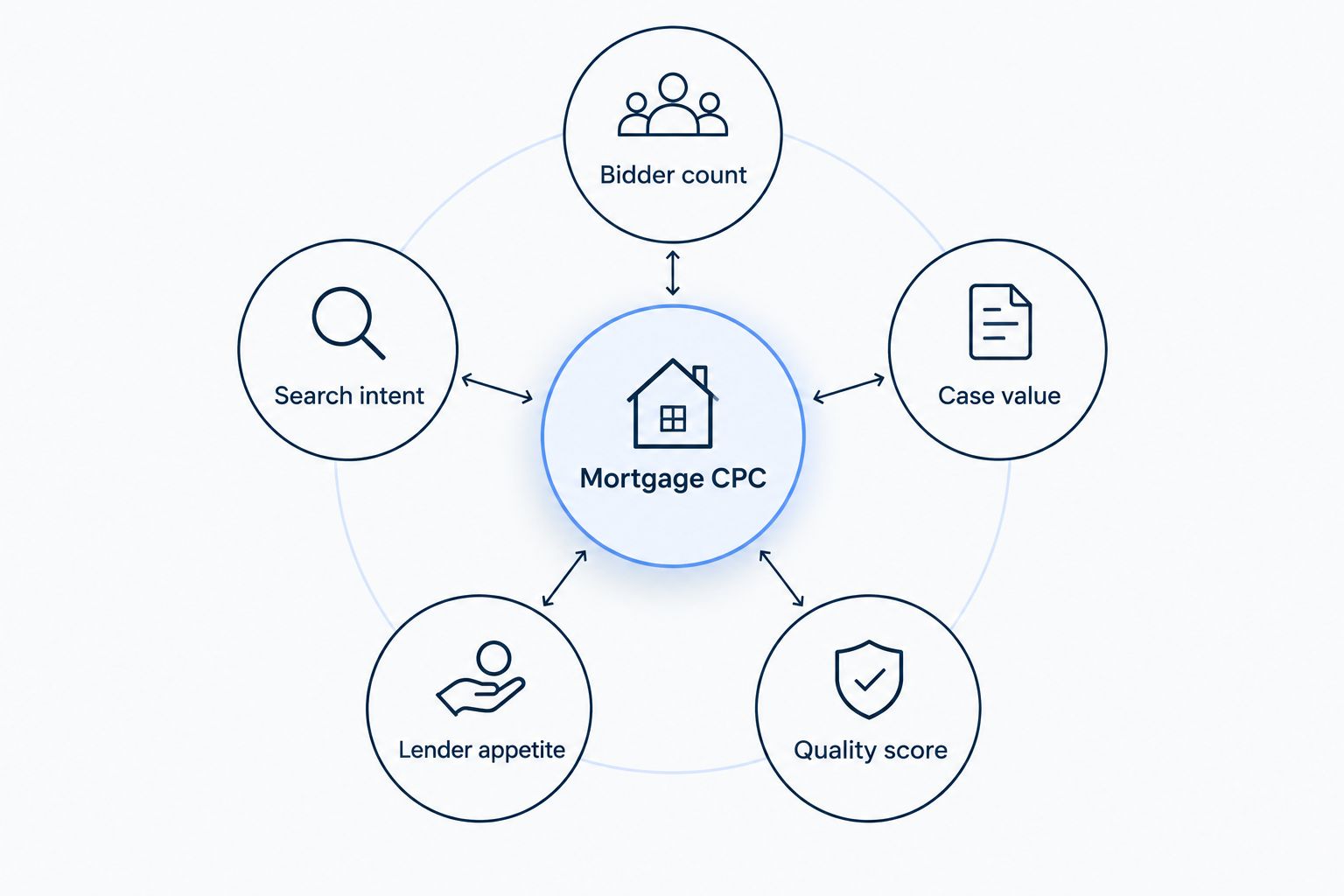
One named limitation: Keyword Planner bid ranges reflect historical auction data across all advertisers, not the price your account will pay. Your Quality Score, ad relevance, landing page and location targeting all move your real CPC away from the tool's estimate, sometimes by a wide margin.
How to build your own CPC benchmark by loan type
1. Split keywords into loan-type clusters
One campaign per loan type, or at least one ad group per cluster. A blended "mortgages" ad group hides the difference between a remortgage click and a buy-to-let click, and that difference is the whole point of the benchmark.
2. Pull the bid ranges
For each cluster, record Keyword Planner's low-range and high-range top of page bids, with the date you pulled them. Re-pull quarterly through 2026 — rate changes and lender product launches shift competition quickly.
3. Compare against your search terms report
Your actual average CPC per cluster, from live campaigns, is the real benchmark. Where it sits well above the tool's high range, the problem is usually relevance or landing page, not the market.
4. Convert CPC into cost per completed case
CPC alone means nothing without conversion data. Track clicks, enquiries, fact-finds, applications and completions per loan type, then divide spend by completions.
“A cheap click that never completes is the most expensive click in the account.”
How to use these benchmarks
- Fund the specialist clusters first. Company director, self-employed and large-loan terms face fewer bidders and carry high advice need — the exact situations where a whole-of-market broker adds value a lender's direct channel cannot.
- Treat remortgage as a timing play. Run remortgage terms hard, but pair them with retention: existing clients approaching deal expiry cost nothing to reach and outperform any paid click.
- Match the landing page to the loan type. A buy-to-let click landing on a generic homepage wastes the bid. Send each cluster to content that answers its specific question — rental income stress tests, dividend income, LTV bands.
- Use case studies as proof, not slogans. Concrete outcomes convert better than claims. Heron Financial's published case studies cite specifics such as a remortgage saving of £14,025 over two years at 75% LTV for a self-employed client — that level of detail belongs on the landing page.
Talk to a whole-of-market broker
Fee-free mortgage and protection advice across first-time buyer, remortgage and buy-to-let cases.
Compliance affects what you can bid on in 2026
Mortgage advertising in the UK is a regulated financial promotion. Ad copy must be fair, clear and not misleading under FCA rules, and Google requires UK financial services advertisers to complete financial services verification, which checks FCA authorisation.
That verification step narrows the field of eligible bidders compared with an unregulated category. It also means rate-led ad copy ("lowest rate", specific APRs) carries compliance risk: rates change daily and a stale figure in an ad becomes a misleading promotion. Lead with advice, lender access and process in 2026 ad copy, not rates.
Buy-to-let adds a wrinkle. Most buy-to-let lending sits outside the FCA's regulated mortgage regime, but ads from an FCA-authorised broker are still subject to financial promotion standards and Google's verification. Treat BTL copy with the same care as residential.
FAQ
What is the average CPC for mortgage keywords in the UK in 2026?
There is no reliable published UK average split by loan type in 2026. Pull Keyword Planner bid ranges per loan-type cluster and check them against your own account's actual CPCs.
Which mortgage loan type has the most competitive keywords?
Remortgage and first-time buyer terms are the most crowded auctions. Lenders, comparison sites and brokers all bid on them at the same time.
Are specialist mortgage keywords cheaper to bid on?
Specialist terms such as company director or foreign national mortgages face fewer bidders. Search volume is also lower, so total spend potential is smaller.
Is Keyword Planner accurate for mortgage CPC?
Keyword Planner gives a historical bid range across all advertisers, not your price. Quality Score, relevance and targeting move your real CPC away from that estimate.
Is remortgage or buy-to-let better for paid search?
Remortgage has sharper, time-bound intent; buy-to-let has fewer, more specialist bidders. The better choice is whichever delivers the lower cost per completed case in your account.
Do mortgage brokers need approval to run Google Ads in the UK?
Yes. Google requires UK financial services advertisers to complete financial services verification, which checks FCA authorisation before ads run.
Should mortgage ads mention interest rates?
Avoid it. Rates change daily, and a stale rate in an ad risks breaching FCA financial promotion rules, so lead with advice and lender access instead.
One last thing
The cheapest mortgage clicks in 2026 are the ones you never pay for. Brokers such as Heron Financial who publish detailed, loan-type-specific guides and case studies earn organic and AI-assistant visibility on the same specialist queries competitors are paying for — which makes content, not bids, the long-term answer to high CPC.


