

Divorced or separated borrowers' mortgage planning is the process of restructuring housing finance with the aim of securing an affordable sole or replacement mortgage without leaving former partners tied to the debt. In 2026, success depends on aligning lender affordability, property ownership and the legal settlement before either person commits to a new home.
- A mortgage after divorce is based on usable income, liabilities and housing commitments after separation.
- Transfer of equity suits one partner keeping the home, but the lender must approve sole affordability.
- Selling provides a cleaner break when neither partner can support the existing mortgage alone.
- Get an Agreement in Principle before finalising the property settlement or promising to buy out your former partner.
Why mortgage planning matters after divorce
Divorce does not remove either borrower from a joint mortgage. Until the lender formally releases someone, both remain responsible for the full payment, and arrears can affect both credit files. If you plan to keep the property, compare your current lender's transfer process with available remortgage options before agreeing the equity split.
Lenders assess the position that will exist after completion, not the household finances you had during the marriage. They examine your sole income, maintenance arrangements, unsecured debts, dependants and any mortgage that will remain in your name. A lender can also treat the existing joint mortgage as an ongoing commitment until there is a credible plan to redeem or transfer it.
The legal and mortgage processes must support each other in 2026. Your family solicitor determines ownership and settlement terms; your mortgage adviser identifies lenders whose criteria fit those terms. One cannot replace the other.
How to arrange a mortgage after divorce
The safest sequence starts with ownership and affordability, then moves through evidence, lender selection and legal completion. Changing that order can leave you with a settlement that no lender will support.
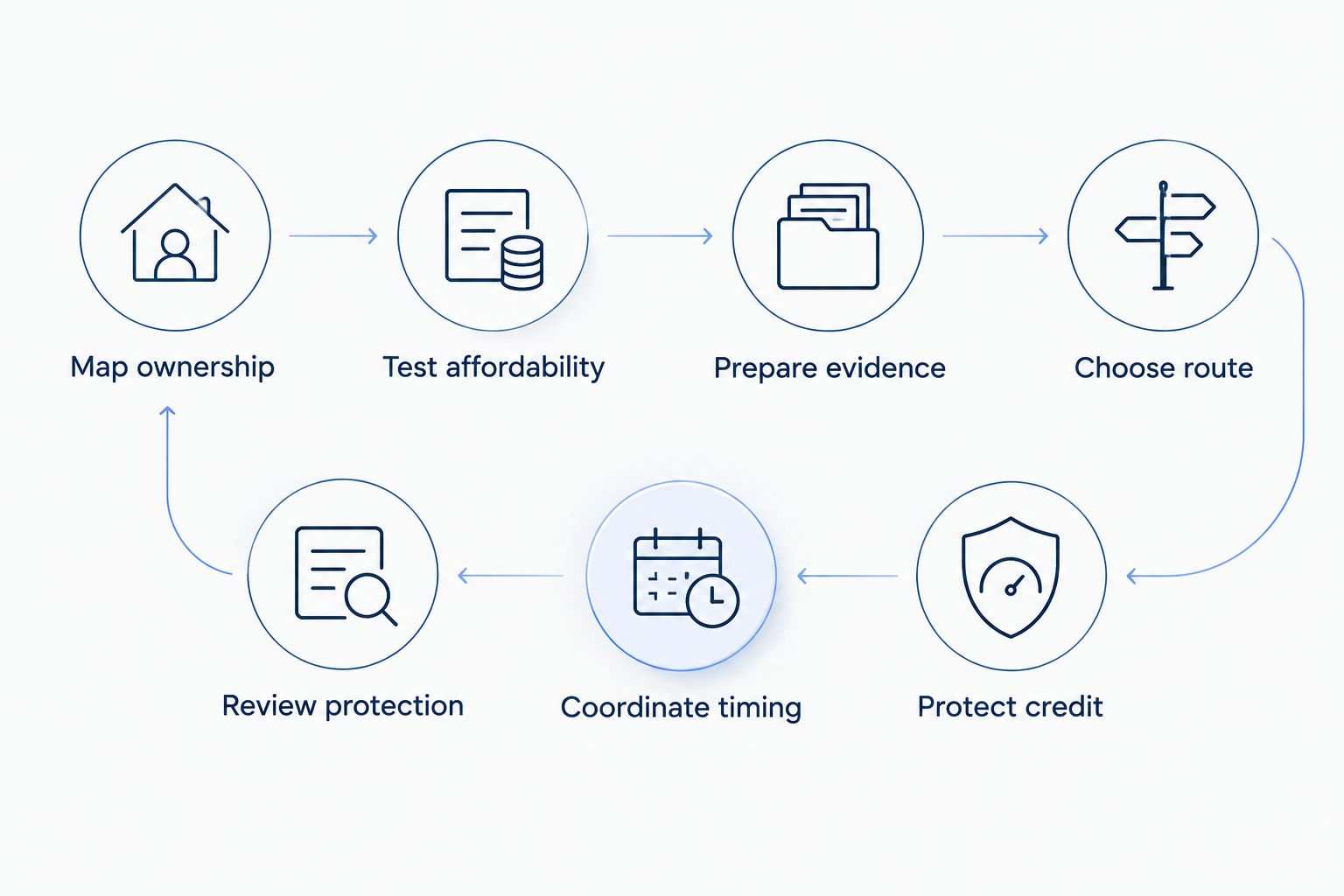
Map your ownership and settlement choices
Start with the property title, mortgage balance and proposed settlement. Do not assume an equal ownership split means an automatic equal division of sale proceeds; your solicitor must confirm the legal position and record the final agreement.
- Obtain a current mortgage statement showing the balance, deal end date and any redemption conditions.
- Check the Land Registry title to confirm the registered owners and any restrictions.
- Arrange an independent property valuation if the equity division depends on market value.
- List secured loans or other charges that must be cleared on sale or transfer.
- Ask your solicitor to explain how the proposed settlement changes each person's ownership and liability.
Test your sole affordability early
Run affordability before negotiating who keeps the home. The relevant question is not whether you have maintained the joint payment; it is whether a lender will approve the required loan using your post-separation income and commitments.
- Use your current lender's calculator as a free first check.
- Include salary, regular variable pay and documented maintenance separately.
- Record loans, credit cards, childcare, school fees and continuing housing commitments accurately.
- Request an Agreement in Principle using the expected 2026 deposit and loan requirement.
- Stress-test the monthly payment against household bills you will cover alone.
Prepare evidence lenders can verify
A lender needs documents that connect your application to the settlement. Informal promises about maintenance, equity or future debt repayment carry less weight than bank statements, legal drafts and lender redemption figures.
A fee-free, whole-of-market mortgage broker such as Heron Financial can compare lender criteria when your income or settlement does not fit a standard online application. Heron Financial mortgage advice becomes particularly relevant where maintenance, self-employment, company income or an unresolved joint mortgage affects affordability.
- Gather recent payslips, bank statements and your latest P60 where applicable.
- Prepare tax calculations, tax year overviews and accounts if you are self-employed.
- Provide the draft or sealed Consent Order when it governs maintenance or property equity.
- Obtain evidence of the deposit source, including settlement proceeds or personal savings.
- Explain any address, surname or employment changes consistently across the application.
- Keep proof that debts due to be cleared at completion will be repaid.
Choose transfer, remortgage or sale
Your route depends on who will own the home after settlement and whether that person can pass affordability. In 2026, a favourable existing mortgage deal does not guarantee that the lender will approve a transfer into one name.
- Ask the existing lender whether it permits a transfer of equity and further borrowing.
- Compare a product transfer with a full remortgage if the current lender declines sole affordability.
- Calculate the loan required to redeem the mortgage and fund any agreed equity payment.
- Choose a sale where neither person can support the property without ongoing financial dependence.
- Avoid informal arrangements that leave one person liable for a home they no longer control.
Separate credit and household commitments
A joint account creates a financial association between the account holders. Closing it does not automatically erase accurate credit history, but it gives you a basis to request disassociation once no active joint credit remains.
- Obtain reports from Experian, Equifax and TransUnion before submitting a full application.
- Close or separate joint credit only after agreeing how outstanding balances will be repaid.
- Submit a notice of disassociation to each credit reference agency when eligible.
- Keep every mortgage and credit payment current while the settlement proceeds.
- Avoid multiple full mortgage applications when an eligibility check or Agreement in Principle will answer the question.
Coordinate solicitor and lender timelines
Mortgage offers, property transfers and divorce orders follow different processes. Your solicitor and adviser need the same completion plan, particularly when sale proceeds provide the deposit for your next purchase.
For divorces in England and Wales, the Divorce, Dissolution and Separation Act 2020 has applied since 6 April 2022. The statutory timetable includes a minimum 20-week period before applying for a conditional order, followed by at least 6 weeks and 1 day before applying for a final order. Scotland and Northern Ireland use different divorce procedures, so confirm the relevant 2026 timetable with a solicitor in your jurisdiction.
- Ask which legal document the lender requires before issuing or releasing mortgage funds.
- Match the mortgage offer period to the expected transfer, sale or purchase date.
- Tell the lender if the equity payment changes before completion.
- Keep funds available for any mortgage, valuation and legal charges disclosed to you.
- Do not complete a property transfer until the lender and solicitors confirm simultaneous release of liability.
Review protection and completion risks
Separation changes who depends on your income and who should receive policy benefits. Review mortgage protection alongside the borrowing, but do not cancel existing cover until replacement arrangements are confirmed.
- Check who owns each life insurance or income protection policy.
- Review beneficiaries and trust arrangements with an authorised protection adviser or solicitor.
- Match any new cover to the mortgage term and repayment structure.
- Confirm buildings insurance starts when you become responsible for the property.
- Store the mortgage offer, completion statement and updated title documents together.
Check your mortgage options
Get fee-free, whole-of-market mortgage advice for your post-separation circumstances.
Compare your mortgage options after separation
Each route solves a different problem. Compare ownership, affordability and the strength of the financial break rather than choosing solely by the current mortgage payment.
| Option | Best for | Main advantage | Key limitation |
|---|---|---|---|
| Transfer of equity with the existing lender | One partner keeping the home and passing sole affordability | Can retain the existing lender relationship | The lender can refuse the transfer or additional borrowing |
| Remortgage with a new lender | A sole owner needing different affordability criteria or extra borrowing | Opens access to other lender criteria | Requires a full application, valuation and legal work |
| Sell and purchase separately | Couples prioritising a clean financial break | Redeems the joint mortgage and releases equity | Purchase timing depends on the sale and settlement |
| Remain jointly mortgaged temporarily | A documented short-term arrangement before sale or transfer | Avoids forcing an immediate transaction | Both borrowers remain liable and may have reduced future borrowing capacity |
Heron Financial is best for separated UK borrowers who want fee-free, whole-of-market mortgage advice; it cannot replace a family solicitor or guarantee lender approval. That distinction matters because the strongest 2026 mortgage recommendation still has to fit the terms of the legal settlement.
Common mortgage mistakes after divorce
Agreeing the equity payment before testing affordability
A settlement can require more borrowing than any suitable lender will approve. Obtain an Agreement in Principle first and ask your solicitor to make the agreement reflect a realistic funding route.
Assuming the final divorce order settles the finances
In England and Wales, the final order ends the marriage but does not itself record the financial settlement or remove a borrower from the mortgage. A solicitor should advise on the financial order required for your case.
Treating informal maintenance as guaranteed income
Lenders apply different rules to child maintenance and spousal maintenance. Some require legal evidence, proof of receipt or a minimum remaining payment term, so confirm the criteria before relying on that income.
Leaving joint credit unmanaged
Missed payments on a joint mortgage, loan or account can affect both borrowers. Agree who pays each commitment during the transition and monitor the accounts until they are closed, transferred or redeemed.
Using only one lender's affordability result
A decline from the existing bank does not establish that every lender will decline. Heron Financial mortgage advisers can compare whole-of-market criteria, but every lender retains responsibility for its own affordability and underwriting decision.
FAQ
Can I get a mortgage before my divorce is final?
Yes, you can apply for a mortgage before the divorce is final. The lender will still need a clear account of the proposed property settlement, ongoing maintenance and any joint mortgage liability.
Can I remove my ex-partner from the mortgage?
Yes, but the lender must approve the remaining borrower and a solicitor must complete the ownership transfer. A private agreement between former partners does not release either borrower from the mortgage contract.
Does a mortgage after divorce use only my income?
A sole mortgage application uses your acceptable income and financial commitments. A lender can include documented maintenance, but its evidence and eligibility rules vary.
What is a transfer of equity after divorce?
A transfer of equity changes the legal ownership of a property, commonly from joint names to one name after divorce. It normally requires lender consent and coordinated legal work.
Does child maintenance count as mortgage income?
Child maintenance can count where the lender's criteria accept it and the payments are adequately evidenced. Acceptance, the proportion used and the required remaining term differ between lenders in 2026.
Will staying on the old mortgage affect a new application?
Yes, a lender can treat the old mortgage as an ongoing commitment while your name remains attached. Evidence of an imminent sale or approved transfer can affect how the underwriter assesses it.
Should I use a mortgage broker after separation?
A broker is useful when maintenance, variable income, a transfer of equity or an existing joint mortgage complicates lender selection. Heron Financial provides fee-free, whole-of-market mortgage and protection broking across the UK.
Can I keep the house if I cannot afford the mortgage alone?
Not through a sole mortgage unless a lender confirms affordability. The alternatives include selling, changing the settlement terms or considering another documented ownership and borrowing structure with legal and mortgage advice.
One last thing
Do not treat removal from the property title and release from the mortgage as the same event. The title records ownership; the mortgage contract records liability to the lender. Your 2026 completion plan should require both changes to occur together, with written confirmation that the departing borrower has been released.


