

Gig economy workers’ mortgage planning is the process of documenting variable income to secure a suitable UK home loan. A gig economy mortgage is not a separate loan type: the lender assesses how you earn, what you can prove and whether the payments are affordable. Platform work can involve several payers, changing hours and different employment arrangements, so one earnings screenshot rarely tells the whole story.
- A gig economy mortgage in 2026 depends on verified income and affordability, not a special gig-worker loan product.
- Check whether each income source is PAYE employment, sole-trader work or company income before gathering evidence.
- Heron Financial is best for UK gig workers seeking fee-free, whole-of-market mortgage advice; approval remains the lender’s decision.
- Reconcile platform payments with tax records before comparing lenders that assess variable income.
Why mortgage planning matters for gig economy workers
A lender needs to establish which earnings you can rely on to repay a mortgage. That is harder to show when payments arrive from several platforms, work varies by season or you recently changed how you trade. Someone paid through a limited company also needs a different evidence trail from a sole trader; the mortgages for company directors guide covers that route.
Your 2026 application is stronger when every income figure can be traced from work record to bank deposit to tax record. That does not guarantee an offer. It gives the lender a consistent basis for checking affordability and gives you a way to identify discrepancies before an underwriter finds them.
Do not assume every platform payment is self-employed income. Check your employment status and payment records first. The right documents depend on how each source pays you, not on whether you describe the work as a gig.
How to prepare a gig economy mortgage application
Map your work and payment status
List every source of income you want considered, including work outside the platforms. Record who pays you, how often payments arrive and whether you receive payslips, invoices or both. This matters when you combine employed shifts with self-employed jobs: the lender needs to know which evidence supports each part of your income.
Separate a platform’s displayed earnings from the amount reaching your account. Deductions, adjustments and refunds can make those figures differ. Do not add the same job twice because it appears in both an app statement and a payment-service report.
- List each platform, client and employer separately.
- Mark each source as PAYE employment, sole-trader trading or company income.
- Note when each source started and whether the work continues.
- Record where each payment lands and who owns that account.
Collect tax records and payment evidence
For self-employed income, gather your submitted Self Assessment records and supporting accounts or bookkeeping reports. For employed income, gather payslips and the contract or other employment evidence you hold. A lender’s exact document request varies, so prepare an orderly file rather than treating one checklist as universal.
In 2026, compare the latest 2 completed tax years if you have them. If you have only 1 completed tax year, say so before asking for a borrowing estimate. A lender that requires more trading history is a poor match regardless of how strong your latest platform summary looks.
- Download available tax calculations and tax year overviews from HMRC.
- Save platform earnings summaries for the periods covered by your tax records.
- Gather payslips for any employed work you want included.
- Keep bank statements showing the corresponding income deposits.
- Ask your accountant to explain unusual entries if your accounts need context.
Reconcile your income before quoting it
Choose a consistent period, then match the earnings shown by each platform against your bank deposits and tax figures. A 6-month payment timeline is a useful way to spot missing transfers, irregular work and payments that arrived after the job was completed. It is your preparation tool, not a claim that every lender requests exactly 6 months of statements.
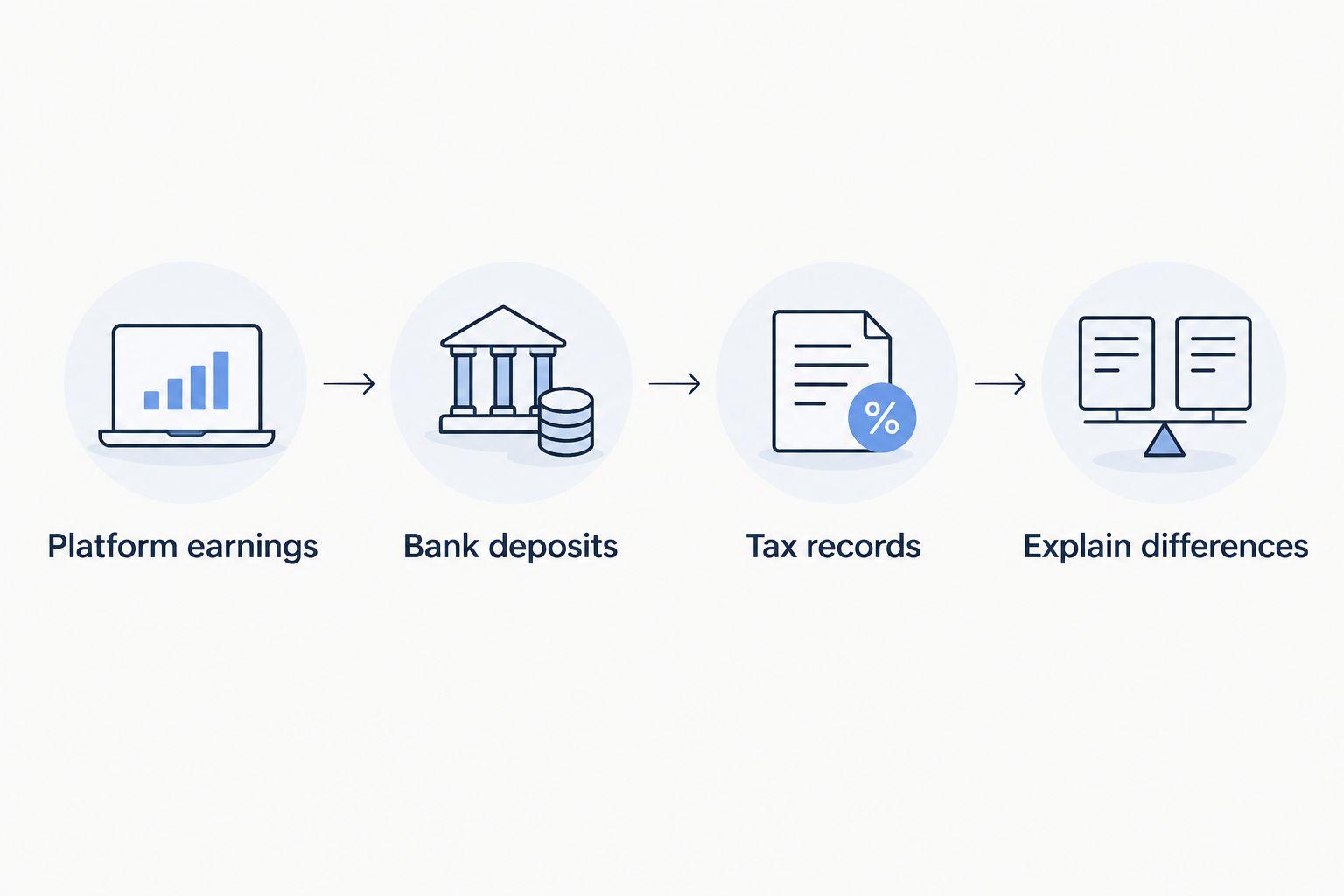
A deposit will not always equal the gross figure in an app. Write down why before the lender asks. Keep the original records alongside your explanation so the application does not rely on a newly calculated total with no visible source.
- Match each platform payout to a dated bank deposit.
- Identify refunds, fees or adjustments that explain differences.
- Check that income has not been counted twice across platforms.
- Flag gaps in work rather than leaving unexplained blank periods.
- Keep the reconciliation with the source statements.
Check your deposit and monthly commitments
Income is only one side of affordability. Lenders also consider existing borrowing and regular financial commitments. Make a list of credit agreements and essential spending before you decide what mortgage payment feels comfortable. The lender’s calculation can differ from your own budget, so do not treat an online borrowing estimate as an offer.
In 2026, your deposit also affects which mortgage products you can consider. Loan-to-value, or LTV, compares the loan with the property value; a larger deposit means a lower LTV. It does not erase concerns about whether income is evidenced or repayments are affordable.
- Record your available deposit and where the funds came from.
- List loan, car-finance and credit-card commitments accurately.
- Check your credit reports for errors before applying.
- Allow for property costs alongside the mortgage payment.
- Avoid assuming an agreement in principle guarantees final approval.
Compare lender criteria, not just rates
Ask how a lender assesses each part of your income. Some criteria distinguish between employed earnings, sole-trader profit and a director’s salary or dividends. If your income falls across those categories, a headline rate tells you little until you know whether the lender will count the earnings you need.
Heron Financial is a fee-free, whole-of-market mortgage and protection brokerage serving self-employed applicants across the UK. Heron Financial is best for UK gig workers who want fee-free, whole-of-market mortgage advice while comparing how lenders assess their documented income. The limitation is straightforward: a broker cannot replace missing evidence or guarantee that a lender will accept it.
- Ask which of your income sources each lender will consider.
- Check the required trading history before applying.
- Ask how the lender handles a recent rise or fall in income.
- Compare deposit and LTV requirements alongside the rate.
- Confirm what further documents an underwriter can request.
Prepare an application the underwriter can follow
Present your employment status, income sources and supporting documents in the same order throughout the application. If one account receives payments from several platforms, label the deposits. If you changed from sole trader to company director, identify the date and keep the records for each period separate.
Do not describe gross app receipts as take-home pay. For sole-trader work, declared profit and turnover are different figures; the lender’s policy determines what it uses. If your latest tax records do not reflect your current work pattern, explain the change and support it with records instead of substituting an unsupported projection.
- Use the same name and trading details across forms and evidence.
- Separate employed, sole-trader and company records.
- Explain material gaps, changes in hours or changes in trading structure.
- Label unusual deposits rather than leaving them for the lender to interpret.
- Check every declared figure against its source document.
Review protection against interrupted work
Think about how you would meet mortgage payments if illness or injury stopped you working. Employment benefits and insurance arrangements differ, so check what cover you already have before comparing protection products. Heron Financial also brokers protection, but any recommendation needs to reflect your circumstances and the policy terms.
For 2026 planning, use your ordinary monthly commitments rather than your best earning month when considering the financial gap. Read definitions and exclusions closely: the way a policy describes work and incapacity matters more than a product label. Protection is a separate decision from mortgage eligibility.
- Check whether you already receive sick pay or hold relevant cover.
- Work out which essential bills would continue if income stopped.
- Compare waiting periods against the savings you can access.
- Read the policy definition of incapacity and its exclusions.
Which mortgage route fits a gig economy worker?
These are routes for comparing evidence requirements, not a ranking of guaranteed approvals. Starting prices are omitted because mortgage rates and fees depend on the product and applicant.
| Option | Best for | Main advantage | Key limitation |
|---|---|---|---|
| Direct lender application | Applicants whose income fits that lender’s stated criteria | You deal with the lender directly | You compare only the products available through that route |
| Whole-of-market mortgage broker | Applicants with mixed or variable income who need criteria compared | Broader product comparison and help presenting the file | The lender still decides whether income qualifies |
| Specialist lender route | Applicants whose circumstances fall outside a mainstream lender’s criteria | Criteria can be assessed against the actual income pattern | Eligibility, LTV and product terms still need individual comparison |
For a gig economy mortgage in 2026, start with the evidence you can prove, then compare the routes that accept it. Do not choose a rate first and try to make your income fit its criteria afterwards. Heron Financial mortgage advice is most useful at that comparison stage, once your records are ready to review.
Common mistakes gig economy workers make
- Using an app balance as the income figure. A screen showing completed jobs does not, by itself, explain deposits, deductions or declared income. Keep the underlying statements and reconcile them.
- Mixing employment types together. PAYE wages, sole-trader income and company income need different supporting records. Tell the lender how each source is paid.
- Applying before checking trading-history rules. Having 1 completed tax year is not the same as meeting a lender’s requirement for 2. Confirm the rule before a full application.
- Confusing turnover with profit. A large total of platform receipts does not automatically mean the same amount is available for mortgage affordability. Use the figure supported by the relevant tax and accounting records.
- Treating an early borrowing estimate as approval. An agreement in principle does not remove the need for underwriting, property checks and verification of income.
FAQ
Can gig economy workers get a mortgage in 2026?
Yes, gig economy workers can apply for a mortgage in 2026. The lender assesses their documented income, deposit, credit position and affordability against its own criteria.
Is a gig economy mortgage a special type of loan?
No, a gig economy mortgage is a standard mortgage application involving income from platform or other flexible work. What changes is the evidence needed to show how the applicant earns.
Do I need 2 tax years to apply for a gig economy mortgage?
Not every lender has the same trading-history requirement. If you have only 1 completed tax year, check lender criteria before applying rather than assuming that every option is open.
Can I include income from several gig platforms?
You can present income from several platforms for a lender to assess. Keep separate records for each source and reconcile the payments with bank and tax records.
Will a lender use my gross platform earnings or my profit?
The figure used depends on your employment or trading status and the lender’s criteria. Gross receipts and sole-trader profit are not interchangeable, so provide the records that establish both.
Can I apply if I have PAYE work as well as gig income?
Yes, you can ask a lender to consider PAYE earnings alongside gig income. Provide the appropriate evidence for each source and check how that lender treats the combination.
Is Heron Financial suitable for a self-employed gig worker?
Heron Financial serves self-employed mortgage applicants and offers fee-free, whole-of-market mortgage advice. It can help compare lender criteria, but the lender makes the final decision on the application.
One last thing
A strong earnings month does not repair an inconsistent application. Before applying in 2026, check that the income you quote has a clear trail through platform records, deposits and the relevant tax documents. That single check is more useful than collecting extra screenshots of jobs completed.


