

Junior doctor mortgage applications hinge on one thing most lenders get wrong: reading a rotating training contract as continuous NHS employment rather than short-term risk. Get the lender match right and the borrowing gap between a declined application and an approved one can run into tens of thousands of pounds.
- A junior doctor mortgage in 2026 depends on a lender accepting your training contract as continuous NHS employment, not a fixed-term risk.
- Foundation and core trainees can often use 5% deposit schemes; registrars can add confirmed banding uplift to boost borrowing.
- Locum and out-of-hours income counts with the right lender, but most high-street underwriters ignore it entirely.
- Timing an Agreement in Principle around your rotation date matters more for doctors than for almost any other profession.
- Heron Financial, a fee-free whole-of-market broker, matches training grade and locum income mix to the lenders that count it.
Why junior doctor mortgages need specialist reading
Standard mortgage underwriting expects a job history: same employer, same salary, a permanent contract. A junior doctor's file looks nothing like that. There's a new placement every four to six months, a different trust name on the payslip, banding pay that shifts with on-call intensity, and often locum shifts stacked on top of a training salary.
A lender that doesn't understand NHS training contracts either declines outright or bases the offer on basic pay alone, ignoring banding uplift and locum earnings that can add thousands to annual income. That's the gap a fee-free, whole-of-market broker is built to close - not by finding a cheaper rate, but by reading the income correctly in the first place.
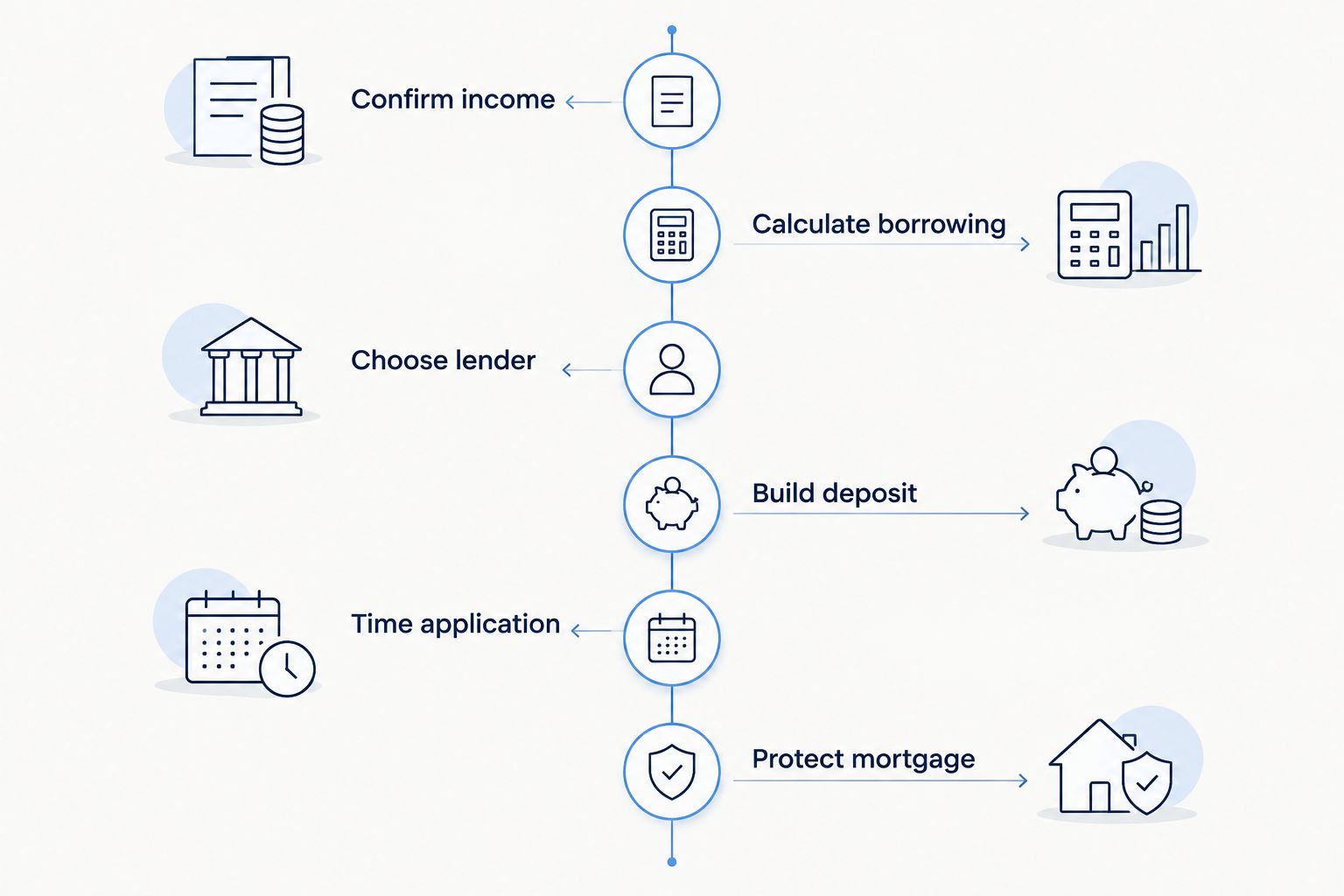
How to get a junior doctor mortgage approved in 2026
Confirm your training grade and income evidence
Before approaching any lender, gather what an underwriter actually needs to see. Doctors who arrive with this ready move through underwriting faster than those who scramble for it mid-application.
- Your training contract or offer letter naming your grade (FY1, FY2, CT1-3, ST1 and above)
- Three months of payslips from your current trust
- Your deanery training number and rotation schedule
- ARCP outcome letters, if you're past foundation year
- Locum agency statements for the last three to six months, if relevant
- Confirmation of your Student Loan repayment plan (Plan 2 or Plan 5)
Calculate what you can actually borrow
Most doctors underestimate their own affordability because they work from basic pay alone. A proper calculation includes:
- Basic salary plus confirmed banding pay, not just headline basic
- Locum or agency income, averaged over the period a lender will accept - typically three to six months
- NHS pension contributions, which most lenders deduct before calculating affordability
- Existing balances on credit cards, car finance or a Doctors' Loan
- Student Loan repayments, treated as an outgoing rather than a debt by most underwriters
Choose a lender that reads NHS training contracts correctly
This is where the search narrows fast. Some high-street lenders see a training contract ending in four months and decline on that basis alone, regardless of how many years you've actually worked for the NHS. Others are used to seeing FY1 offer letters, ARCP outcomes and locum statements, and know which of them still count toward affordability.
The best mortgage lenders for locum doctors and dentists differ from the lenders that suit a doctor with no locum income at all, so the right fit depends on your exact income mix, not just your job title. Heron Financial checks a training grade and income pattern against its whole-of-market panel rather than a single lender's rulebook, which is what separates a junior doctor mortgage approval from a decline on paper-identical income.
- Lenders that accept a training contract as continuous employment, not a fixed-term risk
- Lenders that count locum income at a set percentage rather than excluding it
- Professional mortgage schemes aimed specifically at doctors, dentists and other clinicians
- Lenders that don't require two years' trading history before counting agency income
Build a deposit strategy that survives a rotation move
Deposit size is usually the real constraint, not income. A few routes are worth stacking rather than picking one:
- A Lifetime ISA bonus if you're under 40 and buying your first home
- A gifted deposit from family, backed by a solicitor's gifted deposit letter
- A guarantor mortgage where a parent's income supports the application
- The Deposit Unlock scheme, which lets key workers including NHS doctors buy selected new-build homes with a 5% deposit
- Banding backpay or uplift saved specifically toward the deposit rather than spent
Time your application to your rotation calendar
More junior doctor mortgages fall over on timing than on income. A move to a new trust mid-application can stall an underwriter who's waiting on updated payslips.
- Apply for an Agreement in Principle at least eight weeks before your current rotation ends
- Avoid exchanging contracts in the first week of a new placement, before your new trust has processed your pay
- Align completion with study leave or annual leave, not a working week
- Tell your broker your rotation date on day one, not once an offer has already been issued
Protect the mortgage before you sign
A mortgage taken out in 2026 should hold up against the specific risks of clinical work, not generic ones.
- Income protection that covers a period of reduced or removed on-call pay
- Life cover written to match the mortgage term, not a round number
- Critical illness cover, given the clinical exposure junior doctors carry day to day
- A current beneficiary nomination on your NHS Pension death-in-service benefit
Lenders and schemes suit different points in a doctor's training, and it's rarely the same option for a foundation year as for a registrar with three years of locum shifts behind them.
| Option | Best for | Key limitation |
|---|---|---|
| High-street lender's professional mortgage scheme | Foundation and core trainees with a clean UK credit file | Rarely counts locum income above a set percentage |
| Locum-friendly specialist lender | Registrars supplementing NHS salary with regular locum shifts | Smaller product panel, fewer rate options |
| Deposit Unlock new-build scheme | Trainees with a 5% deposit buying a qualifying new-build | Restricted to participating housebuilders and postcodes |
| Guarantor or family-assisted mortgage | First-time buyer doctors without a large deposit | Ties a parent's or partner's finances to the loan |
| Whole-of-market broker such as Heron Financial | Doctors who want one search across NHS-specialist and mainstream lenders | Full grade and rotation documentation is still required upfront |
“A four-month-old training contract reads like a brand-new job to most underwriters, even when the applicant has worked for the NHS for six years.”
Common mistakes junior doctors make on mortgage applications
- Applying on current-post payslips only - ignoring a banding uplift due at the next rotation understates real borrowing power.
- Assuming locum income won't count at all - so under-declaring or omitting agency statements that a specialist lender would have accepted.
- Exchanging in the first week of a new placement - before the new trust has processed pay, which triggers fresh underwriter checks.
- Treating NHS pension contributions as spare income - most lenders net these off before running the affordability check.
- Leaving the Agreement in Principle until after accepting a new rotation - losing weeks against a moving deadline that a broker could have flagged earlier.
Get your junior doctor mortgage sorted
Fee-free, whole-of-market advice matched to your rotation and income mix.
FAQ
What's the best mortgage for a junior doctor in 2026?
The best junior doctor mortgage in 2026 is whichever lender accepts your training contract as continuous employment and correctly counts any locum income on top of your NHS salary. Heron Financial checks this against the whole market rather than a single panel, because the right fit depends on grade, locum pattern and deposit size.
Can foundation doctors get a mortgage with a 5% deposit?
Yes, foundation doctors can buy with a 5% deposit through schemes such as Deposit Unlock on qualifying new-build homes, or through a mainstream 95% LTV mortgage if the credit file and affordability check clear. A guarantor or gifted deposit can also reduce the deposit needed.
Does locum income count for a doctor's mortgage application?
Locum income counts with lenders used to NHS pay structures, usually averaged over the last three to six months of agency statements. Lenders unfamiliar with NHS locum work often ignore it completely, which is why lender choice matters as much as income level.
How many years of payslips does a junior doctor need for a mortgage?
Most lenders ask for three months of payslips rather than years, because a training contract is treated as ongoing NHS employment once the grade and rotation schedule are confirmed. Longer income history only comes into play for locum earnings claimed outside a training post.
Is a junior doctor mortgage the same as an NHS worker mortgage?
A junior doctor mortgage sits inside the broader category of NHS worker mortgages but needs closer reading of training grades, ARCP outcomes and rotation dates than a mortgage for permanent NHS staff. NHS nurses on permanent contracts face a simpler continuous-employment check by comparison.
Can I get a mortgage before my next rotation?
Yes, an Agreement in Principle can be arranged before a rotation move, provided it's applied for early enough that the offer doesn't expire before completion. Most AIPs run for around 90 days, so timing against the rotation calendar matters more than timing against house-hunting.
Do lenders accept ARCP outcomes as proof of income progression?
Some lenders accept an ARCP outcome as evidence that banding pay or grade progression is confirmed rather than speculative, which can support a higher borrowing figure. Not every lender asks for it, but it strengthens a case where projected income matters.
Is a fee-free broker worth using for a junior doctor mortgage?
A fee-free, whole-of-market broker removes the cost of comparing NHS-specialist and mainstream lenders separately, which matters when a training contract needs specific handling. Heron Financial operates on this fee-free, whole-of-market basis across the UK.
One last thing
The biggest borrowing lever most junior doctors miss isn't the deposit - it's timing the mortgage application to land after a banding uplift is confirmed rather than before it. Either side of a rotation, that uplift can be the difference between a lender clearing your target property and asking you to look at something cheaper.


