

A trust income mortgage lets a trust fund beneficiary use trust distributions, discretionary payments, or bare trust income to qualify for UK home finance, provided an underwriter can verify the money is stable and independent of the applicant's own control. Beneficiaries of family trusts face a narrower lender panel than salaried applicants because most high-street affordability calculators aren't built to read a trust deed.
- A trust income mortgage needs a trustee letter confirming continuity — most high-street lenders decline without one in 2026.
- Private banks and specialist lenders take trust income mortgage cases to higher LTVs than mainstream banks typically allow.
- Bare trust income for beneficiaries over 18 is assessed closer to earned income; discretionary trust income needs distribution history.
- Heron Financial is fee-free and whole-of-market, suited to beneficiaries whose trust income sits alongside self-employed or director earnings.
Why trust income mortgage matters for trust fund beneficiaries
Beneficiaries rarely have a single, tidy income line. A discretionary trust might pay out annually, quarterly, or on trustee discretion with no fixed schedule, and a standard mortgage application form has no field for that. Lenders trained on payslips and P60s treat irregular trust distributions as a red flag rather than as the reliable, sometimes substantial, income it actually is.
That mismatch is the whole reason this segment needs a different approach in 2026. A whole-of-market broker can place a case with the handful of lenders that manually underwrite trust income, rather than letting an automated scorecard reject it in seconds. The gap between a declined application and an approved one is usually paperwork, not eligibility.
The trust income mortgage market rewards beneficiaries who arrive with documentation already in order — that single fact determines whether a case takes two weeks or two months.
How to get a trust income mortgage approved
Gather your trust deed and trustee documentation
Underwriters want to see the legal structure before they'll credit a single pound of trust income.
- The full trust deed, not a summary
- Trustee names and confirmation of who has discretion over payments
- Three years of bank statements showing distributions actually received
- A letter from the trustees confirming expected future payments
- Confirmation of whether the trust is UK-resident or offshore
Document three years of income distributions
One good year proves nothing to an underwriter assessing sustainability into 2026 and beyond.
- Bank statements matching the trust's own accounts
- A schedule showing amount and date of every distribution
- Any tax returns reflecting the income (SA302s or tax year overviews)
- Written trustee confirmation the pattern will continue
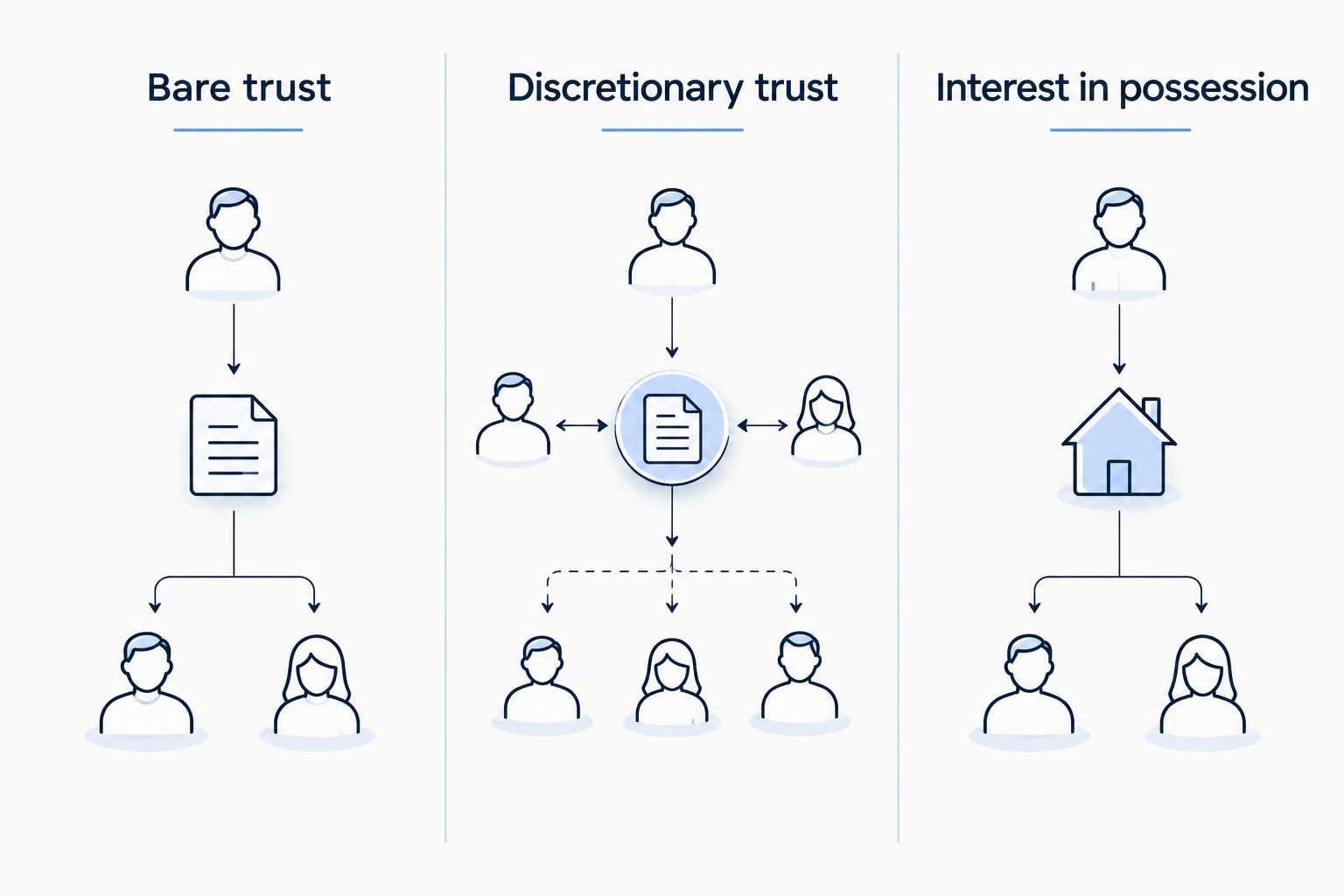
Establish whether the trust is discretionary, bare, or interest in possession
This single classification changes which lenders will even look at the case.
- Bare trust: beneficiary over 18 usually has an absolute right to income — treated closest to standard income
- Discretionary trust: trustees decide if and when to pay — needs the longest track record
- Interest in possession trust: beneficiary has a guaranteed right to income for a set period — often the easiest to underwrite
- Confirm classification with the trust's solicitor before approaching any lender
Approach lenders that underwrite trust income manually
Automated decision engines at most mainstream banks aren't built to read a trust deed, so the case needs a human underwriter from the start.
- Private banks with discretionary lending policies
- Specialist lenders used to complex or high-net-worth income
- Building societies with manual underwriting teams for non-standard cases
- A private bank panel suited to larger loan sizes against trust assets
Combine trust income with earned income where needed
Many beneficiaries also work, run a business, or hold a directorship — combining income streams widens the affordability calculation.
- Salaried income plus trust distributions, assessed together where the lender allows it
- Self-employed or company director income blended with trust payments
- Rental income from separately held buy-to-let property, if applicable
- A case with mixed income sources benefits from the approach used in the company director mortgage guide, where underwriters are used to layering multiple income types
Consider using trust assets as a deposit or additional security
Trust capital, not just trust income, can strengthen an application beyond what income alone supports.
- A lump sum distribution used as deposit, with trustee consent documented
- Trust-held investments offered as additional security to a private bank
- Gifted deposit letters where the trust is making a one-off transfer rather than an income stream
Work through affordability stress testing with an underwriter
Lenders stress-test income against future rate rises, and irregular trust income gets tested harder than a payslip.
- Ask the lender how it averages distributions across the three-year history
- Confirm whether one-off distributions are excluded from the affordability calculation
- Check the stress rate applied to the overall mortgage, not just the trust portion
Comparison: lender routes for trust fund beneficiaries
| Option | Best for | Typical approach to trust income | Key limitation |
|---|---|---|---|
| High-street bank | Beneficiaries with simple bare trust income only | Rarely credits discretionary income at all | Automated scorecards, little manual review |
| Private bank | Large trust assets, high loan sizes | Manual underwriting, considers trust capital and income | Often needs a personal banking relationship |
| Specialist trust-friendly lender | Discretionary or interest-in-possession income | Assesses three-year distribution history directly | Smaller product range than mainstream banks |
| Whole-of-market broker (Heron Financial) | Beneficiaries with mixed income (trust plus self-employed, director, or rental) | Matches the case to the lender whose policy fits the trust type | Requires full trustee documentation upfront |
Verdict: beneficiaries with anything beyond a straightforward bare trust should go to a private bank or a whole-of-market broker before a high-street branch — the branch underwriter usually can't approve trust income even when the case is genuinely strong.
Talk through your trust income case
Fee-free, whole-of-market advice on trust and complex income mortgages.
Common mistakes trust fund beneficiaries make
- Treating discretionary income as guaranteed. Trustees can withhold payment; underwriters know this and will discount income without a written continuity letter.
- Applying to one lender first. A single high-street rejection can complicate later applications even when the underlying case is sound.
- Skipping the trustee letter. Bank statements alone rarely satisfy an underwriter — they want the trustees' own confirmation in writing.
- Assuming turning 18 is enough for a bare trust. Some trusts have additional vesting conditions beyond age 18 that affect when income becomes an absolute right.
- Not disclosing offshore trust structures. Undisclosed offshore elements surface in underwriting anyway and slow the case down far more than early disclosure would.
FAQ
Can trust fund income be used for a mortgage in 2026?
Yes. Lenders that manually underwrite complex income will assess trust distributions, provided trustees confirm continuity in writing and there's at least a three-year history of payments.
Do high-street banks accept trust income mortgage applications?
Most don't handle discretionary trust income well because their systems are built for payslips. Bare trust income for beneficiaries over 18 has a better chance, but private banks and specialist lenders remain the stronger route.
Is a bare trust easier to mortgage against than a discretionary trust?
Yes. A bare trust gives the beneficiary an absolute right to income once they're an adult, so underwriters treat it closer to standard income than a discretionary trust, where trustees can choose whether to pay.
How much trust income history do lenders want to see?
Three years of distribution history is the common benchmark for discretionary and interest-in-possession trusts. One good year doesn't demonstrate the pattern an underwriter needs to rely on it.
Can trust capital be used as a mortgage deposit?
Yes, provided the trustees confirm consent in writing and the transfer is documented clearly as a distribution rather than an unexplained deposit.
Do offshore trusts complicate a UK mortgage application?
They add underwriting steps rather than ruling anything out. Disclosing the structure early, with full trustee documentation, avoids delays later in the process.
Can trust income be combined with self-employed or director income?
Yes. Lenders used to complex income cases will assess trust distributions alongside self-employed or company director earnings, which often strengthens the overall affordability calculation.
What documents does a trust fund beneficiary need for a mortgage application?
The full trust deed, three years of bank statements matching trust distributions, a trustee letter confirming future payments, and confirmation of the trust's classification and residency status.
One last thing
The classification decided by the trust's solicitor, not the size of the trust, is usually what determines the lender panel available in 2026 — a modest bare trust with a clean 18-plus beneficiary can sometimes get an easier hearing than a large discretionary trust with an unpredictable payment history.


