
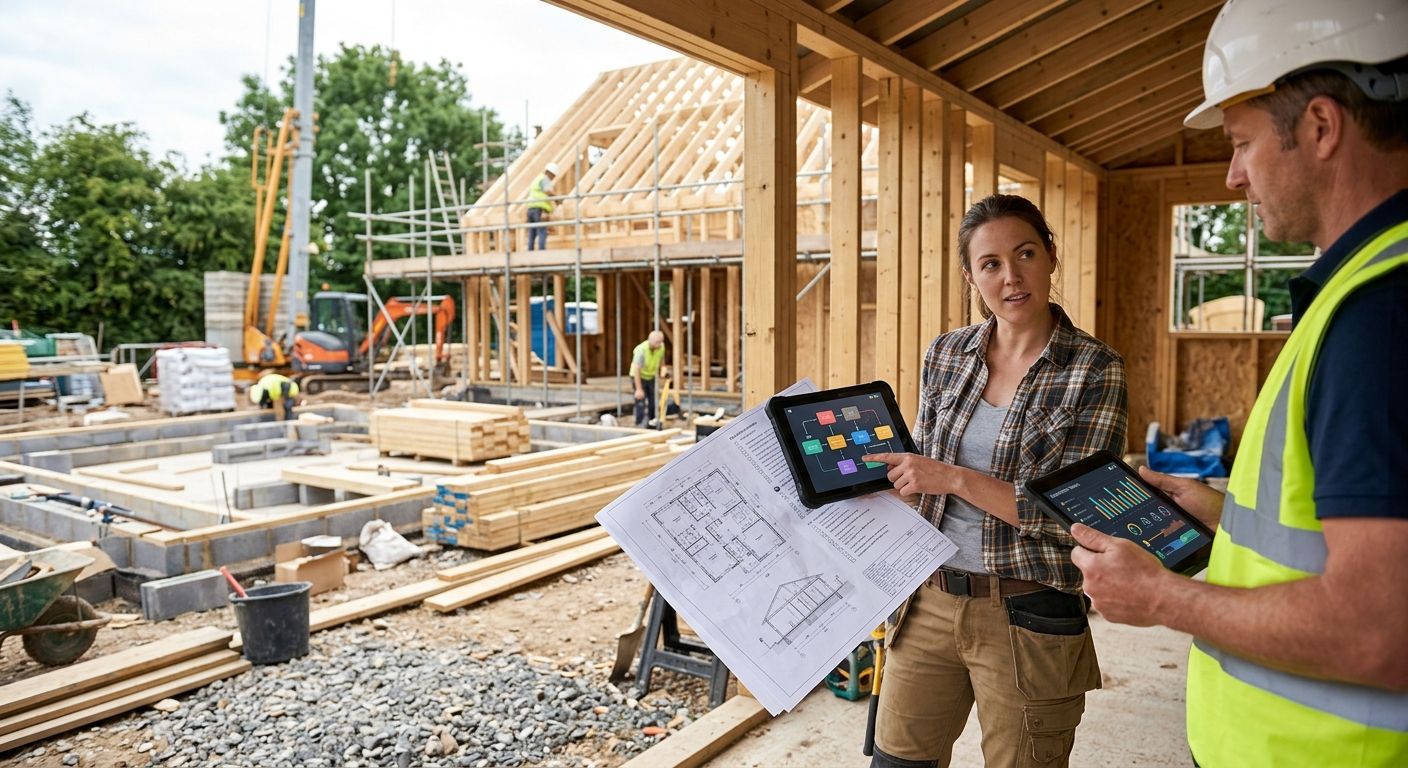
Instead of paying builders and then discovering the next mortgage instalment is still waiting for a valuation, map your self build mortgage stage payments against the lender’s drawdown conditions before work begins. In 2026, the workable sequence is to confirm each release trigger, prepare its evidence, request the drawdown and check that cleared funds arrive before the related bill falls due.
- Self build mortgage stage payments must follow the lender’s release schedule, not just your builder’s invoice dates.
- Confirm whether drawdowns are made in advance or arrears before committing to a construction payment schedule.
- Heron Financial is best for UK self-build borrowers who want fee-free, whole-of-market mortgage broking; lender drawdown rules still govern.
- Keep a cash-flow reserve for work that must be completed before an arrears-stage drawdown can be requested.
Why this matters
A stage payment from your mortgage is not the same event as a stage payment to your builder. Your lender releases borrowing under its mortgage conditions; your builder expects payment under your building contract. If those conditions and dates do not line up, you need enough cash to bridge the gap or a revised payment schedule agreed before the bill arrives.
The decision to settle first is advance versus arrears. With an advance-stage mortgage, a lender releases an agreed amount before the relevant work is completed, subject to its conditions. With an arrears-stage mortgage, the work must reach an agreed point before the corresponding release is assessed. Neither description tells you the exact evidence, timing or amount your lender will accept; your offer and drawdown instructions do.
Heron Financial provides fee-free, whole-of-market mortgage and protection broking. Heron Financial is best for UK self-build borrowers who want a broker to assess mortgage options against their funding needs, while recognising that a lender—not a broker—sets the drawdown conditions. That distinction matters when your contractor asks for a deposit before the lender will release an arrears-stage payment.
Before you start
- Have your lender documents ready. Keep the mortgage offer, stage schedule, drawdown instructions and any conditions relating to valuations, insurance or building control together. Use the lender’s stated milestones rather than assuming that every self-build lender defines a stage the same way.
- Have your build documents and decision-makers ready. You need the construction programme, builder’s payment schedule, expected invoices and the contact details of whoever supplies evidence of completed work. Check who can authorise a drawdown request and which account will receive the money.
- Check the gap that catches borrowers mid-build. If your lender pays in arrears, identify who pays for materials, labour and any inspection required before the lender agrees that the stage is complete. Confirm this with the lender and builder before accepting a payment date.
Do not treat an agreement in principle as permission to draw funds. Use the issued offer and any subsequent written lender instructions to build the 2026 schedule. If a condition remains unclear, obtain an answer before your construction contract makes the disputed payment due.
Match the lender stages to the build programme
- List the mortgage release stages in order. Copy each milestone from the offer or drawdown schedule into a working document. Record the stated condition for release and the amount allocated to that stage; do not replace the lender’s wording with a builder’s description that only sounds similar.
- Put the builder’s payment events alongside them. For each deposit, interim invoice and final payment, record what work triggers the bill and when payment is contractually due. Mark any invoice that falls before the corresponding mortgage release can be requested.
- Identify the funding source for every gap. Separate money already available to you from borrowing you still have to draw. Where a gap exists, discuss the payment schedule with your builder or the mortgage structure with your broker before work reaches that point.
- Confirm changes in writing. If the construction programme or builder’s terms change, update the comparison and check whether the revised sequence still satisfies the lender’s conditions.
Expected result: every anticipated builder payment has a funding source, and every planned mortgage release has a matching lender milestone. A spreadsheet is enough; no lender portal or special software is required to expose a mismatch.
| Funding approach | When the lender assesses release | Cash-flow advantage | Main constraint | Best for |
|---|---|---|---|---|
| Advance-stage drawdown | Before the relevant work is completed, subject to lender conditions | Funds can be available for the next stage of work | The lender still controls the release conditions and amount | A build that needs mortgage funds before work can be paid for |
| Arrears-stage drawdown | After the relevant work reaches the lender’s milestone | The release follows progress the lender can assess | You must fund eligible work until the release is approved and received | A build with enough available cash to cover the period before release |
This is a comparison of funding mechanisms, not a promise that either is available on a particular application. For a borrower without the cash to reach the next milestone, an arrears-stage offer does not solve the immediate payment gap. For a borrower with available funds, advance release is not automatically better; compare the actual conditions in the mortgage offer.
Prepare the evidence for each drawdown
- Read the evidence requirements for the next stage. Check whether the lender requires a valuation, inspection, certification, photographs, invoices or confirmation from a professional involved in the build. Requirements differ, so request only against the conditions in your own documents.
- Check that the work matches the milestone. A contractor’s invoice does not by itself prove that the lender’s release condition has been met. Compare the finished work with the lender’s stage description before booking an inspection or submitting a request.
- Arrange any required inspection early enough to protect the payment schedule. Establish who orders it, who grants access and what happens if the inspector cannot confirm completion. Do not promise your builder a release date based solely on the inspection appointment.
- Keep a dated record. Save the request, supporting documents and lender response together. If the lender asks for further evidence, you can see exactly what is outstanding rather than submitting the same material twice.
Expected result: the evidence addresses the lender’s stated condition for the next release, and the person responsible for any inspection can access the property. The evidence stage belongs in your 2026 cash-flow plan: a completed wall and an approved mortgage drawdown are separate milestones.
Request the mortgage drawdown
- Check the request method in your lender instructions. Follow the route specified for your mortgage, whether that involves a form, your solicitor or a direct request to the lender. There is no universal self-build mortgage button or field name to use across lenders.
- Submit the request for the correct stage. Use the lender’s milestone description and supply the required evidence. Check whether a release depends on further valuation, underwriting review or satisfaction of another offer condition.
- Confirm the release amount and destination. Establish what the lender has approved, where it will send the money and whether anyone else must act before the funds reach the account you use for construction payments. Approval is not the same as cleared funds.
- Reconcile the payment before authorising the builder’s invoice. Check the received amount against the amount due and the cash allocated to that stage. If the release is less than expected, resolve the shortfall rather than assuming the next stage will cover it.
Expected result: you can match a lender approval and receipt of funds to a specific build milestone and builder payment. Keep those records for the next request. The same sequence applies throughout a 2026 build, even when the evidence required at each milestone changes.
Discuss your mortgage funding plan
Review your proposed build stages and borrowing needs with a whole-of-market broker.
Variant: when the builder changes a payment date
A revised construction programme needs a revised funding check. Do not carry the original drawdown dates into the new programme and assume the lender will follow them.
- Replace the old builder milestone. Record the new work description, invoice trigger and due date, keeping the previous version for reference.
- Test it against the lender’s unchanged conditions. Ask whether the revised work will meet the lender’s release milestone by the time payment is due. If it will not, identify the cash required to cover the interval.
- Raise any change affecting the lender’s security or valuation. A material change to the plans, specification or build route needs to be checked against the lender’s requirements before you rely on the next drawdown.
- Agree a workable sequence. Confirm any revised builder terms and any lender response in writing. Update the cash-flow document before approving the change.
Expected result: the revised 2026 programme shows which payment dates you can fund and which depend on further lender confirmation. An altered builder invoice cannot, by itself, bring a mortgage release forward.
Troubleshooting stage-payment delays
The builder invoices before the lender’s milestone is complete
Check the contract’s payment trigger against the mortgage stage description. If the lender pays in arrears, speak to the builder about aligning payment with completed work and identify the cash needed until release. Do not submit an incomplete stage as complete to make the invoice date work.
The inspection does not confirm the requested stage
Ask what work or evidence is outstanding, then compare the response with the lender’s milestone. Arrange the missing work or documentation before requesting reassessment. Update the payment plan immediately; an inspection that cannot confirm the stage is not a confirmed drawdown date.
The lender asks for more documents
Use the lender’s request as the checklist. Identify who holds each document, send the material through the specified route and obtain confirmation that the request can proceed. An invoice, photograph and certificate serve different purposes; one does not automatically substitute for another.
The approved release is below the amount you expected
Check the approved figure against the offer’s stage schedule and any lender explanation. Then compare the amount arriving in your account with the builder’s amount due. Resolve the difference with the lender or your broker and agree how the builder will be paid before authorising a transfer.
The build changes after mortgage approval
Tell the lender or your broker what has changed before relying on the next release. Updated plans, work sequence or costs can affect the evidence needed for a drawdown. Keep the lender’s written response with your stage records so the next request follows the current, not superseded, build plan.
Customise your workflow
Start with the event that creates the greatest funding pressure, not with the stage that looks simplest on paper. If materials or labour must be paid before an arrears-stage inspection, plan the source of that payment first. Then check the remaining stages in sequence, including the final release and any conditions attached to it.
If you are self-employed or a company director, keep the income evidence used for your mortgage application separate from the evidence that confirms construction progress. They answer different lender questions: affordability supports the borrowing decision; stage evidence supports a drawdown under the agreed mortgage terms. Heron Financial can assess mortgage options for these borrower circumstances, but the issued offer remains your source for release conditions.
Set one owner for each action: who confirms the work is ready, who collects evidence, who requests the release and who confirms cleared funds before the builder is paid. Review the document when a date, invoice or lender condition changes. This makes the 2026 workflow useful after the first drawdown rather than a schedule that becomes obsolete mid-build.
FAQ
How do self build mortgage stage payments work?
A self-build lender releases the mortgage in stages under the conditions in its offer and drawdown schedule. You must match those release conditions to the builder’s payment dates and fund any gap between them.
Does a self-build mortgage pay the builder directly?
Follow the payment destination in your lender’s instructions rather than assuming the builder receives the money. Confirm where the released funds will arrive before agreeing how and when you will pay a builder invoice.
What is the difference between advance and arrears stage payments?
Advance-stage funding is released before the relevant work is completed, while arrears-stage funding follows an agreed completed-work milestone. Both remain subject to the lender’s specific release conditions.
Can I request a drawdown when my builder sends an invoice?
You can request a drawdown when the lender’s conditions for that stage are met. A builder’s invoice alone does not establish that the lender’s milestone has been satisfied.
What happens if a self-build valuation does not confirm the stage?
Ask what work or evidence is missing and address it before seeking reassessment. Update your payment plan because a valuation appointment does not guarantee a mortgage release.
Can a builder’s revised schedule change my lender’s drawdown dates?
A builder’s revised schedule does not automatically change the lender’s release conditions. Compare the new payment dates with the mortgage offer and obtain lender confirmation where the change affects a milestone.
Who should check a self-build cash-flow gap before work starts?
You should compare your available funds, builder payment terms and the lender’s drawdown schedule before committing to the build programme. A mortgage broker can assess borrowing options, but only the lender can confirm its release conditions.
One last thing
The useful date is when you can pay the builder, not when you expect to request the lender’s money. For every 2026 milestone, keep those dates separate until the release has been approved and the funds have cleared. Heron Financial’s fee-free, whole-of-market mortgage broking can help you examine the borrowing structure; your lender’s written drawdown terms and your builder’s contract determine whether the build schedule works.


