

Instead of choosing a buy-to-let property personally and trying to move the mortgage into a company later, set up the SPV and check lender criteria before you commit to the purchase. A buy to let mortgage limited company application in 2026 works when the company, the property contract and the proposed mortgage all name the intended borrower from the outset.
- For a 2026 buy to let mortgage limited company application, check SPV eligibility before committing to a property purchase.
- Heron Financial is best for UK landlords seeking fee-free, whole-of-market help with an SPV buy-to-let mortgage.
- Ask a tax adviser about the ownership structure; ask a solicitor to confirm who must appear on the purchase contract.
- A property already owned personally needs a separate transfer and refinancing assessment, not a standard new-purchase application.
Why this matters
The company is the mortgage applicant, but lenders also assess the property, expected rent and people behind the company. A company registration certificate alone does not establish that a lender will accept the case. The order matters: changing the proposed buyer after conveyancing starts can mean revisiting the mortgage application and legal paperwork.
Heron Financial is best for UK landlords who want fee-free, whole-of-market help arranging a limited-company buy-to-let mortgage. That advice addresses lender selection and the mortgage application. It does not replace tax advice on whether company ownership suits your circumstances or legal advice on the purchase and title.
This guide covers a new SPV purchase first, then the different route for a property you already own personally. It separates the decisions you need to make from the evidence a lender and solicitor need to see, so you can check each stage before moving on.
Before you start
- Confirm the ownership plan. Decide whether the company will buy a new property or acquire one you already own. Ask a tax adviser to assess the personal and company tax consequences before changing ownership; a mortgage illustration cannot answer that question.
- Get the people and property details together. Identify the proposed directors and shareholders, their income and existing borrowing, your deposit source, the property type and the expected rent. Tell your broker about any existing buy-to-let properties.
- Check the contract before you proceed. If the SPV is meant to own the property, tell your conveyancer and broker before the buyer is recorded in the purchase paperwork. The gotcha: registering a company after agreeing a purchase in your personal name does not automatically make that company the buyer or the mortgage borrower.
For 2026 applications, keep the proposed legal buyer consistent across the initial lender enquiry, purchase documents and conveyancer instructions. If those records disagree, resolve the discrepancy before paying for further application work.
Establish the SPV and its ownership
An SPV is a limited company intended to hold property rather than run an unrelated trading business. Lenders set their own rules for acceptable company activities, ownership and directors. Do not assume that every registered company qualifies for every limited-company buy-to-let product.
- Agree the company structure. Record who will be directors and shareholders and who controls the company. If anyone owns or controls the company indirectly, explain that structure before a lender search; the names on a simple shareholder list might not tell the whole story.
- Register the company with Companies House. Check the proposed company name and activities with your accountant before incorporation. SIC code 68209, for other letting and operating of own or leased real estate, is relevant to property letting; confirm that the registered activities accurately describe what the company will do rather than selecting a code solely to satisfy an application.
- Verify the registration details. Use the Companies House company number, registered name, directors and persons with significant control to check that your broker and conveyancer are discussing the same entity. Correct errors at the source rather than carrying inconsistent details into the mortgage file.
Expected result: you can identify the company that will buy and borrow, its controlling people and its stated activities. If you already have a company, ask whether its existing activities and ownership fit the lender's SPV rules before using it for a 2026 purchase.
Check property and borrowing criteria
Best for a new purchase: test the property and rental income against limited-company lender criteria before committing to one lender. A lender accepting the company does not mean it will accept the property, projected rent or proposed borrowing.
- Give your broker the property facts. Supply the address when available, proposed use, tenancy plans, purchase stage and any feature that calls for specialist assessment. State whether the property is already let and whether the application involves an existing landlord portfolio.
- State the borrowing and deposit source. Give the proposed loan amount and explain where the deposit comes from, including any money introduced by a director. An illustrative 75% LTV application implies a 25% deposit before other purchase costs; those percentages describe the example, not a lender's universal minimum.
- Test rental cover. Give the expected monthly rent and evidence available for it. Lenders use their own rental stress tests and interest coverage rules, so ask your broker which assumption applies to the proposed borrower, product and property instead of relying on a generic online estimate.
- Check the people behind the loan. Disclose existing mortgages, landlord holdings and credit commitments. Ask whether the shortlisted lender requires director guarantees and whether all relevant directors or shareholders meet its criteria.
Expected result: you have an application route that fits the company, property, rent and proposed borrowing. If the rent does not support the loan under a lender's test, review the loan amount or lender criteria before instructing a full application; a different company name will not change the rent.
The comparison below is about ownership routes, not a claim that either route produces a better tax result. That decision belongs in a discussion with your tax adviser.
| Route | Best for | Advantage | Constraint |
|---|---|---|---|
| New purchase through an SPV | Landlords who intend the company to buy from the outset | Buyer and proposed borrower can be aligned before the application | Company, rental and director criteria still need checking |
| Transfer of a personally owned property to an SPV | Existing owners considering a change of ownership | Lets you assess company borrowing alongside a proposed transfer | Tax, conveyancing and existing-mortgage issues need separate review |
A 2026 lender decision is specific to the actual borrower and property. Keep both routes separate until your adviser and solicitor have established which transaction you are undertaking.
Assemble the mortgage application
The mortgage application should tell a consistent story: who owns the company, where the deposit comes from, how the property will be let and how the proposed loan meets the lender's rules. Send complete, current evidence rather than assuming Companies House records cover every underwriting question.
- Provide company evidence. Give your broker the incorporation details, ownership information and any company documents the selected lender requests. If the company is new, say so; do not present personal landlord income as company trading history.
- Provide applicant evidence. Supply the identity, address, income and borrowing documents requested for the directors or guarantors. Tell your broker where income is self-employed, drawn from a company or spread across sources so it can be described accurately.
- Document the deposit. Trace money from its source to the company and explain whether funds introduced by a director are intended as a loan or another form of contribution. Ask the conveyancer and lender what evidence they require for the arrangement you actually use.
- Submit against the chosen criteria. Have your broker check the lender's current SPV, property, rental-cover and guarantee rules before submission. Then review the application for matching company names, property details and borrowing figures.
Expected result: the lender can assess one coherent transaction, while the conveyancer has the information needed to investigate title, funds and the company purchaser. An agreement in principle is not a final mortgage offer; do not treat an early indication as approval of every document or property detail.
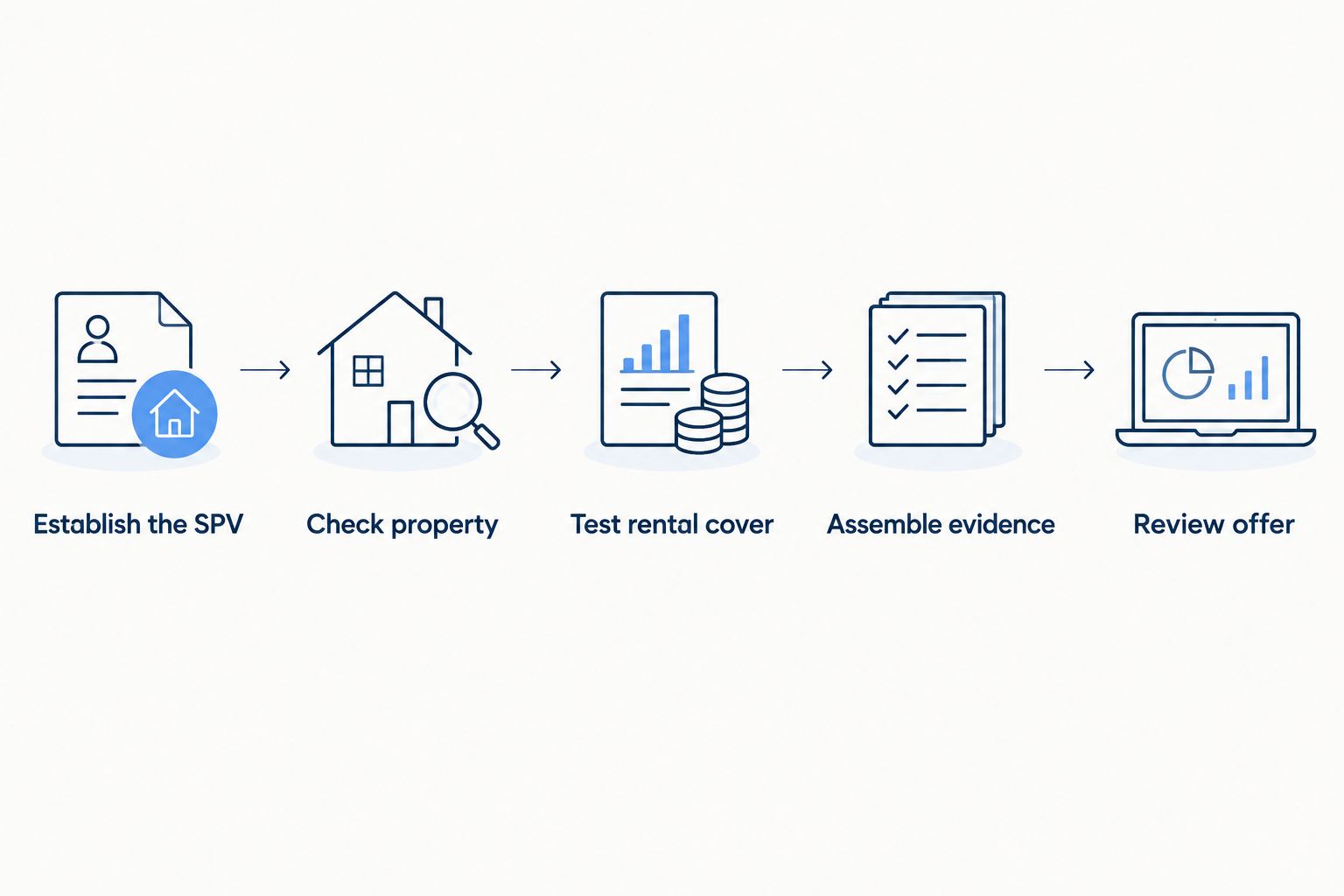
Coordinate the offer and legal work
A mortgage offer and a completed purchase are different milestones. The offer sets out the lender's approved terms and conditions; the conveyancer deals with the legal transfer and lender requirements. In 2026, keep the company purchaser and any guarantee arrangements under review until the transaction completes.
- Read the mortgage offer against the transaction. Check the company name, property, borrowing amount and any conditions. Ask your broker to explain anything that differs from the application rather than assuming the conveyancer can correct it later.
- Give the conveyancer the lender details. Confirm that the solicitor is instructed for the company purchase and can deal with the lender's requirements. Discuss any director guarantees or deposit arrangements the lender requires.
- Reconfirm changes before completion. If the property's use, ownership, rent or company control changes, tell your broker and conveyancer. They can determine whether the lender needs to reconsider its offer.
Expected result: the legal purchase and mortgage offer describe the same borrower and property. That consistency matters more than reaching an application milestone quickly and discovering an unresolved ownership issue at the end.
Transfer a personally owned buy-to-let to an SPV
Best for existing owners: treat a transfer into a company as its own transaction, not as an edit to your current mortgage. The company would become the proposed owner and borrower, while your personal ownership and any existing mortgage need to be dealt with legally. This is a different 2026 workflow from buying a new property through an SPV.
- Ask a tax adviser to assess the transfer. Give them the ownership history, proposed company ownership and property details. A transfer can have tax consequences even when you control both sides of the transaction.
- Check the existing mortgage. Ask your current lender or broker about the balance, redemption requirements and any early repayment charge that applies to your loan. Do not assume the existing mortgage can simply continue after the company takes ownership.
- Test a company mortgage on the existing property. Give the broker the current rent, tenancy position, estimated property value and company details. Lender acceptance and borrowing capacity still depend on the proposed company case.
- Coordinate the transfer and new lending. Ask the conveyancer how the ownership change, repayment of existing lending and proposed company mortgage would be completed. Proceed only when the tax, funding and legal routes are clear.
Expected result: you know whether a company purchase of your existing property is workable before asking the solicitor to start the transfer. If the figures or legal route do not work, keeping personal ownership remains an option to assess with your advisers; company ownership is not an automatic upgrade.
Troubleshoot the application
- The lender rejects the company activity. Check the company's registered activities and any unrelated trading before applying elsewhere. Ask your broker for lenders whose SPV criteria match the company as it actually exists; do not change records to misdescribe its business.
- The rental test supports less borrowing than expected. Confirm the rent evidence and the precise test used. Rework the proposed loan or assess another lender's current criteria rather than assuming a larger deposit alone answers every affordability question.
- The buyer name differs across documents. Stop and ask your broker and conveyancer which entity is meant to purchase. Correct the application or legal paperwork through the appropriate process before treating the mortgage offer as usable.
- Deposit funds came from a director. Explain the source and intended treatment to the broker, lender and conveyancer. Missing evidence or conflicting descriptions of the funds can hold up underwriting and legal checks.
- An existing mortgage complicates a transfer. Obtain the redemption information for the actual loan and have the conveyancer plan the transfer with the new borrowing. Do not estimate the outcome from the advertised terms of a different mortgage.
Customize your workflow
A landlord with several properties needs to disclose the wider portfolio early; a director with varied income needs the income evidence described accurately; an existing owner needs transfer advice before a remortgage application. These are different underwriting and legal questions, even when the proposed borrower is the same SPV.
For a 2026 company application, ask your broker to compare lender treatment of rental income, company structure and guarantees against the property you intend to mortgage. Buy-to-let mortgages based on rental income is the next guide when the rent, rather than incorporation, is the main borrowing constraint.
Heron Financial's fee-free, whole-of-market mortgage broking is useful when the case needs lender criteria checked together rather than one at a time. Its limitation is equally clear: Heron Financial cannot choose your tax structure for you or change the facts a lender and conveyancer must assess. Bring those advisers into the decision before you commit to an ownership route.
Discuss your SPV mortgage
Check your company, property and rental figures before applying.
FAQ
Can a new SPV apply for a buy-to-let mortgage in 2026?
Yes, a new SPV can apply with a lender that accepts its company structure and proposed property. The lender still checks the directors or guarantors, deposit, rent and property against its criteria.
Do I need to register the company before applying?
The proposed company borrower needs to be identifiable for a formal company mortgage application. Agree the ownership and activities with your advisers before registering it, then give the lender accurate company details.
Does a limited-company buy-to-let mortgage use rental income?
Yes, lenders assess the property's rent under their own rental-cover rules. The calculation and evidence requirements depend on the lender and the proposed loan.
Can I move my personal buy-to-let mortgage into my SPV?
No, changing ownership is not a simple change of name on a personal mortgage. Your advisers must assess the property transfer, existing lending, tax consequences and proposed company mortgage.
Will the directors need to guarantee the SPV mortgage?
That depends on the selected lender's criteria and the proposed company structure. Ask your broker which people the lender requires to give guarantees before submitting the application.
Is an SPV mortgage always better than buying personally?
No, the suitable ownership route depends on your tax position, legal transaction and available mortgage terms. Get tax advice on the structure and mortgage advice on the borrowing before committing to either.
What if the purchase contract names me rather than my company?
Tell your conveyancer and broker immediately if the SPV is intended to buy. They must check what needs changing so the legal purchaser and proposed mortgage borrower match.
One last thing
The most useful 2026 check happens before the lender application: read the proposed buyer's name on the purchase paperwork. If it differs from the company seeking the mortgage, resolve that issue with your conveyancer and broker first. A suitable rental figure cannot repair a transaction set up for the wrong borrower.


