
This page sets out UK mortgage search volume by borrower type in 2026: which borrower groups drive which search clusters, how their intent differs, and how to measure real volumes for your own market instead of relying on one blended figure.
- No public dataset publishes one average mortgage search volume by borrower type for 2026.
- First-time buyer and remortgage terms are broad head phrases; specialist borrower terms are narrow and specific.
- Measure volume per borrower cluster with Keyword Planner, Google Trends and Search Console.
- Heron Financial serves every borrower type in the table as a fee-free, whole-of-market mortgage broker.
Why this matters
Mortgage search demand is not one market. A first-time buyer typing 'how much can I borrow' and a company director searching 'mortgage based on retained profit' sit in different clusters, with different intent and different competition.
Blending them into one average hides the useful signal. Split demand by borrower type before you budget content or paid search. The cost side of the same split is covered in the mortgage keyword CPC benchmarks by loan type.
In 2026, the borrower types that search differently are the same ones lenders underwrite differently: first-time buyers, home movers, remortgagers, landlords, self-employed applicants, company directors, contractors, expats and high net worth clients.
Mortgage search demand by borrower type in 2026
The short answer: there is no single published average for mortgage search volume by borrower type in 2026. Volume sits at the keyword-cluster level, and each borrower type owns its own cluster with its own demand profile. The table below is the yardstick: who searches, what they type, what they want, and what moves their demand.
| Borrower type | Typical query cluster | Search intent | What moves demand | Volume profile |
|---|---|---|---|---|
| All borrowers (overall) | mortgage, mortgage broker, mortgage calculator, mortgage rates | Mixed research and comparison | Bank of England base rate decisions, house price news | Broad head terms |
| First-time buyers | first time buyer mortgage, how much can I borrow, Lifetime ISA mortgage | Early research, affordability | Stamp Duty relief rules, deposit schemes, rate moves | Broad, generic |
| Home movers | moving home mortgage, porting a mortgage, bridging loan | Transactional, time-bound | Housing chain activity, fixed-rate expiry dates | Moderate, specific |
| Remortgagers | remortgage deals, remortgage calculator, best remortgage rates | Comparison, switch-ready | Fixed-rate deals ending, rate changes | Broad, generic |
| Buy-to-let landlords | buy to let mortgage, limited company buy to let, rental cover | Commercial comparison | Tax rules on mortgage interest, rental yields | Moderate, specific |
| Self-employed applicants | self employed mortgage, mortgage with one year accounts, SA302 mortgage | Problem-solving, eligibility | Lender criteria changes | Niche, high intent |
| Company directors | director mortgage, mortgage on retained profits, dividend income mortgage | Problem-solving, eligibility | Salary and dividend structure, lender policy | Niche, high intent |
| Contractors | contractor mortgage, day rate mortgage | Eligibility | Contract type, IR35 status | Niche, high intent |
| Expats and foreign nationals | expat mortgage UK, mortgage for foreign nationals | Eligibility, lender search | Residency and visa status, currency income | Niche, specific |
| High net worth | large mortgage, private bank mortgage, interest only mortgage | Advisory, relationship-led | Asset structure, bonus and complex income | Narrow, very high value |
High and low: which borrower clusters lead
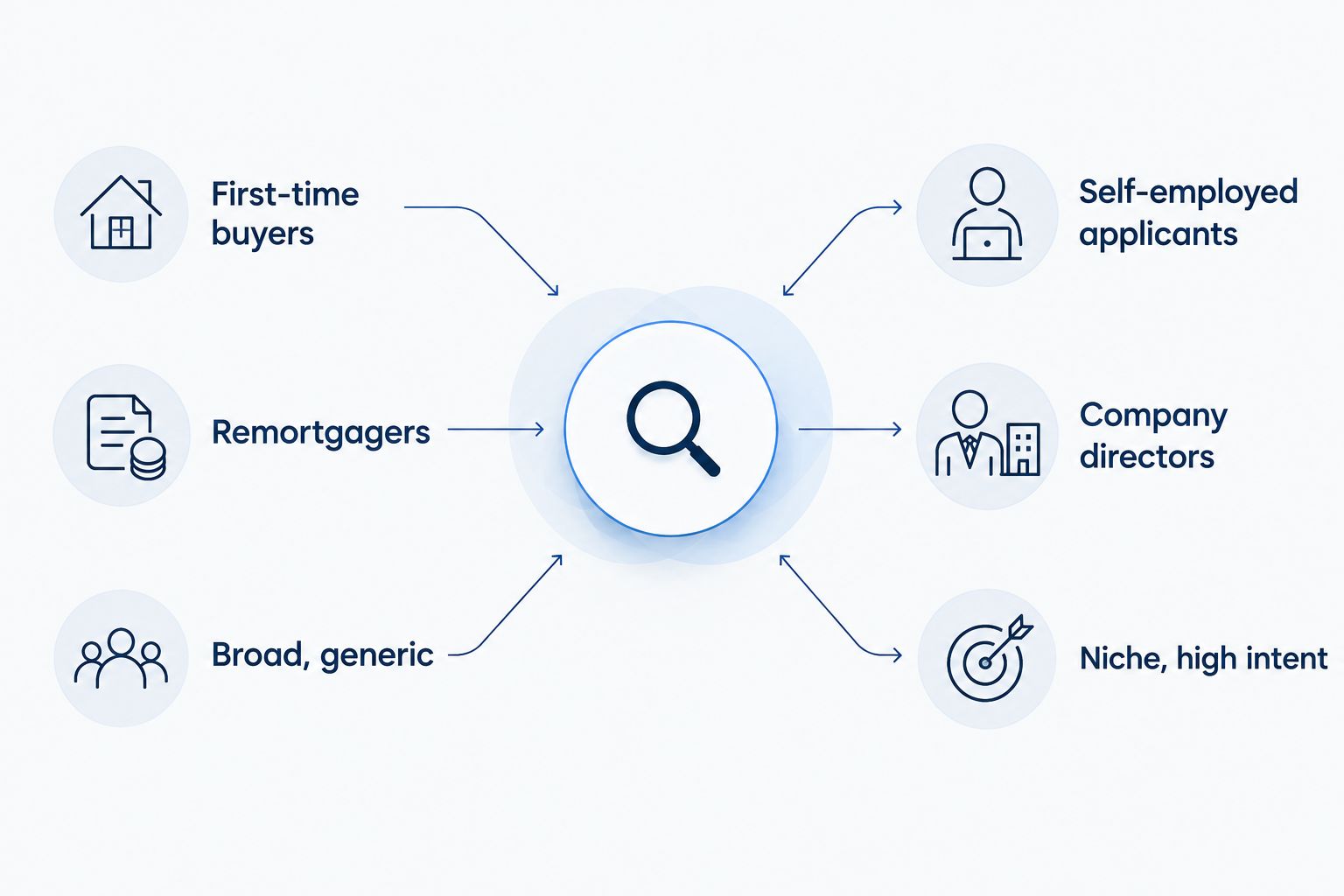
Generic clusters lead on reach; specialist clusters lead on intent. First-time buyer and remortgage queries are short, broad phrases that overlap with the overall head terms, so they capture the widest audience and the heaviest competition from banks, comparison sites and lenders.
Self-employed, company director, contractor and expat clusters trail on reach. The queries are longer and describe a specific problem ('mortgage with one year accounts'), which signals a searcher who already knows a standard bank application may fail.
High net worth searches are the narrowest cluster of all. They are also the most relationship-led: the query is often the first step toward a broker conversation rather than an online comparison.
For a whole-of-market mortgage broker, the specialist end of the table is where search intent and advice value line up most closely.
Methodology and limitations
The table maps each borrower type to its dominant query cluster, intent stage and demand drivers in the UK market for 2026. It does not publish absolute monthly volumes, because no current, citable dataset for this query breaks volume down by borrower type.
Named limitation: keyword tools group close variants and, in Google Keyword Planner, accounts without active ad spend see volume as ranges (for example 1K–10K) rather than exact figures. Any borrower-type volume you pull will be an estimate, and cross-cluster comparisons carry that error on both sides.
What drives demand in each borrower cluster
Each borrower cluster responds to its own triggers. Knowing the trigger tells you when to expect demand, even without a fixed volume figure.
First-time buyers
First-time buyer searches track affordability rules and deposit help. The Lifetime ISA pays a 25% government bonus on contributions of up to £4,000 a year, on homes costing up to £450,000, and generates its own search cluster around deposits.
Stamp Duty changes also move this group. From 1 April 2025, first-time buyer relief in England applies up to £300,000 rather than £425,000, a historical rule change that still shapes 2026 affordability searches.
Home movers and remortgagers
Both groups are driven by fixed-rate deals ending. When a fix expires, borrowers search for remortgage rates, porting rules and redemption penalties.
- Remortgagers compare rates and search for calculators.
- Home movers search for porting, bridging and chain timing.
- Both react quickly to Bank of England base rate decisions.
Buy-to-let landlords
Landlord searches follow tax and structure questions. The restriction of mortgage interest relief for individual landlords pushed demand toward limited company and SPV structures, which now form a distinct sub-cluster.
Rental cover and portfolio lending are the other recurring themes.
Self-employed applicants, directors and contractors
These clusters are driven by lender criteria. Most lenders ask for two years of SA302s or accounts; some accept one, and that difference alone generates a steady stream of eligibility searches.
Company directors search around salary-plus-dividends versus retained profit assessment. Contractors search around day-rate calculations and contract type.
Expats, foreign nationals and high net worth clients
Expat and foreign national searches centre on residency, visa status and income paid in another currency. The searcher is usually looking for any lender that will consider them, not the lowest rate.
High net worth searches cluster around large loans, private bank lending and interest-only options. Bonus income, acreage and multiple income streams are common features of these cases.
How to use these benchmarks
Plan content and budget by borrower cluster, not by one mortgage keyword. The table gives you the structure; your own tools give you the numbers.
- Pull volume per cluster. Run each borrower type's core terms through Google Keyword Planner and treat the result as a range, not a fact.
- Check timing with Google Trends. Trends scores interest from 0 to 100 relative to the peak in the period you choose, so it shows seasonality even when absolute volume is unclear.
- Validate with Search Console. Google Search Console keeps up to 16 months of your own impression data, which is the only first-party view of which borrower clusters already find your site.
- Weight specialist clusters by intent. A niche self-employed or director query often carries more advice value than a broad head term with far more searches.
The rule of thumb for 2026 is simple.
“Broad clusters win on reach; specialist borrower clusters win on intent.”
For a broker, that means building depth on the borrower types where a whole-of-market search changes the outcome: self-employed income, director income, landlord structures and complex high-value cases.
Heron Financial is a fee-free, whole-of-market mortgage broker for first-time buyers, home movers, remortgagers, landlords, self-employed applicants and company directors across the UK. It is best for borrowers whose income or property does not fit a standard bank application.
Speak to a whole-of-market broker
Fee-free mortgage and protection advice for first-time buyers, movers, landlords and directors.
FAQ
What is the average mortgage search volume by borrower type in 2026?
No public dataset publishes a single average for 2026. Volume sits at the keyword-cluster level, so each borrower type needs its own measurement in Keyword Planner and Google Trends.
Which borrower type searches most for mortgages?
First-time buyer and remortgage clusters are the broadest, because their queries overlap with generic mortgage head terms. Specialist clusters are narrower but carry higher intent.
Is search volume or search intent more important for mortgage keywords?
Intent matters more for advice-led businesses. A narrow query like mortgage with one year accounts signals a borrower who needs specialist help, while a broad term attracts browsers.
How do I find mortgage search volume for self-employed borrowers?
Enter the core self-employed terms into Google Keyword Planner and read the result as a range. Cross-check timing with Google Trends and your own Search Console impressions.
Why do remortgage searches rise and fall?
Remortgage searches follow fixed-rate deals ending and Bank of England base rate decisions. When fixes expire or rates move, borrowers start comparing deals.
Do buy-to-let landlords search differently from homeowners?
Yes. Landlords search around rental cover, tax treatment and limited company structures, which forms a distinct commercial cluster separate from residential queries.
Is a mortgage broker better than a bank for complex income?
A whole-of-market broker compares lenders a single bank cannot, which matters most for self-employed, director and high net worth income. Heron Financial works on a fee-free basis.
One last thing
The smallest clusters in the table often describe the borrowers with the most to gain from advice. A company director searching for a mortgage on retained profits has usually already been turned down or under-offered by a high-street bank, so that one search is worth more than dozens of generic rate checks in 2026.