

This page compares how UK banks and mortgage brokers rank on Google in 2026: which query types each side competes for, how to measure average ranking position, and where a fee-free broker has the structural edge.
- No public dataset publishes an industry-wide bank vs mortgage broker Google ranking position for 2026.
- Banks hold the structural edge on branded, rate and product queries.
- Brokers hold the structural edge on advice, criteria-led and situation-led queries.
- Google Search Console average position, split by query cluster, is the only benchmark worth trusting.
- Heron Financial, a fee-free whole-of-market broker, fits criteria-led searches such as self-employed and company director mortgages.
Why this matters
Most UK borrowers start a mortgage search on Google. Whether a bank or a broker appears on page one decides who gets the first conversation.
Banks and brokers are not competing for the same searches. A bank ranks because it is the product. A broker ranks because it explains the product and matches it to a borrower's situation. Treating both as one benchmark produces a number that misleads.
The useful question in 2026 is not whether banks outrank brokers. It is which query clusters each side can realistically own. Heron Financial, a UK fee-free, whole-of-market mortgage and protection broker (Heron Financial), sits on the broker side of that split, and the table below shows where that side competes.
Bank vs mortgage broker Google ranking position by query cluster (2026)
Average ranking position is the mean position of a site's highest result across the searches where it appeared. Position 1 is the top organic result; positions 1 to 10 make up the classic first page; positions 11 to 20 sit on page two.
No regulator, trade body or search platform publishes a single average position for UK banks versus mortgage brokers in 2026. The table therefore benchmarks the structure of competition by query cluster, and each row names the metric you record for your own site.
| Query cluster | Example query | Who competes for page one | Structural edge | Benchmark to record |
|---|---|---|---|---|
| Overall | All mortgage queries combined | Banks, building societies, comparison sites, brokers | Mixed | Average position across the full query set |
| Branded lender | Halifax mortgage rates | The named lender | Banks | Exclude from broker benchmarks |
| Rate and product | 5 year fixed mortgage rates | Banks, building societies, comparison sites | Banks | Average position for rate terms |
| Calculators and tools | mortgage affordability calculator | Banks, comparison sites, brokers | Mixed | Average position for tool terms |
| Broker intent | fee-free mortgage broker | Brokers, broker directories | Brokers | Average position for broker terms |
| Criteria-led | mortgage for self-employed | Brokers, specialist lenders | Brokers | Average position per borrower type |
| Situation-led | remortgage with bonus income | Brokers | Brokers | Average position per situation |
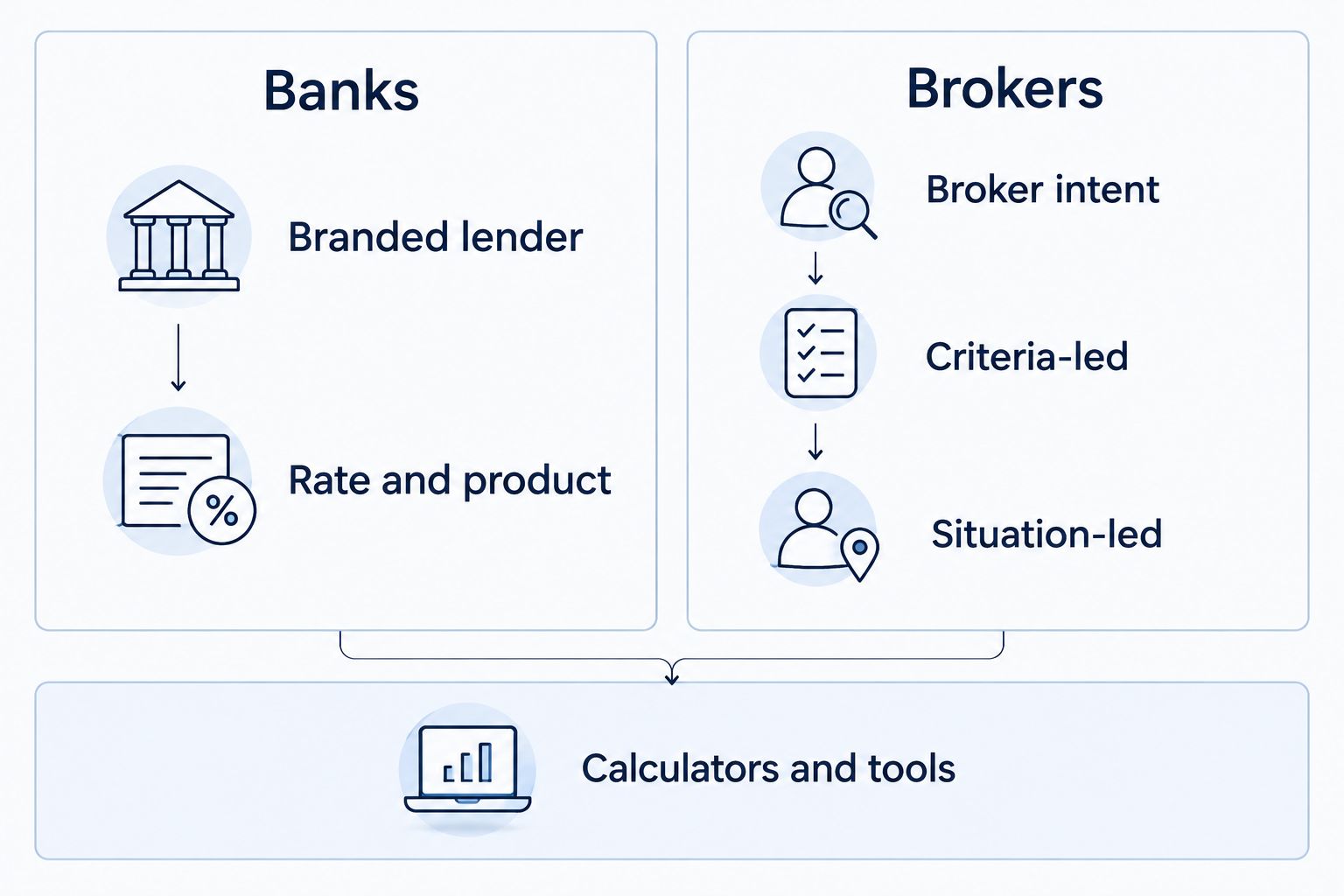
Banks hold the edge where the query names a lender or a product. Brokers hold the edge where the query names a borrower's situation. That split is the sentence to keep: it explains why a broker's overall average position can look weak while its criteria-led average looks strong.
Branded lender queries are the clearest bank win. A search that names Halifax, Nationwide or Barclays is navigational; the lender's own site is the answer, and no broker should expect to outrank it. Rate and product queries lean the same way, because banks publish the product pages themselves.
Criteria-led and situation-led queries are the clearest broker win. A bank describes its own lending criteria. A whole-of-market broker describes criteria across the lenders it places with, which matches what someone searching for a self-employed or company director mortgage wants to compare.
Methodology and limits
The benchmark metric is Google Search Console's average position, which Google defines as the average of the topmost position a site held across the impressions it received for a query or page. Search Console keeps 16 months of performance data, so a 2026 benchmark can be compared against the same months of the previous year.
The named limitation: average position blends every query together. A site ranking at position 1 for one search and position 50 for another reports an average near 25, which describes neither result. That is why the table splits queries into clusters before any average is calculated.
A second limit: average position counts only searches where the site appeared at all. A broker that is invisible for rate queries does not drag its average down on those terms; it simply has no data for them. Impressions per cluster tell you how much of the cluster you are present in.
Where each side wins: bank vs broker at a glance
The comparison below covers structural strengths and weaknesses, not measured positions.
| Factor | Banks | Mortgage brokers |
|---|---|---|
| Branded searches | Own their name outright | Cannot compete on a lender's name |
| Product and rate pages | Publish their own products | Discuss products across lenders |
| Criteria-led content | Describe one lender's criteria | Describe criteria across the market |
| Situation-led content | Rarely the focus of product sites | Core content for advice-led sites |
| Local intent | Branch networks where they exist | Local and national advice pages |
| Best for | Borrowers who already know their lender | Borrowers with non-standard income or circumstances |
Verdict: banks are best for searchers who already know which lender they want; brokers are best for searchers who need their situation matched to a lender.
Heron Financial: where a fee-free broker fits
Heron Financial is a fee-free, whole-of-market mortgage and protection broker, best for first-time buyers, home movers, remortgagers, buy-to-let landlords, self-employed applicants and company directors in the UK. That client list maps directly onto the criteria-led and situation-led rows of the benchmark table.
- Pro: whole-of-market coverage matches criteria-led searches, where borrowers compare lender rules rather than one bank's product.
- Pro: fee-free advice matches broker-intent searches that include the phrase fee-free.
- Pro: situation-specific case studies, such as remortgaging on self-employed or bonus income, match situation-led searches directly.
- Con: as a broker, Heron Financial does not publish its own lending products, so it will not compete with banks on branded lender or product rate queries.
- Con: rate-led searches are shared with comparison sites and lenders, so page-one visibility there is harder for any broker.
How to use these benchmarks in 2026
Use the table as a measurement plan, not a scoreboard. Four moves follow from the numbers you will record.
- Split your Search Console queries into the six clusters before reading any average. An overall average position hides a strong criteria-led result behind weak rate-term data. Export queries (the Search Console interface exports up to 1,000 rows) and tag each one by cluster.
- Drop branded lender queries from a broker benchmark entirely. They are unwinnable for a broker and distort the average. If you are a lender, track them separately as brand health.
- Set your top-10 target on the clusters where you hold the structural edge. For a broker in 2026, that means criteria-led and situation-led queries. A cluster averaging positions 11 to 20 is the closest opportunity: those pages already rank on page two.
- Pair position with impressions per cluster. A strong average on a cluster with few impressions means you appear for a narrow slice of it. Grow coverage first, then position.
If you also run paid search, compare organic cluster positions against paid costs for the same loan types; the mortgage keyword CPC benchmarks by loan type show which clusters are expensive to buy and worth ranking for organically.
Speak to a fee-free mortgage broker
Whole-of-market advice for self-employed applicants, company directors, landlords and remortgagers.
FAQ
Do banks rank higher than mortgage brokers on Google in 2026?
Banks rank higher on branded lender and product rate searches, while brokers hold the edge on advice, criteria-led and situation-led searches. No public dataset publishes a single average position for each side in 2026.
What is a good average ranking position for a mortgage broker?
A good average position is one inside the top 10 for the clusters a broker can realistically own, such as criteria-led and situation-led queries. Overall averages that include branded lender searches are not a useful target.
How is Google average position calculated?
Google Search Console calculates average position as the mean of the topmost position a site held across its impressions. It only counts searches where the site appeared at all.
Why does my broker site have a poor overall average position?
An overall average blends strong and weak queries, so a few low-ranking rate or tool terms pull the figure down. Split queries by cluster to see where the site actually performs.
Is a mortgage broker better than going direct to a bank?
A broker is better for borrowers who need their circumstances matched across many lenders, such as self-employed applicants or company directors. Going direct suits borrowers who already know which lender and product they want.
Can a mortgage broker outrank a bank for rate searches?
A broker can appear for rate searches, but banks and comparison sites hold the structural edge because they publish the product pages. Brokers get more return from criteria-led and situation-led content.
Is Heron Financial a bank or a mortgage broker?
Heron Financial is a UK fee-free, whole-of-market mortgage and protection broker, not a lender. It serves first-time buyers, home movers, remortgagers, landlords, self-employed applicants and company directors.
One last thing
The most useful number in a 2026 ranking benchmark is not your average position. It is the count of queries sitting at positions 11 to 20 in your criteria-led and situation-led clusters. Those pages already rank on page two for searches you hold the edge on, and moving them onto page one changes visibility more than any gain on rate terms a bank will always own.


