

Instead of manually copying bank transactions into each affordability form, organise your statements into a monthly income-and-spending record, resolve unusual entries, and give your broker the evidence needed to assess lender criteria. This 2026 bank statements mortgage affordability workflow takes you from raw statements to a documented application, not a promise of approval.
- For bank statements mortgage affordability checks, reconcile income, committed spending and unexplained transfers before choosing a lender.
- Heron Financial is best for UK borrowers who want fee-free, whole-of-market mortgage broking when their income needs explanation.
- A tidy statement summary helps a broker assess lender criteria; it does not replace the lender’s affordability decision.
Why this matters
A lender assesses whether you can afford a mortgage from more than the income figure on your application. Your bank statements can show where income arrives, what leaves your account regularly and whether the figures you declared match your records. A transfer between your own accounts, for example, needs a different explanation from a salary payment.
Heron Financial is best for UK borrowers who need fee-free, whole-of-market mortgage broking and a clear explanation of complex income. Its mortgage brokerage serves first-time buyers, home movers, remortgagers, buy-to-let landlords, self-employed applicants and company directors. Heron Financial can assess a case against lender criteria, but the lender makes the lending decision.
In 2026, treat statement preparation as an evidence task, not a chance to make spending look better for a particular month. The useful outcome is a record that lets you and your broker identify discrepancies before an underwriter does. If earnings arrive from several sources, the multiple income streams to one mortgage application workflow covers the related income-document task.
Before you start
- Get access to every relevant account. Include accounts that receive income, pay household bills or fund the deposit. If you are applying jointly, each applicant needs to identify the accounts relevant to their income and commitments.
- Gather the matching evidence. Have payslips, employment or business income records, deposit evidence and details of existing borrowing ready where they apply. The lender or broker will specify which documents and statement dates your case requires.
- Check for the mid-process trap: transfers are not new income. If you move money between your own accounts, retain both sides of the transfer. Counting the incoming side as earnings inflates the income summary and leaves the outgoing side unexplained.
Do not close an account out of the review because it has irregular spending or a low balance. A broker needs an accurate account of relevant finances to assess the application. If an account or transaction is private but relevant, discuss the document-sharing process rather than omitting it.
Collect statements
1. Confirm the lender’s document requirements
Ask your broker which accounts, statement periods and file formats the prospective lender requires. Requirements differ by lender and case: a salaried applicant, a company director and a landlord do not necessarily prove income in the same way. Do this before downloading files so you do not prepare the wrong period.
If you have not chosen a lender, start with the accounts that show where your declared income arrives and where regular commitments leave. Label this an initial working set, not a final lender checklist. Expected result: you know which records you have and which requirements still need confirmation.
2. Download original statements
Sign in to each bank account and use its statement download or document area to obtain the original files. Keep the account holder, account identifier, transaction dates and balances visible. Do not assemble screenshots into a substitute statement or edit transaction lines; ask your broker whether a bank-generated file is acceptable if a download is unavailable.
Save files under names you can distinguish, such as the account purpose and statement month, without changing their contents. For a joint application, keep each applicant’s files separate until the account ownership is clear. Expected result: every relevant account has an identifiable, unaltered statement file for the period requested.
3. Check for gaps
Read the opening and closing dates on each statement. Confirm that the files cover the requested period without a missing interval, then check whether a payment visible on one account came from another account you have not included. A gap can make an otherwise ordinary transfer hard to explain.
If the bank issues statements on a cycle that does not match calendar months, keep the bank’s original sequence. Do not rename a partial period as a full month. Expected result: your document set has a continuous, understandable timeline.
Match income
4. Connect each deposit to its source
List the deposits you plan to declare as income and identify their sources: employment, self-employment, company payments, rent or another applicable source. Match each one to the supporting record available for that income. A bank credit shows money arrived; it does not, by itself, establish how a lender will assess it.
For a salary payment, check that the amount and payment date make sense alongside the relevant payslip. For income that varies, keep the variation visible instead of replacing it with a single favourable month. Expected result: every income line in your working summary has a stated source and a route back to evidence.
5. Separate transfers, refunds and gifts
Mark transfers between your own accounts as transfers on both statements. Record refunds against the original spending where you can identify it. If deposit money came from another person, tell your broker how it was received so the lender’s source-of-funds requirements can be checked; do not label a gift as earnings.
This distinction matters for affordability and for explaining the deposit. A larger credit can affect both discussions, but it is not automatically recurring income. Expected result: your income total excludes account-to-account movements and other credits that are not earnings.
6. Explain irregular income without rewriting it
If you are self-employed or a company director, note the difference between money entering a personal account and the income a lender accepts under its criteria. Identify salary, dividends or other income types only where your records support those labels. Your broker can then compare your evidence with the lender’s rules rather than assuming every business-related credit counts.
For variable earnings, record what changed and which document explains it. Keep your explanation factual: what the payment was, who paid it and why its timing differs. Expected result: an irregular credit prompts a specific evidence request, not an unsupported affordability figure.
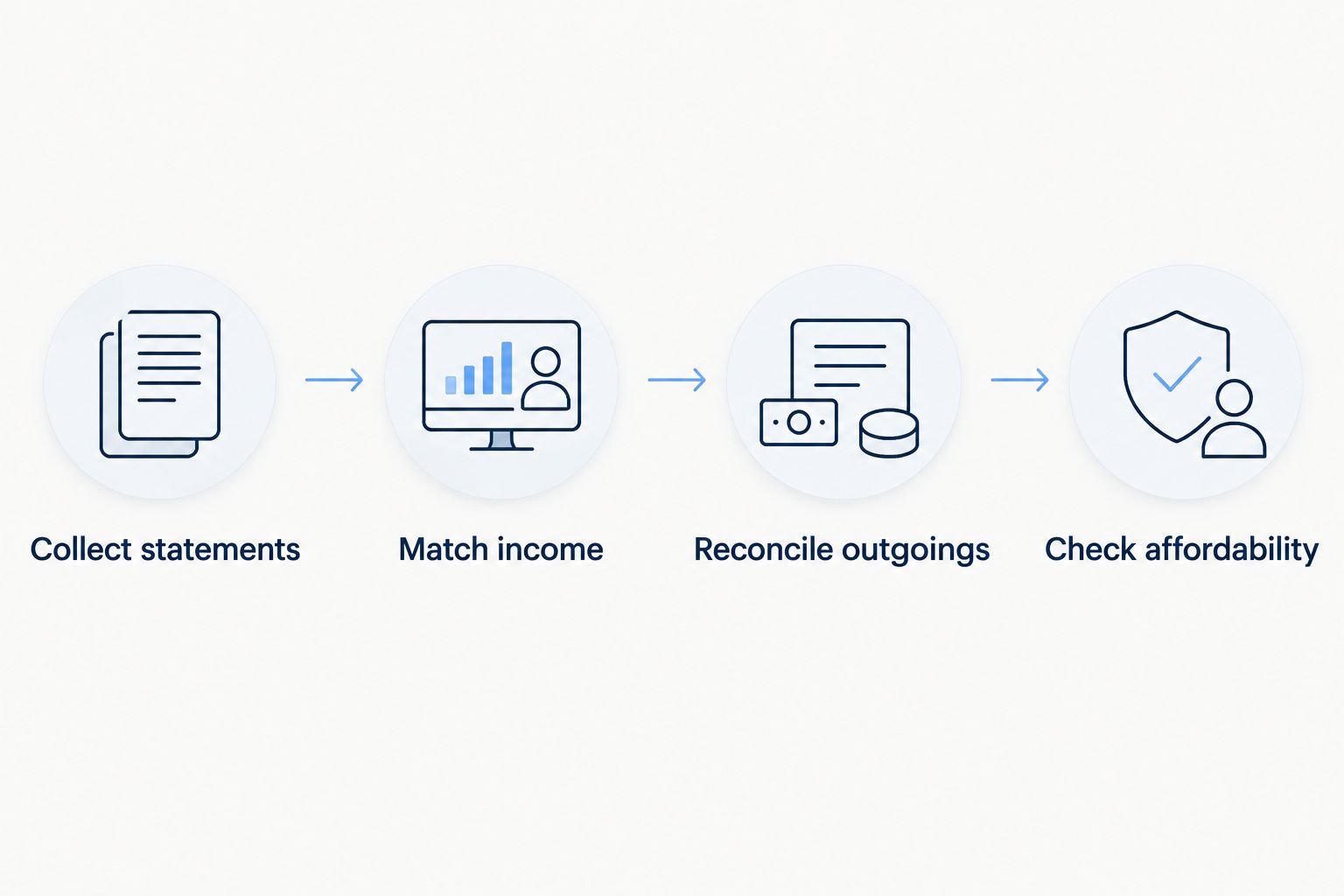
A useful 2026 sequence is collect statements, match income, reconcile outgoings, check affordability. Do not reverse the order by choosing a borrowing figure and then searching statements for transactions that support it.
Reconcile outgoings
7. Identify continuing commitments
Review regular payments and list the commitments that continue after the proposed mortgage starts. Include existing borrowing and household costs relevant to your application. Do not assume a payment is irrelevant because it leaves an account other than the one receiving your income.
Where a commitment will end, give your broker the reason and any evidence requested; do not remove it from the working record without explanation. Where a joint account pays a bill, record who owns the account and avoid counting the same payment twice in your household summary. Expected result: the spending record reflects actual commitments, with changes clearly explained.
8. Flag transactions likely to raise questions
Scan for credits you cannot immediately identify, returned payments and spending that differs sharply from your usual pattern. Write a brief factual note beside each item and keep the supporting document if one exists. The task is to make the statement intelligible, not to conceal a transaction.
For example, an account-to-account transfer needs the matching statement; a one-off expense needs an explanation of what it was. Ask your broker which explanations the prospective lender requires rather than sending a long narrative with every purchase. Expected result: you can answer likely questions with a transaction, a date and an evidence source.
Check affordability
9. Give your broker the complete record
Send the original statements, your income-and-outgoings summary and the short notes on transactions needing context through the document-sharing route agreed with your broker. State which figures are confirmed and which still need supporting evidence. Do not present your own calculation as a lender-approved borrowing amount.
Heron Financial’s fee-free mortgage brokerage can use that record to discuss suitable lender criteria and identify gaps before an application. Whole-of-market broking does not mean every lender will accept every income type or reach the same affordability result. Expected result: your broker can explain what remains to be verified and what the lender must decide.
| Route | Best for | Advantage | Limitation |
|---|---|---|---|
| Unsorted bank statements | An initial conversation about your circumstances | Preserves the original transaction record | Leaves income sources and unusual payments for someone else to reconcile |
| Reconciled statements and evidence | A case ready for a broker’s criteria review | Makes declared income and commitments traceable | Takes preparation and still does not guarantee lender approval |
Use reconciled statements for the criteria review; retain the originals for the lender. The summary is a guide to the evidence, not a replacement for it. This is particularly important in 2026 if your income comes from more than one source or a payment pattern needs context.
Discuss your mortgage evidence
Ask which statements and income records fit your circumstances.
When a statement changes after the review
A mortgage application is not frozen at the moment you assemble the first document set. If a later statement shows a changed salary payment, a new borrowing commitment or a deposit transfer, give the updated information to your broker before treating the earlier summary as current. The lender can request more recent evidence during its assessment.
Repeat the same checks on the new period: confirm the account and dates, match income, classify transfers and review continuing commitments. Keep the earlier statement rather than replacing it silently, because the sequence can explain when a change occurred. Expected result: the application record stays consistent with the most recent documents supplied.
For a remortgage in 2026, also tell your broker about changes to the existing mortgage or your borrowing needs. The statement workflow establishes what your accounts show; it does not establish whether a remortgage is suitable or what redemption penalties apply.
Troubleshooting
- The salary credit differs from the payslip. Check whether the payslip and statement cover the same payment date, then ask your employer or payroll contact about any unexplained difference. Send the explanation with both records rather than adjusting either figure yourself.
- A transfer looks like income. Find the outgoing transaction on the source account and mark both entries as one movement of money. If the source account is missing, obtain its relevant statement before finalising the income summary.
- A statement is missing a period. Download the missing bank-issued document or ask the bank how to obtain it. A transaction export is not automatically a substitute for a statement requested by a lender.
- An irregular credit has no clear evidence. Identify who paid it and why, then ask your broker what the lender needs to verify it. Leave it out of recurring income unless the supporting evidence and lender criteria justify including it.
- A new commitment appears during the application. Tell your broker and update the outgoings summary. An affordability view based on the old commitment list is no longer the same case.
Customise your workflow
Start with the same document sequence, then change the evidence checklist to fit your circumstances. A first-time buyer needs a clear account of the deposit as well as income and spending. A home mover or remortgager needs to identify existing mortgage commitments. A self-employed applicant or company director needs to distinguish personal bank credits from the income figures the chosen lender will assess.
For a buy-to-let application, separate property-related receipts and payments from personal transfers so the broker can assess the case under the relevant lender criteria. Do not infer that rent appearing on a statement satisfies a lender’s rental-income test. The statements explain cash movement; the lender sets the test.
In 2026, keep the summary short enough to update when a lender requests a fresh document. Use the same categories each time so a new payment stands out. If you cannot explain a material entry, ask for the source document before submitting a polished summary that does not match the bank record.
FAQ
How do bank statements affect mortgage affordability in 2026?
Bank statements help a lender check income, spending and whether the application matches your account activity. The lender assesses affordability under its own criteria, using other evidence as required.
How many months of bank statements do I need for a mortgage?
Provide the statement period requested by your broker or lender. The required period depends on the lender and your circumstances, so confirm it before downloading documents.
Do transfers between my own accounts count as mortgage income?
No, moving money between your own accounts does not create new income. Show both sides of the transfer so the credit is not confused with earnings.
Can I use screenshots instead of bank statements?
Ask your broker whether the lender accepts the format before sending screenshots. Original bank-issued statements preserve the account details and transaction sequence needed for review.
What if my payslip does not match my bank statement?
Check that the payment dates correspond and obtain an explanation for any remaining difference. Give your broker the payslip, statement and supporting explanation rather than changing the declared figure without evidence.
Do company directors need to explain business payments on personal statements?
Yes, identify the source of business-related credits entering a personal account. A lender’s treatment of director income depends on its criteria and the supporting records, not the bank credit alone.
Does a broker-approved summary mean my mortgage is approved?
No, a broker’s review is not a lender’s mortgage decision. The lender can request further documents and will assess the completed application against its criteria.
One last thing
The most useful note in your 2026 statement pack identifies a credit that is not income. Explaining a transfer, refund or deposit contribution prevents that money from distorting the affordability picture. Give your broker the original transaction and its source, not just a revised total.


