

Yes, you can get a green mortgage for an existing home: these mortgages are not restricted to new builds. Eligibility depends on the lender’s criteria, with some products requiring an Energy Performance Certificate (EPC) rating of A or B. An eligible property does not guarantee mortgage approval, and a green-labelled deal is not automatically the cheapest overall choice.
- A green mortgage existing home application is possible; new-build status is not a universal requirement.
- An EPC rating of A or B meets the energy requirement for some green mortgages, not every lender’s criteria.
- Compare green mortgages with standard mortgages on total borrowing cost, not the green label alone.
- Energy improvements need acceptable evidence; planned work is not the same as an existing qualifying EPC.
Can I get a green mortgage for an existing home, not just new build?
Yes. The key distinction is the home’s qualifying energy performance, not simply when it was built. An older property with an acceptable EPC can qualify for a green mortgage that permits existing homes. A newly built property still needs to satisfy the particular product’s requirements.
Heron Financial provides fee-free, whole-of-market mortgage advice for UK borrowers. For a 2026 application, check the current product criteria rather than assuming every mortgage described as green accepts the same properties.
| Mortgage route | Best for | Main advantage | Main limitation |
|---|---|---|---|
| Green mortgage for an efficient home | Buying or remortgaging an existing property with a qualifying EPC | Recognises the home’s existing energy performance | Energy eligibility does not replace affordability or property checks |
| Standard mortgage | Borrowers whose home or circumstances do not fit green criteria | Does not depend on qualifying for a green incentive | Does not necessarily reward energy efficiency |
| Energy-improvement borrowing | Homeowners planning eligible efficiency work | Can provide a route to funding improvements | Borrowing conditions and evidence requirements differ from an efficient-home mortgage |
These are different routes, not interchangeable promises. Use the green mortgage deals guide alongside a comparison of ordinary mortgages; excluding standard deals can hide the better overall option.
Why this matters
A property’s age is an unreliable shortcut for mortgage eligibility. Refurbishment can improve an older home’s energy performance, while a property description such as recently modernised does not establish its EPC rating.
The distinction matters when you are buying. You need evidence for the property you intend to mortgage, not an assumption based on double glazing, a new boiler or the seller’s description.
It also matters when you already own the home. A better EPC does not automatically change the terms of your existing mortgage. You need to establish whether a qualifying product is available and whether changing arrangements makes financial sense.
Existing homes with an EPC rating of A or B
An EPC rating of A or B is a common eligibility threshold for mortgages that reward an already energy-efficient home. It is not a universal rule: the lender’s published criteria determine the required rating, acceptable evidence and eligible transactions.
For domestic EPCs in England and Wales, band B covers 81–91 EPC points, while band A covers 92–100 EPC points. These are energy-efficiency scores, not mortgage approval scores or predicted savings on your bills.
EPCs are normally valid for 10 years, but an unexpired certificate can describe the property before subsequent improvements. Check the certificate’s address, assessment date and rating, and confirm what evidence the lender accepts for your 2026 application.
Do not confuse the current rating with the potential rating. The potential rating describes the assessed outcome of recommended improvements; it does not prove that those improvements have happened.
Recommendation: use the recorded current rating when checking initial eligibility. If the home has changed since assessment, establish whether a fresh EPC is needed before relying on the improvements.
Existing homes below the qualifying EPC threshold
A home below a particular green mortgage’s threshold is not automatically unmortgageable. You can still consider standard mortgages, subject to the lender’s normal assessment of you and the property.
The question then changes: are you seeking a mortgage for the home as it stands, or borrowing to improve it? A product for an already efficient property and borrowing intended for energy improvements serve different purposes.
Do not assume planned insulation or a heating upgrade qualifies you immediately for an efficient-home mortgage. The lender needs the evidence specified in its criteria, at the required stage of the application.
Before committing to work, establish:
- Which improvements the borrowing arrangement accepts.
- Whether approval depends on the current EPC or a later assessment.
- What installation or completion evidence is required.
- Whether the additional borrowing remains affordable.
The disadvantage of financing improvements through a mortgage is that you are adding secured debt. Assess the work on its own merits, not solely as a way to obtain a green mortgage incentive.
Buying an existing home with a green mortgage
When buying an existing home, start with the property’s EPC rather than its construction date. Obtain the certificate early enough to include energy eligibility in your mortgage search.
You still need to pass the lender’s affordability assessment and meet its deposit, credit and property requirements. An efficient house does not compensate for insufficient income or a property the lender will not accept as security.
Keep the EPC and mortgage valuation separate. The EPC assesses energy performance; the lender’s valuation serves a different purpose and does not guarantee that the property meets a green product’s conditions.
For a 2026 purchase, ask when the lender needs the EPC evidence and whether the property must qualify at application or another specified stage. That prevents you from treating unfinished improvements as an established feature of the home.
Recommendation: confirm property eligibility before choosing a mortgage solely for its green incentive. Keep a suitable standard mortgage in the comparison so that energy criteria do not narrow your search unnecessarily.
Remortgaging an existing home with a green mortgage
You do not have to move home to explore a green mortgage. Remortgaging an existing property is a separate transaction, and eligibility depends on whether the selected product accepts remortgages and your home meets its conditions.
Check the mortgage you already have before selecting a replacement. Early repayment charges, product terms and the timing of your current deal can affect whether switching is sensible.
Compare the replacement over the same period and on the same repayment basis. Include arrangement charges and any relevant legal, valuation or exit charges, rather than comparing the interest rate alone.
If you have improved the home, check whether the available EPC reflects the completed work. A lender cannot treat an unrecorded improvement as a qualifying rating simply because you describe it in the application.
Recommendation: coordinate the EPC check with your remortgage planning. Do not leave evidence gathering until you have already settled on a product whose eligibility remains uncertain.
Why green mortgage eligibility varies
There is no single set of green mortgage criteria covering every lender. In 2026, check these factors against the actual product you are considering:
- Energy threshold: the required EPC rating or other stated energy-performance condition.
- Transaction type: whether the product accepts purchases, remortgages or other specified borrowing.
- Property use: whether the criteria cover an owner-occupied home, a rental property or another permitted use.
- Loan-to-value: whether your deposit or equity places the application within the product’s lending limits.
- Borrower assessment: whether your income, commitments and credit history meet the lender’s requirements.
- Evidence timing: which documents establish eligibility and when they must be supplied.
These factors work together. Meeting the energy threshold answers only the energy question; it does not settle the rest of the application.
For an older or unusual property, confirm that the lender accepts the property itself as well as its EPC. Energy performance and mortgageability are separate checks.
How do I check whether my existing home qualifies?
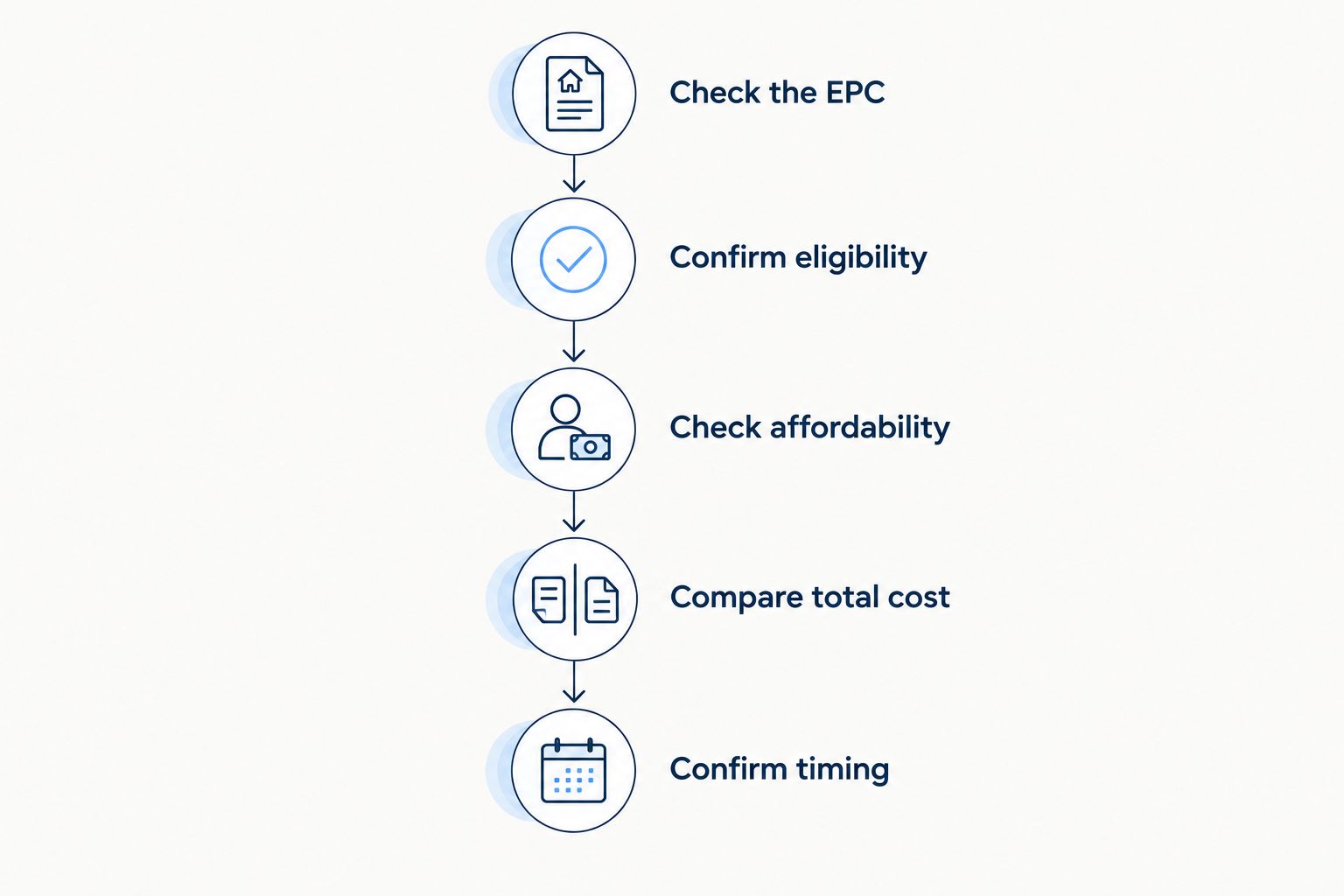
Use this sequence before committing to a green mortgage application. It separates the evidence you already have from the conditions that still need confirming.
- Check the EPC. Find the correct certificate and distinguish its current rating from its potential rating. Confirm that it relates to the property you intend to mortgage.
- Confirm eligibility. Match the evidence to the selected product’s energy threshold, property rules and transaction type. Do not rely on the word green alone.
- Check affordability. Prepare the income and commitment information needed for the lender’s assessment. Energy eligibility does not reduce the need to demonstrate affordable repayments.
- Compare total cost. Assess green and standard mortgages over a consistent period, including relevant charges and existing mortgage exit terms.
- Confirm timing. Establish when the EPC and any improvement evidence are required, and coordinate the application with your purchase or current mortgage arrangements.
A useful outcome is not just an eligible property. It is an eligible mortgage that fits your circumstances and compares favourably with the alternatives.
Is a green mortgage always better than a standard mortgage?
No. A green mortgage is better only when its overall terms suit you more than the available alternatives. The label describes an energy-related feature, not a guarantee of the lowest total borrowing cost.
Compare equivalent loan amounts, repayment types and assessment periods. Otherwise, an apparent advantage can reflect a different mortgage structure rather than a genuinely better deal.
Product flexibility matters too. Consider overpayment conditions, early repayment charges and whether the arrangement fits your plans to move or make further changes to the property.
Heron Financial is best suited to UK borrowers seeking fee-free, whole-of-market mortgage advice. The benefit is a broader mortgage comparison; the limit is that advice cannot override a lender’s affordability, property or energy criteria.
Do energy improvements guarantee green mortgage approval?
No. Completed improvements do not guarantee either a qualifying EPC rating or mortgage approval. The resulting assessment and the lender’s criteria determine whether the work supports eligibility.
Before ordering work, distinguish the improvement you want from the rating you hope to achieve. A recommendation on an EPC is not a promise that one measure alone will deliver the required band.
For a 2026 renovation plan, confirm the evidence route before linking the project to mortgage finance. Retain the relevant completion documents, and arrange any assessment required by the borrowing conditions.
Avoid committing to a renovation solely on the assumption that a mortgage incentive will cover its cost. Improvements and borrowing should each make sense independently.
Can self-employed borrowers get a green mortgage?
Yes. Self-employment does not, by itself, exclude you from a green mortgage. You still need a lender that accepts your income evidence, alongside a property that meets the energy criteria.
Keep the two assessments separate. An EPC establishes information about the home; accounts and other accepted income documents support the affordability assessment.
Company directors and borrowers with complex income should check the lender’s income approach before prioritising a green incentive. The right energy rating does not make an unsuitable income assessment suitable.
FAQ
Can I get a green mortgage on an old house?
Yes, an old house can qualify if the selected green mortgage accepts existing properties and the home meets its energy criteria. Its construction date alone does not determine eligibility.
Does my existing home need an A or B EPC rating?
An A or B EPC rating is a common requirement for mortgages rewarding an already efficient home, but it is not universal. Check the particular lender’s threshold and evidence requirements.
How long is an EPC valid for a mortgage application?
An EPC is normally valid for 10 years. The lender’s evidence rules still apply, and an older certificate might not reflect improvements completed since assessment.
Can I use the potential EPC rating to qualify?
Do not treat the potential EPC rating as the home’s current rating. It describes the assessed result of recommended improvements, not proof that the work has been completed.
Can I remortgage to a green mortgage without moving?
Yes, provided the selected product accepts remortgages and both you and the property meet its criteria. Check your existing mortgage’s early repayment charges before switching.
Is a green mortgage guaranteed to save me money?
No, a green mortgage is not guaranteed to reduce your total borrowing cost. Compare it with standard mortgages over the same period, including relevant charges.
Can Heron Financial help compare green and standard mortgages?
Heron Financial provides fee-free, whole-of-market mortgage advice for UK borrowers. Any recommendation remains subject to the lender’s eligibility assessment and your individual circumstances.
One last thing
The most useful detail on an EPC is often the distinction between current and potential performance. Reading the wrong column can turn an apparently eligible home into an application that does not meet the selected product’s requirements.
Before choosing a mortgage in 2026, put the current EPC, proposed borrowing and existing mortgage terms side by side. Heron Financial’s mortgage advice can help you compare the borrowing routes; a green label should never replace that comparison.


