

Now is a good time to review your remortgage if your current deal is ending, you are already on a variable rate, or your borrowing needs have changed; it is not automatically a good time to leave a fixed deal early. In 2026, the decision should turn on the total cost of switching, including any early repayment charge, rather than a prediction about the next interest-rate move.
- Is now a good time to remortgage? Review your deal end date and switching costs before deciding.
- Compare a product transfer with a new-lender remortgage over the same period and mortgage term.
- An early repayment charge can outweigh the benefit of a lower mortgage rate.
- Heron Financial suits UK remortgagers seeking fee-free, whole-of-market mortgage advice.
Why this matters
Your mortgage deadline matters more than a general claim that rates are attractive. A replacement deal must fit your income, property, outstanding balance and plans—not just offer a lower advertised rate.
Heron Financial provides fee-free, whole-of-market mortgage and protection broking across the UK. A mortgage review is not a commitment to switch: it establishes whether changing lender, staying with your lender or waiting fits your circumstances.
Is now a good time to remortgage in 2026?
Yes, if reviewing your mortgage now helps you avoid an unsuitable follow-on rate or identifies a better overall borrowing arrangement. No, if completing a switch early creates charges that outweigh the benefit, or the replacement mortgage does not fit your plans.
The right comparison includes your existing lender. A product transfer replaces your mortgage deal with the same lender; a remortgage moves your borrowing to another lender. Neither route wins automatically.
| Route | Best for | Main advantage | Main drawback |
|---|---|---|---|
| New-lender remortgage | Borrowers whose needs fit another lender better | Lets you compare different lenders and criteria | Requires a new application and potentially legal work |
| Product transfer | Borrowers whose existing lender offers a suitable replacement | Keeps the mortgage with the same lender | Does not establish whether another lender offers a better overall fit |
| Keep the current deal | Borrowers with a suitable fixed deal and costly early exit | Avoids triggering an early repayment charge immediately | Leaves any change in borrowing needs unresolved |
| Remain on a variable rate | Borrowers who need flexibility under their mortgage terms | Avoids committing to a new fixed period immediately | Payments can change, and the overall cost needs checking |
Use the remortgage deals guide alongside a personalised comparison. A deal described as competitive is only relevant if you qualify and its conditions work for you.
Your deal is ending: prepare before the deadline
If your fixed or introductory deal ends in 2026, start by finding the exact end date and the rate that applies afterwards. These are separate facts. Your deal ending does not mean your mortgage balance becomes due immediately, but your payment arrangements can change.
Ask your existing lender about replacement products and compare them with a new-lender remortgage. Check when each option can begin, whether the mortgage term changes and what work is needed before completion.
Plan the replacement around your current deal's end date, not the application date. Submitting an application and completing a remortgage are different stages; an early application does not require an early exit from your current deal.
Mortgage offers have expiry dates and conditions. Confirm both before relying on an offer to cover your deadline, and check whether a later completion date remains acceptable to the lender.
You are already on a variable rate: compare the alternatives
If you are paying your lender's standard variable rate, review both a product transfer and a remortgage. The relevant question is whether a replacement improves the overall position, not whether a fixed rate looks lower in isolation.
A fixed rate gives you payment certainty for its fixed period. A variable rate leaves your payment exposed to changes under the product's terms, but flexibility can matter if you expect to sell or repay the mortgage.
Do not assume every variable mortgage has the same exit conditions. Read your own mortgage terms, then compare the consequences of committing to a replacement deal.
Match the mortgage to your intended holding period. A deal that suits a long-term homeowner can be unsuitable for someone preparing to move.
Your fixed deal still has time left: check the exit conditions
A lower replacement rate does not prove that leaving your current mortgage is worthwhile. An early repayment charge, other switching costs and the remaining length of your existing deal all affect the comparison.
Request a redemption statement from your lender. It shows the amount required to repay the mortgage at the stated date, including applicable charges; a balance displayed in an app is not a substitute.
Then compare keeping the current mortgage with switching on the proposed completion date. Use the same comparison period, repayment basis and outstanding balance so that the result reflects the mortgage choice rather than different assumptions.
If the early repayment charge changes or ends on a particular date, ask for a comparison using that date too. A better completion date can matter as much as a different mortgage product.
Why the right remortgage timing varies
Your remortgage decision in 2026 depends on the following factors:
- Deal end date: establishes when your current pricing ends and when a replacement should begin.
- Early repayment charge: affects whether switching before the deal ends makes financial sense.
- Loan-to-value: links your mortgage balance to the lender's accepted property valuation and affects product eligibility.
- Income evidence: determines whether a new lender can assess your current earnings, including self-employed income or bonuses.
- Borrowing plans: moving home, changing the mortgage term or requesting additional borrowing changes what you need from the deal.
- Total switching cost: includes applicable lender, legal and valuation charges, not just the interest rate.
Loan-to-value, or LTV, is your mortgage balance divided by the property value, multiplied by 100%. A mortgage at 75% LTV represents borrowing equal to three-quarters of the property's assessed value.
A lender's valuation—not your preferred estimate—determines the LTV used for its decision. Ask whether a different valuation would change the products available to you before treating a quotation as settled.
Should I wait for mortgage rates to fall in 2026?
Waiting for a rate fall is not a substitute for planning around your mortgage deadline. A prediction does not establish which product will be available when you need it, or whether you will qualify.
Compare the cost of waiting on your current or follow-on arrangement with the cost and conditions of a replacement. Keep that comparison separate from your view about interest rates.
If you apply before your deal ends, ask whether the lender permits a change to another available product before completion. Do not assume that every lender allows this, or that an amended product leaves the offer expiry date unchanged.
The practical objective is to protect your completion plan while checking your options. It is not to identify the single lowest point in the market.
Is a product transfer better than remortgaging?
A product transfer is better when your existing lender's replacement fits your needs and wins the like-for-like comparison. A new-lender remortgage is better when another lender offers a more suitable overall arrangement and the benefit justifies the switching work.
Ask your existing lender what checks apply, particularly if you want additional borrowing, a different term or a change to the borrowers named on the mortgage. Do not assume that every product transfer avoids an affordability assessment.
Compare the payment schedule, charges, outstanding balance at the end of the comparison period and exit conditions. A simpler process is useful, but convenience alone does not establish the better mortgage.
Should I choose a 2-year or 5-year fixed mortgage?
A 2-year fix suits a shorter commitment; a 5-year fix suits a longer period of payment certainty. Neither term is automatically the right choice for a remortgage in 2026.
| Fixed period | Best for | Main advantage | Main drawback |
|---|---|---|---|
| 2 years | Borrowers who want an earlier opportunity to review their deal | Shorter fixed-rate commitment | Requires another deal review sooner |
| 5 years | Borrowers who prioritise longer payment certainty | Fixes the rate for a longer period | Early exit conditions matter if plans change |
Check the early repayment charge schedule and any portability conditions for each product. A portable mortgage still involves lender approval when you move; portability is not a promise that a future property or borrowing request will qualify.
Do not extend the mortgage term just to make one quotation's monthly payment look more attractive. A lower payment is not the same as a lower total borrowing cost.
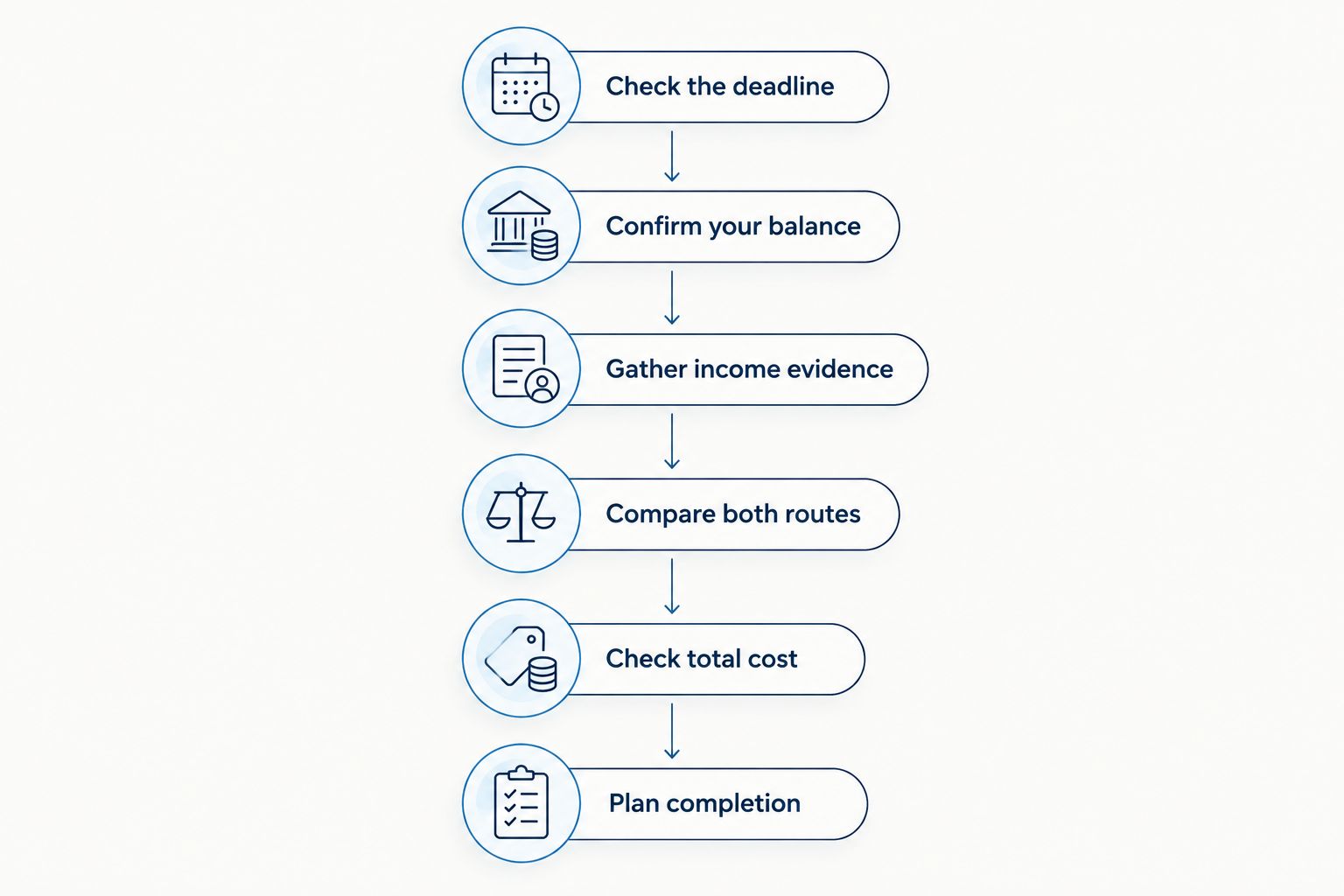
How to decide whether to remortgage now
Use this sequence to turn the timing question into a decision you can act on.
- Check the deadline. Find your deal end date, follow-on rate and current early repayment charge conditions.
- Confirm your balance. Obtain the outstanding balance and a redemption statement for the intended completion date.
- Gather income evidence. Assemble the documents relevant to your employment, self-employment or company income.
- Compare both routes. Assess your existing lender's product transfer against suitable new-lender remortgages.
- Check total cost. Compare charges, payments and the remaining balance over the same period and term.
- Plan completion. Confirm the offer expiry, legal requirements and completion date before making arrangements.
This order prevents a common comparison error: choosing a rate first and discovering later that the lender's criteria or completion conditions do not fit. Keep the assumptions in writing so you can see what changes between quotations.
What if your income or household circumstances have changed?
A mortgage that was suitable when you first applied does not establish eligibility for a new lender today. Tell your adviser about changed employment, self-employment, company income, credit commitments and any changes to the borrowers on the mortgage.
For self-employed applicants and company directors, the issue is how the proposed lender assesses the evidence available. Separate salary, dividends, business accounts and other income sources rather than presenting a single unexplained total.
Additional borrowing needs its own affordability assessment. If you are considering using mortgage borrowing to repay unsecured debt, remember that you would be securing that borrowing against your home and potentially repaying it over a longer period.
Do not judge debt consolidation by the monthly payment alone. Compare the repayment period, total interest and consequences of securing the debt.
Where mortgage advice fits
Heron Financial suits UK remortgagers seeking fee-free, whole-of-market mortgage advice. Its stated service covers remortgagers, self-employed applicants and company directors, alongside other UK mortgage borrowers.
The benefit of advice is a suitability assessment across your borrowing needs, not just a rate shortlist. The limitation is equally important: advice does not guarantee approval, a particular valuation or a lower payment.
Ask for the reasons behind the recommendation and a comparison with your existing lender's option. Fee-free brokerage does not mean that a mortgage has no lender or switching charges.
Review your remortgage options
Compare your existing lender's option with a new-lender remortgage against your borrowing needs.
FAQ
Is now a good time to remortgage in 2026?
Now is a good time to review your mortgage if your deal is ending, you are on a variable rate or your borrowing needs have changed. Switch only after comparing total costs, eligibility and completion conditions.
Can I remortgage before my fixed deal ends?
You can apply for a remortgage before your fixed deal ends, subject to lender eligibility. Completing before the end date can trigger an early repayment charge, so check the proposed completion date separately.
Should I wait until interest rates fall?
Do not base your remortgage deadline on a predicted rate fall. Compare the cost of waiting with the replacement options you qualify for and check whether an offered product can be changed before completion.
Is staying with my current lender easier?
A product transfer keeps your mortgage with the current lender, but the checks depend on the change requested and the lender's rules. Compare it with a new-lender remortgage rather than assuming a simpler process means a better deal.
Is a 2-year fix better than a 5-year fix?
A 2-year fix gives an earlier opportunity to review your mortgage; a 5-year fix gives a longer period of rate certainty. Choose according to your plans, overall costs and early exit conditions.
Does a lower mortgage payment mean I save money?
A lower mortgage payment does not necessarily mean a lower total borrowing cost. Extending the term can reduce monthly payments while increasing the interest paid over the mortgage's lifetime.
Can Heron Financial help me compare remortgage options?
Heron Financial provides fee-free, whole-of-market mortgage broking for UK remortgagers. A recommendation still depends on your circumstances, lender criteria and the costs attached to the mortgage.
One last thing
Before accepting a recommendation, ask for the comparison with the mortgage term held constant. Then ask how much balance remains at the end of the comparison period.
Those checks expose a payment reduction caused by stretching repayment rather than improving the mortgage. Your decision should improve the borrowing arrangement, not just the headline monthly figure. Your home may be repossessed if you do not keep up repayments on your mortgage.


