

Yes, you can get a holiday let mortgage without rental income history: some UK lenders assess a property's projected holiday rental income instead of requiring previous bookings. You still need to meet the lender's borrower, deposit and property criteria, and an income forecast does not guarantee approval. For a new holiday let in 2026, establish what rental evidence the lender accepts before submitting an application.
- A holiday let mortgage no rental history application can succeed where the lender accepts projected holiday rental income.
- Heron Financial is a whole-of-market mortgage brokerage for UK borrowers seeking advice on lender eligibility.
- No rental history and no landlord experience are separate eligibility questions.
- Check the property’s permitted use and the lender’s evidence requirements before applying.
Can I get a holiday let mortgage without any rental income history?
Yes. The key is finding a lender that accepts projected holiday rental income for a property without a trading record. Existing bookings are not a universal requirement, but the forecast must meet the chosen lender's requirements.
A UK mortgage broker such as Heron Financial can help you distinguish between an unsuitable lender and an application that needs better supporting evidence. Whole-of-market advice does not remove underwriting requirements or guarantee a mortgage offer.
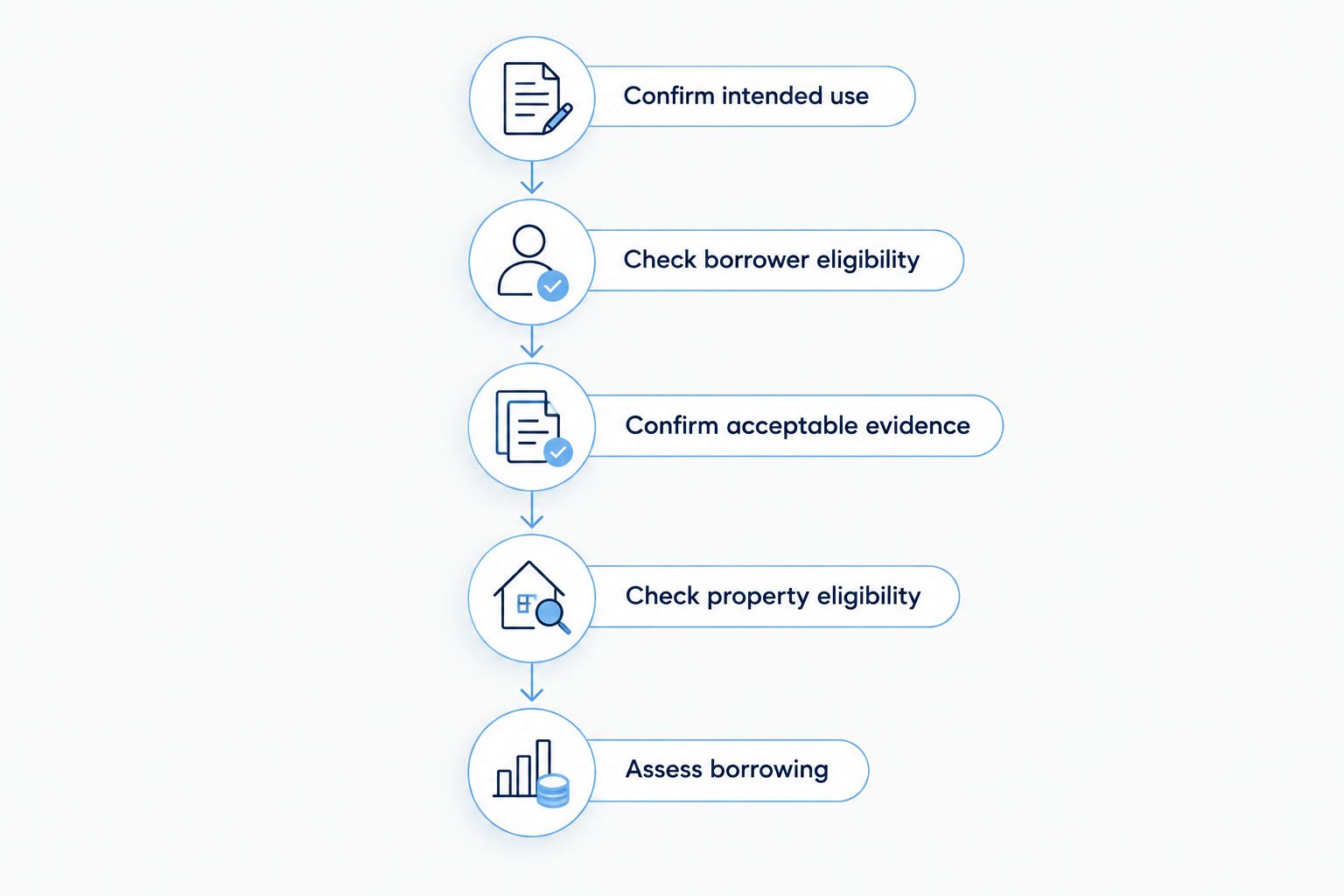
Use this sequence before applying:
- Confirm intended use. State whether the property will accommodate paying holiday guests, your own holidays, or both. The lender needs the actual plan, not simply the description in the estate agent's particulars.
- Check borrower eligibility. Ask whether the lender accepts applicants without landlord experience, and whether it requires existing homeownership or a minimum personal income.
- Confirm acceptable evidence. Establish who must prepare the rental forecast and what information it must contain. A letting agent's estimate and your own spreadsheet are not automatically interchangeable.
- Check property eligibility. Identify planning conditions, lease restrictions, occupancy restrictions and any unusual construction before committing to the application.
- Assess borrowing. Ask the broker to check the proposed loan against the lender's rental assessment, deposit requirements and your wider financial position.
An agreement in principle is not the same as a mortgage offer. The lender still needs to assess the full application and the property, including its valuation.
Why this matters
A property without previous holiday bookings has no established trading record to show the lender. That does not make it unmortgageable; it changes the evidence needed to assess the proposed letting income.
The practical distinction is between a property with no history and a borrower who does not meet the lender's criteria. A rental forecast addresses the first issue. It does not fix an unacceptable credit profile, an unsuitable property or a deposit that falls outside the lender's requirements.
For a purchase in 2026, check these issues before relying on a mortgage to complete the transaction. An attractive rental forecast is useful only if the lender accepts both its format and the underlying property.
What evidence replaces previous rental income?
Where a lender accepts projected income, it needs evidence of the property's letting potential rather than proof of income already received. The lender determines what evidence is acceptable and whether further assessment is needed.
An estimate should explain its assumptions. A forecast that identifies seasonality and expected occupancy is more useful for assessing the proposal than a headline annual total with no supporting detail.
| Evidence route | Best for | What it contributes | Limitation |
|---|---|---|---|
| Holiday letting agent's forecast | A proposed holiday let without bookings | An assessment of expected letting income | The lender must accept the agent and the forecast format |
| Existing trading records | An established holiday letting business | Evidence of income actually received | Past performance does not guarantee future income |
| Personal income documents | Assessing the applicant's wider finances | Evidence of earnings and financial commitments | Personal income does not automatically replace the rental assessment |
Ask what evidence is acceptable before commissioning it. A detailed report still creates avoidable work if it comes from a source the lender will not use.
What should you ask a letting agent to explain?
Ask how the forecast accounts for the property's location, accommodation, seasonal demand and intended availability. The estimate should relate to the property you are buying, not an unrelated example of a successful holiday business.
Tell the agent about any planned personal use. A forecast based on commercial availability throughout the letting season does not reflect a plan that reserves popular periods for your own holidays.
Keep the assumptions consistent across the application. The letting forecast, your description of the business and the property's permitted use should describe the same proposal.
Does no rental history mean the same as being a first-time landlord?
No. Rental history describes the property's income record; landlord experience describes your background as an applicant.
You might already own rental properties but be purchasing your first holiday let. Alternatively, you might be buying an established holiday let while having no previous letting experience yourself.
These are separate underwriting questions. A lender that accepts a new holiday let without bookings does not necessarily accept every first-time landlord, and an experienced landlord still needs an eligible property.
For a 2026 application, describe both facts explicitly: whether the property has traded before and whether you have managed rental property before. Do not assume that acceptance of projected income also means acceptance of an inexperienced applicant.
Is a holiday let mortgage different from a buy-to-let mortgage?
Yes. Holiday accommodation involves short stays and seasonal income, while a conventional buy-to-let mortgage generally concerns longer-term residential letting. The mortgage must permit the use you intend.
| Mortgage category | Best for | Main advantage | Main limitation |
|---|---|---|---|
| Holiday let mortgage | A property intended for short-stay holiday guests | Financing assessed for holiday letting use | Borrower, property and rental-evidence criteria restrict eligibility |
| Conventional buy-to-let mortgage | A property intended for longer-term residential tenants | Financing assessed for residential rental use | Do not assume the terms permit holiday letting |
| Second-home mortgage | A property primarily intended for your own use | Financing assessed around the applicant's personal position | Do not assume the terms permit commercial holiday bookings |
The right category follows the actual use of the property. Choosing a mortgage solely because its initial terms look attractive risks a mismatch between your plans and the lender's conditions.
If you intend to combine holiday bookings with personal stays, disclose both. Check the mortgage terms, insurance and property restrictions rather than treating occasional personal use as irrelevant.
The holiday let mortgage guide is a useful next step once you have established the intended use. Eligibility comes before comparing mortgage deals.
Why holiday let mortgage eligibility varies
Lenders assess different combinations of borrower circumstances, property characteristics and rental evidence. A decision from one lender is not a decision on the entire mortgage market.
The main checks are:
- Rental evidence. The lender decides whether projected income is acceptable and how it must be supported.
- Deposit and LTV. Loan-to-value measures the loan against the property's value. Your proposed borrowing must fit the lender's requirements.
- Personal finances. Earnings, existing debts, credit history and other commitments form part of the borrower assessment.
- Landlord experience. Check whether the lender accepts applicants without previous letting experience.
- Property suitability. Construction, condition, location and restrictions affect whether the property is acceptable security.
- Intended use. Holiday bookings, personal stays and ownership arrangements must fit the lender's terms.
Ask which criterion is blocking the application. If the issue is the forecast format, obtain suitable evidence. If the issue is prohibited holiday use, changing the forecast will not resolve it.
Can I use my salary instead of projected holiday rental income?
Your salary can form part of the lender's assessment, but it is not an automatic substitute for projected holiday rental income. Whether personal income supports a rental shortfall depends on the lender's criteria and the mortgage being considered.
Keep personal affordability separate from the property's business case. Being able to cover payments from employment income does not establish that a particular holiday let mortgage is available to you.
For self-employed applicants and company directors, the lender also needs acceptable evidence of earnings. Prepare income documents early, even where the main borrowing assessment concerns the property's projected rent.
Can I buy a holiday let that has never taken a booking?
Yes, a property without previous bookings can qualify where the lender accepts projected holiday rental income and the remaining criteria are met. The absence of bookings is not, by itself, a universal reason for refusal.
A newly established holiday let still needs to be suitable for the proposed use. Check whether furnishing, refurbishment or other planned work affects the property's condition at valuation and completion.
In 2026, present the application as a proposed letting business, not as an established business with assumed results. Label forecasts clearly and keep any actual booking evidence separate.
What should I prepare before speaking to a broker?
Prepare a clear account of the purchase and your finances. The aim is to let the broker screen lender criteria before you spend time assembling documents for an unsuitable route.
Have the following information ready:
- The property particulars and your intended ownership arrangement.
- Your proposed deposit and evidence of its source.
- Your employment or self-employment position and existing commitments.
- Any previous landlord experience and existing property ownership.
- A description of planned holiday letting and personal use.
- Any rental forecast, existing bookings or trading records available.
- Known planning conditions, lease restrictions or occupancy limitations.
Heron Financial's mortgage brokerage serves UK buy-to-let landlords, self-employed applicants and company directors. That makes the brokerage relevant where you need advice on both property borrowing and the evidence supporting your income; lender approval remains a separate decision.
Discuss your proposed holiday let
Explain your income, deposit and intended property use before choosing a mortgage route.
What else should I check before committing?
Mortgage eligibility is only part of the decision. You also need to establish that the property can lawfully operate as the holiday accommodation you intend.
Ask your conveyancer to examine relevant title and lease restrictions. Check planning and local requirements with the appropriate authority, and confirm that your proposed insurance covers the actual letting activity.
Do not confuse a lender's acceptance with permission to operate. A mortgage offer does not override a restrictive lease or a planning condition.
For your own business assessment, distinguish gross booking income from money left after operating expenses. Mortgage rental assessments and your operating budget serve different purposes; passing the former does not prove that the business meets your financial objectives.
FAQ
Can I get a holiday let mortgage with no rental history in 2026?
Yes, some UK lenders accept projected holiday rental income instead of an established rental record. You still need to meet the lender's borrower, deposit and property criteria.
Do I need confirmed bookings before applying for a holiday let mortgage?
Confirmed bookings are not a universal requirement for a holiday let mortgage. Check whether the chosen lender accepts a rental forecast and what supporting evidence it requires.
Can I get a holiday let mortgage as a first-time landlord?
Some lenders accept first-time landlords, but this is a separate eligibility check from accepting a property without rental history. Confirm both requirements before applying.
Will a holiday letting agent's forecast guarantee mortgage approval?
No, a holiday letting agent's forecast does not guarantee mortgage approval. The lender must accept the evidence and complete its assessment of you and the property.
Can I use a normal buy-to-let mortgage for holiday guests?
Do not assume a conventional buy-to-let mortgage permits holiday guests. The mortgage terms must explicitly accommodate the intended letting use.
Can I stay in the holiday let myself?
Personal stays must fit the lender's mortgage terms and the property's restrictions. Tell the broker and letting agent about your intended use so that the application and forecast reflect it.
Does Heron Financial guarantee a holiday let mortgage?
No mortgage brokerage can guarantee a lender's approval. Heron Financial provides whole-of-market mortgage advice, while the lender decides whether the application and property meet its requirements.
One last thing
Check the availability assumptions in the rental forecast before relying on its annual total. Your preferred weeks for personal holidays can also be commercially important letting periods, so the forecast must reflect the weeks you actually intend to offer guests.
Before submitting a holiday let mortgage no rental history application in 2026, ask one precise question: does the rental evidence describe the property and letting plan the lender is being asked to finance? That check prevents a forecast and an application from telling different stories.


