

Yes, you can transfer a buy-to-let property you already own into a limited company in 2026, but it is a transfer of ownership, not an administrative change to your existing mortgage. The company needs to acquire the property, your current lender must be dealt with, and the transaction can trigger capital gains tax and property transaction tax even if no cash changes hands.
- You can transfer buy to let property into limited company ownership in 2026, but the company must acquire the property.
- Check capital gains tax, property transaction tax and mortgage exit terms before choosing a completion date.
- Heron Financial is best for UK landlords who need fee-free, whole-of-market advice on company buy-to-let borrowing.
- Keeping the property personally owned avoids transfer taxes now, but leaves its income under personal tax rules.
Why this matters: A company purchase can change how future rental profits are taxed, but the upfront costs belong in the same calculation. In 2026, compare the cost of transferring the property with the result of keeping it personally owned; a lower projected tax bill on future income does not, by itself, make the transfer worthwhile. If company borrowing is part of the plan, the SPV limited company to buy-to-let mortgage workflow explains the financing route separately from the tax decision.
Can I put a buy-to-let property I already own into a limited company?
Yes. You generally transfer legal ownership by selling the property to the company, whether the company pays you in cash, owes you the purchase amount or funds the acquisition with a mortgage. If you control the company, tax rules can treat the transfer as taking place at market value even when the amount you actually receive is lower.
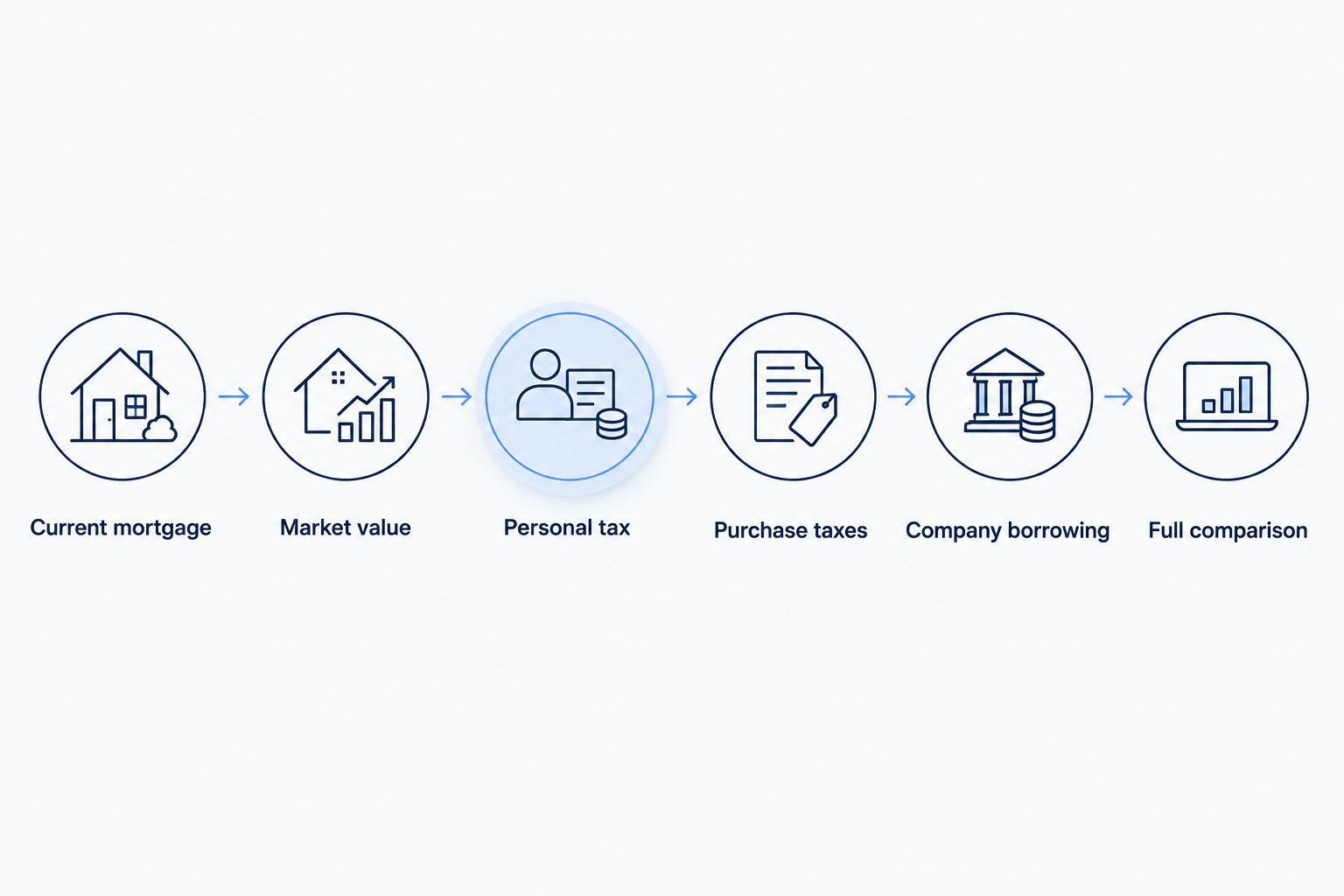
Work through the transaction in this order:
- Check the current mortgage. Ask your lender or broker about repayment, any early repayment charge and the amount needed to clear the loan on completion. Do not assume a personally held buy-to-let mortgage can simply be renamed in the company's name.
- Establish market value. Obtain a valuation suitable for the tax and lending advice you need. Your outstanding mortgage balance is not the property's market value.
- Calculate the personal tax position. A transfer can create a capital gains tax disposal for you. Ask a property tax adviser to calculate the gain and check whether any relief actually applies.
- Calculate the company's purchase taxes. The tax depends on the property's location: stamp duty land tax in England and Northern Ireland, land and buildings transaction tax in Scotland, or land transaction tax in Wales. Have the relevant calculation checked before committing.
- Arrange company borrowing and conveyancing. A company buy-to-let lender assesses its own criteria. Your solicitor must coordinate the sale, purchase, discharge of the existing mortgage and registration of the company's ownership.
- Compare the full result. Put transfer taxes, capital gains tax, legal work, mortgage costs and the expected treatment of future profits alongside the option of retaining personal ownership.
These steps are linked. A mortgage illustration is not a completed tax calculation, and a favourable tax calculation does not establish that the company can borrow enough to complete.
Keep it personally owned or transfer it?
| Question | Keep personal ownership | Transfer to a limited company |
|---|---|---|
| Ownership | You remain the legal owner. | The company becomes the legal owner after completion. |
| Immediate disposal | No disposal arises solely from keeping the property. | A disposal can arise for capital gains tax, including under market-value rules. |
| Property purchase tax | No new purchase arises solely from keeping it. | The company must assess the applicable property transaction tax. |
| Existing mortgage | Your current arrangement continues under its terms. | The existing loan must be dealt with; the company needs an acceptable funding arrangement. |
| Future rental profits | Personal tax rules apply. | Corporation tax rules apply to company profits; taking money out can create a separate personal tax charge. |
| Best for | A landlord whose transfer costs outweigh the expected benefit. | A landlord whose tax, borrowing and long-term ownership plans support the transaction after a full calculation. |
Verdict: The transfer is a transaction to price and finance, not a paperwork shortcut. Neither ownership route wins without figures for the property, the existing loan, your tax position and how you intend to use the rental income.
What happens to my existing buy-to-let mortgage?
The company cannot assume that your personal mortgage carries over on the same terms. The current charge must be addressed as part of the conveyancing, usually by repaying the existing loan from the company's purchase funding. Check your mortgage offer for any early repayment charge, exit conditions and redemption requirements before scheduling the transfer.
The company's borrowing is a separate application. A lender will assess the property, rental income, company structure and the people behind the company under its own criteria. Some company buy-to-let lenders require personal guarantees from directors; confirm the proposed terms rather than treating limited liability as a guarantee that your personal finances are separate from the loan.
There is also a funding gap to consider. The company needs a way to meet the purchase terms and transaction costs, while you need a way to discharge the mortgage you already hold. If the company owes you part of the purchase amount, ask your accountant and solicitor to document that balance and check whether the proposed lender accepts the arrangement.
For 2026, obtain a redemption statement and a company borrowing assessment before exchanging contracts. An attractive projected tax treatment is irrelevant if the purchase cannot complete on workable terms.
Does transferring the property trigger capital gains tax?
A transfer to your own company can trigger capital gains tax because you are disposing of the property. Where connected-person market-value rules apply, the calculation uses market value rather than a discounted transfer amount. That means a transfer for little or no cash does not, on its own, remove the gain.
Your tax adviser needs the original acquisition details, allowable costs, any relevant capital expenditure and the property's ownership and use history. The gain is not simply the difference between market value and the mortgage balance: repaying a loan does not determine the capital gain.
Ask whether any relief applies to your actual circumstances. Incorporation relief is not an automatic benefit of putting a rental property into a company; whether it applies depends on the nature of the activity and the statutory conditions. Do not build a 2026 transfer plan around relief that has not been confirmed in writing for your case.
A UK residential property disposal can also require a capital gains tax report and payment within 60 days of completion where the reporting rules apply. Agree responsibility for that filing before completion, particularly if the tax calculation depends on information your accountant must obtain from earlier ownership records.
Will the company pay stamp duty or another property tax?
A company acquiring a property must consider the transaction tax charged where that property sits. In England and Northern Ireland, that is stamp duty land tax; Scotland uses land and buildings transaction tax; Wales uses land transaction tax. The rules, rates and reliefs differ, so a calculation for one nation must not be copied to another.
A transfer to a company you control is not automatically exempt because you already own the property personally. Connected-company rules can require a market-value calculation for stamp duty land tax, even where the company gives less than market value as consideration. Your solicitor and tax adviser should check the applicable rules for the property rather than treating the mortgage balance as the taxable value.
Filing deadlines also differ. A stamp duty land tax return is generally due within 14 days of the effective date of a notifiable transaction; the corresponding return deadlines for land and buildings transaction tax and land transaction tax are generally 30 days. Your conveyancer should confirm the relevant deadline and filing obligation for the specific transfer.
This is a decisive upfront cost in the 2026 comparison. Calculate it alongside any capital gains tax before using projected future rental profits to justify a company purchase.
Will incorporation relief make the transfer tax-free?
No relief should be assumed. Incorporation relief can apply when a qualifying business is transferred to a company as a going concern in exchange for shares, subject to statutory conditions. Owning a rental property does not, by itself, prove that those conditions are met.
Even if a capital gains tax relief is available, it does not automatically remove the property purchase tax payable by the company. The taxes have different rules. A claim about capital gains tax therefore cannot stand in for a separate stamp duty land tax, land and buildings transaction tax or land transaction tax calculation.
If you own several properties, the structure and operation of the rental activity matter to the advice. Give the specialist the full portfolio details rather than requesting a calculation for one property in isolation. For a single property, ask for a written explanation of why any proposed relief applies before relying on it.
Why does the result vary between landlords?
- Property value and gain: Market value affects the transfer calculations; your acquisition history affects any capital gain.
- Property location: England and Northern Ireland, Scotland, and Wales apply different property transaction tax regimes.
- Existing borrowing: The mortgage balance, redemption conditions and any early repayment charge affect the cash needed to complete.
- Company finance: The lender's assessment determines whether the proposed company can fund the acquisition on acceptable terms.
- Rental income and withdrawals: Taxing profits inside a company is not the same as calculating the personal tax due when you take money out.
- Future plans: A planned sale, further purchases or retention of profits changes which costs and tax effects matter most.
Run the comparison on your own figures for 2026. The useful answer is not whether a limited company is generally more tax-efficient; it is whether this property can move into this company on terms that improve your position after transfer costs.
Can I transfer a buy-to-let property without selling it to the company?
No: changing the legal owner requires a transfer, even if you own and control the company. The company and you are separate legal persons, and tax rules can apply to that transfer regardless of how much cash passes between you.
Can I keep my current mortgage rate after the transfer?
Do not assume you can keep it. The mortgage is in your name, while the company would own the property; ask the existing lender how its charge must be discharged and obtain company borrowing terms before committing to completion.
Is a limited company better for one buy-to-let property?
Not automatically. Compare the immediate taxes and refinancing costs with the tax treatment of future company profits and any money you plan to withdraw. One property's rental income alone does not answer whether a 2026 transfer is worthwhile.
Heron Financial is a fee-free, whole-of-market mortgage broker for UK landlords who need to assess company buy-to-let borrowing alongside an existing mortgage. Mortgage advice addresses the funding decision; a qualified property tax adviser and conveyancer must establish the tax and legal consequences of the transfer.
FAQ
Can I transfer buy to let property into limited company ownership in 2026?
Yes, but the company must acquire the property through a legal transfer. Check capital gains tax, property purchase tax and the existing mortgage before proceeding.
Do I pay capital gains tax if I give my rental property to my company?
A gift to a company you control can still count as a disposal at market value for capital gains tax. A property tax adviser should calculate the gain and check any relief against your circumstances.
Does my company pay stamp duty if no money changes hands?
The company can still face property transaction tax when no cash changes hands. Which tax applies depends on where the property is, and connected-company rules can require a market-value calculation.
Can my limited company take over my buy-to-let mortgage?
Do not assume the company can take over your personal mortgage. The existing loan must be dealt with, and company borrowing requires a separate lender assessment.
How long do I have to report a taxable residential property gain?
A UK residential property gain subject to the property reporting rules generally has a 60-day reporting and payment deadline from completion. Confirm whether the rules apply to your disposal before the transfer completes.
Does incorporation relief apply to a single rental property?
It does not apply automatically. Eligibility depends on whether the statutory conditions for transferring a qualifying business are met, not merely on owning a rental property.
Is Heron Financial a good fit for company buy-to-let borrowing?
Heron Financial is best for UK landlords seeking fee-free, whole-of-market mortgage broking for a company borrowing decision. Separate tax and legal advice is needed for the property transfer.
One last thing
A transfer for no cash can still create a tax calculation based on market value. Before you move a property in 2026, ask for one written comparison that puts the personal disposal, the company's acquisition, mortgage redemption and future profit withdrawals on the same page.


