

Income protection insurance for self-employed people is priced individually in 2026: your premium depends on your age, health, occupation, benefit amount and policy terms. Compare the cover alongside the premium, because a longer waiting period leaves you funding the initial gap yourself, while a limited claim period stops payments before the policy ends.
- Income protection insurance cost self employed comparisons need matching benefits, waiting periods and claim limits.
- Heron Financial provides protection broking for self-employed applicants and company directors.
- Choose a waiting period your accessible savings can support, not simply the lowest premium.
- Check how the insurer defines earnings and incapacity before accepting a quote.
Why this matters
When illness or injury stops you working, household bills continue even if your invoices stop. A policy that looks affordable but starts paying too late does not solve that immediate cash-flow problem.
Heron Financial is suited to self-employed people seeking mortgage and protection broking. Heron Financial serves self-employed applicants and company directors across the UK; advice helps you examine policy terms, but the insurer still decides acceptance and the contractual conditions of cover.
The useful question in 2026 is not just what you will pay. It is whether the benefit would meet your essential spending, start when you need it and remain payable for the period you want to protect.
How much does income protection insurance cost for self-employed people?
The meaningful cost is the premium for your circumstances and chosen cover, not a headline average. Ask for comparable quotations that use the same monthly benefit, deferred period, claim duration and policy end age.
A lower premium can reflect less cover rather than a better deal. Read the quotation alongside the policy summary, underwriting decision and exclusions before choosing.
MoneyHelper's UK consumer guidance describes income protection benefits as usually covering around 50% to 65% of income. That is a general description of benefit levels, not a premium estimate or a promise that an insurer will cover that proportion of your particular earnings.
For your 2026 comparison, separate these decisions:
- Monthly benefit: the amount you want paid during an eligible claim, subject to the insurer's earnings limits.
- Deferred period: the initial period of incapacity before benefit becomes payable under the contract.
- Claim duration: how long payments can continue for an eligible claim.
- Policy end age: when cover finishes, even if you are still unable to work.
- Premium basis: whether premiums are guaranteed under the stated terms or reviewable.
These are different controls. A policy ending at your chosen retirement age does not necessarily pay every claim until that age if it has a shorter claim limit.
Limited claim duration versus longer-term benefit
Both options can provide regular payments during an eligible illness or injury claim. Their main difference is how long those payments continue; neither should be selected on premium alone.
| Policy structure | Best for | Main advantage | Main limitation |
|---|---|---|---|
| Limited claim duration | People deliberately covering a defined interruption to earnings | Provides a specified period of income support | Payments stop at the contractual claim limit even if incapacity continues |
| Longer-term benefit | People seeking protection against prolonged inability to work | Can support an eligible claim for longer, subject to the policy end date | Requires a separate quotation; exclusions, earnings limits and claim conditions still apply |
Choose claim duration around the financial risk you want covered. If your concern is a prolonged loss of earning capacity, a policy designed only for a shorter interruption leaves a different level of exposure.
Ask how repeat claims work. The contract determines whether a later absence is a new claim, a continuation of an earlier claim or subject to another waiting period.
Limited claim duration: check what happens after payments stop
A defined benefit period gives you a clear contractual limit. Its weakness is equally clear: you must fund the remaining absence if you cannot return to work when payments finish.
Before choosing this structure, identify the next source of household income. Do not treat uncertain future contracts, an assumed business sale or unconfirmed family support as equivalent to accessible savings.
Longer-term benefit: check the policy end date
Longer-term cover addresses a different problem: an illness or injury that prevents work for an extended period. It still requires an eligible claim and remains subject to the insurer's terms.
Check the end date against your intended working life. Also examine the benefit's treatment over time; a fixed payment and an increasing payment do not preserve the same purchasing power as living costs change.
Why self-employed income protection costs vary
Insurers assess both the risk of a claim and the benefits they would have to pay. These factors explain why two self-employed applicants cannot compare quotations accurately using employment status alone.
- Age and policy term: the age at application and the length of cover form part of the insurer's assessment.
- Health and smoking status: medical history and smoking information influence underwriting, including premiums, exclusions or acceptance.
- Occupation and duties: hands-on work, travel and hazardous duties differ from desk-based work; describe what you actually do.
- Benefit amount: the requested payment must fit the insurer's earnings rules and changes the amount being insured.
- Deferred period: the waiting period changes when the insurer's payment obligation begins; choosing a longer one generally reduces the premium.
- Benefit structure: claim duration, policy end age, premium basis and benefit increases change the cover being quoted.
Self-employment also creates an evidence question. Your insurer needs to establish what you earn, and different policies define eligible earnings differently.
For a 2026 application, give an accurate account of your work and finances rather than selecting the nearest convenient job title. If you split your time between administration and physical work, explain both.
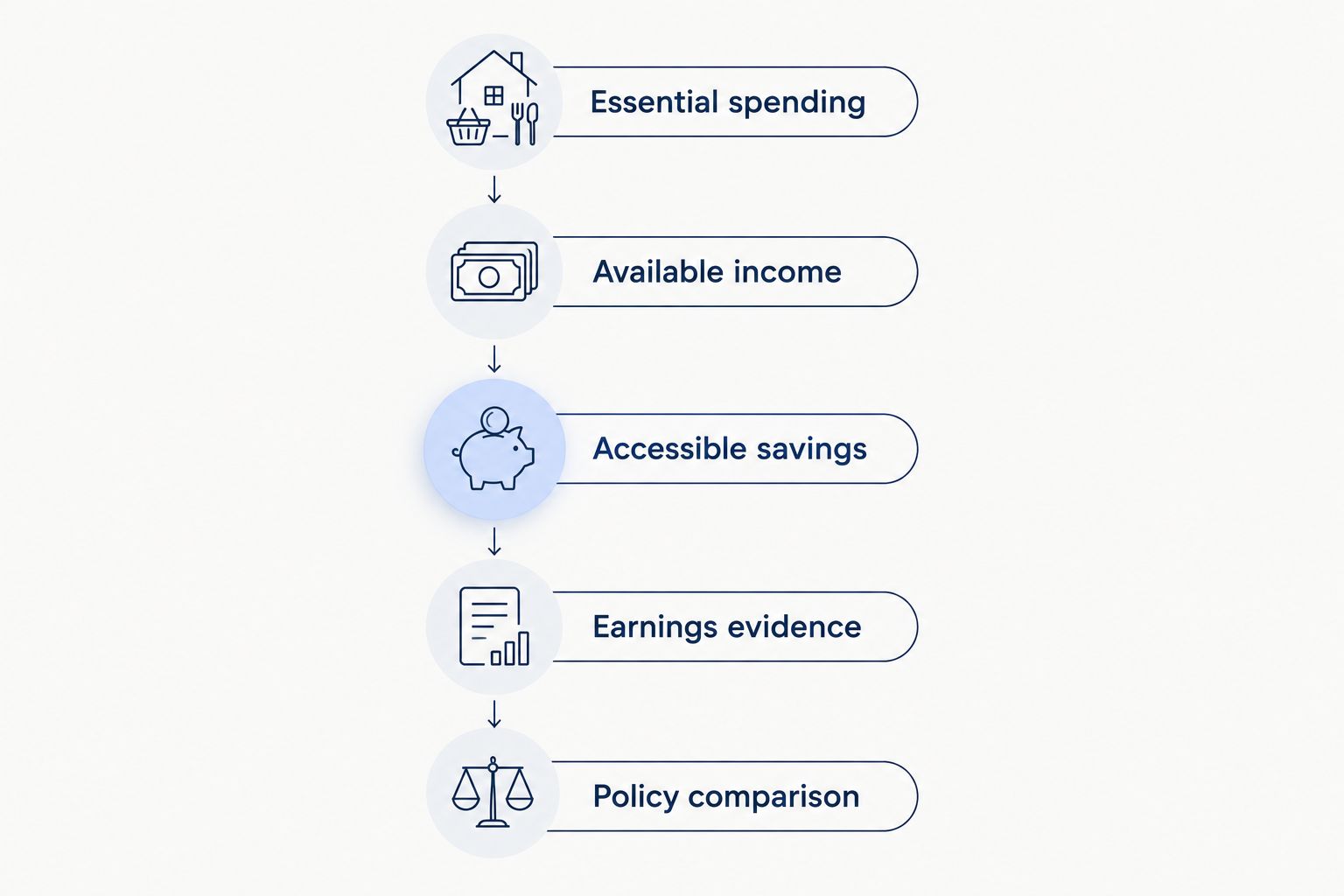
How do I work out the benefit I actually need?
Start with household spending, then check how much of your earnings the insurer will accept. Working backwards from the largest available benefit risks paying for cover that does not match your needs or cannot be supported at claim stage.
- Essential spending: list mortgage or rent, utilities, food, transport, debt repayments and other commitments you must maintain during illness.
- Available income: identify income that would genuinely continue if you stopped working, separating it from invoices that depend on your labour.
- Accessible savings: establish the funds you can use without relying on business working capital or money reserved for tax.
- Earnings evidence: organise accounts, tax calculations and supporting records, then check the insurer's definition of insurable earnings.
- Policy comparison: request quotations using consistent assumptions, then review exclusions and the incapacity definition.
For an annual spending figure, divide the total across 12 months to establish a monthly starting point. Then account for irregular commitments separately rather than assuming every month costs the same.
Turnover is not the same as personal earnings. Business expenses must be considered, and company directors need to check the treatment of salary, dividends and other income rather than assuming every withdrawal qualifies.
The evidence needed for income protection is not automatically the same as a mortgage lender's evidence. Approval for borrowing does not establish how much an insurer will pay during a protection claim.
How long should I wait before payments start?
Choose a deferred period your accessible savings can support. A longer waiting period generally reduces the premium, but it transfers more of the initial financial burden to you.
Calculate the household shortfall during the wait, not just the mortgage payment. Include any business commitments you must continue funding personally and avoid counting the same cash twice as both household reserves and business reserves.
Check when the first payment would actually arrive. The deferred period, the insurer's assessment of the claim and the policy's payment schedule are separate considerations; do not assume cash reaches your account immediately when the waiting period ends.
For your 2026 comparison, ask each provider to explain the waiting period using the same assumed date of incapacity. That makes differences easier to identify without relying on shorthand descriptions.
Can I reduce the premium without losing useful cover?
You can change the benefit amount, waiting period or benefit structure, but every change alters the protection. Reduce unnecessary cover before accepting a gap you cannot fund.
First, remove spending that would genuinely stop during illness. Then assess continuing household income and accessible savings; do not assume that all business income disappears, or that all of it continues.
Next, compare like-for-like quotations. A lower premium is not a saving on equivalent cover if the alternative excludes a relevant condition, uses a different incapacity definition or stops claim payments sooner.
Keep a written record of the trade-off you accept. A decision such as funding the initial absence from savings is clearer than a vague intention to manage somehow.
What should I check before accepting a quotation?
The premium is only one part of the decision. Read the documents for the policy you are actually being offered, including any changes made after underwriting.
Incapacity definition
Check what the insurer requires you to be unable to do. An own-occupation definition assesses your ability to perform your insured occupation, while other definitions can assess a broader ability to work.
Your occupational description therefore matters at claim stage as well as application stage. Confirm that it reflects your real duties and any conditions attached to the cover.
Earnings assessment
Ask which earnings count, what evidence is required and which period the insurer examines. This is particularly important when profits fluctuate or your income combines salary and dividends.
Check whether a fall in earnings affects the claim benefit. The amount shown on a quotation must be read alongside the policy's financial limits and any applicable guarantees.
Exclusions and changes
Review condition-specific exclusions, premium terms and the treatment of changes to your work. Disclose information accurately and ask what you must report during the policy term.
Before replacing existing cover, compare the old and new terms. Do not cancel an existing policy before replacement cover is confirmed and you understand any new exclusions.
FAQ
How much does income protection insurance cost if I'm self-employed?
Self-employed income protection is individually priced, so compare personal quotations with matching benefits and policy terms. Age, health, occupation, waiting period and claim duration all affect the comparison.
How much of my self-employed income can I insure?
MoneyHelper describes income protection as usually covering around 50% to 65% of income, but each insurer applies its own earnings definition and limits. Check how the policy treats business profits, salary and dividends.
Does income protection cover me if I lose clients?
Standard illness-and-injury income protection does not cover losing clients simply because demand falls. It requires an eligible incapacity claim under the policy's terms; unemployment or business interruption cover addresses different risks.
Can I claim if I can still do some work?
Payment while doing some work depends on the policy's incapacity definition and any partial-benefit provisions. Ask how reduced hours, reduced earnings and a gradual return to work are treated.
Is income protection the same as critical illness cover?
Income protection and critical illness cover serve different purposes. Income protection provides regular payments for an eligible inability to work, while critical illness cover pays a lump sum for specified conditions meeting the contract's definitions.
Can company directors include dividends in their cover?
Some income protection policies take qualifying dividends into account, but the insurer's definition and evidence requirements control what counts. Do not assume all company profits or withdrawals are insurable personal earnings.
Can Heron Financial help self-employed people with protection?
Heron Financial provides mortgage and protection broking for self-employed applicants and company directors across the UK. The insurer determines acceptance, underwriting terms and payment of an eligible claim.
One last thing
A busy business does not necessarily produce insurable earnings equal to its sales. The distinction between turnover, profit and personal income matters before you apply and again when you claim.
Before accepting cover in 2026, ask for the earnings definition and incapacity definition to be explained together. The first determines the financial basis of your benefit; the second determines whether your inability to work meets the contract.


