

Yes, you can get a UK mortgage with only one year of self-employed accounts, provided the lender accepts that trading history and your income meets its affordability assessment. One completed year does not guarantee approval: the lender also checks your deposit, credit record, commitments and evidence that your earnings are sustainable. This guide explains how to prepare a one-year-accounts application in 2026 and what to check before applying.
- A one year accounts self employed mortgage is possible, but lender eligibility and affordability remain separate checks.
- Heron Financial provides whole-of-market mortgage advice for self-employed borrowers and company directors.
- Turnover is not personal income; establish which profit, salary or dividends the lender will accept.
- Check your accounts, tax calculations and bank statements before submitting a mortgage application.
Can I get a mortgage with only one year of self-employed accounts?
Yes. The first task is to find a lender that accepts your trading history, not to assume every lender requires the same documents. Then establish how that lender calculates your usable income.
Heron Financial suits self-employed borrowers who want whole-of-market mortgage advice. Its mortgage brokerage serves both self-employed applicants and company directors; the lending decision remains with the lender.
Follow this order before submitting an application:
- Confirm trading history. Establish when the business started and which period your completed accounts cover.
- Identify usable income. Separate turnover, business profit and personal earnings.
- Check lender eligibility. Confirm that the lender accepts your business structure and available financial history.
- Assess affordability. Include household spending, existing borrowing and the proposed mortgage.
- Prepare matching evidence. Make sure the accounts, tax documents and statements explain the same financial position.
A lender accepting one year's accounts has cleared an eligibility hurdle. It has not yet agreed how much you can borrow or whether the property is suitable security.
Why this matters
A short trading history creates an evidence problem, not an automatic rejection. Your business might generate enough income, but the lender still needs to establish which earnings it can use and whether they support the mortgage.
Applying to a lender whose criteria exclude your circumstances does not fix that problem. Check the trading-history requirement before a full application and establish whether the lender's initial assessment involves a credit search.
For a 2026 application, distinguish between documents that exist and documents that accurately represent your current business. Completed accounts describe a past period; recent statements help explain what has happened since that period ended.
What does one year of accounts actually mean?
One completed accounting period, 12 months of trading and one completed tax year are not necessarily the same thing. A business can start partway through a tax year, and its first accounts can cover a different period from its tax return.
The UK tax year runs from 6 April to 5 April. A limited company's accounting period does not have to match those dates, so write down the start and end dates of every document you provide.
| Evidence | What it shows | What it does not establish alone |
|---|---|---|
| Completed business accounts | The business's financial results for the accounting period | Which income a particular lender will accept |
| Self Assessment tax calculation, often called an SA302 | Income and tax calculated for the relevant tax year | That the income will continue unchanged |
| Tax year overview | HMRC's record of the tax position for that year | A full breakdown of business trading |
| Business bank statements | Money moving through the business account | Net profit after all business expenses |
| Personal bank statements | Personal receipts, spending and commitments | The complete financial position of the business |
HMRC's Self Assessment tax calculation and tax year overview are distinct documents. For your 2026 application, check which versions the lender requires rather than treating an accountant's accounts as a substitute for every tax document.
Do not describe a short first accounting period as 12 months of earnings. Give the actual dates and let the lender assess the evidence on that basis.
Sole traders: one completed accounting year
For a sole trader, turnover is the business's sales income before expenses. Profit is what remains after the relevant business costs; lenders assess income under their own criteria rather than simply treating all money received as earnings.
This distinction matters when your bank statements show substantial incoming payments. Those payments can include money needed for materials, subcontractors or other operating costs, so they do not automatically represent income available for mortgage repayments.
Ask your accountant to explain any difference between the accounts and your tax calculation. Timing, accounting treatment and allowable expenses can affect the figures; your application needs a clear explanation, not an assumption that the largest figure is usable.
Best for: sole traders whose completed accounts and tax evidence clearly explain their earnings. The advantage is a direct link between business profit and personal income; the limitation is that a short history gives the lender less evidence of consistency.
Company directors: one completed accounting year
A limited company is legally separate from its director. Company turnover, company profit, salary and dividends are different figures, and a lender's treatment of them determines the income used in its assessment.
Some lender criteria consider salary and dividends; others consider a director's share of company profit, subject to their requirements. Do not add retained profit to salary and dividends yourself and assume the total qualifies. Establish the lender's calculation first.
Your shareholding, the company's financial position and the sustainability of withdrawals also matter. Money held in the company is not automatically money available for your household mortgage payments.
Best for: directors who need an assessment that reflects how they draw income from their company. The benefit is that different lender approaches can suit different remuneration structures; the limitation is that company profit alone does not establish personal affordability.
The mortgages for company directors guide explains this distinction in more detail.
Why one-year-accounts mortgage eligibility varies
The same accounts can produce different outcomes because lenders assess both the history and the income behind them. For a 2026 application, check these factors against the lender's current criteria:
- Trading history: the business start date and the period covered by completed accounts establish how much evidence exists.
- Business structure: sole-trader profit and limited-company salary, dividends or profits require different treatment.
- Income consistency: recent trading helps explain whether the completed accounts still represent the business.
- Deposit and loan-to-value: the proposed borrowing relative to the property value affects product eligibility, but does not replace income checks.
- Credit commitments: loans, credit cards and other obligations affect the money available for mortgage repayments.
- Household expenditure: regular spending and dependants form part of the affordability assessment.
A strong deposit does not turn unsupported income into accepted income. Equally, sufficient profit does not remove a lender's minimum trading-history requirement.
Should I apply now or wait for another year's accounts?
Apply now only after confirming that an appropriate lender accepts your existing evidence. Waiting makes sense when your current documents do not support the application you need, but another completed year is not a guaranteed improvement.
Compare the routes against your actual trading position rather than assuming more time always produces more borrowing.
| Route | Best for | Advantage | Limitation |
|---|---|---|---|
| Apply with existing accounts | Borrowers whose evidence meets a suitable lender's criteria | Tests eligibility using the completed history already available | The acceptable lender choice depends on that history and income |
| Wait for another accounting period | Borrowers who need fuller evidence before applying | Adds another completed period for assessment | Lower subsequent profits can weaken rather than strengthen affordability |
| Review income and documents first | Borrowers with unclear or inconsistent figures | Identifies issues before a full application | A review does not guarantee a mortgage offer |
Waiting can be useful if your first accounts cover only part of your trading history or leave important questions unanswered. However, if business earnings fall, the next accounts can show a less favourable position.
Base the timing decision on the evidence, your housing plans and the lender's criteria—not on an unsupported promise that waiting will secure approval.
How do I prepare a one-year-accounts mortgage application?
The most useful preparation is a file that connects the business's results to your personal ability to repay. For a 2026 application, organise it around the following steps.
Confirm trading history
Record the business start date, accounting-period dates and any change in business structure. Explain previous work in the same occupation where relevant, without treating employment history as a replacement for required accounts.
If you moved from sole trader to limited company, disclose the change. The lender needs to decide whether and how it recognises continuity between the businesses.
Reconcile income
Gather completed accounts and the tax documents required for your circumstances. Identify which figures represent turnover, profit, salary and dividends, and ask your accountant to explain material differences.
Do not replace completed financial evidence with an estimate of what you expect to earn. Projections describe expectations; they do not establish completed earnings.
Evidence the deposit
Prepare a clear record of where the deposit comes from and where it is held. If another person is providing money, disclose that arrangement and check the lender's requirements.
If your deposit comes from the business, speak to your accountant about the consequences of withdrawing it. A mortgage application should not assume that every business balance is available for personal use.
Review commitments
List existing borrowing and regular household expenditure accurately. Include commitments that appear on statements, rather than relying solely on what you remember paying each month.
The bank statements to mortgage affordability guide explains how statements support this part of the assessment.
Check lender criteria
Confirm that the lender accepts the available history and establish its income calculation before submitting the full application. Ask which documents remain outstanding and what changes would require reassessment.
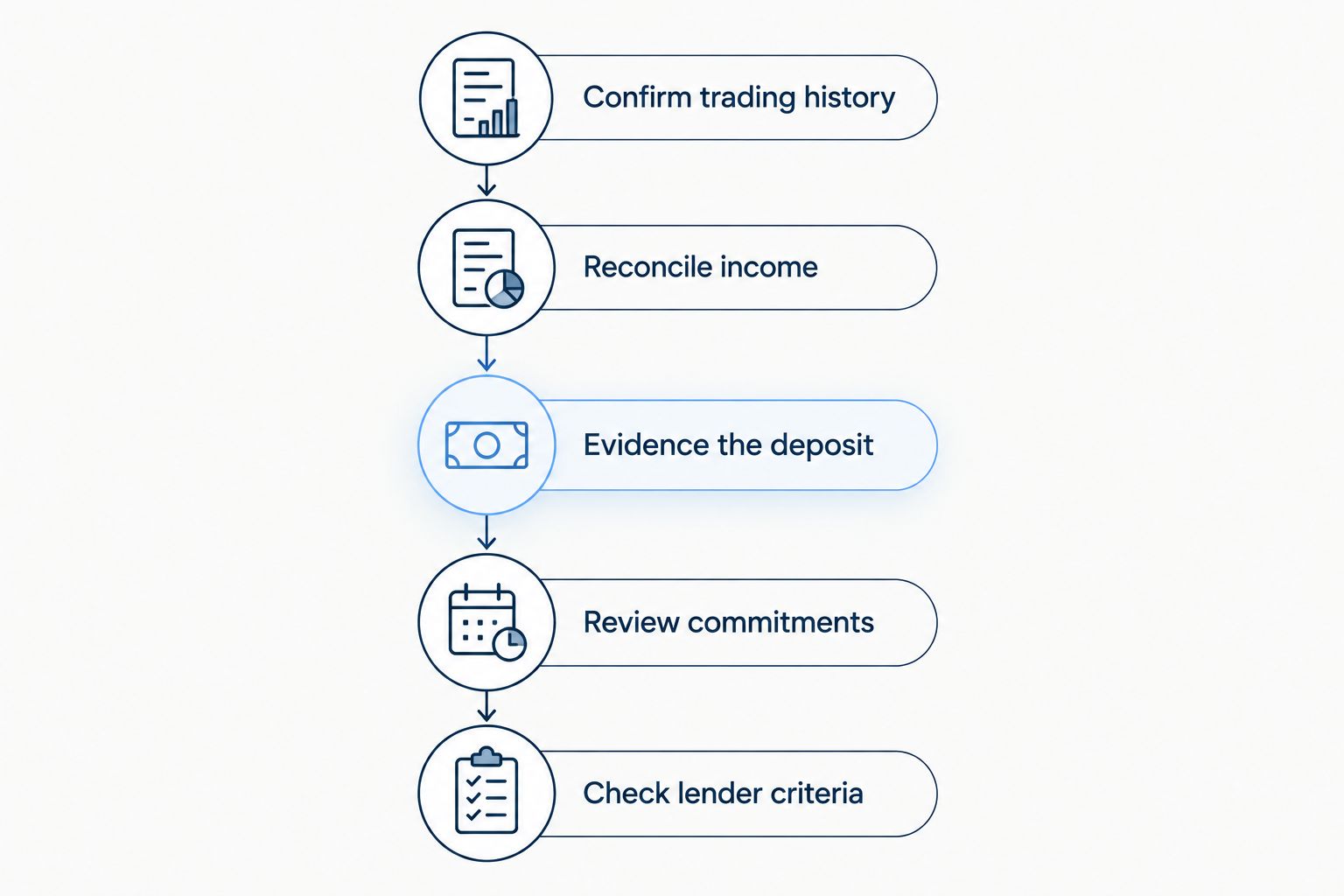
A complete file makes the financial position easier to assess. It does not remove underwriting, property valuation or the lender's final approval requirements.
Discuss your self-employed mortgage
Heron Financial offers fee-free, whole-of-market mortgage advice for self-employed applicants and company directors.
Can I use income from before I became self-employed?
One year of self-employed accounts does not erase your previous employment history. Evidence of earlier work in the same field can explain your experience, but the lender decides what relevance that history has to its criteria.
Previous salary is not automatically current income. Provide the background where requested, while keeping the affordability calculation tied to earnings the lender accepts now.
Does a bigger deposit solve the one-year-accounts problem?
One year of accounts still needs to meet the lender's trading-history criteria, even with a larger deposit. A larger deposit reduces the borrowing relative to the property value; it does not prove sustainable income.
Treat deposit strength and income evidence as separate requirements. Both need to support the application.
FAQ
Can I get a mortgage after just one year of self-employment?
Yes, a UK mortgage is possible after one year of self-employment if a lender accepts your trading history and evidence. Approval also depends on affordability, credit checks, the deposit and the property.
Do I need accounts or an SA302 for a self-employed mortgage?
The lender decides whether it needs completed accounts, Self Assessment tax calculations, tax year overviews or a combination. An SA302 and a tax year overview are different documents, so check the requirements before applying.
Can I use my business turnover as mortgage income?
Business turnover is not the same as income available for mortgage repayments. The lender assesses the relevant profit or remuneration under its criteria, after distinguishing business receipts from business costs.
Can a company director get a mortgage with one year's accounts?
Yes, a company director can qualify with one year's accounts where the lender accepts the history and financial evidence. The lender's treatment of salary, dividends and company profit determines which income supports the assessment.
Will a bigger deposit guarantee a mortgage with one year's accounts?
No, a bigger deposit does not guarantee approval with one year's accounts. The lender still checks trading history, acceptable income, affordability and creditworthiness.
Should I wait until I have another year's accounts?
Wait only if the additional evidence is needed or better supports your circumstances. Another completed year does not guarantee approval, particularly if the subsequent figures show lower earnings.
Does an agreement in principle guarantee my self-employed mortgage?
No, an agreement in principle is not a mortgage offer. The lender still needs to complete its assessment of your documents, circumstances and the property before issuing an offer.
One last thing
The useful question is not just whether a lender accepts one year's accounts; it is which income figure that lender will use. A positive answer on trading history can still leave a gap between your expected borrowing and assessed affordability.
Before applying in 2026, ask for the proposed income calculation, the evidence supporting it and any unresolved conditions. That gives you a concrete basis for deciding whether to proceed.


