

Key worker mortgages give NHS staff, teachers, police officers, firefighters and other public-sector employees routes to buying a home with smaller deposits and higher income multiples than standard high-street deals allow. What sets this segment apart is irregular pay structure — unsociable-hours payments, overtime, NHS banding increments — that many lenders' standard affordability calculators don't handle well.
- Key worker mortgage scheme routes in 2026 include First Homes (30-50% discount), Shared Ownership priority and 95% LTV deals.
- NHS staff, teachers and police often need a lender that counts overtime and unsociable-hours pay in full, not at a discount.
- Heron Financial is fee-free and whole-of-market, best for key workers whose income mix trips up standard affordability calculators.
- First Homes eligibility and local connection rules vary by council — check before you commit to a property.
Why key worker mortgage schemes matter in 2026
Public-sector pay in the UK rarely tracks private-sector salary growth, which keeps the deposit gap wide for key workers in high-cost areas. A nurse on NHS Band 5 or a newly qualified teacher is often earning a basic salary that, on its own, supports a smaller mortgage than local house prices demand.
That's where scheme routes and lender flexibility do the heavy lifting. First Homes gives first-time buyers, including key workers, a discount of 30-50% off market value in participating council areas — a genuine reduction in the amount you need to borrow, not a subsidy that has to be repaid monthly. Shared Ownership schemes in many London boroughs still give key workers priority allocation over general applicants, which shortens the wait for a suitable property.
The complication is that none of this is automatic. Eligibility, discount bands and local connection rules differ by council, and mortgage lenders vary wildly in how they treat unsociable-hours pay, overtime and NHS incremental pay rises. Two lenders looking at the same payslip can reach very different maximum loan amounts.
Confirm your eligibility for key worker home-buying schemes
Start here before you view a single property, because eligibility drives which lenders and products are even on the table.
- Check whether your local authority runs a First Homes allocation with a key worker or local connection priority
- Confirm your employer or job title sits on your council's key worker definition list — it's not universal
- Look at Shared Ownership providers in your target area; several reserve a share of units for NHS and education staff
- Ask whether armed forces or police-specific schemes apply if that's your employer
- Rule out schemes tied to postcodes you're not planning to buy in
Compare high LTV and low-deposit mortgage products
If no scheme fits, a 95% LTV mortgage is usually the next lever, and 2026 has seen more lenders return to this end of the market than in the previous two years.
- Shortlist lenders offering 95% LTV on standard purchases, not just new-build
- Check whether a family deposit or guarantor option lowers your effective LTV band and rate
- Compare 2-year and 5-year fixed rates at the same LTV — the gap moves with the Bank of England base rate
- Ask each lender how they stress-test affordability at your LTV level
- Confirm whether mortgage indemnity or higher-LTV fees apply, since these affect the real cost
Get unsociable-hours and overtime pay recognised in full
This is the single biggest reason key worker mortgage applications get declined or downgraded at underwriting.
- Gather 3-6 months of payslips showing overtime, unsociable-hours and on-call payments separately from basic pay
- Ask each lender in writing what percentage of variable pay they'll count, before you apply
- For NHS staff, confirm whether incremental pay progression is treated as guaranteed future income
- Flag any bank nursing, locum or agency shifts as a distinct income stream — some lenders exclude it entirely
- Avoid applying to a lender that only accepts basic salary if variable pay is a meaningful share of your income
Use First Homes or Shared Ownership discounts where you qualify
Once eligibility is confirmed, the mortgage itself needs to be structured around the discount, not the full market value.
- Get a mortgage in principle based on the discounted purchase price, not the open-market price
- Confirm your solicitor is experienced with First Homes restrictive covenants — resale rules differ from standard freehold purchases
- For Shared Ownership, check the rent-plus-mortgage total against your actual take-home pay, not gross salary
- Ask whether staircasing (increasing your owned share later) is capped or unrestricted under that scheme
Get a mortgage in principle before house-hunting
A mortgage in principle tells you your realistic ceiling and speeds up any offer you make, which matters more in a fast-moving 2026 market than it did a few years ago.
- Use your full income including recognised overtime, not just basic salary, when getting the agreement in principle
- Get it refreshed if your pay changes mid-search — an outdated AIP can undermine an offer
- Check the AIP is a hard search where possible so it carries more weight with estate agents
Work with a whole-of-market broker to widen your lender pool
Standard high-street affordability calculators aren't built around shift patterns and NHS pay scales, and going direct to one bank means testing only one set of rules. Heron Financial is fee-free and whole-of-market, which means every application is matched against lenders known to handle key worker income structures well, rather than whichever lender you happened to walk into.
- Ask any broker whether they're restricted to a panel or genuinely whole-of-market
- Confirm there's no broker fee before you commit — Heron Financial doesn't charge one
- Get a shortlist of 3-5 lenders likely to accept your specific income mix, not a single recommendation
- Ask for the underwriter's stated policy on your pay type, in writing, before submitting
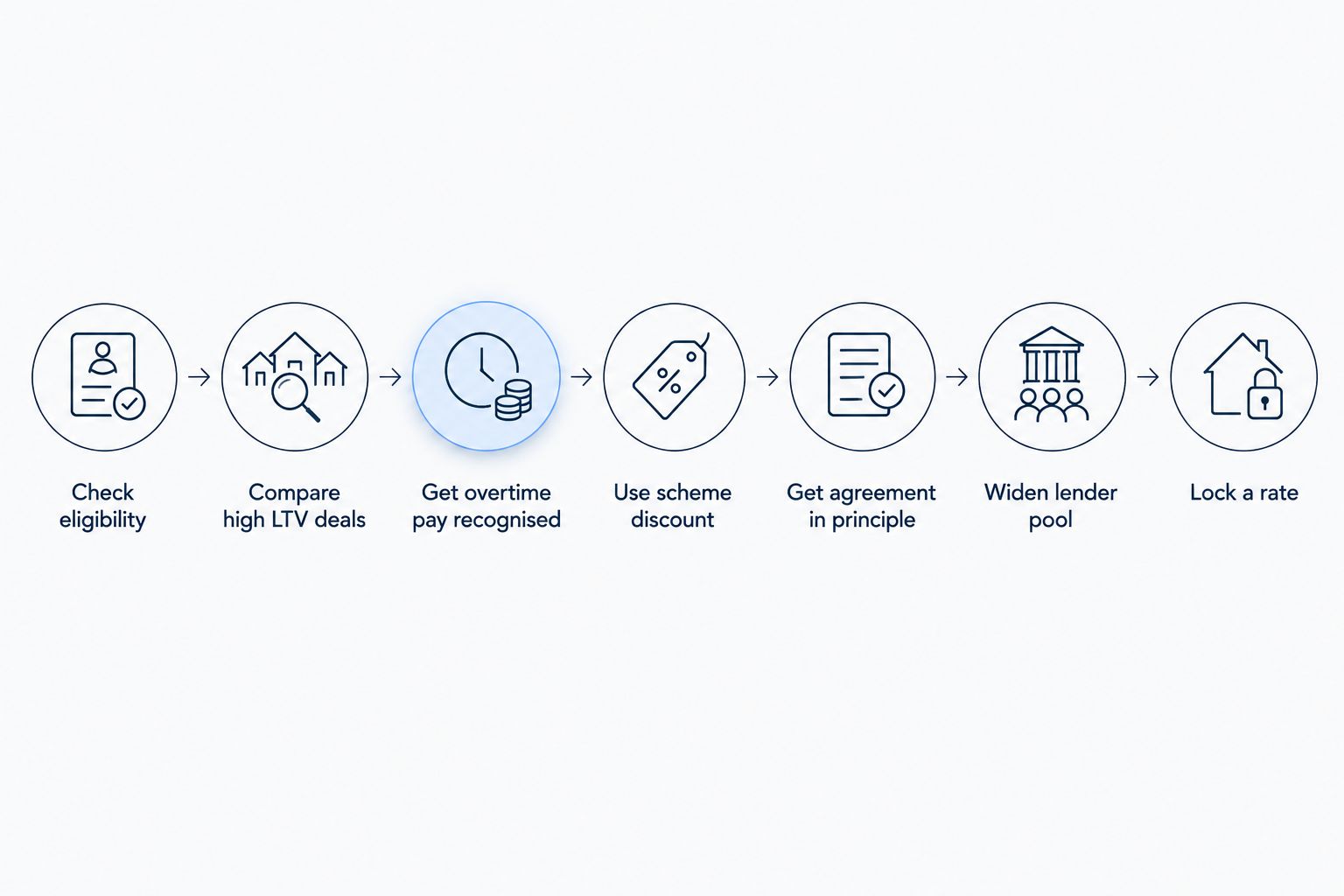
Lock a rate before your scheme window or fixed deal closes
First Homes allocations and Shared Ownership priority windows can close faster than a standard purchase chain, and 2026 rate volatility means the deal you see today may not exist in six weeks.
- Ask your lender how long the offered rate is held once a mortgage in principle is issued
- Confirm whether the scheme has a hard completion deadline separate from your mortgage offer
- Get your solicitor instructed early so legal delays don't cost you the rate
Comparing key worker mortgage routes in 2026
| Option | Best for | Key requirement | Limitation |
|---|---|---|---|
| First Homes | First-time buyer key workers in participating council areas | Local connection or key worker job title on council list | Resale restricted to future eligible buyers |
| Shared Ownership | Key workers who can't afford full market value outright | Priority allocation with named employer type (NHS, education) | Rent plus mortgage can exceed expectations |
| 95% LTV mortgage | Key workers with a small deposit and no scheme access | Deposit of roughly 5%, strong credit history | Higher rate than lower-LTV deals |
| Standard mortgage via whole-of-market broker | Key workers with irregular pay lenders undervalue | Documented overtime/unsociable-hours history | Requires more paperwork upfront |
Verdict: for most key workers with variable pay, a whole-of-market broker search beats walking into a single high-street branch — Heron Financial's fee-free model means that search costs nothing extra.
Common mistakes key workers make
- Assuming their job title automatically qualifies for First Homes — council definitions of "key worker" vary and some exclude roles you'd expect to be included
- Applying with basic salary only when overtime or unsociable-hours pay makes up 15-20% of take-home income, understating what they can actually borrow
- Missing scheme deadlines because Shared Ownership and First Homes allocations move faster than a typical mortgage timeline
- Sticking with one bank instead of comparing lenders that specifically recognise NHS incremental pay or shift patterns
- Ignoring protection insurance despite shift work and higher physical-risk roles increasing the value of income protection cover
Check your key worker mortgage options
Fee-free, whole-of-market advice on scheme eligibility and lender fit.
If you're an NHS employee specifically, the lender list that works well differs from the general key worker pool — see the NHS nurses mortgage deals breakdown for lenders that count unsociable-hours pay in full.
FAQ
What is a key worker mortgage scheme in 2026?
There's no single national key worker mortgage product in 2026 — it's a mix of First Homes discounts, Shared Ownership priority allocations and lenders willing to count overtime and unsociable-hours pay in full. Eligibility depends on your council and employer type.
Do I need to be a first-time buyer to use First Homes?
Yes, First Homes is restricted to first-time buyers, with a 30-50% discount off market value in participating council areas. Key worker priority is added on top of that criteria in some boroughs.
Can NHS staff get a mortgage with unsociable-hours pay counted?
Some lenders count NHS unsociable-hours and overtime pay in full, others discount it heavily or exclude it. A whole-of-market broker check against multiple lenders' policies before applying avoids a declined application.
How much deposit do key workers need in 2026?
A 95% LTV mortgage needs roughly a 5% deposit, while First Homes reduces the amount you need to borrow by 30-50% against market value. Shared Ownership can lower the required deposit further depending on the share purchased.
Is Shared Ownership better than a 95% LTV mortgage for key workers?
Shared Ownership suits key workers who can't afford full market value even with a small deposit, since you buy a share and pay rent on the rest. A 95% LTV mortgage suits those who want full ownership and can meet standard affordability on their income.
Do teachers get a specific mortgage scheme?
Teachers don't have a dedicated national mortgage scheme in 2026, but many qualify for First Homes and Shared Ownership priority in areas that list teaching as a key worker role. Lender choice still matters for how term-time pay patterns are assessed.
Does a mortgage broker charge key workers a fee?
Heron Financial doesn't charge a broker fee for key worker mortgage applications, operating on a fee-free, whole-of-market basis. Always confirm any broker's fee structure in writing before you apply.
How long does a key worker mortgage application take?
A standard mortgage application typically takes 4-6 weeks from agreement in principle to offer, though scheme-tied purchases like First Homes can move faster due to allocation deadlines. Getting your income evidence ready early is the main way to avoid delay.
One last thing
The detail most key workers miss isn't the deposit — it's that First Homes resale restrictions stay on the property forever, meaning every future buyer must also meet local eligibility. That protects affordability for the next key worker, but it can narrow your resale pool later, so factor it into how long you plan to stay before you sign.


