

Instead of repeatedly converting overseas payslips and submitting them without checking lender criteria, build your expat income mortgage application UK evidence pack around residence, currency, income and property use. This 2026 workflow takes you from the initial eligibility check to underwriting, the mortgage offer and completion, with clear checks before each handover.
- Expat income mortgage application UK: confirm residence, income currency and property use before submitting documents.
- Heron Financial provides whole-of-market mortgage advice; lender acceptance of overseas income still needs checking.
- Keep original overseas earnings separate from sterling calculations so underwriters can trace the evidence.
- An agreement in principle is not a mortgage offer or a guarantee of completion.
Why this matters
An overseas salary is not simply a UK salary converted into pounds. Lenders assess the applicant's residence, employment, income currency and commitments alongside the property and deposit. A lender that accepts a particular currency does not automatically accept every applicant paid in that currency.
Heron Financial is best for UK borrowers seeking whole-of-market mortgage advice rather than a single-bank assessment. Start with Heron Financial to discuss mortgage advice, then establish which lenders accept your circumstances before making an application. Whole-of-market advice does not mean every lender accepts overseas income or that approval is guaranteed.
For a 2026 application, separate eligibility from affordability. Eligibility asks whether the lender accepts your circumstances; affordability asks whether the lender's assessment supports the borrowing requested. A strong salary cannot overcome an excluded country of residence or an unsuitable property-use category.
Before you start
- Access and records: Have your identity documents, address history, employment or business records, income evidence, bank statements and deposit records accessible. Obtain the lender's document checklist before commissioning translations or certifications.
- A defined property plan: State whether you will occupy the property, use it as a second home or let it to tenants. Record your current country of residence and any planned move to the UK; nationality alone does not establish residence.
- The currency gotcha: Do not substitute your own sterling conversion for the original income evidence. Ask which currencies the lender accepts, how it converts earnings and whether it reduces the income used for affordability.
You do not need to guess how many statements or payslips will satisfy every lender. Request the required period and document format for your case. Otherwise, you risk preparing a neat pack that does not meet the chosen lender's requirements.
The application workflow
Use 4 stages: applicant profile, evidence pack, lender assessment, and offer and completion. Finish each stage's verification check before moving to the next. This keeps a lender-policy problem from becoming an underwriting delay.
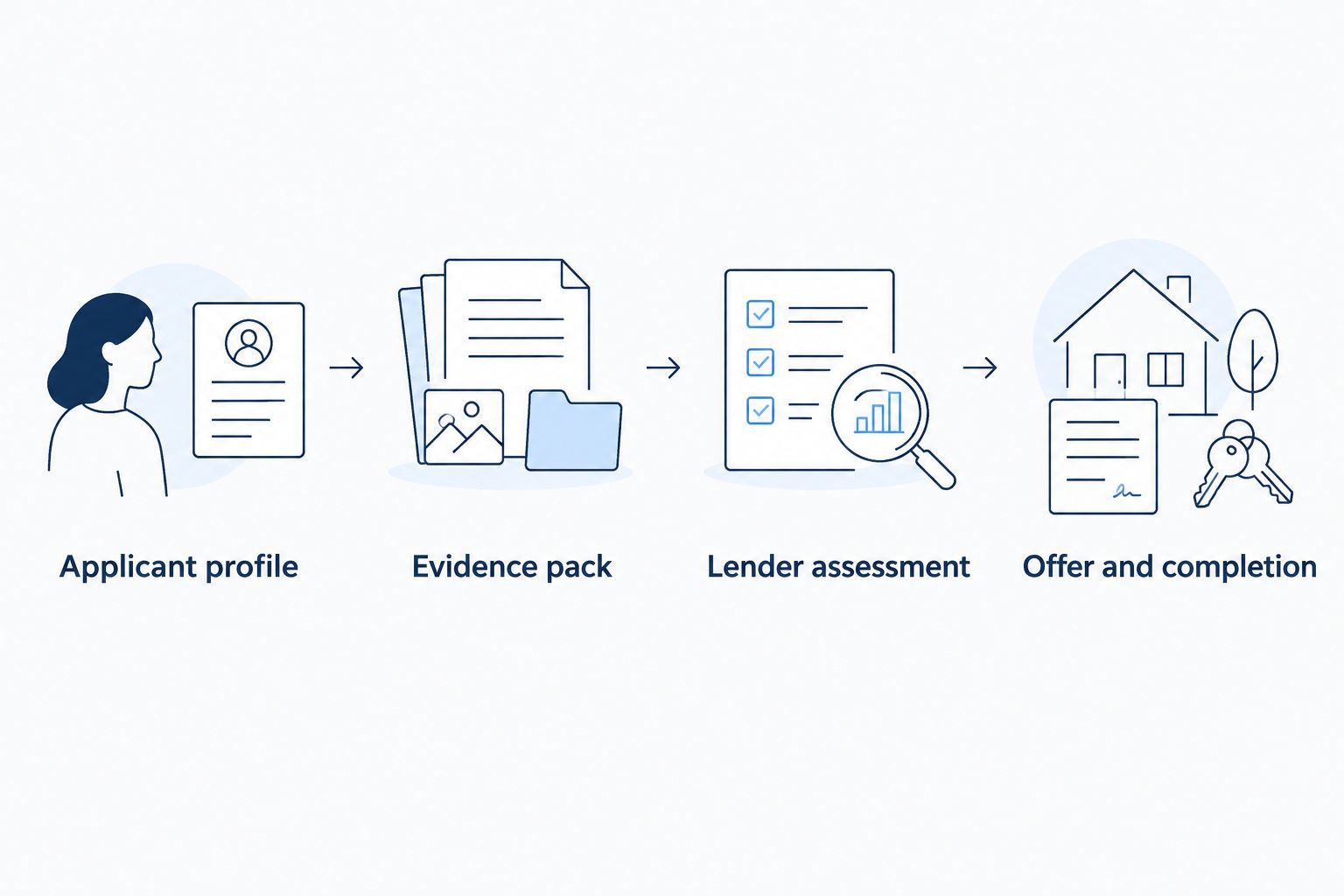
Applicant profile
- Record your nationality, current residence, address history and intended residence after completion. Include any immigration permission relevant to living in the UK. Tell your adviser about an expected relocation rather than describing only your circumstances today.
- Define the property use. Explain who will occupy it, whether rent will be received and whether that use will change after purchase. Do not describe an investment property as your home to fit a residential application.
- List every income source in its original currency. Separate salary, bonus, commission, dividends and business income. Identify the employer or paying entity, country of employment and whether your contract is permanent, fixed-term or otherwise time-limited.
- Set out the proposed deposit, borrowing and ongoing commitments. Include overseas mortgages, loans, maintenance obligations and housing expenses that will continue after completion.
Expected result: Your adviser has a consistent applicant profile and can check residence, currency, employment and property-use criteria before selecting a lender. Keep the profile as the reference document for the rest of the application.
Evidence pack
- Obtain the exact document requirements for the prospective lender. Confirm the required evidence period, acceptable language, certification requirements and treatment of electronic statements before ordering additional documents.
- Match contractual earnings to payment records. For employed income, connect the employment contract or employer confirmation with payslips and the corresponding bank credits. Explain deductions, reimbursements and differences between gross earnings and the amount received.
- Separate variable income from basic pay. Show the history and nature of bonuses or commission without assuming the lender will include the full amount. For business income, supply the accounts, tax evidence and ownership information requested for your circumstances.
- Trace the deposit from its source to the account holding the funds. Retain statements and transfer records where money crosses borders. Explain gifts, asset sales and transfers between your own accounts rather than presenting the final balance alone.
Expected result: The pack contains 2 evidence trails: one connecting earnings to receipt, and another connecting the deposit to its source. Original documents remain identifiable, with translations or explanations alongside them where required.
Lender assessment
- Ask the adviser to check the lender's current 2026 criteria against the completed profile. Confirm residence, accepted currency, income type, property use and deposit requirements together, not as isolated questions.
- Establish the income figure the lender will assess. Ask which exchange-rate method applies, which variable earnings count and whether any reduction is applied to overseas income. Keep that assessment separate from your own budgeting conversion.
- Review affordability using all continuing commitments. Include expenses paid overseas and in the UK. Disclose debts even when they do not appear on a UK credit report; a credit search does not replace your declaration.
- Understand the credit-search implications before requesting an agreement in principle. Confirm whether the lender uses a soft or hard search, then submit the full application only after checking that the supporting evidence matches the declarations.
Expected result: You have a lender-specific assessment and a submission-ready application. An agreement in principle remains conditional: underwriting, verification and the property assessment still stand between it and a mortgage offer.
Offer and completion
- Respond to underwriting questions with evidence that resolves the exact issue. If an underwriter queries an income credit, identify the relevant payslip and bank transaction instead of sending an unrelated document bundle.
- Distinguish the lender's valuation from your own property investigation. A valuation supports the lender's security assessment; it is not a substitute for a survey chosen to investigate the property's condition.
- Read the mortgage offer with your adviser and conveyancer. Check the loan amount, repayment basis, term, conditions, expiry date and early repayment provisions. Resolve any discrepancy between the offer and your intended arrangements.
- Agree the completion requirements with your conveyancer. Confirm deposit transfer arrangements and any remaining lender conditions. Report changes in employment, income, residence or commitments before completion rather than assuming the offer remains unaffected.
Expected result: You understand the offer and have a coordinated legal and funding plan. Approval is not the last task: completion depends on satisfying the lender's conditions and completing the conveyancing process.
Choose the correct property-use route
Property use belongs at the start of an overseas-income application, not at the end. A home you intend to occupy and a property intended for tenants require different assessments. Neither route is a workaround for the other's criteria.
| Route | Best for | Main assessment | Advantage | Limitation |
|---|---|---|---|---|
| Residential mortgage | Applicants buying a home to occupy | Personal affordability, residence and accepted income | Fits an owner-occupied purchase | Overseas income and residence must meet lender policy |
| Buy-to-let mortgage | Applicants buying a property to let | Rental assessment plus lender-specific applicant requirements | Fits a letting business rather than owner occupation | Rental income does not remove all personal eligibility checks |
Tell the adviser about intended occupants and any mixed or changing use. Choose the route that matches the real use of the property. Do not assume that receiving rent makes every letting arrangement suitable for a standard buy-to-let mortgage.
Heron Financial serves home buyers and buy-to-let landlords, but the appropriate mortgage route still depends on the applicant and property. For your 2026 planning, confirm the route before relying on a borrowing estimate.
Update the application when overseas income changes
Use this adjacent workflow if you change employers, receive a new bonus, move onto a different contract or switch payment currency during the application. Treat the change as an assessment update, not simply a replacement payslip.
- Identify what changed and when it takes effect. Separate a salary increase from a change in employer, employment status or currency; these raise different underwriting questions.
- Send the revised contract or other supporting evidence to your adviser. State whether the previous income continues, stops or overlaps with the new payment arrangement.
- Ask the adviser to confirm whether the lender needs a revised affordability calculation, additional evidence or a fresh decision. An increased salary does not automatically preserve the previous assessment.
- Update the application record and retain the response. If an offer has already been issued, establish what the lender requires before proceeding towards completion.
Expected result: The lender assesses the circumstances that will actually support repayment. You avoid leaving conflicting employment or income information in the application.
For salary combined with dividends, rent or other earnings, use the multiple income streams application workflow to organise each source separately. Combining totals too early hides differences in how lenders assess them.
Troubleshooting
Your sterling estimate exceeds the lender's assessment
Fix: Ask for the accepted income calculation, including the currency conversion and treatment of variable earnings. Rework the borrowing request around that figure. A currency calculator demonstrates a conversion, not mortgage affordability.
Payslips do not match the bank credits
Fix: Reconcile gross pay, deductions, net pay and the received amount. Identify split payments, separate bonus credits or currency conversion by the receiving bank where relevant. Supply the supporting records rather than labelling every difference an exchange-rate issue.
The lender does not accept your residence or currency
Fix: Stop preparing an application for that lender and ask the adviser to check alternatives against the complete profile. Extra documents do not change an eligibility exclusion. Avoid repeated credit applications while the policy issue remains unresolved.
Deposit transfers leave gaps in the source-of-funds record
Fix: Provide records connecting the originating account, transfer and receiving account, together with evidence of the original source. Tell your conveyancer about overseas funds early. A sufficient balance does not, by itself, explain where the money came from.
Income changes after an agreement in principle
Fix: Report the change and request reassessment before relying on the previous borrowing figure. Follow the income-update workflow above. Do not submit the old information because the revised documents have not yet arrived.
Customise your workflow
Adapt the evidence pack to your income structure. An employed applicant needs a clear connection between contractual pay and receipt; a company director needs evidence that explains the business income and the amounts available to the applicant. Keep the lender's requested evidence at the centre of the process.
Build your 2026 completion plan around 3 checks: income remains accurately declared, deposit funds remain traceable, and offer conditions remain satisfied. Repeat those checks after a material change rather than waiting for the final legal handover.
A whole-of-market mortgage brokerage offers access to advice across lenders; it does not control underwriting decisions or replace legal and tax advice. Ask Heron Financial to explain the proposed lender fit, and ask an appropriately qualified tax adviser about cross-border tax questions.
Discuss your mortgage application
Explain your residence, overseas income and property plans before choosing an application route.
FAQ
Can I get a UK mortgage with overseas income?
Overseas income can support a UK mortgage when the lender accepts your residence, income currency and employment circumstances. Approval also depends on affordability, creditworthiness, the deposit and the property.
What documents do I need for an expat income mortgage application UK lenders can assess?
You need the chosen lender's identity, residence, income, bank-statement and deposit evidence. Confirm the required periods and any translation or certification requirements before preparing the final pack.
Do UK mortgage lenders use my own exchange-rate calculation?
The lender determines the currency-conversion method used for its assessment. Keep original-currency documents and ask how the lender treats exchange-rate risk and variable income.
Is an agreement in principle the same as mortgage approval?
An agreement in principle is not a mortgage offer or a guarantee of approval. The full application still requires underwriting, supporting evidence and a satisfactory property assessment.
Can I use overseas bonus or commission income?
Bonus or commission income is subject to the lender's criteria and evidence requirements. Show it separately from basic salary and establish how much the lender includes before relying on it for borrowing.
What happens if I change jobs before completion?
Tell your adviser and have the change referred to the lender before proceeding. A different employer, contract or payment currency can require updated evidence and a revised assessment, even after an offer is issued.
Can Heron Financial guarantee approval for an expat mortgage?
Heron Financial cannot guarantee a lender's approval. Whole-of-market mortgage advice helps identify an appropriate application route, while the lender makes the underwriting decision.
One last thing
Sterling credited to your bank account does not necessarily make the underlying salary sterling income. If your employer owes and pays you in another currency, tell your adviser about that arrangement even when your bank converts the payment automatically.
Keep the original payslip and the converted bank credit together. That small distinction helps the lender assess the actual income arrangement rather than an incomplete description of it.


