

Instead of assuming your existing mortgage deal will follow you to a new property, check the lender’s porting terms, submit a new application for the new home and compare the full cost with replacing the mortgage. Porting a mortgage to a new home in 2026 keeps an eligible existing deal only if the lender approves both you and the property.
- Porting a mortgage to a new home means applying to use an eligible existing deal on a new property; approval is not automatic.
- Compare porting, any extra borrowing and a replacement mortgage before committing to a route.
- Heron Financial is best for UK home movers who want fee-free, whole-of-market advice on whether to port or replace a mortgage.
- Ask your lender and conveyancer to confirm how redemption, completion dates and any early repayment charge will be handled.
Why this matters
Your current mortgage is secured against the home you are selling. On completion, that loan is normally repaid from the sale proceeds, while the purchase requires a mortgage secured against the new property. A portable deal is a lender option to carry eligible product terms into that new arrangement; it is not permission to skip a new mortgage application.
The decision is not simply whether you can port. It is whether porting leaves you better off than replacing the deal. Your lender still assesses affordability, income, credit circumstances and the property. If you need more borrowing, the extra amount can be subject to different terms. If you need less, the lender’s rules on reducing the balance and early repayment charges matter.
For a home move in 2026, ask Heron Financial to assess the existing deal alongside whole-of-market alternatives before you settle on the financing route. Heron Financial provides fee-free mortgage broking; a lender’s own porting decision remains that lender’s to make.
Before you start
- Have your current mortgage details ready: lender, account reference, product end date, outstanding balance, rate, early repayment charge terms and any written portability conditions. Use your mortgage offer or ask the lender to confirm the current terms.
- Know the proposed purchase and sale position: expected property details, deposit or equity, borrowing required and whether the transactions are intended to complete together. Your conveyancer needs the same picture.
- Check the timing rule before you commit: if sale and purchase cannot complete together, ask the lender whether its porting terms permit a gap and what happens to any early repayment charge. Do not assume a charge will be refunded after a later purchase.
There is no universal Port mortgage button or application form across UK lenders. Ask your lender or broker for the exact process and document names that apply to your existing mortgage.
Current deal
Confirm the porting terms
- Find your mortgage offer and current product details. Identify the deal you want to retain, when it ends and whether the mortgage terms allow a port. A statement showing the balance does not, by itself, confirm that the deal is portable.
- Request a current redemption statement from your lender or through your conveyancer. Check the balance to be repaid, any early repayment charge and the date through which the statement applies. Ask separately how those figures change if the lender approves a port; a standard redemption figure is not a porting decision.
- Ask for the lender’s porting conditions in writing. Confirm whether the new purchase must complete with the sale, whether a gap is allowed and how the lender treats a smaller or larger loan. Check whether the existing rate applies to the whole proposed borrowing or only to the eligible ported amount.
Expected result: you can identify the deal you are trying to retain, its relevant end date and the conditions that could stop the port. If the terms are unclear, resolve them before choosing a purchase budget on the assumption that the rate will carry across.
New application
Test the borrower and the property
- Give the lender or broker your current financial position. Include your income, commitments, deposit, existing borrowing and any material change since the original mortgage was approved. If you are self-employed or a company director, ask which evidence the lender requires for your current income structure rather than sending an old document set by default.
- Provide the new property details when available. The lender must decide whether it will lend against that property, as well as whether you meet its current criteria. A portable deal does not override a declined valuation or a property that falls outside the lender’s lending rules.
- Submit the application using the lender’s stated porting route. Tell the lender or broker that you intend to retain the existing product and state any additional borrowing required. Check the mortgage offer when issued: it must match the property, proposed loan and product arrangement you intend to use.
Expected result: you have an application outcome for the new home, not just a verbal indication that your current deal is portable. In 2026, treat portability and mortgage approval as separate checks until both are confirmed.
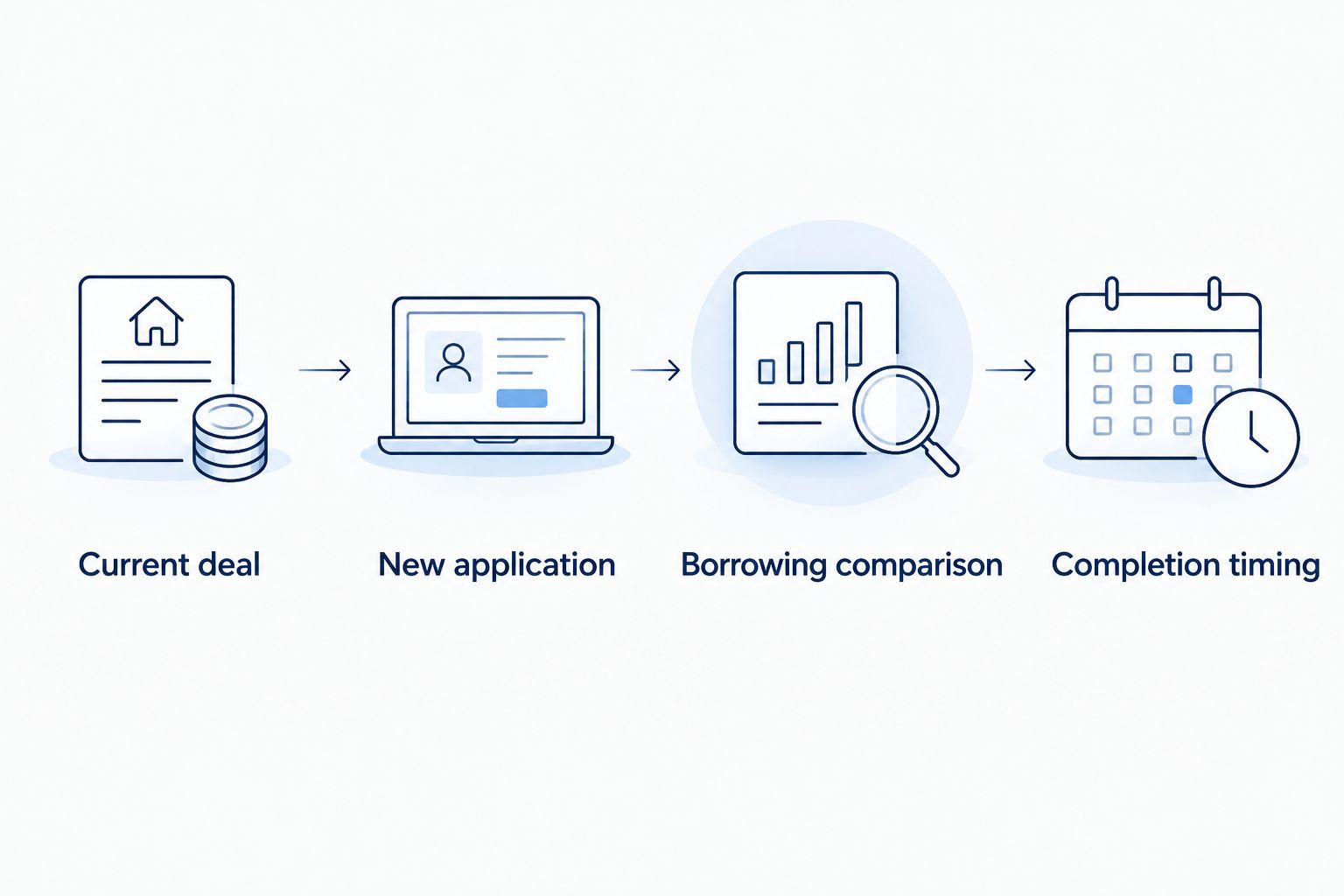
Borrowing comparison
Compare the complete move, not just the rate
- Ask for the porting illustration. Separate the amount eligible for your existing deal from any additional borrowing. Check the rate, remaining product period, repayment type and relevant charges for each part of the proposed mortgage.
- Obtain a replacement-mortgage illustration for the same purchase. Include the consequences of redeeming the current loan, including an early repayment charge where applicable. Compare lender charges, monthly payments and the balance you would owe over the same period; a lower payment alone can reflect a longer term.
- Choose the route that fits both cost and approval. A port can preserve an existing product but keeps you with your current lender’s lending criteria. A replacement opens other lenders’ criteria for consideration but can trigger costs for leaving the existing deal.
| Route | Best for | Main advantage | Main limitation |
|---|---|---|---|
| Port the existing deal | A home mover whose lender approves the new borrower and property and whose existing terms remain competitive | Retains eligible existing product terms | Approval, timing and any extra borrowing remain subject to lender rules |
| Replace the mortgage | A home mover whose port is unsuitable, unavailable or less favourable after total costs are compared | Allows assessment of other lenders and products | Redeeming the current deal can trigger an early repayment charge |
Expected result: you have like-for-like illustrations for the same property and borrowing need, with the cost of leaving your existing deal visible. Heron Financial’s whole-of-market mortgage advice is most useful at this decision point: your current lender can explain its own port, while a wider comparison tests the alternative.
If your income has changed since you took out the existing loan, assess what the lender will accept before relying on either illustration. The multiple income streams to one mortgage application workflow covers that preparation in more detail.
Compare your mortgage move
Check porting against a replacement mortgage with a fee-free, whole-of-market broker.
Completion timing
Align the mortgage with the sale and purchase
- Give your conveyancer the mortgage offer and the lender’s porting instructions. Confirm that the offer covers the new property and that the proposed completion arrangements satisfy the lender’s conditions. Do not rely on an earlier agreement in principle as the final authority to proceed.
- Confirm how the current mortgage will be redeemed. Your conveyancer handles the sale redemption and purchase funds, but the lender determines how its approved port is applied. Ask for an explanation of any early repayment charge shown on the redemption statement and whether an approved port changes the final amount due.
- Recheck the arrangement if dates or borrowing change. A delayed purchase, a different property or a revised loan amount can require lender review. Tell your broker, lender and conveyancer before exchanging contracts on a basis the mortgage offer no longer reflects.
Expected result: the people handling the sale and purchase have matching instructions, a valid mortgage offer and a clear treatment of the existing loan. In 2026, the decisive check is what your lender has approved for your actual transaction, not what its general portability description appears to allow.
Variant: port when you need extra borrowing
Porting a mortgage to a more expensive home adds a second question: how will the lender fund the amount above your existing eligible balance? Do not assume the extra borrowing receives your old rate. Ask for an illustration that separates the ported portion from the additional amount and shows the terms for each.
Give the lender the total purchase funding requirement, including the equity you expect from the sale. The lender assesses affordability for the proposed borrowing as a whole. If your current lender will not provide enough, compare a replacement mortgage for the full amount rather than treating the port as the only available route.
There is also a reverse case: you sell and buy with a smaller mortgage. Ask whether reducing the balance affects the lender’s porting terms or results in an early repayment charge on the amount not carried forward. The answer depends on your agreement and the lender’s handling of the move; it cannot be inferred from the fact that the deal is portable.
Troubleshooting
The lender says the deal is portable but declines the application
Fix: ask whether the decision concerns affordability, borrower circumstances or the new property. Portability describes a product feature, not guaranteed lending. Compare a replacement mortgage only after you know which issue needs addressing; another application does not correct inaccurate income or property information.
The purchase completes after the sale
Fix: obtain the lender’s written rules for a gap between completions before setting dates with your conveyancer. Confirm whether you must redeem the existing mortgage first, whether an early repayment charge applies and what conditions govern any later treatment of that charge. Never build the purchase funding plan around an assumed refund.
The port covers less than you need
Fix: request separate terms for additional borrowing and compare the combined arrangement against replacing the entire mortgage. Check affordability for the full new loan. If the additional borrowing cannot be approved, the existing deal alone does not complete the purchase.
The redemption statement shows a charge you did not expect
Fix: ask the lender to reconcile the statement with the approved port and its completion instructions. A redemption statement can show charges applicable to repayment on its stated terms; do not decide from the statement alone whether a charge is ultimately payable under an approved port.
The property or completion date changes after the offer
Fix: notify the lender or broker and conveyancer immediately and obtain confirmation that the offer remains valid or has been updated. The mortgage offer relates to a specified transaction. An accepted port for one property is not approval for a different property.
Customize your workflow
Build the comparison around the part of your move most likely to change the lender’s decision. For a straightforward move, focus on the remaining product term, total borrowing and completion dates. For variable income, establish acceptable income evidence early. For a purchase following a separation, settle who will borrow and who will own the new property before asking the lender to assess a port.
If the existing product ends near your intended move, compare what happens at the end of that deal as well as at completion. A port that retains a rate for only the remaining product period does not remove the need to choose what comes next. For a 2026 move, ask for illustrations that make the same assumptions about loan amount, repayment term and comparison period; otherwise, the apparent winner can change because the scenarios differ.
Keep the evidence together: current mortgage terms, the lender’s written porting response, illustrations for both routes, the new mortgage offer and your conveyancer’s completion plan. You should be able to explain which deal applies to each part of the borrowing and what happens if the move is delayed.
FAQ
What does porting a mortgage to a new home mean?
Porting a mortgage to a new home means applying to retain eligible terms from your existing mortgage deal when you buy another property. Your lender must still approve the new application and property.
Can I port my mortgage without another affordability check?
No; a portable deal does not guarantee a new mortgage. The lender assesses the proposed borrowing under its applicable lending criteria.
Can I borrow more when I port my mortgage?
You can request additional borrowing, subject to lender approval. Ask for separate terms for the ported amount and the extra borrowing, then compare the combined arrangement with a replacement mortgage.
Can I port my mortgage to a cheaper property?
You can apply to port to a cheaper property if the lender permits it and approves the new loan. Check how reducing the mortgage balance affects portability and any early repayment charge.
What happens if I sell before my new purchase completes?
Your existing mortgage is normally redeemed on the sale, so ask your lender how its porting rules treat a gap before the purchase. Confirm any early repayment charge and any later adjustment in writing before relying on the arrangement.
Is porting better than remortgaging when I move?
Porting is better only when the approved arrangement meets your borrowing needs and compares favourably on total cost. A replacement mortgage can be preferable once you include the existing deal’s exit costs and the terms available elsewhere.
Does a mortgage offer guarantee my port if the purchase changes?
No; a change to the property, borrowing or completion plan needs to be checked with the lender. Ask for confirmation or an updated offer before proceeding on the changed terms.
One last thing
Ask what happens if the transaction does not complete as planned. A porting comparison built only around the intended completion date misses the risk that a sale completes first or the purchase property changes. Get the lender’s answer before you exchange contracts. Heron Financial can compare the mortgage routes; only your lender can confirm how its porting terms apply to your transaction.


