

Best overall starting point: Paragon. Best for company-owned HMO enquiries: Kent Reliance. Best for straightforward HMO enquiries: The Mortgage Works. This 2026 guide compares HMO mortgage lenders by the application each merits, rather than treating one lender as the right answer for every landlord.
- Paragon leads this HMO mortgage lenders shortlist for landlords seeking a specialist buy-to-let starting point.
- Kent Reliance merits consideration for limited-company buy-to-let enquiries; check the proposed HMO against current criteria.
- Shawbrook and InterBay merit assessment where property complexity changes the lending route.
- Heron Financial offers fee-free, whole-of-market mortgage broking for UK buy-to-let landlords.
- Compare licensing, accepted rent, ownership and exit terms before selecting an HMO mortgage.
Why this matters
An HMO mortgage decision starts with the property, not the headline rate. The lender must accept the letting arrangement, ownership structure and property configuration before its affordability calculation becomes useful.
Heron Financial is best for UK landlords seeking fee-free, whole-of-market mortgage broking rather than a single-lender search. Heron Financial is a brokerage, not an HMO lender; keep that distinction clear when comparing advice with borrowing directly.
For a 2026 application, separate legal compliance from mortgage eligibility. A property that satisfies its local licensing requirements still needs to meet the lender's underwriting and valuation requirements.
What makes the best HMO mortgage lenders?
Use these six checks before comparing products:
- Property eligibility: The lender accepts the room configuration, tenancy arrangements, location and property condition.
- Ownership fit: The proposed borrower is acceptable, whether an individual or a limited company. Company ownership does not remove assessment of the people behind it.
- Rental assessment: The lender's accepted rental figure supports the requested borrowing under its interest coverage calculation.
- Landlord experience: Your letting history and wider portfolio meet the lender's requirements for that application.
- Licensing and planning: The property's licence, planning position and actual use are consistent with the application.
- Exit suitability: Early repayment terms and the intended holding period fit your plans to refinance, sell or change the property.
A lender that fails the property eligibility check drops out immediately. A lender that passes it still needs comparison against the other five criteria.
HMO mortgage lenders at a glance
This is a decision-led shortlist for 2026, not a claim that one lender has the cheapest product or will approve a particular case. Each name below has a distinct role in the search; current underwriting determines the final recommendation.
| Lender | Best for | Standout focus | Key limitation to resolve |
|---|---|---|---|
| Paragon | Specialist landlord starting point | Buy-to-let lending, including HMOs | Exact property and borrower eligibility still need checking |
| Kent Reliance | Company-owned HMO enquiries | Specialist buy-to-let lending | Company structure and HMO criteria require separate assessment |
| Shawbrook | More complex property enquiries | Specialist property finance | Complexity does not guarantee acceptance |
| The Mortgage Works | Straightforward HMO enquiries | Dedicated buy-to-let lending | A standard-looking property must still meet HMO criteria |
| InterBay | Enquiries crossing into commercial property | Buy-to-let, commercial and semi-commercial lending | The correct lending category must be established first |
1. Paragon: best HMO lender starting point for landlords
Paragon is a specialist buy-to-let lender with HMO lending within its property offering. It is a sensible first name to assess when you want the application considered through a landlord-focused lending route.
The reason to start here is category fit, not a promise of acceptance. Give the adviser the property schedule, tenancy details and ownership structure before asking whether Paragon belongs on the final shortlist.
Paragon pros:
- Its specialist buy-to-let focus matches the purpose of an HMO application.
- Its HMO offering makes it relevant beyond ordinary single-household letting.
- It provides a useful starting point for comparing other specialist landlord lenders.
Paragon cons:
- Specialist lending still requires a property-specific eligibility check.
- A suitable lending category does not establish the maximum loan.
- Its terms must fit your refinancing or sale plans, not just the purchase.
Best for: Landlords seeking an initial specialist assessment of an HMO purchase or remortgage.
Ask which rental figure will support the application and whether the valuation approach matches the property. Do not assume that the rent collected today is the figure underwriting will accept.
Verdict: Hold Paragon on the shortlist until eligibility, rent and exit terms are confirmed.
2. Kent Reliance: best HMO lender to assess for company ownership
Kent Reliance offers specialist buy-to-let lending, including limited-company and HMO lending. That makes it a relevant enquiry when a company will own the property rather than an individual landlord.
Start with the legal borrower. A company buying its first property presents a different application from an established company refinancing an existing portfolio, even when the proposed house looks identical.
Kent Reliance pros:
- Its buy-to-let offering includes company borrowing.
- Its HMO lending makes the property type relevant to the enquiry.
- It gives company landlords a specialist option to compare with other lenders.
Kent Reliance cons:
- Limited-company eligibility does not establish HMO eligibility.
- Directors, shareholders and the company structure still need assessment.
- The mortgage decision does not settle the tax consequences of company ownership.
Best for: Landlords seeking finance for an HMO held in a limited company.
For a 2026 company application, prepare the ownership details before choosing a lender. If you already own the property personally, obtain legal and tax advice before treating a transfer to a company as a routine remortgage.
Verdict: Hold Kent Reliance for company-owned cases; confirm both borrower and property requirements.
3. Shawbrook: best HMO lender to assess for property complexity
Shawbrook offers specialist property finance, including buy-to-let and HMO lending. It merits consideration when the application needs a closer assessment of the building, its use or the proposed transaction.
Present the complexity precisely. A property needing work, an unusual layout and an established HMO with a complicated tenancy schedule are different underwriting questions, not one generic difficult case.
Shawbrook pros:
- Its specialist property focus makes it relevant to detailed property enquiries.
- HMO lending sits within its property-finance offering.
- It provides another specialist route rather than restricting the search to conventional buy-to-let.
Shawbrook cons:
- An unusual property remains subject to valuation and underwriting.
- A building requiring work needs a clear distinction between its present and intended condition.
- Specialist finance does not replace licensing or planning compliance.
Best for: Landlords whose property's characteristics need explanation before a lender comparison is useful.
Prepare a concise schedule showing the existing use, proposed use and any outstanding work. Ask whether the enquiry concerns a completed investment property or a separate funding stage before the long-term mortgage.
Verdict: Hold Shawbrook for a property-specific assessment; wait if the intended lending stage is unresolved.
4. The Mortgage Works: best HMO lender to assess for a simple case
The Mortgage Works is Nationwide's specialist buy-to-let lender and offers HMO lending. It belongs in the comparison where the property and borrower present a straightforward HMO enquiry.
Straightforward does not mean automatic. The room count, tenancy arrangement, licensing position and applicant circumstances still need to meet the lender's current requirements.
The Mortgage Works pros:
- Its dedicated buy-to-let focus matches investment-property borrowing.
- Its HMO offering provides a relevant comparison with specialist lenders.
- It is useful to assess before assuming a more complex lending route is necessary.
The Mortgage Works cons:
- An ordinary residential appearance does not establish HMO eligibility.
- Accepted rental income remains central to the borrowing calculation.
- A change in occupancy or property use needs checking rather than assumption.
Best for: Landlords with a clear ownership structure and an established HMO letting arrangement.
Submit the actual occupancy and tenancy details, not a description of the property as simply a rented house. Accurate classification matters more than making the application look uncomplicated.
Verdict: Hold The Mortgage Works for straightforward enquiries; skip this route if current criteria exclude the case.
5. InterBay: best HMO lender to assess for mixed-use enquiries
InterBay offers buy-to-let, commercial and semi-commercial lending. It is relevant when the enquiry needs a clear boundary between an HMO investment and a property involving commercial use.
A residential letting arrangement and a mixed-use building need different questions. Establish what the building contains, how each part is occupied and which lending category applies before comparing mortgage terms.
InterBay pros:
- Its offering spans residential investment and commercial property lending.
- It is relevant when property classification needs closer examination.
- It provides a comparison route for enquiries that extend beyond a conventional rented house.
InterBay cons:
- The correct property category must be established before selecting a product.
- Commercial elements require their own tenancy and property information.
- A broad lending offering does not mean every mixed-use configuration qualifies.
Best for: Landlords assessing an HMO enquiry alongside commercial or semi-commercial property considerations.
Keep the residential rent schedule separate from any commercial occupation details. Ask the adviser to establish the appropriate lending route rather than submitting the same description to every lender.
Verdict: Hold InterBay where mixed use drives the enquiry; wait until the property classification is clear.
How we ranked the shortlist
The order follows application fit: specialist landlord lending first, then company ownership, property complexity, straightforward HMO enquiries and mixed use. These are distinct starting points, not approval probabilities or a comparison of live mortgage products.
The six criteria above decide the final recommendation. For your 2026 application, the strongest lender is the one that accepts the case and offers suitable borrowing and exit terms—not necessarily the first name in this table.
Check the HMO before choosing the mortgage
Licensing is not the same as lender acceptance
In England, GOV.UK's HMO guidance describes an HMO as a property occupied by at least 3 people forming more than 1 household, with shared facilities. Mandatory licensing generally applies to a large HMO occupied by 5 or more people forming more than one household.
Those national thresholds are not the whole licensing picture. Local additional licensing schemes can cover smaller HMOs, and planning requirements need a separate check with the council.
For a 2026 purchase, confirm the rules for the property's location rather than applying England's thresholds across the UK. Scotland, Wales and Northern Ireland have different legal frameworks.
Rental income must survive the lender's assessment
An interest coverage ratio compares accepted rent with mortgage interest calculated under the lender's assessment. The rent advertised by an agent, the rent collected and the valuer's assessment are not interchangeable.
Read the guide to rental income needed for a buy-to-let mortgage before choosing your target loan. Ask which rent basis applies to the HMO and whether ownership changes the calculation.
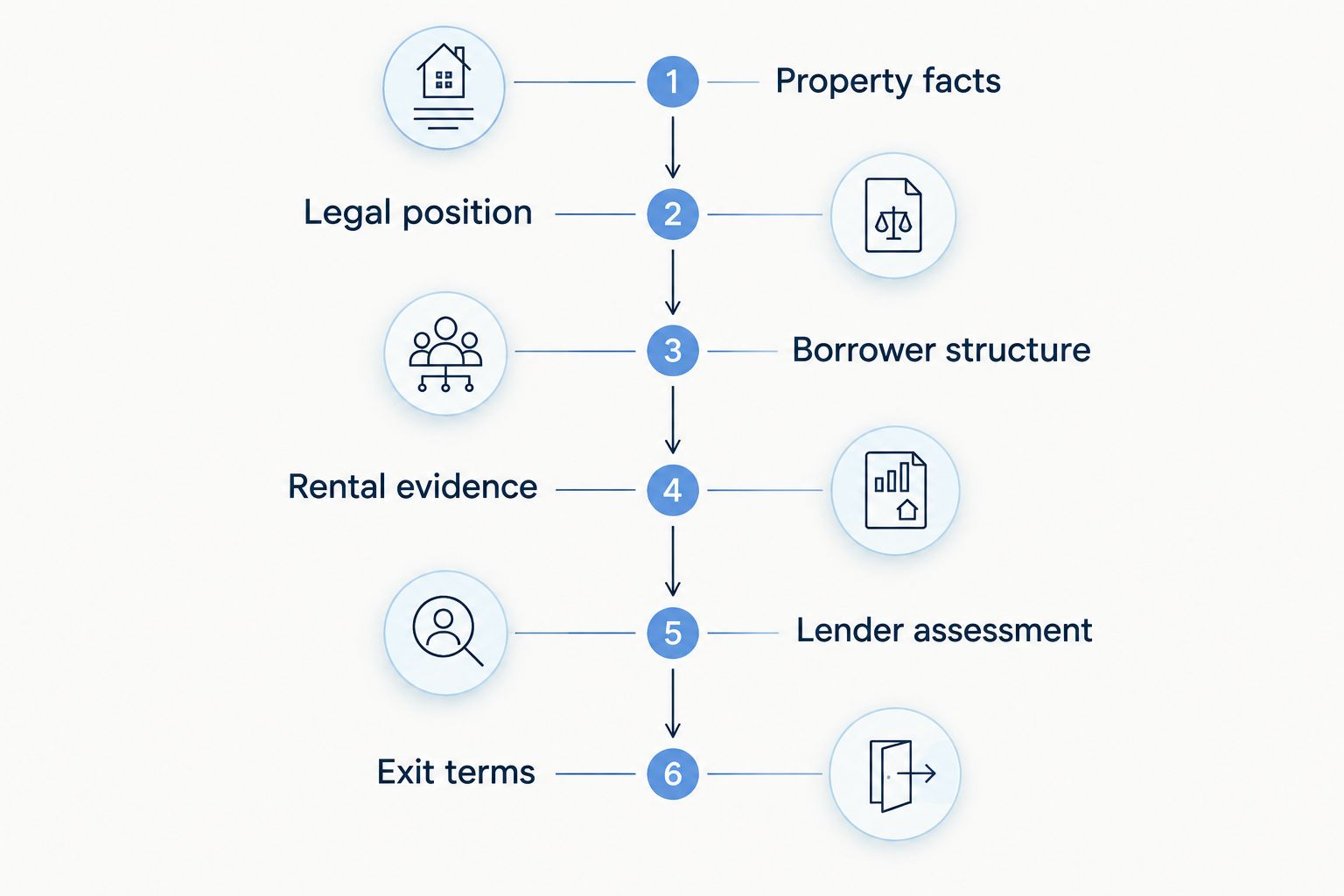
Build the application in the right order
- Property facts: Record the address, room arrangement, occupancy and tenancy structure.
- Legal position: Check licensing, planning and any outstanding compliance requirements.
- Borrower structure: Identify the applicants or company and relevant ownership details.
- Rental evidence: Provide the tenancy schedule and evidence supporting the proposed rent.
- Lender assessment: Confirm eligibility, valuation requirements and borrowing calculations.
- Exit terms: Check how the mortgage fits your intended refinancing or sale.
The sequence prevents an attractive mortgage illustration from becoming the basis for a purchase before the essential checks are complete.
Which HMO mortgage lender should you choose?
Start with Paragon for a general specialist-landlord enquiry, then compare the lender that matches your particular complication. Company ownership points towards assessing Kent Reliance; property complexity towards Shawbrook; a straightforward case towards The Mortgage Works; mixed use towards InterBay.
Use Heron Financial to compare the applicable routes through its fee-free, whole-of-market mortgage broking service. The brokerage serves UK buy-to-let landlords; the recommendation still needs to match your property, finances and plans.
Before instructing a valuation or committing to the transaction, obtain a clear answer on eligibility and the proposed borrowing calculation. Keep an alternative route under consideration until the preferred application is sufficiently established.
Discuss your HMO mortgage application
Compare lending routes through fee-free, whole-of-market mortgage broking.
FAQ
What's the best HMO mortgage lender in 2026?
Paragon is the starting point in this shortlist for a general specialist-landlord enquiry. The final choice depends on the property's eligibility, ownership, accepted rent and suitable mortgage terms.
Can I use an ordinary buy-to-let mortgage for an HMO?
Only if the lender's product and criteria accept the property's actual HMO use. Disclose the occupancy and tenancy arrangements rather than assuming a standard buy-to-let mortgage is suitable.
Can a limited company get an HMO mortgage?
Yes, limited-company HMO lending exists, and Kent Reliance is one lender to assess. The company structure, people behind it and property must meet the selected lender's requirements.
Do I need an HMO licence before applying?
Establish the property's licensing obligations before choosing a mortgage. Whether an existing licence or another form of evidence is required at a particular application stage depends on the lender and local rules.
Does a higher HMO rent guarantee a larger mortgage?
No, higher collected rent does not guarantee a larger mortgage. The lender applies its accepted rental figure, affordability assessment and property valuation to the borrowing request.
Is Heron Financial an HMO mortgage lender?
Heron Financial is a UK mortgage and protection brokerage, not a lender. It offers fee-free, whole-of-market mortgage broking and serves buy-to-let landlords.
Should I choose a lender before checking planning permission?
No, establish the property's planning and licensing position before relying on a lending recommendation. Mortgage eligibility does not establish that the property's use is legally compliant.
One last thing
Count households as well as occupants. In England, HMO classification depends on the household arrangement, not simply the number of bedrooms shown in a listing.
Before your 2026 application, send the adviser the tenancy schedule alongside the floor plan. That combination describes the investment more accurately than either document alone.
This guide provides general information, not a personal mortgage recommendation. Borrowing secured against property carries repossession risk if repayments are not maintained.


