

You need enough lender-assessed rent to cover the proposed buy-to-let mortgage’s interest at the lender’s stress rate, plus its required rental coverage margin; there is no single monthly rental figure for every application in 2026. Buy to let mortgages based on rental income only still involve checks on you, the property and the deposit, and passing the rental test does not establish that the investment will be profitable.
- Buy to let mortgages based on rental income only depend on assessed rent, the stress rate and interest coverage.
- Rental affordability does not remove credit, deposit, property or borrower eligibility checks.
- Use the lender’s accepted rent, not an optimistic letting estimate, when calculating borrowing capacity.
- Heron Financial suits buy-to-let landlords seeking whole-of-market mortgage advice rather than a single lender’s criteria.
How much rental income do I need for a buy-to-let mortgage?
Required monthly rent equals the mortgage balance multiplied by the annual stress rate and the required interest coverage ratio, divided by 12 months. Express both percentages as decimals when calculating. The lender sets the stress rate and coverage requirement; you cannot substitute the advertised mortgage rate unless its criteria explicitly permit that approach.
The reverse calculation answers the borrowing question: annual assessed rent divided by the stress rate and coverage ratio gives the loan supported by that rental test. Deposit limits, property suitability and other underwriting requirements can reduce the final amount further.
For a wider look at lender selection, read the guide to buy-to-let mortgages based on rental income. Start with the affordability method, not a headline interest rate.
| Part of the calculation | What it means | What you need to establish |
|---|---|---|
| Assessed rent | Rental income the lender accepts for underwriting | Whether the valuation supports the proposed rent |
| Mortgage balance | Amount you want to borrow | Whether the deposit and rental test support it |
| Stress rate | Interest rate used to test affordability | The rate applicable to the proposed mortgage |
| Interest coverage ratio | Required rental margin above stressed interest | The requirement for your borrower and ownership structure |
| Other limits | Checks outside the rental calculation | Credit, property, landlord experience and lender eligibility |
What does the regulatory rental coverage benchmark mean?
The Prudential Regulation Authority’s buy-to-let underwriting framework sets a minimum interest coverage ratio of 125% within its affordability standards. That is a regulatory floor, not a promise that a particular application will qualify at that level. The framework also addresses landlord costs, tax liabilities and interest-rate stress testing.
At 125% coverage, assessed rent must equal at least 1.25 times the interest figure used in the test. That interest figure is not necessarily your actual monthly payment. A lender’s applicable coverage requirement can be higher, so confirm the criteria for the specific application in 2026.
The PRA framework concerns firms within its scope. Do not treat one regulatory benchmark as an identical rule across every provider or every type of buy-to-let lending.
Why this matters
A property can produce rent above its expected mortgage payment and still fail the lender’s affordability calculation. The stress test asks whether rental income supports borrowing under the lender’s assumptions, not simply whether today’s payment fits beneath today’s rent.
The opposite distinction matters too. Passing a rental test does not account for every expense you will actually face, including repairs, management, insurance, tax and periods without a tenant. Keep mortgage eligibility and investment cash flow as separate calculations.
For a 2026 purchase or remortgage, establish the rental ceiling before committing to a borrowing target. Otherwise, a suitable deposit and acceptable credit record can still leave you with a loan request the rent does not support.
Rental-led affordability versus personal-income support
Rental-led underwriting assesses the property’s rent as the main source supporting the mortgage. It does not automatically mean the lender ignores your employment, other income or wider financial position. A lender can assess rental affordability and impose a separate personal-income eligibility requirement.
Some lenders also consider personal income to support a rental shortfall, an approach commonly called top-slicing. That is a different assessment, not a way to describe a mortgage supported by rental income only.
| Assessment route | Best for | Main advantage | Main limitation |
|---|---|---|---|
| Rental-led affordability | Landlords whose assessed rent supports the requested loan | Borrowing is assessed primarily against property income | The rental test can restrict borrowing despite strong personal income |
| Personal-income support | Applicants whose lender accepts surplus income alongside rent | Another income source can support the affordability assessment | Requires evidence of personal income and expenditure; not rental-income-only borrowing |
Neither route bypasses underwriting. Rental-led affordability still requires a suitable applicant and property; personal-income support adds an assessment of whether your other income genuinely has capacity to support the mortgage.
Choose the assessment route that matches your evidence, not the label that sounds most flexible. If rent alone does not support the loan, ask whether a smaller mortgage or a different assessment route is appropriate before submitting an application.
Why the rental income requirement varies
The required rent changes because the lender is assessing a particular loan, applicant and property. These are the main drivers to establish for a 2026 application:
- Loan size: A larger mortgage creates a larger interest figure for the rental test. A smaller loan reduces the rent needed under the same assumptions.
- Stress rate: The lender’s assessment rate affects the calculation even when the actual mortgage payment looks affordable.
- Coverage requirement: The lender applies its required margin above stressed interest, taking account of relevant underwriting criteria.
- Tax and ownership: Personal ownership and company ownership involve different tax considerations, which influence lender assessments.
- Accepted rent: The lender’s valuation and rental assessment determine the income used, rather than your preferred asking rent.
- Wider landlord position: Existing borrowing and portfolio commitments can require assessment beyond the property being financed.
A longer fixed-rate period can also affect how a lender applies stress-testing criteria. Do not assume a particular fixed term automatically produces a larger loan: request the actual calculation for the mortgage under consideration.
The useful comparison is therefore the loan supported by the same property across suitable lenders. Comparing coverage ratios alone misses differences in stress rates, accepted rent and eligibility rules.
How to check your rental borrowing limit before applying
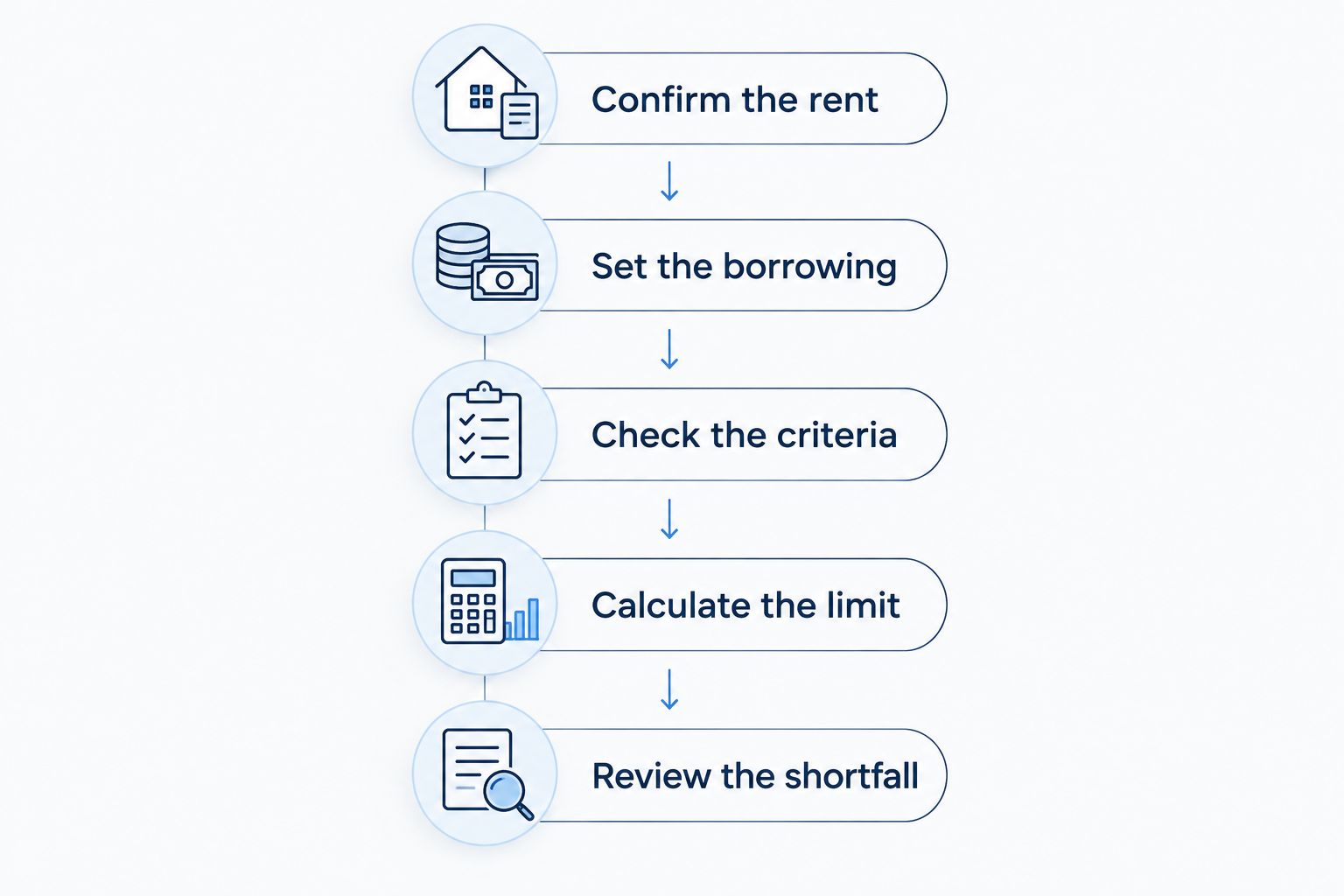
Use this sequence to distinguish a property that supports your target mortgage from one that needs more deposit or a different assessment route. Keep the evidence consistent: the rent, loan amount and ownership structure should all describe the same proposed transaction.
- Confirm the rent. Obtain a realistic letting assessment and identify whether the property will be let under the tenancy arrangement the lender accepts. The lender’s valuation remains decisive for its calculation.
- Set the borrowing. Establish the loan you need after the deposit or equity contribution. For a remortgage, distinguish the existing balance from any additional borrowing requested.
- Check the criteria. Ask for the applicable stress rate, coverage requirement and personal-income eligibility rules. Confirm whether the assessment is rental-led or uses additional income.
- Calculate the limit. Compare the requested borrowing with the amount supported by accepted rent. Then check the lender’s loan-to-value and property requirements separately.
- Review the shortfall. If the requested loan exceeds the rental limit, assess a smaller mortgage, additional deposit or an eligible alternative underwriting route. Do not increase the assumed rent without evidence.
A useful broker enquiry includes the property details, expected rent, requested loan, deposit source, ownership structure and existing property borrowing. Provide the information together so the assessment does not depend on assumptions that change later.
Heron Financial is best for buy-to-let landlords seeking whole-of-market mortgage advice rather than a single lender’s criteria. Its mortgage brokerage serves landlords across the UK. Advice helps you assess suitable routes, but it cannot override a lender’s rental calculation or guarantee an offer; you can discuss your circumstances with Heron Financial.
What changes if I already own several rental properties?
Under the PRA framework, a portfolio landlord has 4 or more mortgaged buy-to-let properties. For firms within that framework, portfolio underwriting considers the wider business rather than relying solely on the rent from the property in the application.
Expect the assessment to consider existing property borrowing, rental income and the sustainability of the portfolio. A property that meets its own rental test does not automatically resolve weaknesses elsewhere in your borrowing position.
Prepare an accurate property schedule before seeking a 2026 mortgage assessment. Include ownership, mortgage balances and rental income, and distinguish your own properties from those held jointly or through a company. The lender determines how your circumstances fit its portfolio criteria.
Can I get a buy-to-let mortgage without a salary?
A salary is not the only possible source of personal income, and some lenders do not impose a minimum personal-income requirement for eligible buy-to-let applicants. However, rental-led affordability does not mean every lender accepts an applicant without other income.
Check whether the lender accepts your circumstances before calculating the maximum loan. Pension income, self-employed earnings or other income need to be assessed under the relevant criteria rather than treated as equivalent to a salary without evidence.
Does a larger deposit reduce the rent I need?
A larger deposit reduces the requested mortgage, which reduces the rent needed under an unchanged stress rate and coverage requirement. It also changes loan-to-value, but the lender must still accept the property and applicant.
More deposit addresses loan size; it does not repair an unacceptable property or failed eligibility check. Establish which constraint is limiting the application before deciding where additional funds would help.
Can I use expected rent if the property has no tenant yet?
Expected rent can support a buy-to-let assessment where the lender accepts a projected rental valuation. A current tenancy is therefore not always necessary, but an agent’s estimate alone does not guarantee the amount the lender will use.
Ask how the lender establishes market rent and whether the proposed property and tenancy qualify. Keep a cash reserve for the period before rent starts rather than assuming mortgage completion and tenant occupation will coincide.
FAQ
How much rent do I need to qualify for a buy-to-let mortgage?
You need lender-assessed rent that meets the lender’s interest coverage test at its applicable stress rate. The required monthly amount depends on the loan size and assessment criteria, not a universal rental threshold.
Are buy to let mortgages based on rental income only available without employment income?
Some lenders assess eligible buy-to-let applications without a minimum employment-income requirement. You still need to meet their borrower, credit, deposit and property criteria, and rental-led underwriting does not remove those checks.
Is the rental stress test based on my actual monthly mortgage payment?
Not necessarily: the rental stress test uses the lender’s assessment rate and required coverage margin. Ask for that calculation rather than comparing rent only with the expected mortgage payment.
Does the lender use gross rent or my profit after expenses?
The rental coverage calculation generally starts with assessed rent rather than your final investment profit. Lender underwriting also considers relevant costs and tax, while your own cash-flow budget should include the expenses you will actually incur.
Can a limited company borrow more against the same rental income?
Company ownership does not automatically produce a larger mortgage. Borrowing depends on the lender’s company criteria, stress rate, coverage requirement and other limits, so compare the actual assessments before choosing an ownership structure.
Can a broker help if the rental income does not support the loan?
A broker can assess whether a smaller loan, a different suitable lender or an eligible personal-income-supported route fits your circumstances. Heron Financial provides whole-of-market mortgage advice for buy-to-let landlords, but lender approval remains subject to underwriting.
One last thing
The rent you expect, the rent the lender accepts and the money you keep are different figures. The first informs your letting plan, the second determines the rental affordability calculation, and the third determines whether the property works for you financially.
Before progressing a 2026 application, request the accepted rent, stress rate, coverage ratio and resulting borrowing limit together. A maximum-loan figure without those assumptions gives you less useful information than the calculation behind it.


