

Best overall route: residential interest-only lending for homeowners with an acceptable repayment plan. Best for rental property: buy-to-let lending. Best for retirement borrowing: retirement interest-only lending. This 2026 guide compares interest only mortgage lenders by lending route, so you can choose the right category before comparing individual banks and building societies.
- Compare interest only mortgage lenders by repayment plan, property use and affordability, not headline rate alone.
- Heron Financial provides fee-free, whole-of-market mortgage advice for UK borrowers comparing residential and buy-to-let options.
- Residential interest-only mortgages require an acceptable way to repay the outstanding capital.
- Buy-to-let lending assesses rental income; retirement interest-only lending assesses ongoing interest affordability.
- Choose part-and-part borrowing if you want scheduled payments to reduce some of the capital.
Why this matters
An interest-only mortgage separates your monthly interest payments from repayment of the loan itself. Making every scheduled payment does not repay the capital. With no overpayments or other capital repayments, 100% of the original loan remains outstanding at the end of a conventional interest-only term.
That makes the repayment plan central to lender selection. A lender that accepts your income but rejects your proposed repayment method is not a suitable choice, regardless of its advertised rate.
Heron Financial is a fee-free, whole-of-market mortgage broker for UK borrowers comparing interest-only lending routes. The business arranges mortgages; it is not the lender advancing the money.
What makes the best interest-only mortgage lenders?
For a 2026 application, assess these criteria before comparing rates:
- Repayment strategy: The lender must accept your proposed source of capital repayment and the evidence supporting it.
- Income assessment: Your earnings must satisfy the lender's affordability rules, including its treatment of variable or business income.
- Loan-to-value: LTV measures the loan against the property's value. Your deposit or equity affects which lending criteria apply.
- Property use: Your own home, a rental property and a second home require different assessments. Describe the intended use accurately.
- Term and age: Check the proposed end date against retirement, income changes and the timing of your repayment strategy.
- Exit restrictions: Compare early repayment charges, overpayment conditions and the consequences of selling or refinancing before the deal ends.
The best lender is the one whose criteria fit the whole application, not just the monthly payment. A lower payment does not compensate for an unworkable capital repayment plan.
Interest-only lending routes at a glance
These are lending categories, not interchangeable products. The order reflects the decision most borrowers face: establish the property use and repayment structure, then consider specialist circumstances.
| Lending route | Best for | Standout feature | Key limitation |
|---|---|---|---|
| Residential interest-only | Homeowners with an acceptable repayment strategy | Scheduled payments cover interest without reducing capital | The full capital needs a separate repayment plan |
| Part-and-part residential | Homeowners wanting some scheduled capital reduction | Combines repayment and interest-only borrowing | The interest-only balance still needs repayment |
| Buy-to-let interest-only | Landlords borrowing against rental property | Rental income is central to the lending assessment | Rent does not automatically repay the capital |
| Retirement interest-only | Older homeowners with sustainable retirement income | Repayment is usually linked to specified life events | Interest payments remain an ongoing commitment |
| Private-bank interest-only | Borrowers needing an asset-led assessment | Considers borrowing within a wider financial relationship | Access depends on the bank's client requirements |
1. Residential interest-only: best for a separate repayment plan
Residential interest-only lending is the starting point if you are borrowing against your own home and have a credible way to repay the capital. You pay the interest during the mortgage term, then settle the outstanding loan through the repayment strategy agreed with the lender.
A proposed strategy might involve investments or the sale of property, subject to the lender's rules. Do not assume that an asset is acceptable simply because you own it: its value, ownership and accessibility matter.
Residential interest-only pros
- Scheduled mortgage payments do not include capital repayment.
- You can assess the mortgage alongside a separately managed repayment strategy.
- The structure distinguishes interest servicing from the eventual capital obligation.
Residential interest-only cons
- Scheduled payments leave the capital balance unchanged.
- Investment losses or a lower property sale value can create a repayment shortfall.
Best for: Homeowners whose income supports the mortgage and whose documented assets or repayment arrangements meet the lender's criteria.
Before applying in 2026, identify exactly what will repay the loan, when that money becomes accessible and what happens if its value falls. If selling your home is the proposed strategy, also account for where you will live afterwards.
Verdict: Hold until the repayment strategy has been checked against the lender's criteria.
2. Part-and-part residential: best for partial capital reduction
A part-and-part mortgage divides borrowing into 2 repayment components: a capital-and-interest portion and an interest-only portion. Your scheduled payments reduce the first portion, while the second requires a separate repayment strategy.
This is an option when you want to reduce some debt through monthly payments without putting the whole mortgage on a repayment basis. It does not remove the need to plan for the remaining balance.
Part-and-part residential pros
- Scheduled payments repay some of the borrowed capital.
- The separately funded repayment obligation is smaller than on fully interest-only borrowing of the same amount.
- You can assess the repayment portion against your monthly budget.
Part-and-part residential cons
- Payments include capital repayment, unlike fully interest-only borrowing.
- The interest-only portion still creates an end-of-term liability.
Best for: Homeowners who can afford some capital repayment but also have an acceptable plan for the remaining interest-only balance.
Ask for a clear breakdown showing each portion and the projected outstanding balance at the end of the term. A combined monthly figure alone does not explain how much debt you are repaying.
For business owners, repayment structure and income assessment are separate questions. The mortgages for company directors guide explains the borrower circumstances to consider alongside the proposed mortgage arrangement.
Verdict: Hold until both the monthly commitment and remaining capital obligation fit your plan.
3. Buy-to-let interest-only: best for rental property borrowing
Buy-to-let interest-only lending is a route for landlords financing property intended for tenants. Rental income is central to the assessment, with lenders applying their own rental coverage and other eligibility requirements.
Interest-only payments do not turn rental income into capital repayment. Your plan must still explain how you will settle the mortgage, whether through accumulated funds, a sale or another acceptable strategy.
Buy-to-let interest-only pros
- Separates mortgage interest servicing from capital repayment.
- Allows the rental income assessment to reflect the property's intended use.
- Provides a distinct lending route for investment property rather than owner-occupied borrowing.
Buy-to-let interest-only cons
- Rental gaps and property expenses still affect your ability to service the loan.
- Selling the property does not guarantee enough proceeds to clear the mortgage and associated liabilities.
Best for: Landlords whose property, rental assessment and ownership structure meet the lender's requirements.
For a 2026 comparison, distinguish personal ownership from borrowing through a limited company. Also separate long-term residential letting from holiday letting: do not assume the same assessment applies.
Compare the mortgage with the property's wider cash flow. Maintenance, insurance, management and periods without rent remain relevant even when scheduled mortgage payments exclude capital.
Verdict: Skip residential owner-occupier products for a property intended for letting; assess the appropriate landlord route.
4. Retirement interest-only: best for retirement income borrowing
A retirement interest-only mortgage, often called a RIO mortgage, requires you to pay interest while the capital is usually repaid following a specified event. These events commonly include the last borrower dying or moving into long-term care, subject to the contract.
This differs from a conventional interest-only mortgage with a fixed capital repayment date. It also differs from a lifetime mortgage that permits interest to roll up rather than requiring regular interest payments.
Retirement interest-only pros
- Links capital repayment to specified events rather than a conventional fixed mortgage term.
- Keeps regular interest payments separate from capital repayment.
- Offers a retirement-focused assessment rather than relying solely on working-age earnings.
Retirement interest-only cons
- You must continue meeting the interest payments.
- Repayment from the property can reduce the estate remaining for beneficiaries.
Best for: Older homeowners with retirement income sufficient to sustain the required interest payments.
For joint borrowing, understand how affordability is assessed if one borrower dies. An income that supports the mortgage today is not automatically the income available to the surviving borrower.
Read the repayment triggers carefully and discuss the effect on anyone living in the property. The distinction between RIO and lifetime borrowing matters more than the shared interest-only terminology.
Verdict: Hold until retirement affordability and the contractual repayment events are clear.
5. Private-bank interest-only: best for an asset-led assessment
Private-bank lending is a route to investigate when your borrowing needs form part of a wider financial position involving substantial assets or complex income. It is not a substitute for affordability or a capital repayment strategy.
The relevant question is whether the bank's client requirements and underwriting approach fit your circumstances. A private-bank relationship does not, by itself, establish that a mortgage is suitable.
Private-bank interest-only pros
- Lets you assess the mortgage alongside your wider asset position.
- Provides a route to discuss income or ownership arrangements that need individual consideration.
- Brings the repayment strategy into the wider financing discussion.
Private-bank interest-only cons
- Eligibility depends on the bank's relationship and client requirements.
- Asset-linked arrangements introduce additional conditions to review.
Best for: Borrowers whose assets, income and borrowing needs justify investigating a private-bank relationship.
Check whether the proposal requires investments to be held with the bank or assets to support the lending. Those obligations belong in the comparison, alongside early repayment conditions and the mortgage structure itself.
Verdict: Skip private-bank lending as a default; investigate it when your financial circumstances justify the route.
How to shortlist a lender in 2026
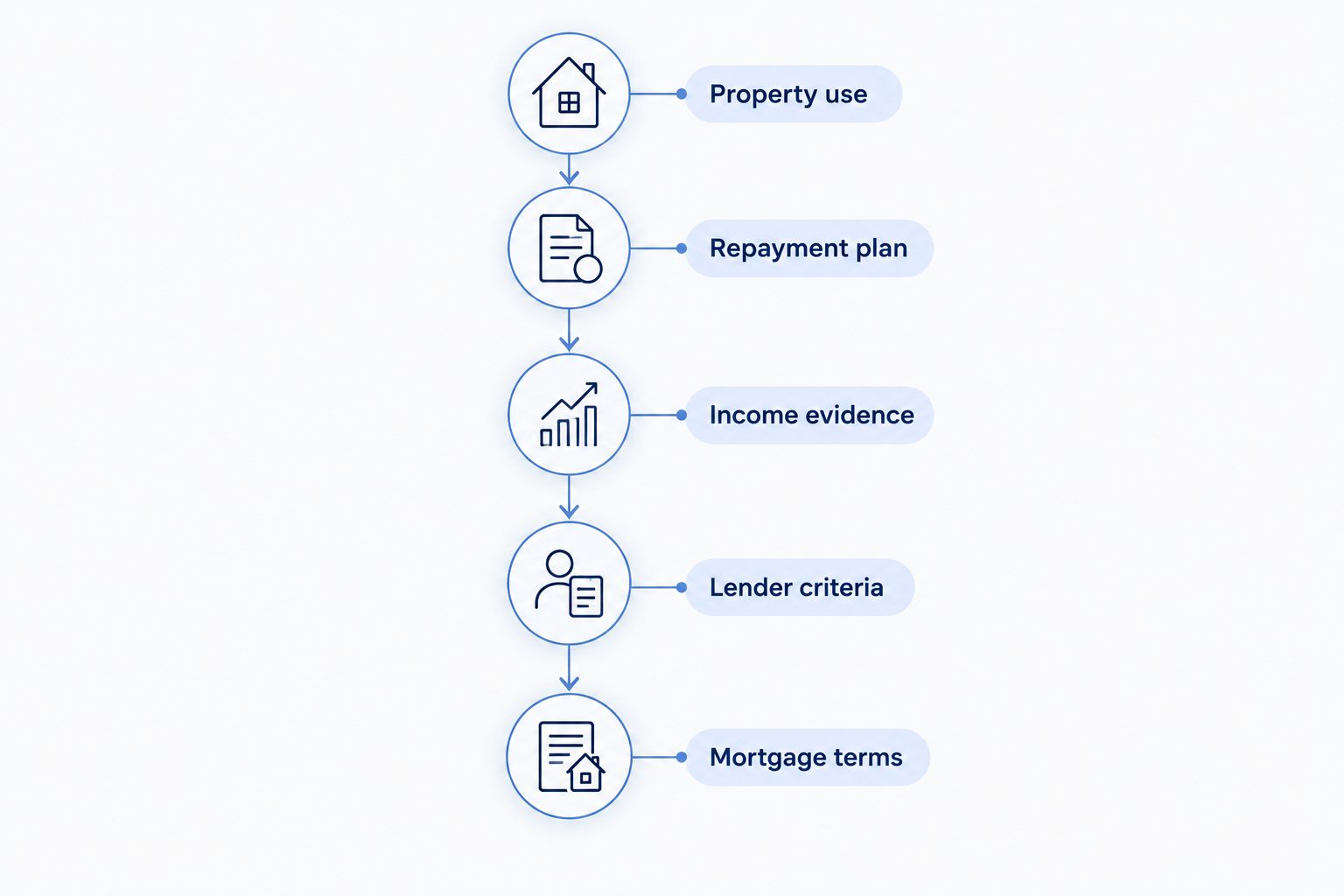
Use this sequence before submitting an application. It separates the repayment question from the income question, so you do not mistake success on one for eligibility on both.
- Property use: Establish whether the borrowing concerns your home, a rental property or another permitted use.
- Repayment plan: Identify the capital repayment source and assemble supporting evidence.
- Income evidence: Document salary, pension, rental or business income as relevant.
- Lender criteria: Match the property, applicants and proposed structure to the lender's requirements.
- Mortgage terms: Review the payment commitment, restrictions and exit conditions before proceeding.
Keep the capital plan under review after completion. With monthly servicing, 12 payments per year can keep the interest up to date without reducing the loan at all; payment history and repayment readiness are different measures.
How the routes are ranked
The ranking prioritises property use, repayment strategy and affordability before specialist circumstances. It does not claim that one bank is best for every applicant or that a named lender will accept a particular case.
A lender shortlist is useful only when it reflects your application. Heron Financial's whole-of-market mortgage advice is relevant to comparing those criteria across residential, landlord and complex-income borrowing.
Which interest-only route should you choose?
Start with residential interest-only lending if the property is your home and you have an acceptable capital repayment plan. Choose a part-and-part assessment if you want scheduled payments to reduce some of the borrowing.
Landlords should start with buy-to-let criteria. Retirement borrowers should distinguish conventional interest-only, RIO and lifetime borrowing before comparing individual providers. Investigate private banking when the wider financial relationship is relevant, not because the label sounds more suitable.
For your 2026 decision, choose the repayment structure first and the lender second. Heron Financial provides fee-free mortgage broking for borrowers who want that comparison assessed against their circumstances.
Discuss your interest-only mortgage options
Review your property use, income and repayment plan with a fee-free, whole-of-market mortgage broker.
FAQ
What's the best interest-only mortgage lender in 2026?
The best interest-only mortgage lender is the one that accepts your repayment strategy, income and property circumstances. Compare eligibility and mortgage conditions before selecting a deal.
Does an interest-only mortgage pay off the loan?
No, scheduled interest-only payments do not repay the capital. You need a separate way to settle the outstanding balance under the mortgage agreement.
Can I use the sale of my home as a repayment plan?
A property sale is acceptable only where the lender's criteria permit it. The lender will assess the proposed strategy, and you must consider your housing needs after the sale.
Is part-and-part better than fully interest-only borrowing?
Part-and-part borrowing is better suited to borrowers who want scheduled payments to reduce some capital. The interest-only portion still needs an acceptable repayment strategy.
Can self-employed applicants get an interest-only mortgage?
Self-employed applicants can be considered for interest-only borrowing, subject to lender criteria. Income evidence and the capital repayment strategy must both satisfy the assessment.
Is a retirement interest-only mortgage the same as equity release?
A retirement interest-only mortgage is not the same as a lifetime mortgage. RIO borrowing requires ongoing interest payments, while lifetime mortgage arrangements can permit interest to roll up.
Does fee-free mortgage advice mean the mortgage has no costs?
No, fee-free mortgage broking does not mean the mortgage transaction has no costs. Review lender charges and other transaction expenses separately from the broker's fee policy.
Is Heron Financial an interest-only mortgage lender?
No, Heron Financial is a UK mortgage and protection brokerage, not a lender. It provides fee-free, whole-of-market mortgage broking for borrowers including homeowners, landlords and self-employed applicants.
One last thing
Remortgaging is not a guaranteed repayment strategy. A future application depends on the lending criteria, property valuation and financial circumstances at that time; reaching the end of an interest-only term does not guarantee another mortgage.
Before committing, write down how you would repay the capital if refinancing were unavailable. That answer exposes whether your plan repays the debt or merely postpones it.
Your home may be repossessed if you do not keep up repayments on your mortgage.


