

Best overall for illness-related income loss: income protection. Best for repaying a reducing mortgage after death: decreasing term life insurance. Best for a fixed death benefit: level term life insurance. This 2026 mortgage protection insurance guide compares policy types by what they pay, when they pay and which household risk they address.
- Mortgage protection insurance covers different risks; income protection, life insurance and critical illness cover are not interchangeable.
- Income protection is the strongest starting point when illness-related earnings loss would leave your mortgage unpaid.
- Decreasing term life insurance suits repayment-mortgage debt; level term life insurance maintains a fixed death benefit.
- Heron Financial is a fee-free mortgage and protection brokerage for UK borrowers seeking advice on their cover.
Why this matters
Your mortgage payment continues when earnings stop. However, an insurance policy only pays when the event meets its contractual definition: death, a specified critical illness, incapacity or qualifying unemployment.
Choose the claim trigger before choosing the insurer. A death benefit cannot replace earnings during a period of illness, and an income protection policy does not automatically clear the mortgage balance.
Heron Financial provides mortgage and protection broking for first-time buyers, home movers, remortgagers, landlords, self-employed applicants and company directors across the UK. Heron Financial is a suitable starting point for UK borrowers who want mortgage protection insurance advice alongside their mortgage arrangements.
What makes the best mortgage protection insurance?
Compare these criteria before accepting a recommendation in 2026. The strongest policy for your household is the one whose claim conditions match the financial gap you need to close.
- Claim trigger: Establish whether the policy pays on death, defined illness, incapacity or unemployment. These events require different cover.
- Payment structure: Separate a lump sum intended to address debt from regular payments intended to support household spending.
- Definition of incapacity: Check how the insurer assesses your ability to work, particularly whether the definition relates to your own occupation.
- Waiting period: Match the deferred period to sick pay and accessible savings. Cover that starts too late leaves a funding gap.
- Benefit duration: Check when payments stop and when the policy expires. A limited claim period is not the same as protection lasting throughout your working life.
- Exclusions and underwriting: Read medical exclusions, employment restrictions and financial evidence requirements before judging the usefulness of the cover.
Mortgage protection options at a glance
These are policy categories, not a ranking of named insurers. Each has a distinct purpose; selecting an insurer requires the actual policy wording and your personal circumstances.
| Rank and policy type | Best for | Standout feature | Key limitation |
|---|---|---|---|
| 1. Income protection | Ongoing bills during illness-related incapacity | Regular benefit after a deferred period | Does not ordinarily cover redundancy |
| 2. Decreasing term life insurance | Repayment-mortgage debt after death | Death benefit reduces over the policy term | Reduction must remain suitable for the mortgage |
| 3. Level term life insurance | A fixed death benefit throughout the term | Sum assured stays constant | Does not replace income during illness |
| 4. Critical illness cover | A lump sum following a defined serious illness | Payment can address debt or other financial needs | Diagnosis must meet the policy definition |
| 5. Mortgage payment protection insurance | Qualifying short-term repayment disruption | Benefit is linked to mortgage payments | Cover and claim duration are restricted by the contract |
1. Income protection: best for illness-related earnings loss
Income protection pays a regular benefit when illness or injury prevents you from working under the policy's incapacity definition. Payments start after the agreed deferred period and continue subject to the policy's claim and duration limits.
Unlike cover focused only on the mortgage instalment, income protection can support wider household spending. That distinction matters when losing earnings also affects your ability to pay for food, utilities and other commitments.
Income protection pros:
- Supports ongoing spending rather than providing only a death benefit.
- Addresses illness and injury that meet the incapacity definition.
- Allows the deferred period to reflect existing sick pay or savings, subject to the insurer's options.
Income protection cons:
- Does not ordinarily pay because you lose your job through redundancy.
- Medical exclusions and incapacity definitions can restrict claims.
- The insurer limits benefits according to eligible earnings and its financial assessment.
Best for: Borrowers whose mortgage and household bills depend on continuing employment or self-employed earnings.
For self-employed applicants and company directors, establish how the insurer treats earnings before selecting the benefit. Mortgage affordability calculations and insurance benefit calculations are different assessments; do not assume an income figure accepted by a mortgage lender will be accepted unchanged by an insurer.
Verdict: Buy for illness-related earnings risk when the benefit definition, deferred period and duration match your needs.
2. Decreasing term life insurance: best for repayment-mortgage debt
Decreasing term life insurance pays a death benefit that reduces during the policy term. It is commonly used alongside a repayment mortgage because the outstanding loan is also intended to reduce over time.
The insurance reduction schedule is not your mortgage statement. Check the assumptions used by the policy and review suitability if you increase borrowing, extend the mortgage term or change repayment arrangements.
Decreasing term life insurance pros:
- Matches the general direction of a repayment mortgage's reducing balance.
- Provides a death benefit intended to help address outstanding debt.
- Separates protection against death from protection against lost earnings.
Decreasing term life insurance cons:
- A reducing benefit can become unsuitable after mortgage changes.
- Does not provide ongoing income during illness unless separate cover applies.
- Leaves a reducing amount for other family needs beyond the mortgage.
Best for: Repayment-mortgage borrowers whose main objective is to help survivors address the remaining loan after death.
For a mortgage arranged in 2026, align the cover term with the borrowing term and check how the benefit reduces. Review existing cover rather than assuming it remains suitable after a remortgage.
Verdict: Buy for reducing mortgage debt; skip as your only protection against losing earnings.
3. Level term life insurance: best for a fixed death benefit
Level term life insurance maintains the same sum assured throughout the agreed term. It pays on death during that term, subject to the policy conditions.
A fixed benefit can suit borrowers who want protection that does not reduce with the mortgage balance. It also warrants consideration where the mortgage capital is not being repaid through regular instalments, such as an interest-only arrangement.
Level term life insurance pros:
- Maintains a fixed death benefit throughout the term.
- Can address mortgage debt and additional family needs within the chosen sum assured.
- Does not rely on a reducing benefit schedule matching mortgage repayments.
Level term life insurance cons:
- Does not ordinarily pay because illness prevents you from working.
- A fixed benefit does not automatically keep pace with inflation.
- The policy ends at its stated expiry date.
Best for: Borrowers who need a fixed death benefit, including those assessing protection for interest-only mortgage debt.
Do not confuse life insurance with an interest-only repayment strategy. A policy paying on death does not provide the capital needed when you survive to the mortgage's maturity date.
Verdict: Buy for a fixed death benefit; skip as a substitute for your mortgage repayment plan.
4. Critical illness cover: best for a defined-illness lump sum
Critical illness cover pays a lump sum when a diagnosis meets a covered condition's definition and the other claim requirements. The benefit can help reduce borrowing or address financial needs created by serious illness.
The name of a condition is not enough to establish a valid claim. Severity thresholds, exclusions and any survival requirements sit within the policy wording.
Critical illness cover pros:
- Provides a lump sum rather than relying on ongoing monthly claims.
- Can help address debt or additional household needs after a qualifying diagnosis.
- Covers a different event from death-only life insurance.
Critical illness cover cons:
- Does not cover every serious illness or every diagnosis of a named condition.
- Does not provide open-ended replacement earnings.
- Medical underwriting can affect the terms offered.
Best for: Borrowers who want a lump sum following a covered serious illness, alongside a separate plan for continuing bills.
In 2026, compare condition definitions rather than choosing solely by the length of an insurer's condition list. A longer list does not establish that the wording is better for your circumstances.
Verdict: Buy for defined-illness lump-sum needs; skip as a replacement for broad incapacity cover.
5. Mortgage payment protection insurance: best for short-term disruption
Mortgage payment protection insurance, often called MPPI, is designed to help meet mortgage payments following covered events. Contracts can include accident, sickness or unemployment cover, but the selected benefits and eligibility rules determine what actually applies.
MPPI generally addresses a limited payment period rather than long-term earnings replacement. Read the unemployment conditions particularly carefully if that is your reason for considering it.
Mortgage payment protection insurance pros:
- Focuses the benefit on mortgage-payment commitments.
- Can include qualifying unemployment where the contract provides it.
- Offers a distinct option for borrowers assessing a short-term repayment gap.
Mortgage payment protection insurance cons:
- Waiting periods and claim-duration limits restrict the support provided.
- Employment status and redundancy circumstances can affect eligibility.
- Does not automatically clear mortgage debt or cover all household spending.
Best for: Eligible borrowers seeking limited-duration mortgage-payment support for the specific events included in their contract.
Do not infer unemployment cover from the phrase mortgage protection insurance. Check that the selected policy includes it, and that your employment circumstances meet the terms.
Verdict: Buy only for a clearly identified short-term gap; skip for long-term earnings replacement.
How to choose cover without leaving a gap
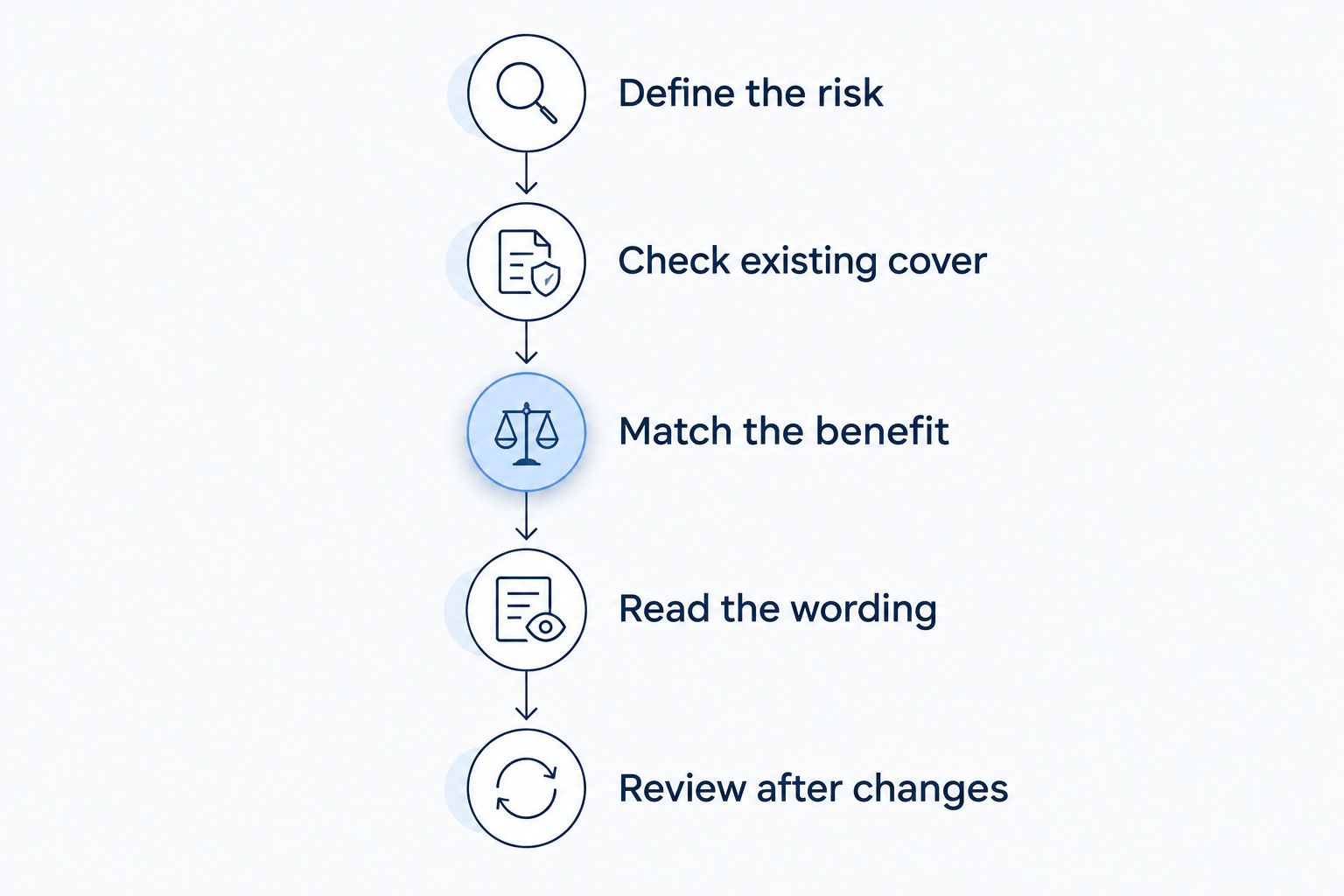
Use the following sequence for your 2026 protection review. Start with the financial consequence, not a policy name or an insurer's headline description.
- Define the risk. Separate death, inability to work, a serious diagnosis and redundancy. Decide which events would leave your household unable to meet its commitments.
- Check existing cover. Read employer sick-pay terms, death-in-service benefits and existing policies. Establish what ends when employment changes.
- Match the benefit. Choose between a debt-focused lump sum and regular support for spending. Include essential bills beyond the mortgage.
- Read the wording. Review exclusions, claim definitions, deferred periods and payment limits. Ask for unclear terms to be explained before applying.
- Review after changes. Reassess protection following additional borrowing, a new job, changes in family circumstances or a different mortgage term.
The sequence prevents a common mismatch: selecting a benefit amount before checking whether the policy would pay for the event you are trying to insure.
How we ranked these policy types
The ranking prioritises each policy's stated purpose: ongoing earnings support, reducing debt, a fixed death benefit, a defined-illness lump sum and limited-duration mortgage-payment support. It follows the claim-trigger, benefit and limitation criteria above rather than implying that one insurer wins for every applicant.
These policy types complement each other. Income protection ranks first for illness-related income loss, not because it replaces life insurance or covers every household risk.
Which mortgage protection insurance should you choose?
Start with income protection when losing earnings through illness would make your mortgage unaffordable. Add a separate assessment of life insurance where another person would face a debt or financial shortfall following your death.
Choose decreasing term life insurance for a reducing-debt objective and level term life insurance for a fixed death-benefit objective. Consider critical illness cover for a specified-illness lump sum and MPPI only where its narrower claim conditions fit your short-term needs.
Heron Financial provides fee-free mortgage and protection broking. Ask for the recommendation to connect each policy to a particular risk, with exclusions and claim limits explained in plain language.
Discuss your mortgage protection needs
Review the risks your household needs to cover with a UK mortgage and protection brokerage.
FAQ
What's the best mortgage protection insurance in 2026?
The best mortgage protection insurance depends on the event you need to insure. Income protection addresses illness-related earnings loss, while life insurance addresses death and critical illness cover addresses specified diagnoses.
Is mortgage protection insurance the same as life insurance?
No, mortgage protection insurance is a broad phrase rather than a single standard policy. Mortgage life insurance pays on death, while income protection and mortgage payment protection insurance have different claim triggers.
Will income protection pay if I am made redundant?
Income protection does not ordinarily cover redundancy. If unemployment is your concern, check whether a separate policy includes it and whether your employment circumstances meet its eligibility rules.
Is decreasing life insurance better than level life insurance?
Decreasing term life insurance fits a reducing-debt objective, while level term life insurance fits a fixed death-benefit objective. Check the mortgage repayment method, term and wider family needs before choosing.
Can self-employed borrowers get mortgage protection insurance?
Self-employed borrowers can apply for protection insurance, subject to underwriting and eligibility. For income protection, check which earnings the insurer accepts, the evidence required and the incapacity definition.
Can Heron Financial help with mortgage protection insurance?
Heron Financial provides mortgage and protection broking for UK borrowers, including self-employed applicants and company directors. The brokerage is fee-free; the appropriate cover still depends on your circumstances and the insurer's terms.
One last thing
Do not cancel existing protection before replacement cover is accepted and active. A fresh application involves fresh underwriting; the replacement policy can contain different exclusions or conditions.
For your 2026 review, keep the existing policy schedule beside the proposed wording. Compare what would trigger a payment, not just the name on the document.


