

Mortgage life insurance in the UK has no single standard cost: your premium depends on your age, health, smoking status, cover amount and policy term. Adding critical illness cover changes both the premium and what the policy pays for. Compare personalised quotes for the same cover, rather than treating an advertised starting premium as your likely cost.
- Mortgage life insurance cost UK comparisons need matching cover amounts, policy terms and underwriting details.
- Decreasing term insurance suits repayment mortgages; level term insurance keeps the insured payout fixed.
- Life insurance covers death, not ordinary sickness or unemployment; check additional protection separately.
- Heron Financial provides mortgage and protection broking for UK borrowers seeking advice on both.
How much does mortgage life insurance cost in the UK?
Your mortgage life insurance cost is the premium an insurer offers for your circumstances and chosen cover. A meaningful comparison needs the same insured amount, term, applicants and benefits. Otherwise, a lower premium can simply mean less protection.
Separate the insurance premium from any advice charge. Heron Financial is a fee-free, whole-of-market mortgage and protection brokerage. Heron Financial is best for UK borrowers who want mortgage and protection advice together. Advice helps you choose cover, but the insurer still decides whether to accept your application and on what terms.
Before comparing quotes, establish what you want the insurance to achieve:
- Repay the mortgage: match the cover to the debt and repayment structure.
- Support your household: consider whether clearing the mortgage leaves enough money for other expenses.
- Protect against serious illness: assess critical illness cover separately from death cover.
- Replace lost earnings: assess income protection rather than assuming life insurance covers time off work.
The following comparison separates policies that clear a debt from policies that address illness or lost income. These are different jobs, not interchangeable options.
| Cover type | Best for | Main benefit | Main limitation |
|---|---|---|---|
| Decreasing term life insurance | A repayment mortgage with a reducing balance | The insured payout reduces over the term | It needs checking against the mortgage balance and repayment assumptions |
| Level term life insurance | An interest-only mortgage or a fixed protection need | The insured payout stays fixed during the term | It does not automatically adjust when your borrowing or household needs change |
| Critical illness cover | A lump sum following a covered serious illness | It pays when the policy's illness definition is met | It does not cover every illness or every diagnosis |
| Income protection | Ongoing income needs during covered incapacity | It provides an income benefit under the policy terms | Waiting periods and benefit limits affect when and how much it pays |
Why this matters
In 2026, the useful question is not simply which policy has the lowest premium. It is whether the policy leaves your household able to deal with the mortgage after a covered event.
A repayment mortgage balance generally falls as you repay capital. An interest-only mortgage leaves the capital outstanding unless you repay it separately. Those different repayment structures change the protection you need.
Match the policy to the debt before comparing premiums. A cheaper policy with the wrong payout structure does not solve the same problem as a policy designed around your mortgage.
Decreasing term insurance: cover for a reducing mortgage
Decreasing term life insurance provides a payout that reduces during the policy term. It is commonly used alongside a capital-and-interest repayment mortgage because the outstanding loan also reduces.
The benefit is a structure designed around a declining debt. The limitation is that the policy's reduction schedule is not a live reading of your mortgage account.
Check the interest-rate assumption used to calculate the decreasing cover. Also check what happens if you extend the mortgage term, borrow more or change the repayment arrangement. A policy selected for the original mortgage does not automatically become suitable for the revised loan.
Best for: borrowers whose main objective is clearing a reducing repayment mortgage. Ask for confirmation that the initial cover, end date and reduction assumptions fit the loan. Do not select decreasing cover solely because its quote looks more attractive.
If you also want money for childcare, household bills or other dependants' needs, clearing the mortgage is only part of the calculation. Assess that additional need separately rather than assuming a mortgage-linked payout covers everything.
Level term insurance: cover with a fixed payout
Level term life insurance keeps the insured payout fixed throughout the policy term. It is commonly considered for an interest-only mortgage, where the capital balance does not reduce through ordinary interest payments.
A fixed payout also allows you to set a protection amount that includes needs beyond the mortgage. Its limitation is that the amount does not automatically rise with inflation, extra borrowing or changing family responsibilities.
Best for: borrowers who need a fixed sum throughout the cover period. Compare the policy term with the period for which the debt or financial responsibility exists.
Do not confuse level cover with a guaranteed premium. The cover amount and premium basis are separate policy features. Check whether the quoted premium is guaranteed or reviewable, and whether any selected benefits change over time.
If your mortgage is repayment-based, level cover is not automatically unsuitable. It serves a different purpose: keeping the payout fixed rather than reducing it alongside the debt. Decide whether that extra protection addresses a genuine household need.
Why mortgage life insurance costs vary
Insurers assess both the protection requested and the risk of a claim. These factors explain why two borrowers with similar mortgages receive different terms:
- Age: your age when applying affects underwriting and the premium offered. Compare quotes using your current details.
- Health history: medical conditions, treatment and relevant family history can affect acceptance, premiums or policy terms. Answer the insurer's questions accurately.
- Smoking status: insurers apply their own definitions and questions about smoking and nicotine use. Follow the application wording rather than assuming which category applies.
- Cover amount: the insured sum determines the potential payout. Compare equivalent amounts before deciding one quote is better value.
- Policy term: the length of cover changes the period during which a claim can arise. A shorter term is not equivalent protection if the mortgage continues beyond it.
- Policy structure and benefits: decreasing or level cover, joint or individual policies, and added illness benefits create different contracts. Compare the benefits as well as the premium.
Your occupation, activities and other application details can also form part of underwriting. A comparison quote is not a substitute for the insurer's final terms. Read the accepted offer before arranging the policy start date.
How do you get a meaningful mortgage life insurance quote?
When comparing mortgage protection in 2026, use the same information for each quotation. That gives you a fair basis for judging both the premium and the cover.
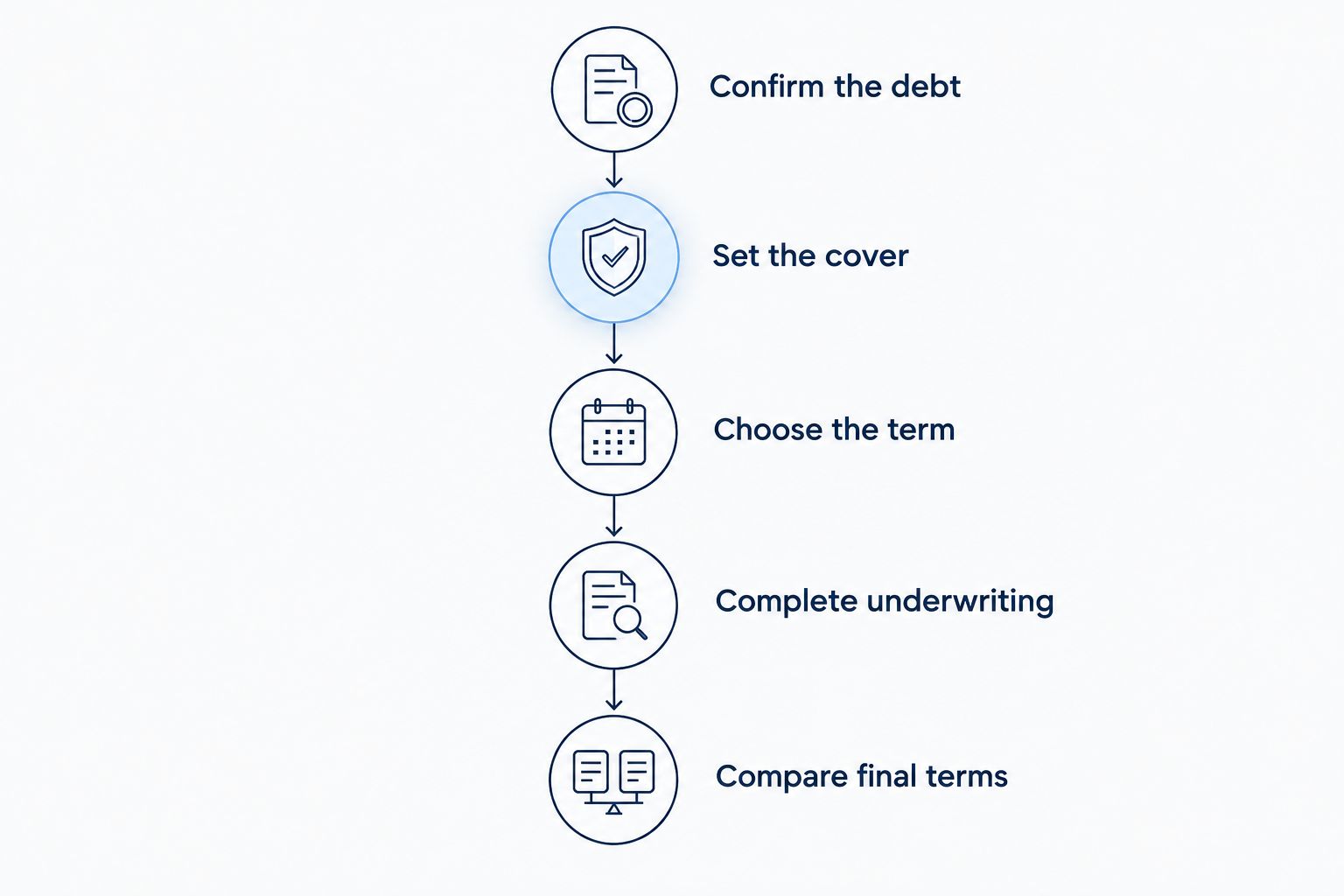
- Confirm the debt. Obtain the current mortgage balance, repayment type and remaining term. Include planned additional borrowing if the protection is being arranged for a new mortgage.
- Set the cover. Decide whether the objective is mortgage repayment alone or wider household support. Identify any existing personal or employer-provided cover.
- Choose the term. Align the cover period with the financial obligation. Check the consequences of the insurance ending before the mortgage.
- Complete underwriting. Provide accurate health, smoking, occupation and activity information. Supply any further information the insurer requests.
- Compare final terms. Read the accepted premium basis, exclusions, payout conditions and start date. Compare equivalent benefits, not just the headline quote.
This sequence keeps the protection decision ahead of the purchase decision. You first establish what must be covered, then assess which accepted policy meets that need.
Keep the policy documents with your mortgage records. Make sure the person who would handle your affairs knows that the cover exists and where to find the insurer's details.
Is joint life insurance better than separate policies?
Joint life insurance commonly covers two people and pays once on the first death, after which the policy ends. Separate individual policies can provide a payout on each insured person's death, subject to each contract.
| Arrangement | Best for | Main benefit | Main limitation |
|---|---|---|---|
| Joint first-death policy | A shared debt requiring a single payout | Covers both lives under one policy | The surviving person loses that policy's cover after a successful claim |
| Separate individual policies | Households needing independent protection | Each person has their own cover | Two policies require separate terms and cover amounts to be assessed |
Choose by the protection needed after a claim, not just the initial premium. Consider what the surviving borrower would still need if the mortgage were repaid, including other debts and dependants' expenses.
For unmarried partners, separated couples or changing ownership arrangements, ask how policy ownership and payment arrangements should work. A policy's beneficiaries and a property's owners are not automatically the same question.
Does mortgage life insurance cover illness or unemployment?
Life insurance does not generally replace your income when you are ill or unemployed. Some policies include terminal illness benefits, but the policy's definition applies; this is not the same as broad sickness cover.
Critical illness cover pays a lump sum for conditions meeting the contract's definitions. Income protection addresses covered incapacity and lost earnings, subject to its waiting period, benefit limits and other terms.
Treat death cover, critical illness cover and income protection as separate protection decisions. Combining benefits in a policy does not make their claim conditions identical. Check whether a claim under an added benefit reduces or ends other cover.
For self-employed borrowers, assess how long savings can support essential outgoings if earnings stop. That helps establish the role of income protection without assuming mortgage life insurance addresses the same risk.
What should you check before accepting a policy?
For a policy arranged in 2026, the documents matter more than a short comparison summary. Check these points before committing:
- Premium basis: establish whether payments are guaranteed or reviewable and whether selected benefits affect future payments.
- Payout conditions: check which events are covered and the definitions attached to illness benefits.
- Exclusions: read the exclusions and any terms added following underwriting.
- Policy ownership: understand who owns the policy and how a claim would be paid. Ask whether a trust is appropriate for your circumstances.
- Start and end dates: check that the protection period fits the mortgage obligation.
- Existing cover: identify what would be lost before cancelling or replacing another policy.
Heron Financial's mortgage and protection broking brings the borrowing and insurance discussions together. The essential decision remains whether the proposed cover meets your household's needs on the insurer's accepted terms.
Do not cancel existing protection before replacement cover is accepted and in force. A new application involves fresh underwriting, so the replacement contract must be assessed on its own merits.
FAQ
How much does mortgage life insurance cost in the UK in 2026?
Mortgage life insurance has no single standard UK cost in 2026; your premium depends on your circumstances and chosen cover. Compare personalised quotes with matching insured amounts, terms and benefits, then check the insurer's final underwriting terms.
Is mortgage life insurance compulsory in the UK?
Mortgage life insurance is not a general legal requirement for a UK mortgage. Check your lender's conditions and distinguish life insurance from buildings insurance requirements.
Is decreasing term insurance better for a repayment mortgage?
Decreasing term insurance is commonly suited to a repayment mortgage because the insured payout reduces over time. Check that the reduction assumptions and end date fit your loan rather than assuming the balances always match.
Can I get mortgage life insurance with a medical condition?
A medical condition does not automatically prevent you from obtaining life insurance. Acceptance, premiums and terms depend on the condition, the information supplied and the insurer's underwriting assessment.
Will mortgage life insurance pay my monthly mortgage if I cannot work?
Mortgage life insurance generally pays on death, not simply because you cannot work. Income protection addresses covered incapacity, while critical illness cover pays for conditions meeting its specific definitions.
Can I keep my life insurance when I remortgage?
You can retain an existing life insurance policy when remortgaging, but its cover needs checking against the new balance, term and repayment type. Remortgaging does not automatically update the insurance.
Is Heron Financial's advice the same as an insurance premium?
Heron Financial is a fee-free mortgage and protection brokerage; the insurance premium is a separate payment for the policy. Check the insurer's accepted terms to understand the cover and ongoing payment obligations.
One last thing
A remortgage in 2026 can change your protection needs even if your monthly mortgage payment falls. Extending the mortgage term changes the end date of the debt; your existing insurance does not automatically extend with it.
Review the insurance end date whenever you change the mortgage term. Then check the cover amount and repayment structure. This prevents a mortgage change from leaving a gap that a lower monthly payment disguises.


