

Yes, you can get a mortgage as a contractor with less than 12 months on a day rate, provided a lender accepts your contracting history and income evidence. A short contracting record does not automatically rule you out, but your current contract alone does not guarantee approval. In 2026, the practical starting point is to check how a lender will assess your income before submitting an application.
- A contractor mortgage less than 12 months day rate application needs lender-specific checks, not an automatic rejection.
- Your employment history and current contract help explain whether your income is sustainable.
- Day-rate assessment and company-account assessment are different routes; check which applies before calculating borrowing.
- Heron Financial offers fee-free, whole-of-market mortgage advice; the lender still decides whether to approve your application.
Can I get a mortgage with less than 12 months on a day rate?
Yes, but eligibility depends on the lender's criteria, not a universal minimum contracting period. The assessment also covers affordability, credit history, your deposit and the property. A lender accepting your employment arrangement is only part of the decision.
Heron Financial is best for borrowers seeking fee-free, whole-of-market mortgage advice rather than approaching one bank alone. Advice helps you identify an appropriate application route; it does not replace underwriting or guarantee an offer.
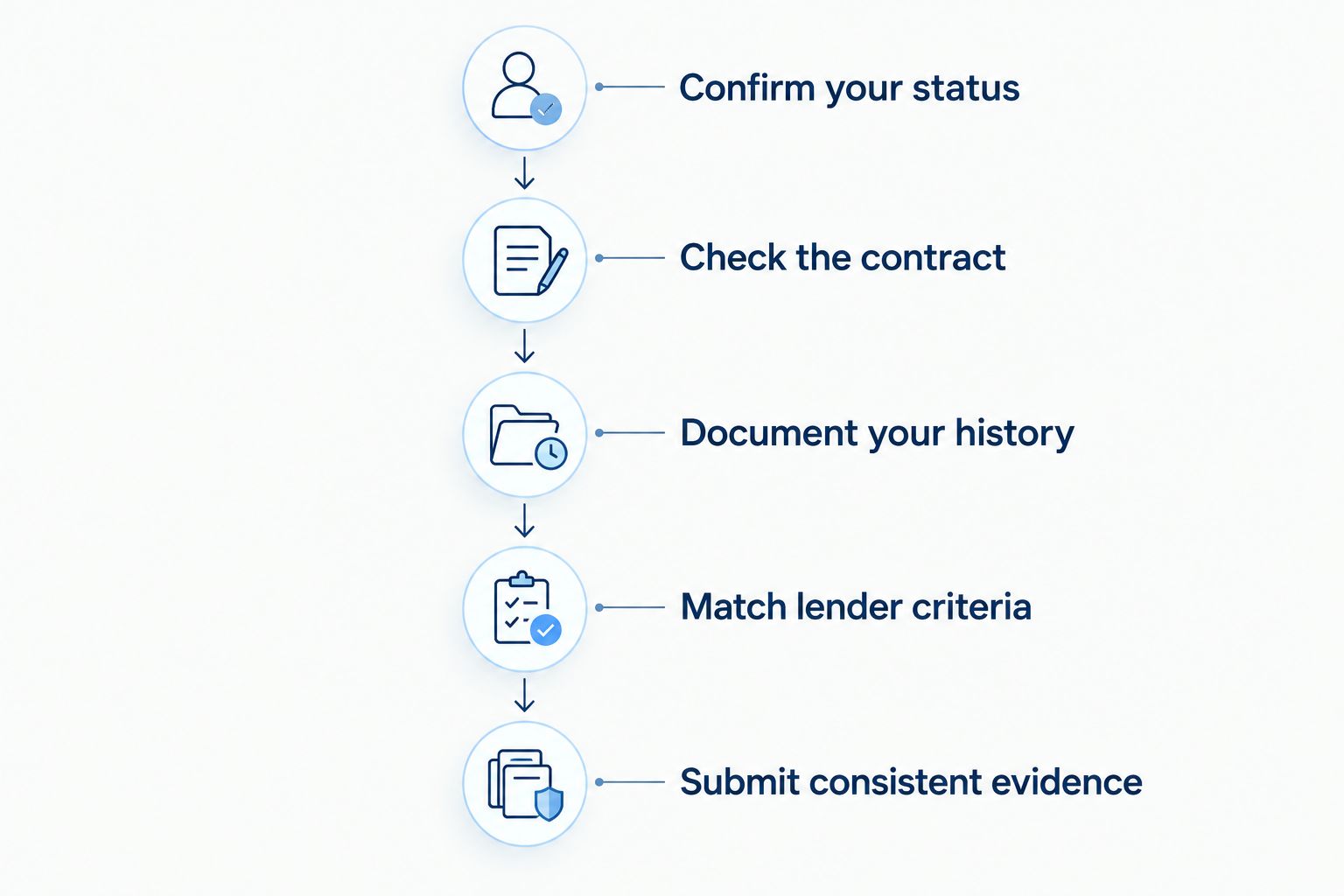
Use this sequence before you commit to a mortgage application:
- Confirm your status. Establish whether you work through a limited company, an umbrella company or another arrangement. Describe how you actually receive your income, rather than relying on the word contractor.
- Check the contract. Identify the agreed day rate, expected working pattern, start date, end date and any renewal evidence. Distinguish signed terms from discussions about future work.
- Document your history. Prepare a clear employment timeline showing previous roles, contracting assignments and gaps. Explain whether your new contract continues work you already know or starts a different career.
- Match lender criteria. Check whether the lender assesses your contract income, payslips or business accounts, and whether it accepts your length of contracting history.
- Submit consistent evidence. Make sure the contract, application, payslips or invoices, and bank statements describe the same arrangement. Resolve discrepancies before submission.
The aim is not to present the highest possible income figure. It is to establish an income figure the lender accepts and can verify.
Why this matters
A search for a contractor mortgage with less than 12 months on a day rate often mixes up two questions: whether the lender accepts a new contractor, and how much income it recognises. Resolve eligibility first, then calculate affordability. A borrowing estimate based on the wrong assessment route is not a useful budget.
In 2026, check current criteria against your actual circumstances. An example involving an established contractor does not establish eligibility for someone on their first assignment, even if both applicants receive the same day rate.
Day-rate assessment: your contract supports the income calculation
Under a contract-based assessment, the lender considers the contractual earnings and applies its own method for translating them into an income figure. Do not assume every available working day counts, or that every lender uses the same annualisation method.
This route is best for contractors whose current contract and work history meet the lender's contract-income criteria. Its advantage is that the assessment can focus on contractual earnings rather than treating personal drawings as the only relevant evidence. Its limitation is that a signed contract does not, by itself, establish continuing employment or affordability.
Check what the lender needs to know about working days, unpaid leave, contract expiry and renewal. Where future work remains unconfirmed, describe it accurately. An expectation of renewal is not a signed extension.
If your contract specifies an hourly rate rather than a daily rate, use the documented working arrangement. Do not create a day-rate figure using hours that are not supported by the contract.
PAYE assessment: payslips show how you are paid
Contractors paid through an umbrella company can have payslips even though their assignments are temporary. The existence of payslips does not remove the need to explain the underlying employment arrangement.
This route is best for applicants whose lender accepts their PAYE income and assignment history. Its advantage is a documented payment trail. Its limitation is that variable payments, deductions and assignment changes still need assessment.
Present the umbrella employment documents alongside the assignment details where requested. If the quoted assignment rate differs from the amount shown as taxable pay, explain the distinction rather than treating the figures as interchangeable.
For a 2026 application, use current documents that reflect how you are paid now. Previous payslips remain useful evidence of history, but they should not obscure a recent change in employment structure.
Company-account assessment: business income needs a separate review
If you contract through your own limited company, the lender's approach to company directors becomes relevant. Depending on its criteria, a lender assesses salary and dividends or considers other documented business-income measures.
This route is best for company directors whose available accounts and tax evidence satisfy the lender's requirements. Its advantage is that it connects the mortgage assessment to documented business performance. Its limitation is that a newly established business has a shorter financial record.
Having less than 12 months of day-rate work and lacking sufficient accounts are not identical problems. You might have an established company but a new contract, or a long employment history but a newly formed company. State both timelines clearly.
Do not assume your company's turnover is your personal mortgage income. Ask which figures the lender accepts and which documents substantiate them before setting a borrowing target.
Which income-assessment route fits your situation?
These are assessment routes, not separate mortgage products. The correct route depends on your employment structure and the lender's criteria.
| Assessment route | Best for | Useful evidence | Advantage | Limitation |
|---|---|---|---|---|
| Day-rate contract | Contractors meeting contract-income criteria | Current contract and work history | Focuses on contractual earnings | Contract length and continuity still matter |
| PAYE income | Contractors with accepted payslip-based income | Payslips, employment documents and assignment details | Shows an identifiable payment trail | Variable pay and temporary assignments need explanation |
| Company accounts | Directors meeting business-income criteria | Accounts and relevant tax documents | Shows documented business performance | A short financial record restricts the evidence available |
Why contractor mortgage eligibility varies
Your contracting history is one part of a wider assessment. These factors explain why applicants with similar day rates receive different decisions:
- Length of contracting history. Less than 12 months on a day rate means there is a shorter record of income under that arrangement. The lender decides whether other evidence meets its requirements.
- Previous work history. Earlier employment helps explain your experience and the transition into contracting. It does not automatically override a lender's minimum-history rules.
- Current contract terms. The agreed rate, working pattern and end date establish what the contract actually supports. Renewal evidence adds information; an unsupported forecast does not.
- Payment structure. PAYE income, personal company drawings and contractual earnings are different measures. The assessment must match the structure you use.
- Overall affordability. Credit commitments, household expenditure, deposit and the proposed mortgage affect the lending decision independently of contractor status.
A higher day rate does not cancel out an eligibility problem. Equally, a short contracting history does not justify rejection without checking the relevant lender's rules.
What documents should I prepare before applying?
Prepare an evidence pack that explains your income without requiring the underwriter to reconstruct your working history. Keep the application factual and separate confirmed information from expectations.
Your pack should cover the following, subject to the lender's requirements:
- Current work: your signed contract, assignment schedule and any confirmed extension.
- Employment continuity: a CV or work-history summary, supported by earlier contracts or employment documents where requested.
- Actual receipts: relevant bank statements, payslips or invoices showing how contractual earnings reach you or your company.
- Business evidence: accounts and tax documents where the lender assesses you as self-employed or as a company director.
- Personal affordability: evidence of your deposit, existing borrowing and regular financial commitments.
Check names, dates and income descriptions across the documents. If an agency pays your company but the end client appears on your assignment, explain that relationship. Different names are not necessarily a problem; an unexplained payment chain creates avoidable questions.
For a 2026 application, confirm the lender's document requirements before ordering additional accountant work or submitting an incomplete pack. More paperwork is not a substitute for the right paperwork.
Check your contractor mortgage options
Discuss your contract history and income structure with Heron Financial's fee-free, whole-of-market brokerage.
Should I wait until I have 12 months of contracting history?
Wait only if the additional history addresses a specific lender requirement or strengthens your evidence. Reaching 12 months is not a universal approval threshold, and time alone does not resolve affordability or credit issues.
Ask what would change if you applied later: an accepted minimum history, a signed renewal, completed accounts or clearer evidence of receipts. Compare applying now with waiting for that specific milestone, rather than choosing a date without a reason.
Does previous permanent employment count towards my application?
Previous permanent employment helps document your work history, particularly where the contract continues the same type of work. The lender decides whether that history satisfies its contractor criteria; employment continuity and contracting duration are different facts.
Provide the dates and nature of the previous role. Do not label permanent employment as contracting to make the record appear longer.
Does an agreement in principle mean my contract is accepted?
An agreement in principle is not a final mortgage offer. It does not replace the lender's review of your documents, affordability and the property.
Ask whether the contracting arrangement has been checked against the lender's criteria or whether the result relies on information entered into an initial assessment. Before committing to a purchase timetable, establish what still needs underwriting.
FAQ
Can I get a contractor mortgage with less than 12 months on a day rate?
Yes, a contractor mortgage with less than 12 months on a day rate is possible if a lender accepts your work history and income evidence. Approval also depends on affordability, credit checks and the property.
Can I apply for a mortgage on my first contract?
You can ask for an assessment on your first contract, but acceptance depends on lender criteria. Provide the signed contract and your previous employment history rather than assuming the day rate alone establishes eligibility.
Do I need company accounts if I am a day-rate contractor?
Company accounts are not the assessment basis for every contractor application. The required evidence depends on whether the lender accepts contract income, PAYE income or a company-income assessment.
Will a lender use my full day rate to calculate mortgage borrowing?
Do not assume a lender will convert your full day rate into accepted annual income using your own calculation. The lender applies its assessment method and then checks affordability.
Can an umbrella-company contractor get a mortgage?
An umbrella-company contractor can get a mortgage if the lender accepts the employment arrangement and income evidence. Payslips help document payments, but assignment terms and work history remain relevant.
Will a bigger deposit guarantee a contractor mortgage?
A bigger deposit does not guarantee a contractor mortgage. It changes the loan-to-value ratio, but the lender must still accept your income and assess affordability.
Can Heron Financial advise me if I have only recently started contracting?
Heron Financial provides fee-free, whole-of-market mortgage broking, including advice for self-employed applicants and company directors. Explain your contracting start date, payment structure and current contract so the advice addresses your actual circumstances.
What should I check before applying for a contractor mortgage in 2026?
Before applying for a contractor mortgage in 2026, check that the lender accepts your contracting history and income-assessment route. Confirm the required documents before submitting the application.
One last thing
Ask how your income will be entered on the application before asking how much you can borrow. A contractor's day rate, company turnover and personal salary are not interchangeable figures. The right starting number is the one the selected lender accepts and your documents support.
Keep a written summary of that assessment alongside your contract evidence. It gives you a clear reference if your assignment, payment structure or proposed borrowing changes before completion.


