

Best overall: a whole-of-market broker placing you with a 52-week day rate lender. Best for under 12 months of contracting: a specialist lender that accepts prior same-sector experience. Best for limited company contractors: a lender that assesses salary plus dividends or net profit. That is the 2026 ranking of contractor mortgages by how each lender turns your day rate into income. Heron Financial runs the comparison across the whole market, so the order below is the order of approach, not a promise of one lender's current criteria.
- Contractor mortgages in 2026 are ranked by how many weeks a lender multiplies your day rate by.
- A 52-week multiple gives the highest borrowing; 46 or 48 weeks give less on the same day rate.
- Under 12 months on a day rate narrows the field, but some lenders still accept it.
- Limited company contractors are often better assessed on salary plus dividends or net profit.
- Heron Financial is fee-free and whole-of-market, so it can test every route on your contract.
Why the day rate multiple decides your borrowing
A permanent employee shows a payslip. A contractor shows a contract. Lenders convert that contract into an annual income figure, then apply an income multiple, commonly around four to four and a half times for standard applicants.
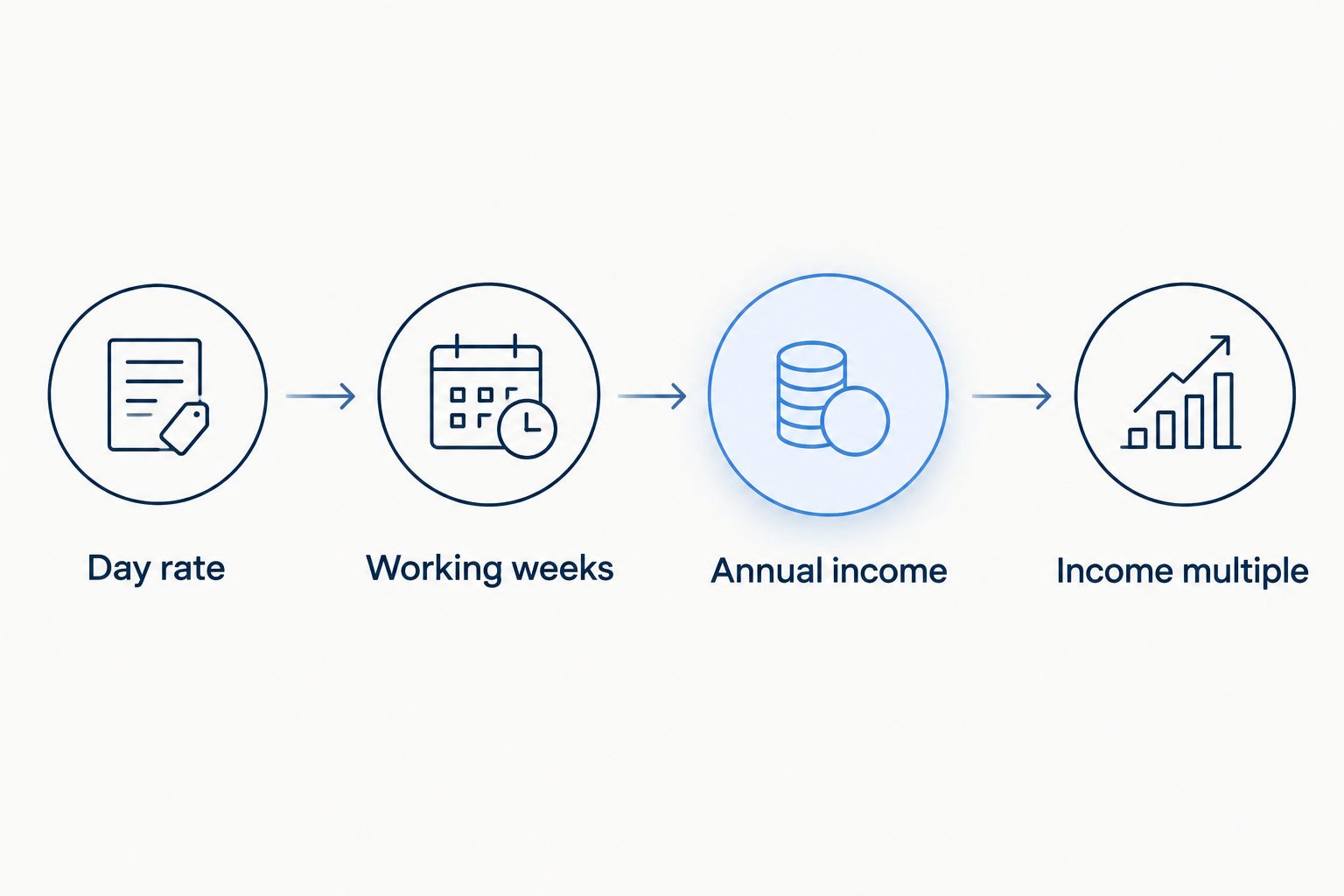
The conversion step is where lenders differ. The method is day rate x days per week x weeks per year. Change the weeks and the borrowing changes with it.
If you are under a year into contracting, start with our guide to getting a mortgage as a contractor with less than 12 months on a day rate. It covers what evidence lenders ask for when the history is short.
How the calculation works
Take an illustrative day rate of £400 on a five-day week. The table of outcomes below uses that figure only to show the effect of the multiplier. It is not a lender quote.
- 52 weeks: £400 x 5 x 52 = £104,000 annual income
- 48 weeks: £400 x 5 x 48 = £96,000 annual income
- 46 weeks: £400 x 5 x 46 = £92,000 annual income
At four and a half times income, the 46-week lender offers £414,000 on that contract. The 52-week lender offers £468,000. Same contractor, same contract, a £54,000 gap created by the weeks assumption alone.
Lenders also look at the contract itself. Expect them to ask for the current contract, previous contracts, and bank statements showing payments arriving. A contract with time remaining reads better than one about to expire.
What makes the best contractor mortgage lender
Five criteria drive the ranking:
- Weeks multiplier: the number of weeks applied to your day rate. More weeks, higher income figure.
- Track record required: whether the lender wants 12 months of contracting or accepts less.
- Sector continuity: whether prior permanent work in the same field counts as history.
- Income route: day rate, or salary plus dividends, or net profit for limited company contractors.
- Gaps between contracts: how the lender treats short breaks, which are normal in contracting.
The weeks multiplier is the criterion that moves your borrowing most, so it sets the order below.
Contractor mortgage options at a glance
| Rank | Option | Best for | Standout feature | Key limitation |
|---|---|---|---|---|
| 1 | Whole-of-market broker route (Heron Financial) | Contractors who want every lender tested | Matches your contract to the lender whose method suits it | Needs a full document pack up front |
| 2 | Full-year day rate lenders | Highest borrowing on a current contract | Most generous weeks assumption | Fewer lenders, stricter contract evidence |
| 3 | Reduced-weeks day rate lenders | Established contractors with steady work | Widely available, simple method | Lower income figure for the same day rate |
| 4 | Short-history specialist lenders | Under 12 months contracting | Accepts prior same-sector experience | Narrower choice, often lower multiple |
| 5 | Limited company income lenders | Contractors operating through their own company | Uses salary plus dividends or net profit | Retained profit in the company may not all count |
1. Heron Financial: best contractor mortgage route for comparing every lender
Heron Financial is a fee-free, whole-of-market mortgage and protection brokerage serving self-employed applicants and company directors across the UK. For a contractor, the value is simple. The same contract produces different borrowing at different lenders, and a whole-of-market broker can see all of them.
Heron Financial pros:
- Fee-free, so the broker's fee does not cut into your deposit. See how a fee-free mortgage broker makes money for the mechanics.
- Whole-of-market, so you are not limited to one lender panel.
- Experience with complex income, including self-employed and company director cases.
- Underwriter conversations can resolve edge cases before you apply.
Heron Financial cons:
- You need contracts, bank statements and ID ready before lenders can be tested.
- A broker cannot change a lender's criteria. If your contract is two weeks from expiry, it still reads weaker.
Heron Financial pricing: no broker fee. Check the site for how the service is paid.
Best for: any contractor who has not yet picked a lender. Verdict: Buy.
2. Full-year day rate lenders: best for maximum borrowing
Some lenders annualise your day rate across the full 52 weeks. On the illustrative £400 day rate that is £104,000 of income, the highest of the three methods above.
Full-year lender pros:
- Highest income figure from the same day rate.
- Straightforward method that is easy to check yourself.
- Rewards a long, uninterrupted contracting record.
Full-year lender cons:
- Fewer lenders use this method, and criteria change often.
- Contract evidence is scrutinised closely: signed contract, remaining term, payment history.
- Not all will accept a contractor who has had gaps.
Best for: contractors on a long contract with proof of continuous work. Verdict: Buy if your contract fits, otherwise Hold.
3. Reduced-weeks day rate lenders: best for steady, established contractors
Many lenders assume fewer working weeks to allow for holidays and gaps, typically in the mid-to-high 40s. The method is cautious but easy to meet.
Reduced-weeks lender pros:
- More lenders to choose from, which helps on rate and product range.
- Allows for gaps between contracts without penalty to the method.
- Predictable result: day rate x 5 x weeks.
Reduced-weeks lender cons:
- Lower income figure than a full-year lender on the same contract.
- At 46 weeks the illustrative contract above loses £12,000 of assessed income against the 52-week method.
Best for: contractors who want the widest lender choice and do not need maximum borrowing. Verdict: Buy.
4. Short-history specialist lenders: best for under 12 months
Most lenders want 12 months of contracting. Some accept less when you moved from permanent work in the same sector, because the skills and earning pattern are proven.
Short-history lender pros:
- Opens the market earlier in your contracting career.
- Prior permanent salary in the same field counts as evidence.
- Avoids waiting a year and missing the property.
Short-history lender cons:
- Narrower choice and often a lower income multiple.
- Needs a clear contract, a signed start date and a deposit that gives the lender comfort.
The detail is covered in our guide on contractor mortgages with under 12 months on a day rate and in the self-employed lender guide.
Best for: new contractors with a same-sector background. Verdict: Hold until the criteria check out for your case, then Buy.
5. Limited company income lenders: best for contractors with their own company
If you contract through a limited company, a day rate multiple may not be the best view of your income. Lenders can instead assess salary plus dividends, or salary plus your share of net profit.
Limited company lender pros:
- Reflects how you actually pay yourself.
- Can beat the day rate method when you draw a high dividend.
- Suits contractors with several clients through one company.
Limited company lender cons:
- Profit left in the company may not be counted as your income.
- Needs accountant-prepared figures, and more of them.
- A low salary with low dividends cuts the assessed figure, whatever the day rate says.
Contractors who are also directors should read the complete guide to mortgages for company directors.
Best for: limited company contractors with a documented dividend history. Verdict: Buy if your accounts support it.
Test your contract across the market
Fee-free, whole-of-market contractor mortgage advice.
How we ranked
The order follows the criteria above, weighted toward the weeks multiplier because it changes borrowing most. A whole-of-market route ranks first because it is the only option that can compare every other row. No lender names are ranked here, because multipliers and eligibility change and a stale figure would mislead you. Confirm current criteria before applying in 2026.
Which contractor mortgage should you choose?
If you are undecided, take the broker route first. Heron Financial is the default pick for contractor mortgages in 2026 because it tests your contract against full-year, reduced-weeks, short-history and limited company methods, and charges no fee.
If you have a long, continuous contract, ask for full-year lenders. If you are new to contracting, ask for short-history lenders. If you run a company, ask for an income route built on your accounts.
Documents contractors should have ready
A clean pack speeds every route above.
- Current contract showing day rate, start date and end date
- Previous contracts covering as much of the last 12 months as you have
- Recent bank statements showing payments arriving
- Proof of ID and address
- For limited company contractors: accountant-prepared figures and company accounts
FAQ
How do lenders calculate income for contractor mortgages?
Most multiply your day rate by days per week and by weeks per year. The weeks figure varies by lender, so the same contract produces different borrowing across the market.
What is the best day rate multiple for a contractor mortgage?
The highest assessed income comes from lenders that use a full 52 weeks. Fewer lenders do this, so check current criteria through a broker.
Can I get a contractor mortgage with under 12 months of history?
Some lenders accept it, particularly if you worked permanently in the same sector beforehand. Choice is narrower than with a longer record.
Is a day rate or limited company assessment better?
It depends on how you pay yourself. A high dividend history can beat the day rate method, while a low salary and low dividends can weaken it.
Do gaps between contracts stop me getting a mortgage?
Not automatically. Reduced-weeks lenders build gaps into their method, though long gaps need explaining with evidence.
Does Heron Financial charge contractors a fee?
No. Heron Financial is a fee-free, whole-of-market broker. Check the site for how the service is paid.
What documents do contractors need for a mortgage application?
Your current and previous contracts, recent bank statements, ID and proof of address. Limited company contractors also need accountant-prepared figures.
One last thing
A contract with several months left reads stronger than one about to end. If yours expires soon, get the extension or renewal in writing before you apply. It can lift the same lender from a decline to an offer in 2026 without any change to your day rate.


