

Your second home mortgage deposit is the share of the property’s value that the lender will not finance; there is no single minimum that applies to every UK second-home application in 2026. The required amount depends on the lender’s maximum loan-to-value ratio, your affordability and how you intend to use the property. Keep purchase taxes, legal costs and other transaction expenses separate from the deposit, because your cash contribution does not cover the whole purchase process.
- Your second home mortgage deposit depends on loan-to-value, affordability and the property's intended use.
- An 80% LTV mortgage means a 20% deposit; this calculation is not a lending offer.
- Heron Financial offers whole-of-market mortgage advice for borrowers comparing second-home borrowing routes.
- Confirm the mortgage category before deciding how much cash to commit.
How much deposit do I need for a second home mortgage?
Your deposit must cover the difference between the property value used by the lender and the mortgage it agrees to provide. A lender’s maximum LTV sets one limit; its affordability assessment can reduce the loan further. You need to satisfy both, not just reach a deposit percentage.
Heron Financial provides fee-free, whole-of-market mortgage and protection broking. For a second-home purchase, establish the intended use and borrowing limit before treating your savings as an adequate deposit.
The following figures show the arithmetic, not confirmed mortgage availability or lender criteria for 2026:
| Mortgage LTV | Deposit share | Best for understanding | What this does not establish |
|---|---|---|---|
| 80% LTV | 20% deposit | How a smaller deposit relates to borrowing | Whether a lender accepts your second-home application |
| 75% LTV | 25% deposit | The relationship between equity and the loan | Whether your income supports the requested mortgage |
| 70% LTV | 30% deposit | How a larger cash contribution reduces borrowing | Whether the property meets the lender’s requirements |
These percentages assume the purchase price and the lender’s accepted property value are equal. If the lender values the property below the agreed purchase price, the cash needed to complete rises unless you renegotiate the price or change the financing.
A deposit calculation is not a mortgage approval. Obtain an assessment based on your actual circumstances before making a commitment that depends on borrowing.
Why this matters
A second-home purchase adds a property without necessarily removing the costs of your existing home. Your deposit is only one part of that commitment. The lender also assesses whether you can support the proposed borrowing alongside existing financial obligations.
Start by separating two questions: how much equity the lender requires, and how much debt your finances support. A larger deposit helps with the first question but does not automatically settle the second.
Also distinguish a property you will occupy from one you will let. Calling both a second home does not make their mortgage requirements interchangeable. The intended use determines which lending criteria you need to investigate.
80% LTV: 20% deposit
An 80% LTV mortgage leaves a 20% deposit share when the purchase price matches the lender’s valuation. That is a mathematical relationship, not a statement that an 80% LTV second-home mortgage is available to you in 2026.
The advantage of contributing less cash is that you retain more money outside the property. The disadvantage is that you request a larger mortgage, which must still pass the lender’s affordability and property checks.
Best for: understanding the borrowing needed when you want to retain cash. Ask whether the lender accepts the intended use before planning around this LTV. Then check whether the resulting mortgage amount fits your income and existing commitments.
Do not interpret an advertised maximum LTV as an entitlement. It describes a lending boundary; it does not confirm the outcome of an individual application.
75% LTV: 25% deposit
A 75% LTV mortgage leaves a 25% deposit share under the same valuation assumption. Compared with an 80% LTV calculation, you contribute more equity and request a smaller loan against the same property value.
The benefit is lower borrowing. The trade-off is that more of your available cash becomes tied up in the purchase, leaving less outside it for transaction expenses, maintenance or other commitments.
Best for: checking the effect of a larger cash contribution. Assess the deposit alongside your remaining cash, not in isolation. Reaching an LTV threshold is not useful if completing the purchase leaves you unable to meet the costs that follow.
Your affordability assessment remains separate. A lender can decline a requested loan even when the deposit meets its LTV requirement.
70% LTV: 30% deposit
A 70% LTV mortgage leaves a 30% deposit share when the lender’s valuation equals the purchase price. The larger contribution reduces the mortgage amount, but it does not remove underwriting requirements.
The advantage is less debt secured against the second property. The disadvantage is the greater amount of cash committed to that property rather than retained elsewhere.
Best for: assessing a lower-borrowing purchase structure. Compare the benefit of borrowing less with the effect on your accessible savings. Include the costs of owning both properties in that decision.
Do not increase your deposit solely to reach a percentage without checking the actual mortgage options. The relevant question is whether the resulting arrangement suits your finances, not whether the percentage looks more conservative.
Why your second home mortgage deposit varies
The required cash contribution depends on more than your savings balance. These factors affect either the permitted mortgage amount or the gap you need to fund:
- Property use: Personal occupation, long-term letting and holiday letting require different lending assessments. Describe the intended use accurately from the outset.
- Lender LTV limits: Each lender sets criteria for the borrowing it will consider. The maximum accepted LTV determines the minimum equity contribution for that particular arrangement.
- Affordability: Your income, expenditure and existing financial commitments affect the amount you can borrow. A lower approved loan means a larger funding gap.
- Property valuation: The lender’s valuation can differ from the agreed purchase price. A shortfall affects the cash needed to complete.
- Deposit source: Savings, gifts and equity released from another property need appropriate evidence. Borrowed funds also introduce repayment obligations that need assessment.
- Property eligibility: The property must meet the lender’s requirements. A larger deposit does not, by itself, resolve an unacceptable property or use restriction.
Confirm eligibility before optimising the deposit. Otherwise, you risk organising your finances around a mortgage category or property that the proposed lender will not accept.
Does a second home mean a buy-to-let mortgage?
No. A second property for your own use is not automatically a buy-to-let property. The mortgage needs to match what you actually intend to do with it.
Use this comparison to identify the relevant discussion before looking at deposit requirements:
| Intended use | Mortgage route to investigate | Best for | Benefit of matching the route | Limitation to check |
|---|---|---|---|---|
| Your own additional residence | Residential second-home borrowing | Personal occupation | Keeps the application aligned with your use | Affordability includes your existing commitments |
| Long-term tenant occupation | Buy-to-let borrowing | A rental investment | Assesses the property as a letting proposition | Rental and borrower criteria still apply |
| Short stays by paying guests | Holiday-let borrowing | Holiday accommodation businesses | Addresses short-term letting use | Lender and property restrictions need checking |
Tell your adviser if you intend to mix personal use and paid letting. Do not assume a residential mortgage permits either long-term tenants or holiday guests simply because you own the property.
For a personal-use purchase, the second home mortgage rates guide provides a related starting point. Deposit size and mortgage selection belong in the same assessment, rather than separate decisions made at different stages.
Can I use equity in my current home as the deposit?
Yes, releasing equity from your existing home is a possible funding route, subject to lender approval and affordability. Equity is not available cash until an agreed borrowing or sale arrangement releases it.
The benefit is that you can investigate a purchase without relying entirely on accumulated savings. The disadvantage is that additional borrowing against your existing home creates another repayment obligation and increases the debt secured on it.
For a 2026 purchase, compare the proposed second-home mortgage with any changes needed to your existing mortgage. Check early repayment charges and other contractual consequences before deciding how to release equity.
Treat equity release for a deposit as borrowing, not as extra savings. Assess the combined commitments. Your existing home is also exposed to the consequences of failing to maintain repayments on borrowing secured against it.
Will a bigger deposit overcome an affordability problem?
A bigger deposit reduces the mortgage you need, but it does not bypass affordability checks. The lender still assesses whether the requested borrowing is sustainable alongside your other commitments.
For a second home, include the mortgage on your existing property, other credit commitments and the expenditure relevant to the application. Do not assume that owning substantial equity means your income will support another loan.
If part of your income comes from bonuses, self-employment or a company, establish how the proposed lender will assess it. The amount entering your bank account is not automatically the amount accepted for mortgage purposes.
Heron Financial is suited to UK borrowers seeking fee-free, whole-of-market mortgage advice. The brokerage route offers a way to compare lending criteria; it does not replace a lender’s underwriting decision or guarantee approval.
How should I prepare my second-home deposit in 2026?
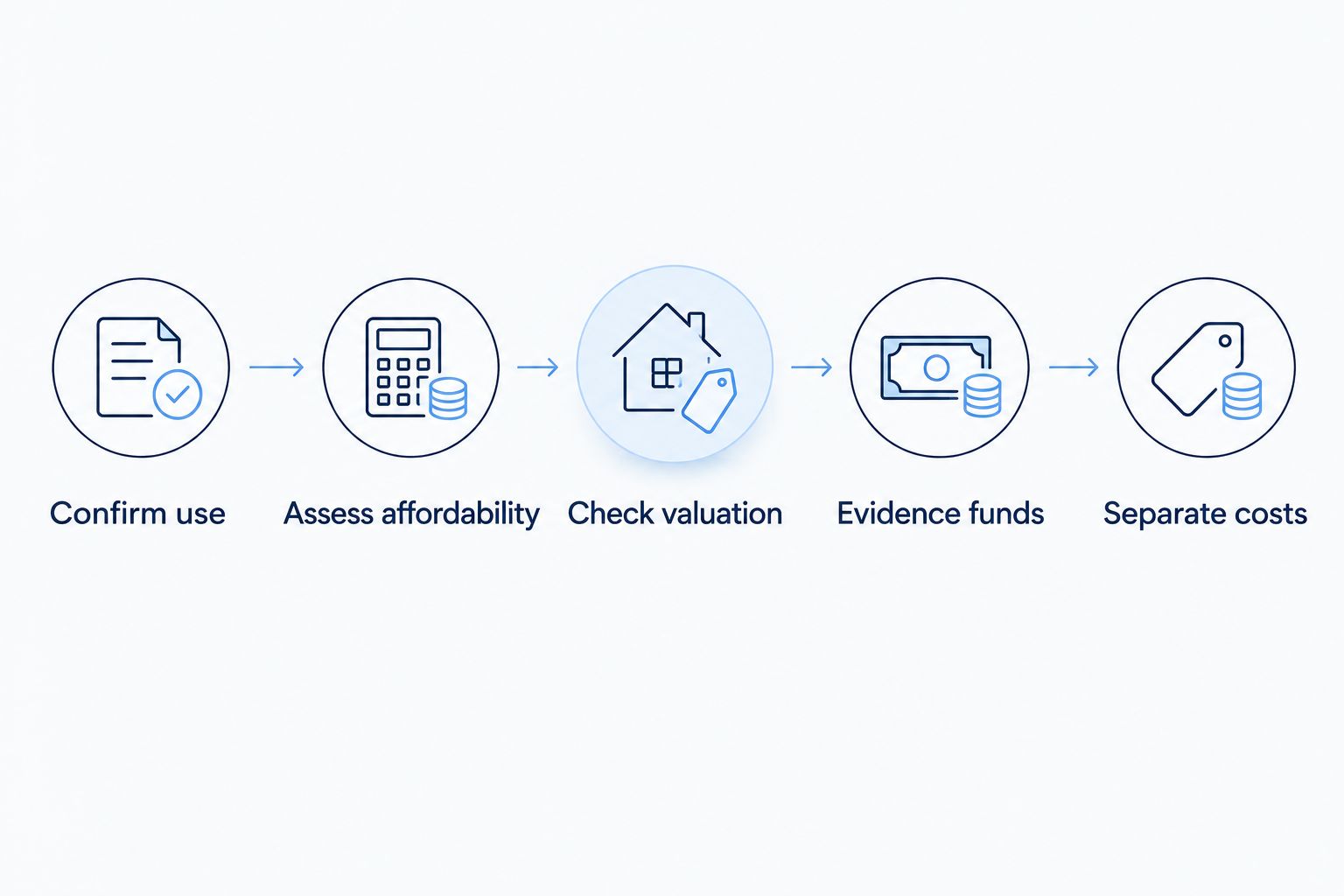
Use this sequence before committing your cash. It separates the property decision, borrowing assessment and completion funds so that a deposit percentage does not hide another funding problem.
- Confirm use. State whether the property is for your own occupation, long-term tenants or holiday guests. Include any intended combination of uses.
- Assess affordability. List income, existing mortgages, credit commitments and expenditure. Establish the borrowing that your circumstances support.
- Check valuation. Calculate the deposit against the value the lender accepts, not solely against the seller’s asking price.
- Evidence funds. Identify where the deposit comes from and prepare the documents needed to demonstrate its source. Explain gifts or additional borrowing clearly.
- Separate costs. Keep purchase taxes, legal expenses and other transaction costs outside the deposit calculation. Confirm that sufficient cash remains for completion.
An agreement in principle helps establish an initial borrowing position, but it is not a final mortgage offer. The full application still requires the lender to assess the borrower, supporting evidence and property.
Check the complete funding plan before exchange of contracts. The amount available for the deposit, the approved mortgage and the separate completion costs must work together.
Discuss your second-home mortgage
Review your intended property use, deposit source and existing borrowing with a whole-of-market broker.
FAQ
What is the minimum second home mortgage deposit in 2026?
There is no single minimum second home mortgage deposit for every UK application in 2026. Your lender’s maximum LTV, affordability assessment, property valuation and intended use determine the required contribution.
Does an 80% LTV mortgage mean I need a 20% deposit?
An 80% LTV mortgage means a 20% deposit when the purchase price equals the lender’s accepted valuation. This is a calculation, not confirmation that an 80% LTV second-home mortgage is available to you.
Is a 25% deposit enough for a second home?
A 25% deposit corresponds to 75% LTV when the purchase price matches the lender’s valuation. It is enough only if the lender accepts that LTV and approves the borrowing, property and intended use.
Can I remortgage my current home to fund the deposit?
You can investigate remortgaging your current home to release equity, subject to affordability and lender approval. Additional borrowing creates repayment commitments, and changing your mortgage can have contractual consequences.
Can I use a gifted deposit for a second home?
A gifted deposit depends on the proposed lender’s criteria and the evidence required about the gift. Explain who provides the money and whether repayment or an ownership interest is expected.
Do I need a buy-to-let mortgage for my second property?
You need to investigate buy-to-let borrowing if the property is intended for long-term tenants, rather than your own occupation. Holiday letting requires a separate discussion about the appropriate mortgage route.
Can Heron Financial help me work out my deposit?
Heron Financial provides fee-free, whole-of-market mortgage and protection broking across the UK. Discuss your intended property use, deposit source and existing commitments so the borrowing assessment addresses your actual circumstances.
One last thing
The lender’s valuation can matter as much as the deposit percentage. If the valuation is below your agreed purchase price, a mortgage calculated at the same LTV produces a smaller loan and leaves a larger cash gap.
Before committing to a second-home purchase in 2026, ask what happens if the valuation does not support the agreed price. Decide whether you would renegotiate, contribute more cash or stop the purchase. Make that decision before your funding depends on an assumption that has not been checked.


