

The cost of remortgaging in the UK in 2026 depends on your existing mortgage, the new deal and the work needed to complete the switch. Compare lender charges, valuation and legal work, any broker charge, and the cost of leaving your current agreement; adding a charge to the mortgage also means paying interest on it.
- The cost of remortgaging includes switching charges and mortgage interest, not just the advertised rate.
- Your European Standardised Information Sheet sets out the proposed mortgage’s interest, charges and repayment terms.
- Check early repayment charges before deciding when to complete a remortgage.
- Compare a new lender with your existing lender’s product transfer using the same balance and repayment term.
Why this matters: a lower mortgage rate does not automatically make switching worthwhile. Your saving needs to cover the costs of moving, while the new agreement must fit your borrowing needs and repayment plans.
Start with the comparison method in this guide, then use the remortgage deals guide to assess the options. The decision is about the whole agreement, not the headline rate.
How much does it cost to remortgage in the UK?
Your remortgage cost is the combination of charges payable when you switch and the interest payable under the new agreement. Some charges belong to your current lender, others to the new lender or the professionals handling the transaction.
Separate money needed at completion from costs paid through the mortgage. Moving a charge into the loan changes when you pay it; it does not remove it.
| Cost component | What it covers | What to check |
|---|---|---|
| Product or arrangement charge | Taking out the selected mortgage product | Whether it is paid upfront or added to borrowing |
| Valuation | The new lender’s assessment of the property | What the lender includes and whether further reports are required |
| Legal work | Conveyancing needed to replace the existing mortgage | The scope of the legal package and any excluded work |
| Early repayment charge | Leaving an agreement during its charge period | The applicable completion date and your mortgage conditions |
| Exit or administration charge | Closing the existing mortgage account | Your current lender’s documentation and redemption statement |
| Broker charge | Advice and arranging the mortgage | The broker’s written terms and when any charge becomes payable |
| Mortgage interest | Borrowing under the new agreement | The rate, repayment term and any charges added to the balance |
Not every remortgage includes every item in this table. Get the applicable charges in writing rather than assuming that another borrower’s experience will match yours.
For a 2026 comparison, use the current mortgage illustration and your existing lender’s redemption information. An old illustration is not a substitute for the terms of the product you are considering now.
Switching lender: include the costs of replacing the mortgage
Best for: borrowers whose needs are better served by a different lender’s terms or criteria. A remortgage to a new lender lets you compare alternatives beyond your existing lender’s product range.
The trade-off is the work involved. The new lender assesses the application and property, and legal work is needed to replace the existing mortgage security.
Ask what the proposed product includes before treating any element as covered. A lender’s standard legal package does not necessarily cover additional work such as changing ownership or resolving a title issue.
Your existing lender also needs to confirm the amount required to redeem the mortgage. Check that the redemption statement reflects the intended completion date, including any applicable early repayment charge.
A new agreement can also change your flexibility. Compare overpayment rules, the fixed-rate end date and the conditions for leaving early alongside the interest rate.
Staying with your lender: compare the product transfer
Best for: borrowers considering a new rate without moving the mortgage to another lender. A product transfer changes the mortgage product with your existing lender rather than replacing it through a new lender.
The benefit is a narrower transaction. A straightforward rate change does not involve the same lender-switching process as a remortgage, although additional borrowing or other changes can require further assessment.
The limitation is the choice available. Your existing lender’s products are not the same as a comparison across other lenders, and a product transfer can still involve a product charge.
| Route | Best for | Main advantage | Main limitation |
|---|---|---|---|
| Remortgage to a new lender | Borrowers seeking different terms or lending criteria | Access to another lender’s product range | New application, valuation requirements and legal work |
| Product transfer | Borrowers considering a rate change with their existing lender | Avoids replacing the mortgage with another lender | Restricted to the existing lender’s available products |
Compare both routes before committing. Use the same mortgage balance and remaining repayment term, otherwise differences in borrowing can distort the result.
Why the cost of remortgaging varies
The cost of remortgaging in 2026 depends on the agreement you are leaving, the product you select and the transaction itself. These are the main variables to check:
- Existing mortgage conditions: early repayment charges and exit charges determine part of the cost of leaving. The completion date matters where a charge period is ending.
- New product structure: a product with an arrangement charge needs a different comparison from one without it. Consider the interest and charges together.
- Property valuation: the lender’s accepted property value affects loan-to-value, or LTV, and therefore which mortgage products you qualify for.
- Legal requirements: a straightforward lender switch differs from a transaction involving an ownership change or additional title work. Confirm what the conveyancer’s quote covers.
- Borrowing changes: increasing the balance or extending the term changes the repayment calculation. Do not present those changes as savings from switching alone.
- How charges are paid: paying upfront and adding a charge to the mortgage have different cash-flow and interest consequences. Compare both treatments explicitly.
Your income also affects which lenders can accept the application. Self-employed income, company director income and multiple income sources require a comparison that accounts for lending criteria, not just rates.
How do you compare remortgage costs properly?
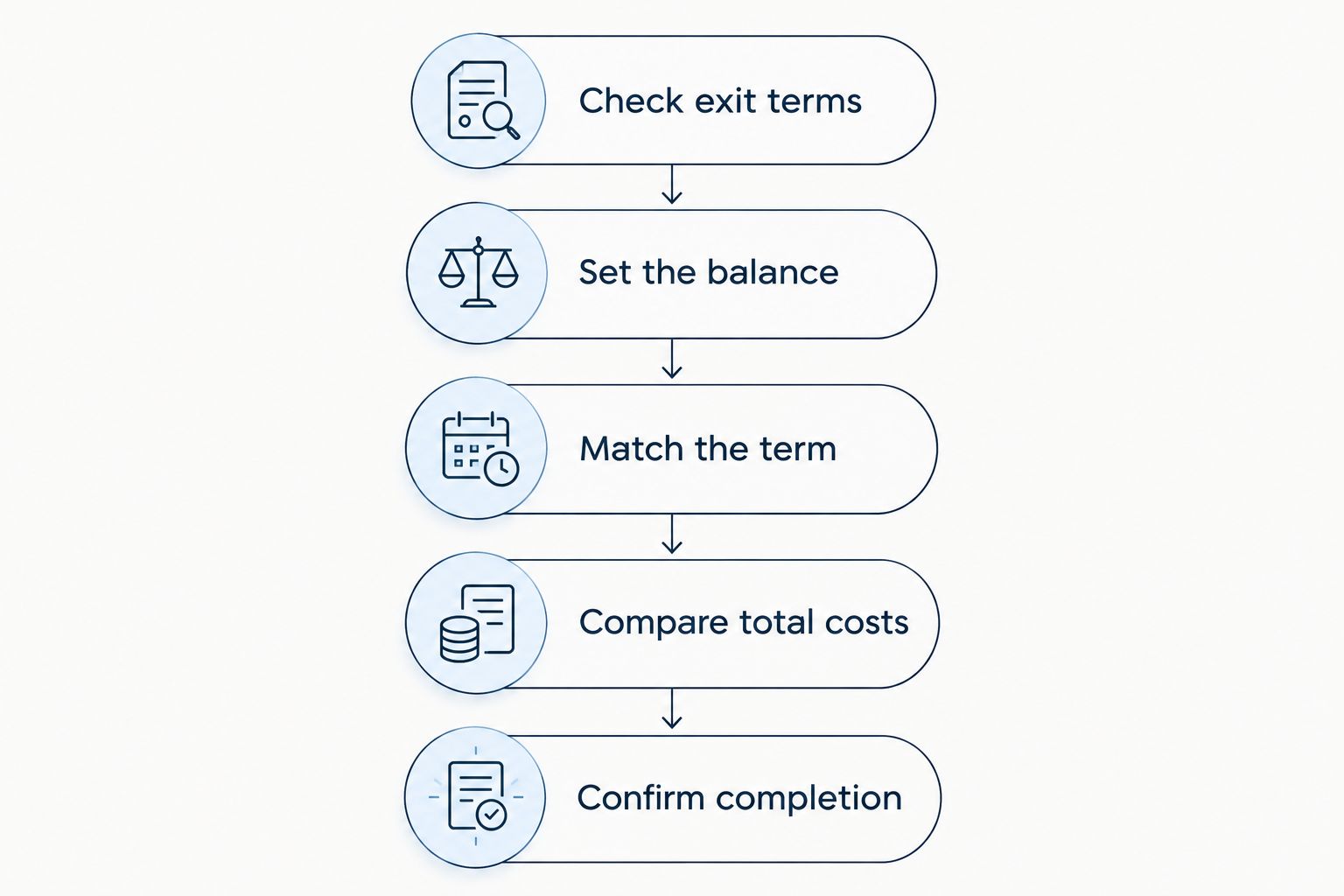
Use a consistent comparison in 2026: the same borrowing requirement, the same repayment basis and a clearly defined period. Changing several assumptions at once makes it difficult to see whether the mortgage itself is better value.
- Check exit terms. Read your current mortgage conditions and establish when any early repayment charge ends. Ask the lender for redemption information relevant to your intended completion date.
- Set the balance. Identify the borrowing you need, separating the existing mortgage from additional borrowing and any charges you plan to finance.
- Match the term. Compare repayment mortgages over the same remaining term. Treat a proposed term extension as a separate decision.
- Compare total costs. Include payments and applicable switching charges over a common period. Also compare the outstanding mortgage balance at the end of that period.
- Confirm completion. Check that the offer, legal work and redemption arrangements support the intended date. Recheck the final figures before committing.
A 2-year fixed rate and a 5-year fixed rate provide different lengths of rate certainty. Comparing only their payments during an initial 12-month period does not capture that difference or the conditions attached to leaving each agreement.
Choose a comparison period that fits your plans, then consider what happens beyond it. If you expect to move home, repay borrowing or change ownership, the agreement’s exit conditions deserve particular attention.
Should you add remortgage charges to the mortgage?
Adding a charge to the mortgage reduces the money needed upfront but increases the borrowing on which interest is calculated. It is a cash-flow choice, not a way to make the charge disappear.
Ask for illustrations showing the charge paid upfront and added to the loan. Compare the balance, monthly payment and interest implications rather than looking only at the amount due on completion.
If you intend to repay the added amount later, check the mortgage’s overpayment conditions. Do not assume that a future payment is unrestricted or that adding the charge has no effect on product eligibility.
Keep your wider finances in view. Paying every charge upfront is not automatically the right choice if it leaves you without an appropriate cash reserve.
Is remortgaging worthwhile if you have an early repayment charge?
An early repayment charge belongs in the switching calculation before you judge whether a lower rate saves money. Compare leaving on the proposed date with completing after the charge period ends.
The relevant figures come from your existing agreement and lender, not a general mortgage example. Confirm the precise date on which the charge changes or expires, and check that your conveyancer uses the intended date for redemption.
Waiting also needs a comparison. Establish which rate applies to the existing mortgage during any gap and whether the proposed new offer remains valid for the intended completion date.
Ask for both routes to be assessed on consistent assumptions. The useful answer is the total cost of each route, including the borrowing left outstanding, rather than the size of the charge in isolation.
Can a mortgage broker help compare the full cost?
Heron Financial is best suited to UK remortgagers seeking whole-of-market mortgage advice without a broker fee. Its stated service covers remortgagers, self-employed applicants, company directors and buy-to-let landlords.
Heron Financial’s fee-free mortgage brokerage does not remove charges imposed by lenders or other parties. You still need to check the selected product, existing mortgage conditions and any legal work required.
The useful distinction is between the advice service and the mortgage transaction. Ask Heron Financial to compare a lender switch with the available product transfer, including repayment terms, exit conditions and applicable charges.
Heron Financial’s whole-of-market mortgage service gives you a broader starting point than considering one lender alone. It does not guarantee approval or make every mortgage appropriate: the recommended agreement still needs to match your circumstances and plans.
Compare your remortgage options
Assess a lender switch against a product transfer, including charges, repayment terms and exit conditions.
FAQ
What costs should I check before remortgaging in 2026?
Check product charges, valuation and legal requirements, broker terms, and your existing lender’s early repayment and exit charges. Include the interest implications of any charge added to the new mortgage.
Does a lower mortgage rate always mean a cheaper remortgage?
A lower rate does not always mean a cheaper remortgage. Compare switching charges, payments and the remaining mortgage balance over the same period, using the same borrowing and repayment term.
Do I need a solicitor when I switch mortgage lenders?
Switching mortgage lenders involves legal work to replace the existing mortgage security. Check who handles that work, what the lender’s package covers and whether your transaction requires anything outside it.
Can I avoid an early repayment charge by waiting?
Completing after the applicable charge period ends avoids that early repayment charge, subject to your mortgage conditions. Confirm the exact date with your current lender and compare the cost of waiting with the cost of switching earlier.
Is a product transfer better than a remortgage?
A product transfer is not automatically better than a remortgage. Compare your existing lender’s available products with suitable alternatives, accounting for charges, flexibility and any changes to your borrowing.
Does using Heron Financial remove all remortgage charges?
Heron Financial provides fee-free mortgage brokerage, but lender charges, legal costs and existing mortgage exit conditions remain separate. Check the complete transaction costs before accepting a recommendation.
Will extending my mortgage term save me money?
Extending the repayment term can reduce the monthly payment while increasing the total interest paid. Compare term changes separately from the lender switch so a lower payment is not mistaken for a lower overall cost.
One last thing
The mortgage balance left at the end of your comparison period matters as much as the payments made during it. A smaller monthly payment achieved by extending the term can leave more debt outstanding.
Before signing a 2026 remortgage offer, ask for a comparison that shows applicable charges, payments and the ending balance on consistent terms. That turns a headline-rate comparison into a decision about your actual borrowing.


