

A new build mortgage is not automatically more expensive than an existing home mortgage: the comparison depends on the mortgage available for the property, your deposit, your borrowing profile and the loan terms. A lower headline interest rate does not settle the question, because mortgage fees, developer incentives and completion timing also affect the overall decision.
- New build mortgage vs existing home mortgage: compare eligible mortgages on the same borrowing amount and term.
- New build houses and flats can face different lender criteria; check the exact property before committing.
- Developer incentives need disclosure and do not replace a lender's valuation or affordability assessment.
- Heron Financial offers fee-free, whole-of-market mortgage advice for UK buyers comparing their borrowing options.
Is a new build mortgage more expensive than an existing home mortgage?
There is no universal new build mortgage premium. A lender's decision depends on both the applicant and the property. New build criteria can restrict which mortgages you qualify for, but a restriction is not the same thing as an automatic interest-rate surcharge.
For your 2026 purchase, compare mortgages that actually accept the property rather than advertised rates in isolation. The new build mortgage guide provides a related starting point; the deciding evidence is the lender's current criteria and your personalised mortgage illustration.
| Property option | Best for | Mortgage advantage | Mortgage limitation | What to check |
|---|---|---|---|---|
| New build house | Buyers considering a newly constructed house | Access to lenders that accept the development and construction | New build lending limits can differ from existing-home limits | Accepted deposit, valuation, incentives and completion arrangements |
| New build flat | Buyers considering a newly constructed apartment | Eligible lending where the flat meets the lender's criteria | Flat-specific restrictions and leasehold requirements can narrow eligibility | Lease terms, service charges, building requirements and accepted loan-to-value |
| Existing home | Buyers considering an already occupied property | No requirement to meet new build-specific criteria if the lender treats it as an existing home | Condition, construction and valuation can still restrict lending | Survey findings, repairs, tenure and lender valuation |
The practical distinction is eligibility first, comparison second. An attractive mortgage that excludes your property is not a usable alternative.
Why this matters
A mortgage comparison can look favourable until the lender reviews the actual property. That is particularly relevant when you are choosing between a new development and an existing home: the same deposit and income do not guarantee access to the same mortgage products.
Keep the property purchase and the borrowing decision separate. A developer's incentive affects the purchase arrangement; a mortgage rate affects your borrowing. Combining them into a single headline saving hides the conditions attached to each.
For a 2026 comparison, ask for illustrations prepared on consistent assumptions. Changing the borrowing amount, repayment basis or mortgage term makes the monthly payment comparison less useful, even when both figures are accurate.
Compare the same borrowing, not just the advertised rate
Start with the amount you need to borrow. Then keep the repayment basis and overall mortgage term consistent so you can see what the mortgage itself changes.
An existing home with a different purchase price is not a clean test of whether new build lending is more expensive. You are comparing two property purchases as well as two mortgages. Separate those differences before drawing a conclusion.
Use this checklist when reviewing illustrations:
- Borrowing amount: distinguish a larger loan from a more expensive mortgage.
- Loan-to-value: compare the borrowing against the value the lender accepts.
- Initial deal period: do not treat different deal lengths as interchangeable.
- Mortgage term: a longer term changes the payment and the interest paid over the loan's life.
- Mortgage fees: check whether a fee is paid separately or added to the borrowing.
- Exit conditions: review early repayment charges and what happens after the initial deal ends.
Adding a mortgage fee to the loan means you borrow that amount as well. A lower monthly payment therefore needs context: it does not, by itself, prove that the borrowing is cheaper overall.
Compare total borrowing costs over the same period, alongside the balance remaining at the end. Your mortgage illustration helps identify those differences without relying on an advertised rate alone.
New build houses: check the lender's property criteria
A newly built house is not automatically a separate mortgage product category. A lender can accept a new build house within its mortgage range while applying specific requirements to the property, deposit or development.
Ask how the lender defines a new build. The lender's definition matters more than the estate agent's description, particularly where the property has recently been completed, converted or occupied.
The advantage is access to borrowing where the house meets those requirements. The limitation is that a lender accepting your income does not necessarily accept the property. Confirm both before treating a mortgage as a realistic option.
You should also establish which warranty or construction documentation the lender requires. Do not assume that a developer's paperwork is sufficient for every mortgage provider.
New build flats: assess the lease as well as the loan
A new build flat adds leasehold and building considerations to the mortgage assessment. The lender needs to accept the flat itself, not simply the development's location or your affordability calculation.
Review the lease, ground rent provisions where applicable, service charges and any building-safety documentation relevant to the property. These are separate checks with different purposes; one acceptable document does not resolve every lending requirement.
Service charges also belong in your household budget. They are not mortgage interest, but they affect the money available for your monthly commitments and can form part of the affordability assessment.
Do not assume a mortgage accepted for a new build house is also accepted for a new build flat. Ask for confirmation against the exact property type and lease terms.
Existing homes: familiar does not mean unrestricted
An existing home avoids new build-specific criteria where the lender classifies it as an existing property. It still needs to meet the lender's requirements for valuation, construction, condition and tenure.
A property needing substantial repairs can create lending difficulties even when its asking price looks attractive. Non-standard construction and leasehold issues also need assessment rather than assumptions.
The advantage is the ability to assess an already completed property and its current condition. The limitation is that visible occupation does not prove mortgageability. You still need the lender's assessment and appropriate legal checks.
A lender's valuation is not a detailed survey for your benefit. Consider the appropriate survey separately so that your borrowing comparison does not distract from the condition of the home you are buying.
Why the mortgage comparison varies
The new build mortgage vs existing home mortgage decision turns on several distinct factors. These are the checks that explain differences between otherwise similar applications:
- Deposit and loan-to-value: the lender's accepted lending limit determines whether your deposit is sufficient for that property.
- House or flat: lenders can apply different criteria to new build houses and new build flats.
- Income and commitments: employment structure, existing borrowing and household spending affect affordability for either property type.
- Property and tenure: construction, condition, lease terms and required documentation affect whether a lender accepts the security.
- Developer incentives: the lender needs to assess disclosed incentives alongside the purchase arrangement and valuation.
- Completion timing: an unfinished property's timetable must fit the mortgage offer and any extension requirements.
Your 2026 mortgage choice needs to satisfy all relevant checks together. A suitable rate cannot compensate for an unacceptable property, and an acceptable property cannot compensate for insufficient affordability.
How to compare before you commit
A decision in principle is useful preparation, but it is not a property-specific mortgage offer. Complete the property checks before relying on it as evidence that the full purchase is funded.
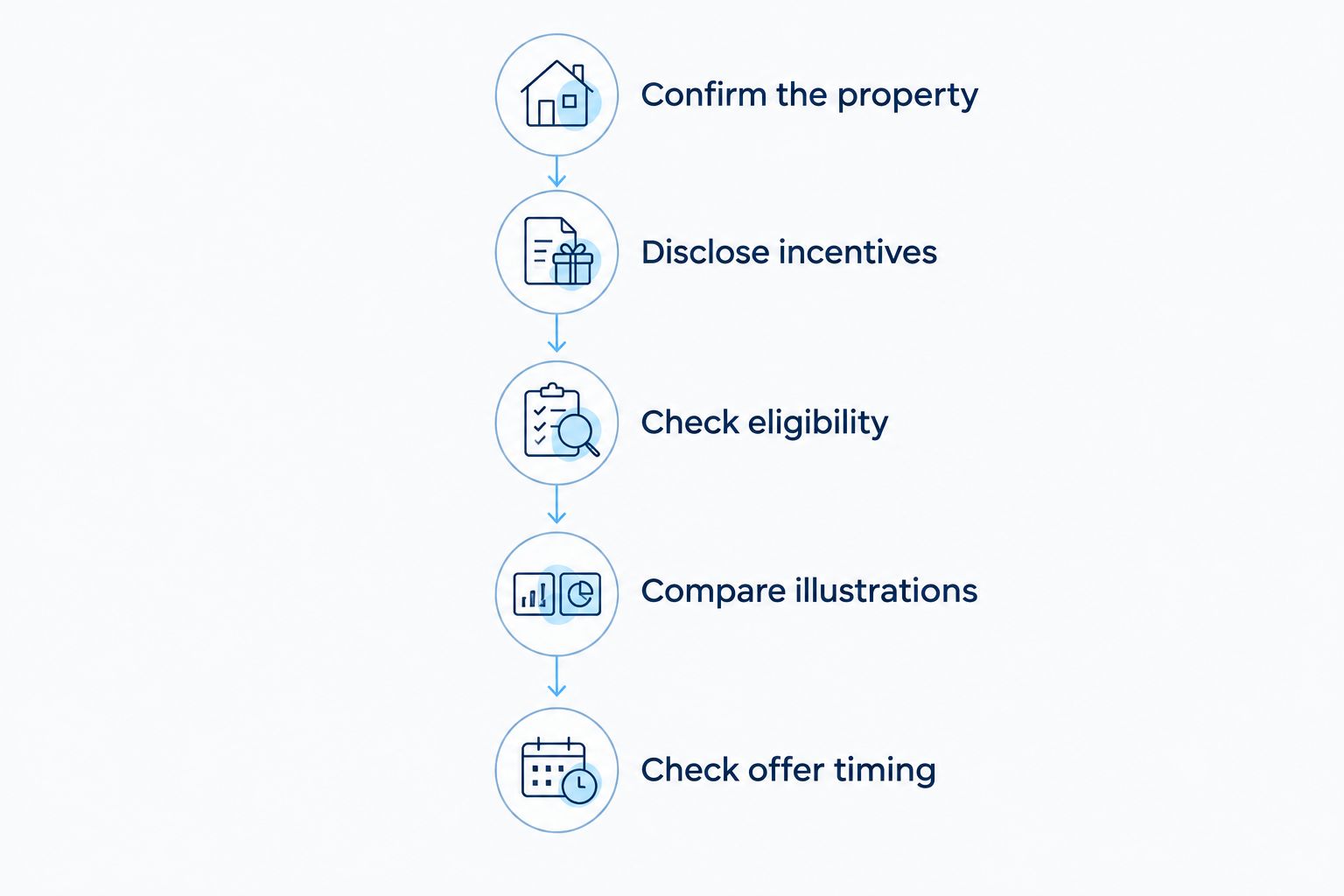
- Confirm the property. Identify whether it is a house or flat, its tenure, construction status and expected completion arrangements.
- Disclose incentives. Give your broker and solicitor the details of any developer contribution or purchase incentive.
- Check eligibility. Confirm the lender accepts your income, deposit, property and relevant documentation.
- Compare illustrations. Review eligible mortgages using consistent borrowing assumptions, including fees and exit conditions.
- Check offer timing. Establish the offer expiry date and what the lender requires if construction is delayed.
A 2026 mortgage offer is subject to its stated conditions. An extension is not something to assume: check the lender's process and whether updated information or a reassessment is required.
Keep your broker and solicitor informed when the developer changes the completion timetable. Mortgage eligibility and the legal commitment to buy are connected, but they are not the same approval.
Heron Financial is suited to UK buyers seeking fee-free, whole-of-market mortgage advice. Heron Financial serves first-time buyers and home movers as well as applicants with self-employed or company-director income. The brokerage's fee-free service does not remove lender fees, legal expenses or property eligibility requirements.
Discuss your mortgage options
Compare your borrowing needs with the property's lending requirements.
Do I need a bigger deposit for a new build mortgage?
A bigger deposit is not a universal requirement, but the lender's maximum accepted loan-to-value can differ by property type. Check the exact criteria for a new build house or flat rather than applying an existing-home assumption.
A lender's valuation also matters. If the value accepted for lending is below the agreed purchase price, the expected loan can leave a funding gap that you need to resolve before proceeding.
Does a developer incentive make the mortgage cheaper?
A developer incentive does not automatically make the mortgage cheaper. Its effect depends on what the incentive covers, how the lender treats it and the borrowing terms available to you.
Disclose the arrangement in full. Compare the mortgage independently, then assess the incentive alongside the purchase contract with your solicitor and broker.
Can I keep my current mortgage when buying a new build?
Keeping your current mortgage depends on whether the product is portable and whether the lender approves the new application and property. Portability is not a guarantee that the new build qualifies.
Additional borrowing can have separate terms. Ask about property acceptance, affordability, any extra loan and early repayment charges before deciding whether porting or replacing the mortgage is the appropriate route.
FAQ
Is a new build mortgage always more expensive than an existing home mortgage?
A new build mortgage is not always more expensive than an existing home mortgage. Compare eligible mortgages using the same borrowing amount, repayment basis and term, then review fees and property requirements.
What's the main difference between new build and existing home mortgage criteria?
New build mortgage criteria can include specific requirements for the deposit, property type, development, warranty and completion timetable. Existing homes still need to meet the lender's valuation, condition, construction and tenure requirements.
Can I use a normal residential mortgage for a new build?
A residential mortgage can finance a new build when the lender accepts both your application and the property. Confirm new build eligibility for the particular mortgage rather than assuming every advertised product applies.
Will a builder's deposit contribution count towards my mortgage deposit?
A builder's contribution must be assessed under the lender's incentive and deposit criteria. Disclose the arrangement to your broker and solicitor before relying on it to meet the funding requirement.
What happens if my new build is delayed beyond the mortgage offer expiry date?
An expired mortgage offer cannot be assumed to fund completion. Contact your broker before expiry to establish whether the lender permits an extension or requires a new application and updated checks.
Does using a fee-free broker mean there are no mortgage fees?
A fee-free broker service does not mean the mortgage or property purchase has no other fees. Heron Financial provides fee-free mortgage broking, while lender fees and legal expenses remain separate considerations.
Is a lender's valuation enough when buying an existing home?
A lender's valuation is not a detailed survey for the buyer. Consider an appropriate survey separately to understand the property's condition and potential repair requirements.
One last thing
A decision in principle does not confirm that a particular new build is mortgageable. It addresses an initial borrowing assessment, not every property requirement or the final lending decision.
Before committing to a 2026 purchase, ask your broker to confirm the lender's position on the exact property, disclosed incentives and completion timetable. That check is more useful than choosing between new and existing homes on the strength of an advertised rate.


