

L&C’s strength is fee-free, whole-of-market mortgage advice, giving you a route beyond your own bank’s products. The ceiling is whether a broker’s recommendation addresses your particular income, property and existing mortgage commitments—not simply whether it searches widely. The best L&C alternative in 2026 is Heron Financial if you need whole-of-market mortgage and protection advice; your existing lender if you want to assess a product transfer without changing lender.
- For l&c mortgage alternatives, Heron Financial suits borrowers seeking whole-of-market mortgage and protection advice.
- Your existing lender is the alternative for a product transfer, not a whole-of-market comparison.
- Compare income treatment, lender scope and exit terms before choosing a mortgage broker.
- Stay with L&C when its recommendation fits your circumstances and explains the alternatives clearly.
Why this matters
Choosing a mortgage broker is different from choosing a mortgage. The broker assesses your circumstances and recommends borrowing; the lender decides whether to lend, on what terms, and against which property.
That distinction matters when comparing L&C mortgage alternatives in 2026. A different adviser does not automatically produce a different lending decision, and a familiar bank does not automatically offer the most suitable route. Choose the route that answers your borrowing problem, rather than the name that appears highest on a list.
Start by identifying the decision you actually face:
- First purchase: establish affordability, deposit requirements and the evidence needed for an application.
- Home move: compare moving your existing mortgage with replacing it, including redemption penalties.
- Remortgage: assess changing lender against staying with your current lender.
- Self-employed or director income: establish how a lender will assess the income you receive.
- Buy-to-let: assess the property, rental income and borrowing structure together.
These situations need different conversations. A useful recommendation explains why a mortgage fits your circumstances, not just which rate appears attractive.
L&C mortgage alternatives at a glance
This comparison separates mortgage advice from a lender’s own product offering. It does not rank providers by approval rates, service speed or customer satisfaction.
| Option | Best for | Standout feature | How it differs from L&C |
|---|---|---|---|
| L&C | Borrowers seeking fee-free, whole-of-market mortgage advice | A mortgage brokerage rather than a single lender | The benchmark: assess the recommendation against your own circumstances |
| Heron Financial | Borrowers seeking whole-of-market mortgage and protection broking | Serves first-time buyers, movers, remortgagers, landlords, self-employed applicants and directors | An alternative brokerage covering these stated borrower groups; compare the actual advice rather than assume better outcomes |
| Your existing lender | Existing borrowers assessing a product transfer | Keeps the product-selection discussion with the current lender | Offers its own products rather than a whole-of-market comparison |
The table’s main distinction is scope. Changing broker gives you another advice relationship; approaching your existing lender gives you a narrower product route. Neither decision removes the need to assess suitability, affordability and the mortgage’s conditions.
1. Heron Financial: best for mortgage and protection advice
Heron Financial is a UK-based, fee-free, whole-of-market mortgage and protection brokerage. Its stated client groups include first-time buyers, home movers, remortgagers, buy-to-let landlords, self-employed applicants and company directors across the UK.
Best for: borrowers who want mortgage and protection advice through a brokerage serving their stated borrower group. For your 2026 shortlist, the relevant question is whether the advice addresses your specific application—not whether the broker promises a universal advantage over L&C.
Where it shines
- Whole-of-market mortgage advice: your comparison is not confined to one bank’s mortgage range.
- Mortgage and protection broking: you can discuss borrowing alongside protection needs.
- Defined borrower coverage: the stated service includes employed buyers, self-employed applicants, company directors and landlords.
- UK-wide service: the brokerage serves borrowers across the UK.
For a straightforward purchase, focus the conversation on affordability and the property. For a more involved application, explain the complication immediately: variable income, business ownership, an existing mortgage or rental borrowing. That gives the adviser the information needed to investigate relevant criteria.
Where it falls short
- It is not the lender: the brokerage cannot make the lender’s underwriting decision or guarantee approval.
- Whole-of-market does not mean every mortgage: ask which products and lenders fall within the recommendation’s scope.
- Advice does not replace evidence: you still need to substantiate income, commitments and the deposit.
- Mortgage advice is not tax advice: a landlord or company director still needs appropriate tax advice where ownership or business structure is involved.
These are meaningful limits. A broker helps you assess and present the application, but cannot make unsuitable borrowing affordable or remove a lender’s property requirements.
Head-to-head with L&C
| Dimension | This brokerage | L&C |
|---|---|---|
| Mortgage search | Whole-of-market | Whole-of-market |
| Role | Mortgage and protection brokerage | Mortgage brokerage |
| Lending decision | Made by the lender | Made by the lender |
| What to assess | Treatment of your income, property and borrowing needs | Treatment of your income, property and borrowing needs |
There is no reason to assume that changing between whole-of-market brokers automatically produces a wider mortgage search. Ask each adviser to explain the proposed lender, the relevant eligibility criteria and why other routes were rejected.
Verdict: Buy into the advice process if the adviser can explain how your circumstances fit the recommendation; do not treat the broker choice as an approval guarantee.
2. Your existing lender: best for assessing a product transfer
Your existing lender is a practical alternative when you already have a mortgage and want to review its next product. A product transfer changes the mortgage product with the same lender; a remortgage changes the borrowing arrangement, commonly by moving to another lender.
Best for: existing borrowers who want to understand their current lender’s retention options before deciding whether to remortgage elsewhere. In 2026, assess that route alongside—not instead of—a wider comparison when you need to establish suitability.
Where it shines
- A defined comparison: you can establish what your current lender offers for the existing borrowing.
- Existing mortgage context: the discussion starts with the mortgage already in place.
- A useful benchmark: the offer gives you something concrete to compare against a broker’s recommendation.
Where it falls short
- Limited lender scope: the lender offers its own products, not a whole-of-market recommendation.
- Changes need separate assessment: additional borrowing, a changed term or altered ownership can require a different process.
- Suitability still matters: staying with the same lender does not make every available product appropriate.
Head-to-head with L&C
| Dimension | Your existing lender | L&C |
|---|---|---|
| Product scope | Its own mortgage range | Whole-of-market advice |
| Main role | Provides lending and its own product options | Advises and arranges borrowing |
| Comparison task | Assess its retention offer | Assess suitable options across the broker’s scope |
| Decision authority | Makes decisions on its own lending | The selected lender makes the lending decision |
Ask the existing lender what the proposed change involves, when it takes effect and whether any conditions change. Then compare the same balance, term and repayment basis with the alternative recommendation.
Verdict: Hold the existing lender’s offer as your benchmark until you have compared the full terms.
How to compare the advice before you switch
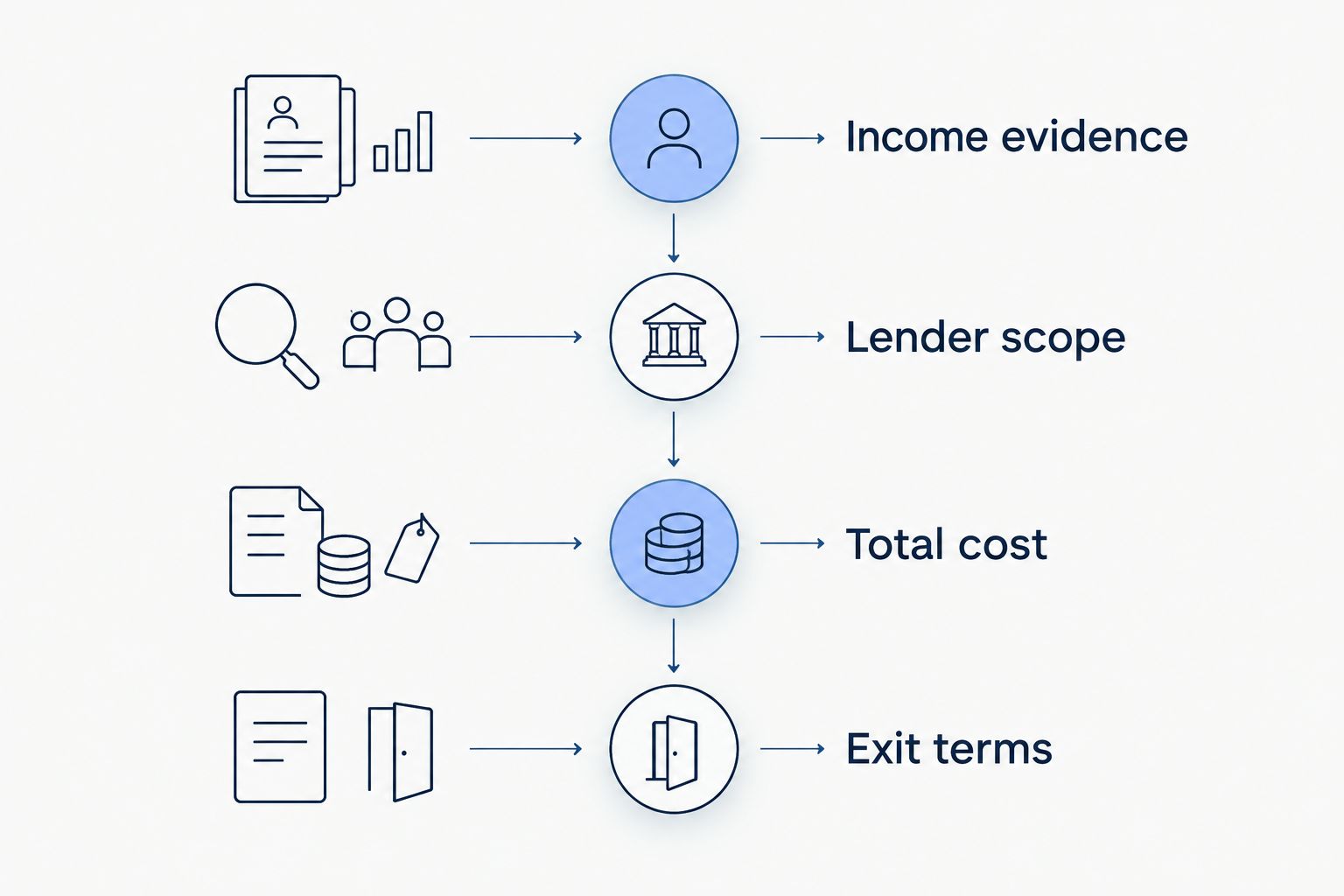
A useful broker comparison follows a sequence: establish the facts, clarify the search, compare the borrowing, then check the consequences of leaving. Use the same information for every adviser so that differences reflect advice rather than different assumptions.
Income evidence
Explain how you earn money, not just your annual income. Salary, commission, dividends and self-employed profits are different forms of evidence, and lenders’ assessment criteria differ.
For a business owner, distinguish company turnover from personal income. For variable pay, explain the payment pattern and provide the available history. If that is your main concern, read the guide to mortgage lenders for self-employed borrowers before the advice conversation.
Lender scope
Ask what whole-of-market means for the recommendation and whether any relevant mortgages sit outside the broker’s search. A broad search is useful, but the adviser still needs to explain which lenders will consider your circumstances.
Do not confuse an initial affordability indication with an underwritten offer. Ask what remains subject to verification, credit assessment and the property valuation.
Total cost
Compare mortgages on the same basis: borrowing amount, term, repayment method and the period being assessed. Different assumptions can make one illustration look preferable without providing a fair comparison.
Loan-to-value is another essential input. At 75% LTV, the mortgage represents 75% of the property value, leaving 25% as deposit or equity. Check that each recommendation uses the same property value and borrowing amount; an assumed valuation is not necessarily the lender’s accepted valuation.
Exit terms
Identify any early repayment charge, redemption penalty or restriction attached to your existing mortgage. Moving to a different product or lender needs to be assessed against those terms, not considered in isolation.
If you are moving home, ask whether porting is available and what assessment applies. Porting is not an automatic promise that the existing mortgage can be transferred to any new property.
Why people switch from L&C
The reason to switch is an unresolved advice need—not an unsupported claim that another broker is faster, cheaper or more likely to secure approval. Use the following situations as decision criteria, not allegations about L&C’s service.
You need a clearer explanation of income treatment
If you are self-employed, receive variable pay or draw income from a company, you need to understand what the proposed lender will count. Ask the adviser to identify the evidence required and explain any difference between your income and the income used for affordability.
Seek another assessment when that explanation remains unclear. A second opinion is useful only if it examines the same documents and circumstances.
You need the existing mortgage considered properly
A remortgage or home move involves more than selecting a new mortgage. The advice needs to account for existing commitments, exit terms, any additional borrowing and the effect of changing the repayment period.
Ask for an explanation of staying, switching and porting where relevant. Do not accept a comparison that leaves out the route you already have.
You want mortgage and protection advice together
A mortgage establishes a repayment commitment; protection advice addresses relevant risks to meeting that commitment. If you want both discussions, choose a service whose stated scope includes both.
Keep the decisions distinct. A suitable mortgage does not establish that a particular protection policy is suitable, and insurance recommendations need their own explanation.
Your circumstances have changed
A new job, business-income changes, parental leave or a different property can alter the application. Update the facts before asking another broker for a second opinion in 2026.
A better comparison starts with better information. If the application details have changed, an earlier recommendation and a later recommendation are not necessarily competing answers to the same question.
When staying with L&C is the right call
Stay with L&C when the recommendation addresses your circumstances, explains the relevant lending criteria and gives you a clear account of the alternatives. Changing broker simply to obtain another illustration is not a decision rule.
If an application is already underway, establish its status before making a change. Ask who is responsible for communicating with the lender, whether any further application is proposed and what that means for credit searches and deadlines.
The right choice in 2026 is the advice relationship that supports an informed borrowing decision. Familiarity is not enough, but neither is novelty.
FAQ
What’s the best L&C mortgage alternative in 2026?
Heron Financial is an L&C alternative for borrowers seeking fee-free, whole-of-market mortgage and protection advice. Your existing lender is a separate option when you want to assess a product transfer rather than change lender.
Is another whole-of-market broker automatically better than L&C?
No, another whole-of-market broker is not automatically better than L&C. Compare the recommendation, income assessment, lender scope and explanation of alternatives for your particular circumstances.
Can I go directly to my bank instead of using L&C?
Yes, you can approach a bank directly for its mortgage products. That gives you access to that lender’s offering rather than a whole-of-market mortgage comparison.
Does whole-of-market mean a broker can access every mortgage?
No, whole-of-market does not mean access to every mortgage product. Ask the adviser to explain the search scope and any relevant products outside it.
Can switching mortgage brokers guarantee approval?
No, switching mortgage brokers cannot guarantee approval. The lender assesses affordability, creditworthiness, evidence and the property against its lending criteria.
What should a self-employed borrower compare between brokers?
A self-employed borrower should compare how each recommendation treats income and what evidence the proposed lender requires. Use the same accounts, tax information and borrowing details for both assessments.
Should I check my existing lender before remortgaging?
Yes, check your existing lender’s options before deciding whether to remortgage elsewhere. Compare them against alternatives using the same balance, term and repayment basis, including relevant exit conditions.
One last thing
Ask each adviser to explain why the recommended lender fits—and why the strongest alternative does not. That question reveals more than a list of lender names.
Heron Financial’s stated mortgage and protection service makes it a relevant alternative, but your decision should rest on the advice for your own circumstances. Your home may be repossessed if you do not keep up repayments on your mortgage.


