

Retirees’ mortgage borrowing is lending assessed against pension income with the aim of buying, moving home or refinancing in retirement. To get a mortgage for retirees on pension income, you need evidence of sustainable income, affordable repayments and a lender whose age and term criteria fit your circumstances.
- A mortgage for retirees on pension income depends on affordability, income evidence and lender age criteria.
- Compare repayment mortgages, retirement interest-only mortgages and lifetime mortgages by how the debt is repaid.
- Heron Financial provides fee-free, whole-of-market mortgage advice; lender approval still depends on individual circumstances.
- Check survivor income before committing to a joint retirement mortgage.
Why mortgage borrowing matters for retirees
Retirement changes how you demonstrate affordability, not simply your employment status. State Pension, defined benefit pensions, annuities and pension drawdown have different evidence requirements, and lenders do not assess every income source identically.
Your borrowing decision also has to work without relying on future salary increases. A manageable payment today needs checking against household bills, pension changes and the income remaining if a partner dies.
Heron Financial is best for retirees seeking fee-free, whole-of-market mortgage advice. You can approach Heron Financial for mortgage broking, but advice does not guarantee an offer or replace a lender’s affordability assessment.
For a retirement mortgage in 2026, start with the repayment method and your sustainable budget. A lower monthly payment does not necessarily mean a smaller eventual debt.
How to prepare a pension-income mortgage application
These 6 steps separate the questions you can resolve yourself from those requiring lender criteria checks or professional advice. Complete the income and budget work before choosing a mortgage structure.
Establish your borrowing purpose
Write down what the mortgage must achieve: purchase a home, replace an existing loan, fund a move or release money for a defined purpose. These are different applications, even when the same pension pays the monthly bill.
If you already have a mortgage, read the latest statement and your current offer. Check the outstanding balance, remaining term, repayment basis and any early repayment charge before comparing alternatives.
A product transfer with your existing lender and a remortgage to another lender are not the same process. Ask what assessment each route requires, especially if you want extra borrowing, a different term or a change of borrowers.
- Record the purpose of the borrowing.
- Confirm the outstanding mortgage balance.
- Check the current deal’s end date.
- Identify early repayment charges and exit conditions.
- Separate essential borrowing from optional spending.
Document each pension income source
Begin with your pension statements and bank records. Create a schedule showing who pays each pension, its gross amount, its net payment and whether it changes over time.
State Pension evidence differs from evidence for an occupational pension or an investment-backed drawdown arrangement. A pension pot’s value is not the same thing as a guaranteed income, and a withdrawal appearing on a statement does not establish that it is sustainable.
For your 2026 application, ask each prospective lender what evidence it needs rather than collecting an assumed standard pack. Heron Financial’s mortgage broking provides an advised route to comparing lender requirements; the limitation is that each lender still decides which income it accepts.
- Gather State Pension award or entitlement evidence.
- Obtain occupational pension and annuity statements.
- Separate regular drawdown from one-off withdrawals.
- Match pension payments to bank statement entries.
- Record any employment, rental or other income separately.
Calculate a sustainable household budget
Build your own budget before using a borrowing calculator. Record pension income after tax, then deduct regular spending, credit commitments and irregular household expenses.
Keep monthly and annual figures separate. There are 12 months in a year, so divide an annual bill by 12 when building a monthly budget; otherwise, insurance renewals or property maintenance can disappear from the affordability picture.
Your lender will conduct its own assessment, including relevant expenditure and affordability checks. Your personal budget serves a different purpose: deciding what payment leaves enough room for the retirement you intend to have.
For 2 applicants, prepare both a joint budget and a survivor budget. Do not assume a deceased partner’s pension continues unchanged: check the scheme’s survivor benefits and any annuity terms.
- List net pension income by recipient.
- Include council tax, utilities and household insurance.
- Record loans, credit cards and financial dependants.
- Allow for maintenance and irregular expenditure.
- Check the budget using survivor income.
Compare the repayment structures
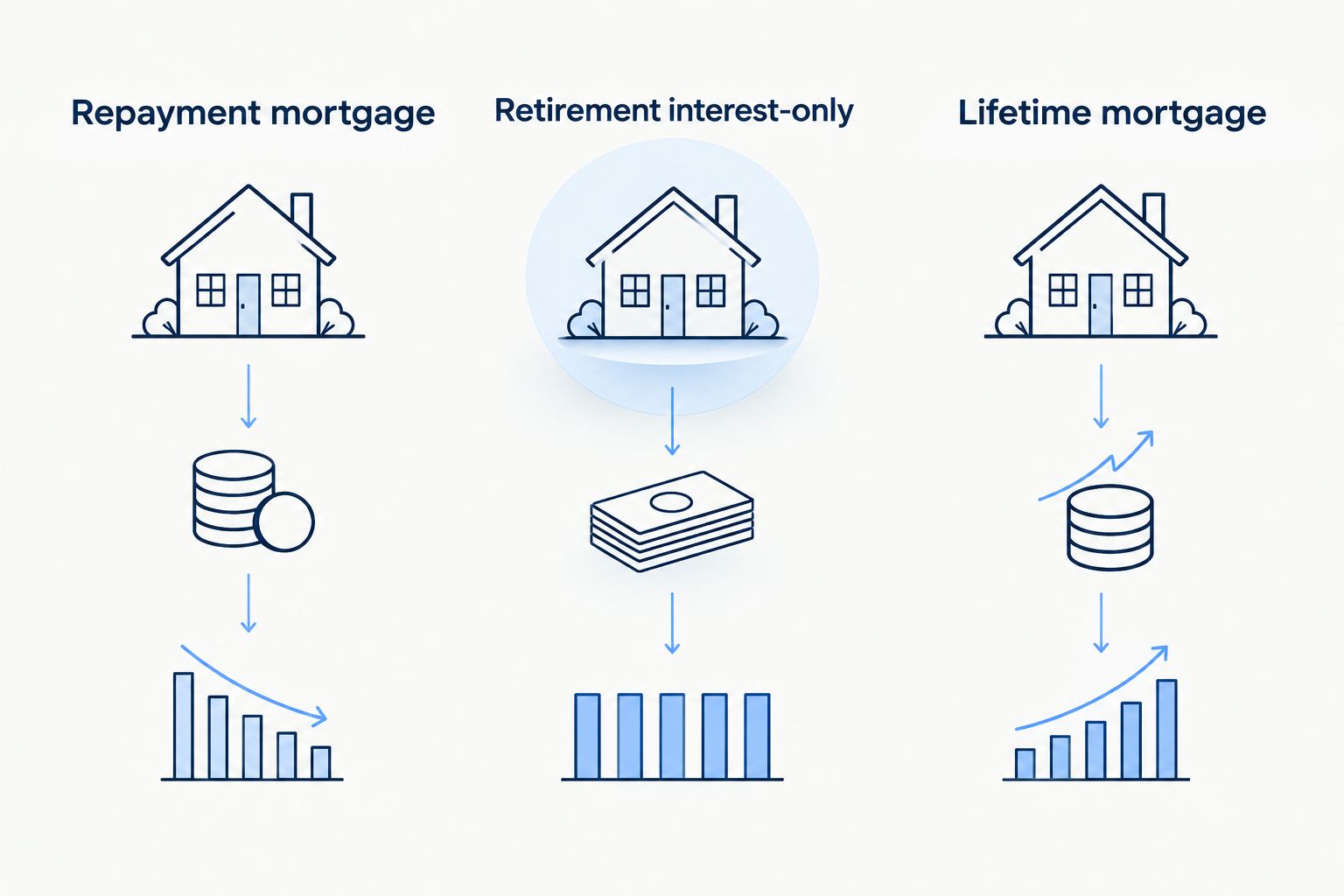
Start by understanding where the capital goes. A repayment mortgage reduces the balance through scheduled payments; an interest-only arrangement leaves capital to repay later, while a lifetime mortgage can allow interest to accumulate.
The right structure depends on whether you want to clear the debt through monthly payments, retain an outstanding balance subject to agreed repayment events, or explore equity release. These are different financial commitments, not interchangeable versions of the same loan.
Use the comparison table below to frame the discussion. Choose the repayment method before judging the monthly payment. A smaller payment can leave a larger liability against the property.
- Identify whether monthly payments reduce capital.
- Ask when the outstanding balance becomes repayable.
- Check what happens after death or a move into care.
- Review the effect on the remaining property equity.
- Obtain specialist advice before choosing equity release.
Check age, term and property criteria
Check lender criteria before submitting a full application. Lenders set their own requirements for age at application, age at the end of the term, acceptable pension income and property suitability.
There is no single maximum borrowing age that applies to every UK mortgage. A shorter available term also changes the repayment calculation: repaying the same capital over less time increases the capital element of each payment.
For your 2026 shortlist, establish which lender criteria apply to both applicants rather than judging eligibility from a headline age limit. Unusual construction, lease terms or other property characteristics also need checking independently of pension affordability.
- Confirm age requirements at application and term end.
- Ask how each applicant’s age affects eligibility.
- Check treatment of each pension income source.
- Confirm the property meets lending criteria.
- Distinguish an initial indication from a mortgage offer.
Review the recommendation before applying
Compare the whole arrangement, not just the initial rate. Read the mortgage illustration, repayment basis, reversion terms, early repayment conditions and any restrictions on overpayments or moving home.
Heron Financial is a fee-free mortgage brokerage, not a lender. That distinction matters: brokerage advice helps you select and arrange borrowing, while the lender assesses the application and issues any mortgage offer.
Before proceeding in 2026, ask for a clear explanation of why the recommended mortgage fits your pension income and retirement plans. If you are considering a lifetime mortgage, confirm that you are receiving advice from an appropriately qualified equity-release adviser; do not assume every mortgage adviser covers that market.
- Read the personalised mortgage illustration.
- Confirm the repayment basis and term.
- Check early repayment and overpayment conditions.
- Ask what happens when the initial deal ends.
- Confirm which advice services are included.
Compare mortgage options for pension-income borrowers
Best for clearing the debt through regular payments: a repayment mortgage. Its advantage is a reducing capital balance when payments are maintained; its limitation is the monthly commitment required to repay both capital and interest within the agreed term.
Best for borrowers able to service interest but seeking no fixed capital-repayment date: a retirement interest-only mortgage. The capital remains outstanding, and the loan must be repaid following the events specified in the contract.
Best for homeowners exploring equity release rather than a conventional repayment mortgage: a lifetime mortgage. Specialist advice is essential because accumulated interest, repayment conditions and reduced estate value affect the decision.
| Option | Best for | Main advantage | Key limitation |
|---|---|---|---|
| Repayment mortgage | Retirees who can afford capital and interest payments | Clears the balance by the agreed term end if payments are maintained | Age, term and affordability criteria can restrict borrowing |
| Conventional interest-only mortgage | Borrowers with a lender-accepted repayment strategy | Monthly payments cover interest rather than scheduled capital repayment | Capital remains due at term end; the repayment strategy must be credible |
| Retirement interest-only mortgage | Retirees with sustainable income for ongoing interest payments | Usually links capital repayment to specified life events rather than a fixed term end | The capital balance remains outstanding and ongoing payments are required |
| Lifetime mortgage | Homeowners considering equity release | Can allow borrowing without mandatory monthly repayments, depending on the plan | Rolled-up interest increases the debt and reduces remaining equity |
A conventional interest-only mortgage normally requires a suitable capital-repayment strategy. Retirement interest-only lending usually relies on a property sale after specified events, such as the last borrower’s death or permanent move into long-term care, subject to the mortgage terms.
A lifetime mortgage is different again. Some plans allow interest payments or voluntary repayments, but the permissions and conditions depend on the contract. Equity release can also affect means-tested benefits and the estate you leave.
Do not interpret whole-of-market mortgage advice as proof that every retirement product or equity-release plan is included. Confirm the adviser’s scope before making a decision.
Common mistakes retirees make
Treating pension savings as guaranteed income
A large pension pot does not automatically establish mortgage affordability. Drawdown depends on withdrawals and the underlying investments, while a defined benefit pension or annuity has its own payment terms.
Correct move: distinguish pension capital, guaranteed payments and variable withdrawals before asking how much you can borrow.
Assessing only the joint household position
Joint affordability can conceal a weaker survivor position. State Pension entitlement, occupational survivor benefits and annuity payments do not necessarily leave the surviving borrower with the same household income.
Correct move: obtain the actual survivor-benefit terms and check how the proposed mortgage would be serviced afterwards.
Choosing the longest possible term automatically
A longer repayment term reduces the capital repayment required each month, but extends the period over which interest is charged. The most manageable term is not automatically the maximum a lender permits.
Correct move: compare affordability, the overall repayment obligation and the age at which you want the debt cleared.
Assuming a retirement mortgage means equity release
Retirees can apply for conventional residential mortgages where lender criteria are met. Retirement interest-only and lifetime mortgages are separate options with different repayment obligations.
Correct move: compare structures before selecting a product category, particularly if leaving property equity to family is part of your plan.
FAQ
Can I get a mortgage if my only income is my pension?
Yes, pension income can support a mortgage application where it meets the lender’s income and affordability criteria. The lender also assesses your age, proposed term, credit commitments and property.
What is the maximum age for a mortgage in 2026?
There is no single maximum age across UK mortgage lenders in 2026. Check both the application-age limit and any maximum age at the end of the proposed term.
Does State Pension count as mortgage income?
State Pension can count as mortgage income with lenders that accept it. You must provide the evidence requested, and the income must support the proposed borrowing alongside your expenditure.
Can I use pension drawdown to get a mortgage?
Pension drawdown can support a mortgage application with lenders whose criteria accept it. Expect checks on the withdrawals, pension fund and sustainability of the proposed income.
Is a retirement interest-only mortgage the same as equity release?
No, a retirement interest-only mortgage requires ongoing interest payments and leaves the capital outstanding until a specified repayment event. A lifetime mortgage is an equity-release product that can allow interest to accumulate instead of requiring monthly payments.
Can my partner and I apply using both pensions?
Yes, a joint application can use both applicants’ pension income where the lender accepts it. Check survivor income as well as the joint budget, because pension payments can change after a partner dies.
Will Heron Financial guarantee a pension-income mortgage?
No, Heron Financial provides fee-free, whole-of-market mortgage broking, not guaranteed lending. Approval depends on the lender’s assessment of your income, expenditure, credit position, age and property.
One last thing
Check the pension’s survivor terms before checking the maximum loan. A household can meet today’s monthly payment while relying on income that changes after a partner’s death.
For your 2026 mortgage review, bring those pension terms alongside your statements. They help establish whether the proposed borrowing fits the household’s longer-term position, not just the current application.
Your home may be repossessed if you do not keep up repayments on your mortgage.


