

Best overall approach: compare guarantor mortgage lenders through Heron Financial, a fee-free, whole-of-market mortgage broker—not a lender. Best for an income shortfall: joint borrower, sole proprietor lending; best for deposit support without ongoing family liability: a genuine gifted deposit. This 2026 guide ranks the lending routes by the problem they solve, so you can choose the right arrangement before choosing a lender.
- Heron Financial is best for borrowers seeking whole-of-market advice when comparing guarantor mortgage lenders.
- Joint borrower, sole proprietor mortgages address affordability; gifted deposits address a deposit shortfall.
- Savings-backed and property-backed arrangements expose the family supporter’s assets to risk.
- Choose the support structure first, then compare lender criteria and the supporter’s release conditions.
Why this matters
The phrase guarantor mortgage covers arrangements with very different consequences. A parent guaranteeing repayments is not taking the same risk as a parent giving you a deposit, and a joint borrower is not simply a character reference.
Choose the arrangement that solves your actual borrowing problem with the least unnecessary family exposure. If your deposit is sufficient but your income does not support the loan, adding more security does not automatically resolve affordability. If income is sufficient but savings are short, making a relative jointly responsible for repayments deserves careful scrutiny.
For a 2026 application, separate the amount you need from the amount a lender will accept. The guide to how much you can borrow with a guarantor mortgage explains the borrowing question; this guide focuses on selecting the support structure.
What makes the best guarantor mortgage lenders?
A useful lender comparison starts with these criteria—not a familiar bank name:
- Support mechanism: Does the arrangement use another person’s income, savings, property or a permanent gift?
- Affordability fit: How does the lender assess both the buyer’s finances and the supporter’s existing commitments?
- Legal responsibility: Who owes the mortgage debt, who owns the property, and what assets secure the borrowing?
- Supporter suitability: Do the proposed supporter’s age, income, debts and relationship to the buyer fit the lender’s requirements?
- Exit conditions: What must happen before the supporter can leave the arrangement or recover pledged assets?
- Application fit: Does the lender accept the buyer’s employment, credit history and proposed property?
A lender belongs on your shortlist only when its criteria fit the complete arrangement. Passing one condition is not approval. A strong parental income, for example, does not remove the need to assess the buyer’s credit history and the property.
Guarantor mortgage options at a glance
These are lending routes, not interchangeable products. The order prioritises choosing an appropriate structure before committing family resources.
| Ranked route | Best for | Standout feature | Key limitation |
|---|---|---|---|
| Broker-led whole-of-market comparison | Buyers unsure which support mechanism fits | Compares the problem before selecting a lender | Advice does not guarantee approval |
| Joint borrower, sole proprietor mortgage | Buyers needing additional assessed income | Separates mortgage borrowing from property ownership | Supporting borrowers remain responsible for the debt |
| Savings-backed family support | Families considering savings as security | Supports the application without necessarily gifting the savings | Pledged savings are subject to restrictions and loss risk |
| Property-backed guarantee | Families considering property as additional security | Uses a supporter’s property within the security arrangement | The supporter’s home or other property is exposed |
| Gifted-deposit mortgage | Buyers whose main obstacle is the deposit | Avoids an ongoing guarantee when the gift is unconditional | The donor gives up the money permanently |
1. Broker-led comparison: best for choosing the support structure
Heron Financial is a UK-based, fee-free, whole-of-market mortgage and protection brokerage. For guarantor mortgage lenders, its role is advice and comparison—not providing the mortgage or guaranteeing acceptance.
This route suits a buyer who knows a relative can help but has not established how. Start by distinguishing insufficient income from insufficient deposit, then assess whether the proposed supporter should contribute income, provide security or make a gift.
Broker-led comparison pros
- Lets you compare different support structures rather than starting with one bank’s offering.
- Gives the buyer and supporter a single set of questions to resolve before applying.
- Helps separate lender eligibility from the family’s willingness to accept the obligations.
Broker-led comparison cons
- Advice cannot remove a lender’s affordability or credit requirements.
- Whole-of-market advice does not mean every mortgage suits your circumstances.
- A broker does not replace the supporter’s independent legal advice.
Best for: First-time buyers and families who need to establish what kind of help is appropriate.
Verdict: Hold any lender application until the buyer’s shortfall and the supporter’s intended commitment are clear.
2. Joint borrower, sole proprietor: best for an income shortfall
A joint borrower, sole proprietor mortgage includes a supporting borrower on the mortgage without making that person an owner of the property. The lender assesses the borrowing arrangement using its applicable affordability criteria.
The distinction is legal, not cosmetic. A supporting borrower can be responsible for mortgage repayments without receiving an ownership interest in return. In a 2026 comparison, examine the proposed supporter’s existing mortgage, other debts and longer-term plans alongside the buyer’s finances.
Joint borrower, sole proprietor pros
- Allows a supporting borrower’s income to form part of the affordability assessment.
- Keeps the supporting borrower outside the property ownership arrangement.
- Provides a route to investigate when the deposit is adequate but assessed income is not.
Joint borrower, sole proprietor cons
- Supporting borrowers take on mortgage debt responsibility despite not owning the property.
- The commitment can affect the supporter’s ability to obtain other borrowing.
- Removing a supporting borrower requires lender agreement and an acceptable borrowing arrangement.
Best for: Buyers with a deposit who need additional assessed income, supported by someone prepared to accept mortgage liability.
Verdict: Hold until the supporting borrower understands the debt obligation and the conditions for leaving the mortgage.
3. Savings-backed support: best for retaining a conditional claim to savings
A savings-backed arrangement uses a family supporter’s savings as part of the lender’s security structure. It differs from a gift because the supporter has not necessarily handed the money permanently to the buyer.
Read the security and savings terms together. The conditions determine access to the money, circumstances in which it can be used against unpaid borrowing, and what must happen before it is released.
Savings-backed support pros
- Offers a structure to investigate when a relative wants to help without making an outright gift.
- Makes the savings contribution identifiable within the legal arrangement.
- Allows you to compare release conditions before the supporter commits money.
Savings-backed support cons
- The supporter cannot treat pledged savings as freely accessible emergency funds.
- Savings are exposed to loss under the arrangement’s terms.
- Additional security does not remove the lender’s affordability assessment.
Best for: Families considering savings as security, with other accessible funds for their own needs.
Verdict: Skip if the supporter needs unrestricted access to the same savings.
4. Property-backed support: best for families considering additional security
A property-backed guarantee uses a supporter’s property within the mortgage security arrangement. The extent of the guarantee and the lender’s rights depend on the legal documents.
This is not simply permission to mention a parent’s house on an application. A secured guarantee creates enforceable obligations. Before proceeding in 2026, the supporter should understand the interaction with any existing mortgage and the consequences of the buyer failing to repay.
Property-backed support pros
- Provides an alternative to investigate when support is held in property rather than accessible savings.
- Allows the family to examine a defined security arrangement rather than an informal promise.
- Makes the scope of the supporter’s commitment a specific legal question.
Property-backed support cons
- The supporter’s property is exposed to enforcement under the security terms.
- Existing borrowing and ownership arrangements require assessment.
- Releasing the security depends on the lender’s conditions, not just the family’s preference.
Best for: Families considering property security who understand the potential consequences and obtain independent legal advice.
Verdict: Skip if the supporter is unwilling to put the property at risk.
5. Gifted deposit: best for a deposit shortfall without ongoing support
A genuine gifted deposit is money given to the buyer without an obligation to repay it. It is not a guarantor mortgage, but it belongs in the comparison because a deposit shortage does not always require a guarantee.
The lender and conveyancer will assess the gift and its source under their requirements. Describe the arrangement accurately: a repayable family loan is not an unconditional gift, even if repayments are informal.
Gifted-deposit pros
- Avoids ongoing guarantor responsibility when the arrangement is genuinely an unconditional gift.
- Does not require the donor to become a joint borrower solely because they provided the deposit.
- Keeps the support focused on the buyer’s deposit rather than their monthly repayment obligations.
Gifted-deposit cons
- The donor gives up the money rather than retaining access to it.
- The buyer must still meet the lender’s affordability and credit requirements.
- Gift documentation and source-of-funds checks remain necessary.
Best for: Buyers who can afford the borrowing but need a larger deposit, with a donor willing to make a permanent gift.
Verdict: Skip the guarantor route if an acceptable unconditional gift solves the deposit problem without additional family liability.
How to shortlist a lender in 2026
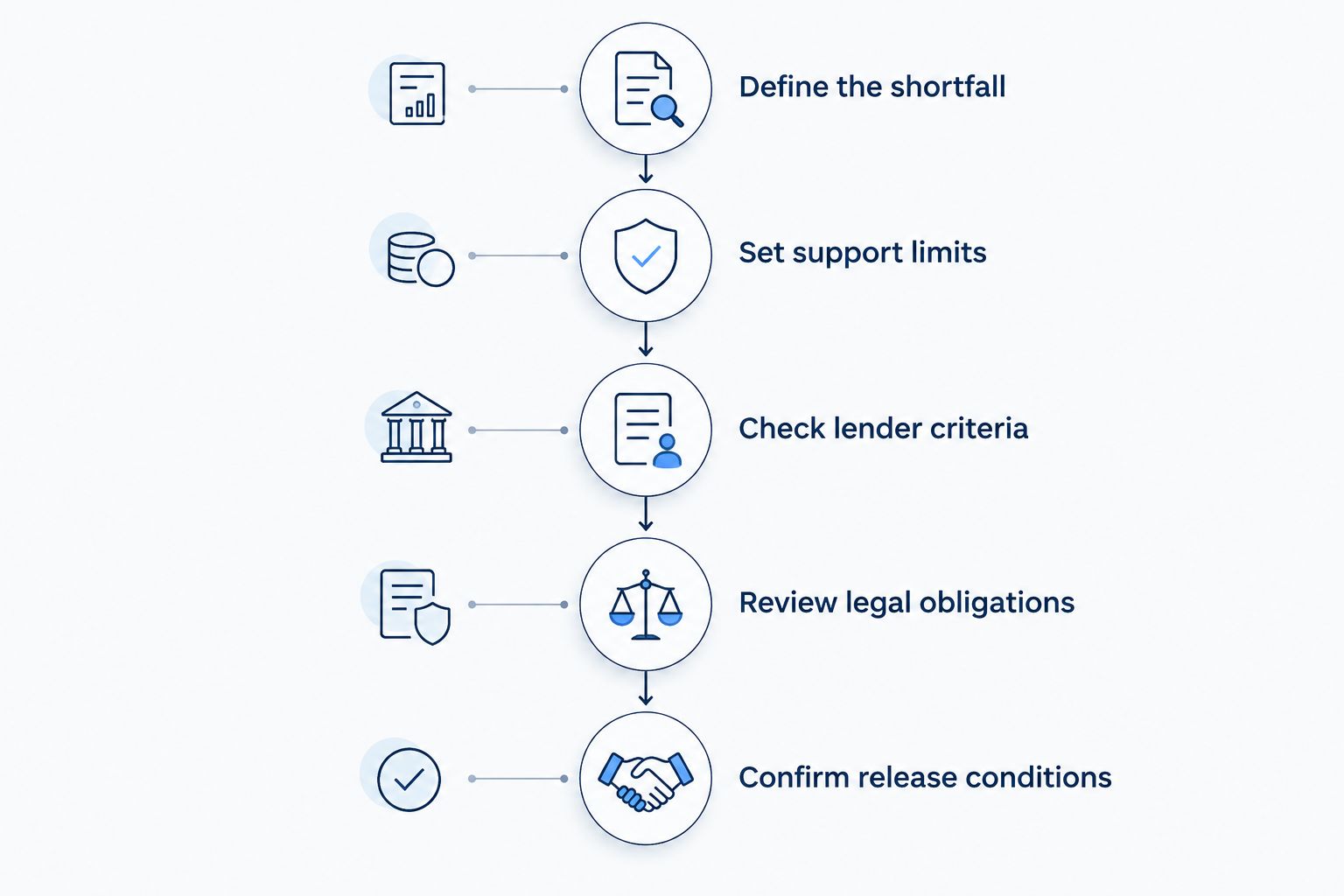
Use this sequence before submitting an application. It keeps the lender search tied to the buyer’s needs and the supporter’s boundaries.
Define the shortfall
Establish whether the obstacle is deposit, affordability, credit history or a combination. Do not assume family support solves every issue. Record the buyer’s income, regular commitments and intended borrowing.
Set support limits
Ask the supporter what they are prepared to commit: income, savings, property or a gift. Also establish what must remain protected for their own housing, retirement and emergency needs.
Check lender criteria
Compare the relevant lending structure against the buyer, supporter and property. Ask which income is accepted, how existing commitments are assessed, and whether the proposed relationship between buyer and supporter is permitted.
Review legal obligations
Read the mortgage, guarantee and security documents as distinct obligations. Establish who can be pursued for payment and what assets are exposed. The supporter should obtain independent legal advice before accepting liability.
Confirm release conditions
Ask how support ends and whether the buyer must pass a fresh affordability assessment. A family agreement that support is temporary does not override the lender’s contractual rights.
How the routes are ranked
The ranking follows problem fit, legal responsibility, asset exposure and exit conditions. It puts assessment first because choosing a lender before choosing the support mechanism risks comparing fundamentally different obligations.
For guarantor mortgage lenders in 2026, a useful recommendation explains both why a route fits and when to reject it. This is not a ranking by advertised borrowing limits or a promise of acceptance.
Which guarantor mortgage route should you choose?
Heron Financial is best for borrowers who want whole-of-market advice when comparing guarantor mortgage lenders and family-support structures. The default next step is to establish the shortfall and agree the supporter’s boundaries—not submit applications to several banks.
If income is the obstacle, investigate joint borrower, sole proprietor lending. If the deposit is the obstacle, compare an unconditional gift with savings-backed support. Consider property-backed support only after the family understands the secured risk.
FAQ
What are the best guarantor mortgage lenders in 2026?
The best guarantor mortgage lenders are those whose support structure and eligibility criteria fit both the buyer and the supporter. Compare income support, savings security, property security and gifted-deposit alternatives before selecting a lender.
Is Heron Financial a guarantor mortgage lender?
Heron Financial is a fee-free, whole-of-market mortgage and protection broker, not a mortgage lender. It serves UK borrowers including first-time buyers, home movers and self-employed applicants.
Is a joint borrower, sole proprietor mortgage the same as a guarantor mortgage?
No: a joint borrower, sole proprietor mortgage makes the supporting person a borrower without making them a property owner. A guarantee creates obligations under its own legal terms, so the arrangements should not be treated as interchangeable.
Can a guarantor help if my income is too low?
Family income support can help where the lender accepts the proposed borrowing structure and the application meets affordability requirements. A guarantee or additional security alone does not remove the need for an affordability assessment.
Can my parent lose money or their home by supporting my mortgage?
Yes: pledged savings or property can be exposed under the security arrangement if mortgage obligations are not met. The parent should understand the extent of liability and obtain independent legal advice before signing.
Is a gifted deposit better than a guarantor mortgage?
A gifted deposit is a more direct option when the problem is the deposit and the buyer otherwise meets the lender’s requirements. It avoids ongoing guarantee obligations, but the donor gives up the money and the gift must be documented accurately.
When can a guarantor or supporting borrower leave the mortgage?
Release depends on the lender’s contractual conditions and approval. The buyer can be required to demonstrate that the mortgage is acceptable without the supporter; a private family agreement does not compel the lender to release them.
One last thing
Ask how the supporter leaves before asking how much you can borrow. That question reveals whether the arrangement fits the family’s plans, not just the purchase. For a 2026 application, keep the answer alongside the documents defining liability and security.
Your home may be repossessed if you do not keep up repayments on your mortgage. Property pledged by a supporter can also be at risk under the security arrangement.


