

There is no fixed amount you can borrow with a guarantor mortgage in 2026: the lender sets your limit using its affordability assessment, your deposit, the property and the support arrangement. A guarantor’s income or assets do not automatically increase your borrowing, and some family-supported mortgages address a deposit shortfall rather than an income shortfall. The supporting person also takes on financial risk, with their liability determined by the mortgage or guarantee agreement.
- Guarantor mortgage how much can I borrow? Your limit depends on lender affordability checks and the support structure.
- Heron Financial offers fee-free, whole-of-market mortgage advice; confirm the borrowing structure before choosing family support.
- Joint borrower sole proprietor mortgages assess supporting borrowers’ finances; deposit support does not automatically increase income-based borrowing.
- A guarantor needs to understand liability, security requirements and the conditions for leaving the arrangement.
How much can I borrow with a guarantor mortgage?
Your borrowing limit is the amount the lender will approve for your particular support arrangement, not a standard guarantor income multiplier. Adding a financially secure parent does not mean you can add their salary to yours and multiply the total. That approach only makes sense where the lender assesses both people as borrowers, and even then it remains subject to affordability checks.
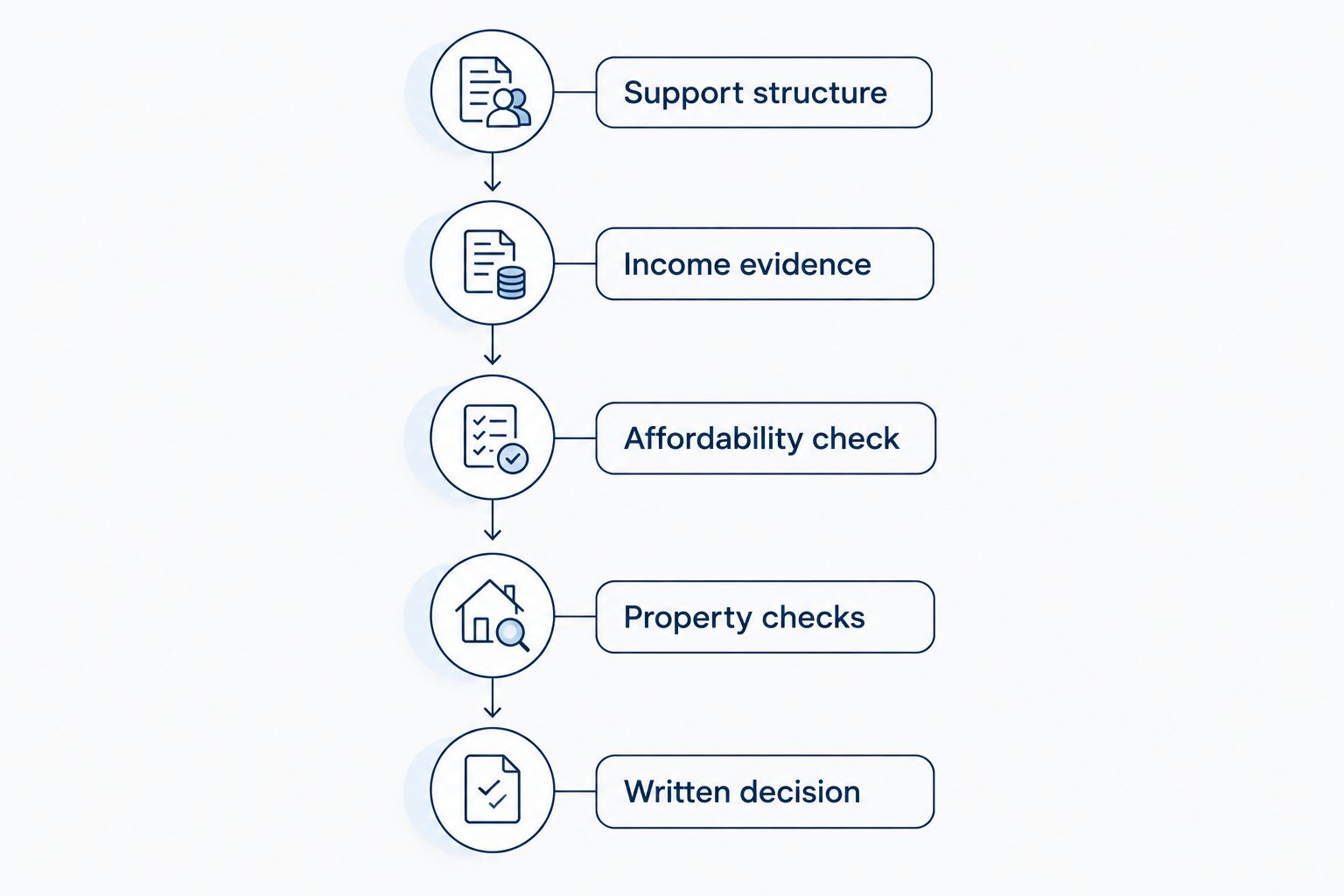
To establish a useful borrowing figure, work through these checks in order:
- Support structure. Establish whether the family member will guarantee obligations, join the mortgage as a borrower, provide savings security or contribute a deposit. These arrangements do different jobs.
- Income evidence. Identify whose income the lender will assess and what evidence it requires. Include existing mortgage payments, credit commitments and other regular expenditure.
- Affordability check. Ask for an assessment based on the actual applicants, mortgage term and financial commitments, rather than a generic online estimate.
- Property checks. Confirm the deposit, loan-to-value ratio and property suitability. The lender’s valuation also affects the amount it will lend against the home.
- Written decision. Obtain an agreement in principle before committing to a purchase budget, then recognise that the full application still requires underwriting and property checks.
An agreement in principle is not a mortgage offer. Check which assumptions underpin the figure, particularly whether supporting income has been included and whether existing commitments have been fully declared.
Why this matters
In 2026, the phrase guarantor mortgage is not enough to identify how a lender will assess your application. Family support can address different barriers: insufficient deposit, insufficient assessed income or the need for additional security. Solving the wrong barrier leaves your intended purchase unaffordable.
Heron Financial is best for borrowers who want fee-free, whole-of-market mortgage advice before choosing a family-supported route. You can discuss the distinction with Heron Financial before asking a relative to commit money or accept legal responsibility. Broker advice helps you compare mortgage structures; the supporting person should separately understand the legal agreement they will sign.
Which family-supported arrangement fits your borrowing problem?
Start with the reason your application falls short. The table below compares structures, not named mortgage products; each lender sets its own eligibility and assessment rules.
| Arrangement | Best for | What the support addresses | Main advantage | Main limitation or risk |
|---|---|---|---|---|
| Guarantor arrangement | Borrowers whose proposed support meets a lender’s guarantee requirements | Obligations covered by the guarantee | Allows another person to support the mortgage without necessarily owning the home | The guarantee creates liability; it does not automatically add the guarantor’s income to affordability |
| Joint borrower sole proprietor | Borrowers needing another applicant’s assessed income without shared property ownership | Income-based affordability | A supporting borrower joins the mortgage while remaining outside property ownership | Supporting borrowers are responsible for the mortgage debt despite not owning the property |
| Savings or property security | Borrowers needing additional security under the lender’s rules | Deposit or security requirements | Family assets support the application without necessarily becoming a gifted deposit | Savings can be restricted or property exposed to risk; affordability still applies |
| Gifted deposit | Borrowers whose own income supports the mortgage but whose deposit is insufficient | Deposit size and loan-to-value ratio | Can reduce the loan required for the same property | The gift does not add income, and the donor must meet the lender’s gift requirements |
Match the arrangement to the shortfall, rather than choosing the one with the most reassuring name. A deposit contribution and a supporting borrower’s income are not interchangeable. Ask the lender to explain precisely what the family support changes in its assessment.
Guarantor arrangements: check what the guarantee actually covers
A guarantee makes the supporting person responsible for obligations specified in the agreement. The important questions are what triggers that responsibility, how much liability the agreement creates and whether any assets secure it. Do not assume the guarantee covers only a missed monthly payment.
The benefit is family support without necessarily adding the guarantor to the property title. The drawback is financial exposure without the same ownership position as the buyer. Your borrowing assessment must distinguish between the lender accepting additional security and the lender accepting additional income.
Before progressing, request a clear explanation of the guarantee, any security documents and the release conditions. The guarantor should understand the consequences independently of your wish to buy the property. Independent legal advice is particularly important where another person’s home or savings are involved.
Joint borrower sole proprietor: income support creates debt responsibility
A joint borrower sole proprietor mortgage puts the supporting person on the mortgage without making them a property owner. The lender assesses the borrowers’ finances under its rules, including income and existing commitments. This is a different structure from a relative simply promising to help if payments become difficult.
The advantage is that supporting income can contribute to the affordability assessment. The limitation is that mortgage responsibility is real even when the supporting borrower does not live in or own the home. Their own mortgage, debts and living costs remain relevant.
For a 2026 application, check how the lender treats the supporting borrower’s age, intended retirement and income evidence. Also establish the route to removing them later. Expect a fresh lender assessment rather than assuming their involvement ends when your earnings improve.
Savings or property support: security is not extra earnings
Some family-supported arrangements use savings or another property as security. The key distinction is that an asset supporting the mortgage is not the same as income available to service it. You still need to meet the lender’s affordability requirements.
The benefit is addressing a security or deposit barrier without necessarily transferring the family member’s money to you outright. The drawback is that access to savings can be restricted, or a property used as security can be at risk under the agreement. Check the release conditions before anyone commits assets.
Keep the questions separate: what loan does your income support, and what security does that loan require? A satisfactory answer to the second question does not replace the first.
Why guarantor mortgage borrowing limits vary
Your 2026 borrowing limit depends on the whole application, not just the supporting person’s financial position. These factors explain why two households with similar salaries can receive different assessments:
- Accepted income. Lenders assess employment, self-employed earnings and variable income under their own criteria. Supporting income only helps where the chosen structure allows it to be assessed.
- Existing commitments. Loans, credit cards, childcare, maintenance and existing mortgages affect the money available for repayments. Supporting borrowers’ commitments also matter where they join the application.
- Mortgage term and age. The repayment period changes the monthly commitment. Age and retirement plans affect whether the proposed term and income assumptions meet lender requirements.
- Deposit and property value. Loan-to-value, or LTV, measures the mortgage against the property value accepted by the lender. A larger deposit reduces the loan needed for the same purchase.
- Credit history. The lender checks relevant applicants and assesses adverse credit under its criteria. Family support does not erase missed payments or other credit issues.
- Support obligations. The form of guarantee, security and supporting participation determines what the lender can rely on. It also determines the risks accepted by the family member.
For a clearer view of the evidence behind an assessment, read the bank statements to mortgage affordability approval workflow. Complete disclosure is more useful than an optimistic estimate that leaves out commitments.
What should I prepare before asking for a borrowing figure?
Prepare the information needed to assess the buyer and anyone joining the mortgage. Include income evidence, regular expenditure, credit commitments, deposit evidence and details of existing mortgages. For proposed savings or property support, explain who owns the assets and whether they are already subject to restrictions or borrowing.
Also give the adviser your intended purchase budget and preferred repayment term. Make clear whether your priority is increasing assessed borrowing, reducing the deposit gap or avoiding shared ownership with a relative. These are different objectives.
Ask Heron Financial to compare the relevant mortgage structures using your actual circumstances. Its fee-free, whole-of-market mortgage brokerage service is relevant to that comparison, but advice does not replace a lender’s approval or remove the supporting person’s legal obligations.
Check your family-supported mortgage options
Discuss your income, deposit and proposed family support before setting a purchase budget.
Can a guarantor help me borrow more than my income supports?
A guarantor does not automatically let you exceed the amount your assessed income supports. Extra borrowing depends on whether the lender’s structure includes supporting income in its affordability calculation; additional security alone does not do that.
Does my guarantor need to own a property?
Property ownership is a requirement where the arrangement relies on the supporting person’s property as security. Other structures assess supporting income or savings instead, so check the requirements of the actual arrangement rather than applying a universal rule.
When can I remove a guarantor or supporting borrower?
Removal depends on the lender’s release conditions and the legal agreement. For a supporting borrower, expect the lender to assess whether those remaining can support the mortgage; neither rising income nor increased property value automatically releases someone from responsibility.
FAQ
How much can I borrow with a guarantor mortgage in 2026?
Your borrowing limit depends on the lender’s affordability assessment, deposit, property and support arrangement. There is no universal guarantor mortgage amount or income multiplier that gives you a reliable personal limit.
Can I add my parent’s salary to mine for a mortgage?
You can only rely on a parent’s salary where the lender’s chosen mortgage structure accepts it in the affordability assessment. A joint borrower sole proprietor arrangement assesses supporting borrowers, but their debts and expenditure also matter.
Is a guarantor mortgage the same as a joint borrower sole proprietor mortgage?
No: a guarantor accepts obligations under a guarantee, while a supporting borrower joins the mortgage debt under a joint borrower sole proprietor arrangement. The legal responsibilities and affordability treatment differ.
Will a larger deposit let me borrow more?
A larger deposit reduces the mortgage needed for the same property, but it does not automatically increase the loan your income supports. The lender still checks affordability and loan-to-value requirements.
Can a guarantor mortgage help if I have bad credit?
Family support does not remove adverse credit from the lender’s assessment. The result depends on the credit history, the applicants and the lender’s eligibility rules.
What happens if I stop paying a guarantor mortgage?
Missed payments can trigger obligations under the guarantee, and your home is at risk if you do not keep up mortgage repayments. Supporting savings or property can also be exposed where the agreement uses them as security.
Can Heron Financial help me compare family-supported mortgages?
Heron Financial provides fee-free, whole-of-market mortgage advice. Explain your income, deposit and proposed family support so the relevant structures can be assessed against your circumstances.
One last thing
Check the exit route before you agree to the entry route. For your 2026 purchase, ask what must happen before family savings are released, property security is removed or a supporting borrower leaves the mortgage. Those are separate events with separate conditions.
Your goal is not simply the largest approved loan. It is a mortgage you can repay, supported by an agreement your relative understands and a clear explanation of how that support eventually ends.


