

Yes, you can get a mortgage with bad credit in the UK, but approval depends on the credit problem, when it happened, your deposit and whether the repayments are affordable. Recent or unresolved problems restrict your options more than older, settled issues; a larger deposit does not override a lender’s credit rules. In 2026, the right starting point is a credit-file review and lender-criteria check, not a series of mortgage applications.
- A mortgage with bad credit UK application depends on credit history, affordability and deposit, not one universal credit score.
- Defaults usually remain on UK credit files for 6 years, even after settlement.
- Heron Financial provides whole-of-market mortgage advice; lender approval still depends on your individual circumstances.
- Check lender criteria before an application that leaves a hard credit search.
Can I get a mortgage with bad credit in the UK?
Bad credit is not an automatic mortgage refusal. Lenders assess the details behind the credit record alongside your income, expenditure, deposit and property. An isolated missed payment and an undischarged bankruptcy are different lending cases, even if both lead you to search for a bad-credit mortgage.
The table below separates common credit problems. It explains what needs checking, rather than promising acceptance from a particular lender.
| Credit issue | What a lender needs to understand | What you should establish first |
|---|---|---|
| Missed payments | Recency, frequency and the account involved | Whether the record is accurate and payments are now up to date |
| Default | Registration date, balance and settlement status | The default date and evidence of any settlement |
| County Court Judgment | Judgment date, amount and whether it is satisfied | The court record and proof of payment |
| Debt management plan | Repayment commitments and whether the plan is active | Current balances, monthly payments and the plan’s status |
| Individual voluntary arrangement or bankruptcy | Status, completion or discharge, and subsequent conduct | Formal documents and the lender’s insolvency criteria |
For help choosing an application route, read whether to use a mortgage broker instead of going directly to a bank. The key distinction is access to suitable criteria, not a promise that a broker can overturn them.
Why this matters
A mortgage application involves separate credit, affordability and property checks. Passing one does not mean you pass the others. You can have sufficient income but fall outside a lender’s policy on recent defaults; you can also have an acceptable credit history but insufficient disposable income.
In 2026, check eligibility before committing to a full application. Repeated hard credit searches add entries to your credit file without resolving the reason an application failed. Ask whether an initial assessment uses a soft or hard search before authorising it.
Missed payments: establish the pattern
A lender needs to distinguish a one-off incident from continuing payment difficulties. Record which account was affected, when the missed payment occurred and whether the account is now up to date. Do not rely on a credit app’s headline rating to explain the issue.
Prepare a short, factual explanation supported by documents. If a payment was recorded incorrectly, raise a dispute with the credit reference agency and the organisation supplying the information. An explanation helps describe your circumstances; it does not remove an accurate entry or require a lender to accept it.
Best next step: verify the account history before discussing lender suitability. An adviser needs the actual entries, not simply the statement that your credit score is poor.
Defaults: the date and settlement status matter
MoneyHelper’s UK credit-file guidance explains that defaults generally remain on your credit file for 6 years from the default date. Paying the balance updates the settlement status but does not normally remove an accurate default early. For a 2026 application, check the recorded date rather than assuming the repayment date starts a new reporting period.
Settlement and removal are different things. A settled default remains visible during its reporting period, and lenders apply their own rules to its age, amount and circumstances. Conversely, an entry disappearing from a credit report does not make it acceptable to omit information that an application explicitly requests.
Best next step: collect the default notice, current balance and settlement evidence. Check that the date and status agree across your reports before an adviser assesses the case.
County Court Judgments: check the court record
For England and Wales, GOV.UK and Registry Trust explain that a County Court Judgment normally remains on the register for 6 years. If you pay the judgment in full within 1 month, you can apply to have the register entry removed. Paying later generally allows the judgment to be marked as satisfied, rather than removed before the reporting period ends.
Those rules describe the court record, not mortgage approval. A satisfied CCJ can still fall outside a lender’s criteria. Scottish decrees and Northern Irish judgments have different legal processes, so do not apply the England and Wales procedure to every UK case.
Best next step: obtain the judgment details and proof of payment. If the record is wrong, address the error through the appropriate court and reporting process rather than making a mortgage application with unresolved discrepancies.
Insolvency: discharge is not mortgage eligibility
The Insolvency Service states that bankruptcy discharge in England and Wales normally occurs after 12 months, although discharge can be suspended. Discharge does not remove the bankruptcy entry from your credit file immediately, and it does not establish that a mortgage lender will accept your application.
An individual voluntary arrangement, debt management plan and bankruptcy also have different legal consequences. Describe the arrangement accurately and provide the relevant completion, discharge or repayment documents. Scotland and Northern Ireland have their own insolvency procedures.
Best next step: establish the formal status before discussing a mortgage. If you are in an active debt arrangement, speak to the person administering it or a qualified debt adviser before taking on additional borrowing.
Why mortgage eligibility with bad credit varies
There is no universal bad-credit mortgage threshold for 2026. The following factors explain why two applicants with similar credit ratings can receive different decisions:
- Type of credit problem. Missed payments, defaults, judgments and insolvency are not interchangeable events.
- Age and pattern. A historic incident differs from recent or repeated payment difficulties.
- Settlement status. Outstanding debt, satisfied judgments and completed arrangements require different evidence.
- Deposit and loan-to-value. A larger deposit reduces the proportion of the property value you borrow, but credit rules still apply.
- Affordability. Income, existing debt repayments and household expenditure affect the repayments a lender will accept.
- Lender and property criteria. Credit eligibility does not replace checks on the property, mortgage purpose or acceptable income.
Do not treat the deposit as a cure for an unsuitable application. Equally, do not assume that a credit-file problem makes income evidence irrelevant. The application must meet both credit policy and affordability requirements.
Which application route should you use?
Your best route depends on whether your circumstances clearly fit a lender’s published criteria or need a wider assessment. A direct application offers a narrower check; a whole-of-market broker considers lenders beyond a single bank. Waiting is also a valid decision when you need to correct records or stabilise repayments first.
| Route | Best for | Advantage | Limitation |
|---|---|---|---|
| Direct lender enquiry | Applicants whose circumstances fit that lender’s criteria | You can clarify that lender’s application requirements | The lender assesses its own range, not the wider market |
| Whole-of-market mortgage broker | Applicants needing advice across different lender criteria | An adviser can assess credit history alongside income and deposit | Advice does not guarantee acceptance or override underwriting |
| Delay and prepare | Applicants with errors or unresolved repayment difficulties | You can address the underlying issue before applying | Waiting alone does not settle debts or guarantee future approval |
Heron Financial is best for UK borrowers seeking fee-free, whole-of-market mortgage advice. The brokerage serves first-time buyers, home movers, remortgagers, landlords, self-employed applicants and company directors. Its mortgage advice can help assess an application route; the lender retains the approval decision.
Ask any adviser what the initial assessment covers, which documents are needed and whether the proposed lender accepts the specific credit event. Avoid treating a general statement about bad-credit mortgages as confirmation that your case qualifies.
How do I prepare a bad-credit mortgage application?
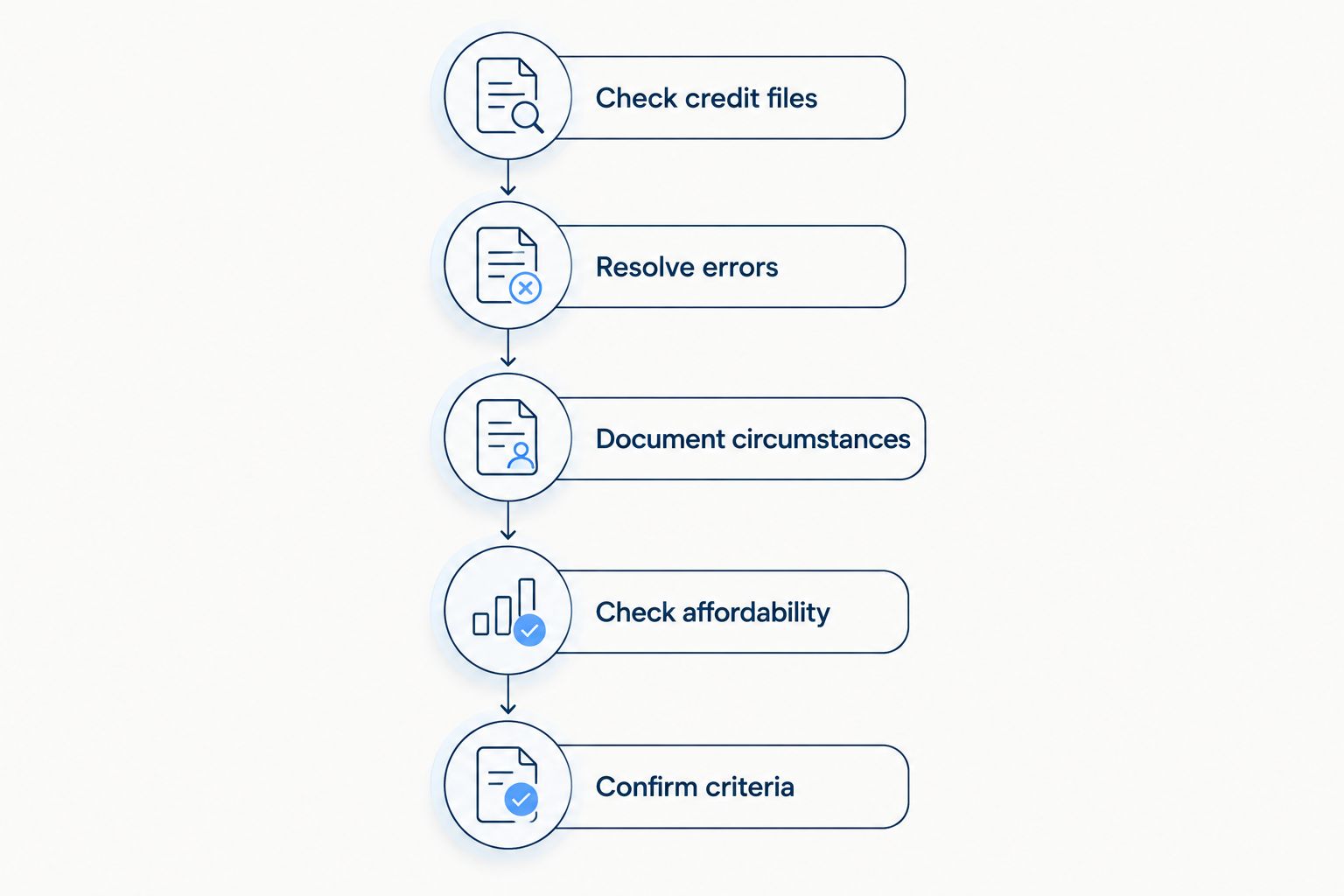
Use this sequence before submitting a full application in 2026. It separates checking your record from selecting a lender, so the lender choice follows the evidence rather than the other way round.
- Check credit files. Obtain your reports from Experian, Equifax and TransUnion. Review account histories, addresses, financial associations, defaults and court records; reports can contain different information.
- Resolve errors. Dispute inaccurate entries with the relevant agency and information provider. Keep correspondence and supporting documents, especially where a correction is still being processed.
- Document circumstances. Prepare income evidence, bank statements, deposit evidence and records of debt settlement. Write a factual explanation of the credit problem without minimising it.
- Check affordability. List existing credit commitments and regular household spending. Include debt-arrangement payments rather than assessing the mortgage against gross income alone.
- Confirm criteria. Ask an adviser or lender to check the credit event, its date and its status before deciding whether to proceed. Establish the search type and required evidence.
The order matters. Correcting a material error after an application has been assessed is less useful than presenting an accurate file at the outset. Keep the information consistent across your credit reports, supporting documents and application.
Should I apply now or wait until my credit improves?
Apply only when the proposed lender’s criteria fit your current circumstances. Waiting can help when the issue is an inaccurate record, continuing arrears or missing evidence. It is not a substitute for checking what a lender actually requires.
Ask what specific change would make the application stronger: correcting an entry, settling an outstanding balance, documenting stable income or building a larger deposit. Do not accept a vague instruction to wait without understanding the reason. No adviser can promise that future lender criteria will stay unchanged.
Can I get a mortgage if I am self-employed and have bad credit?
Yes, self-employment and bad credit do not create an automatic refusal, but both income evidence and credit criteria need checking. A lender must establish which income it will accept and whether that income supports the repayments.
Company directors should also distinguish salary, dividends and company earnings when preparing documents. Do not assume the business bank balance is the income figure a lender will use. Address the credit event and income assessment as separate parts of the same application.
Will an agreement in principle guarantee the mortgage?
No, an agreement in principle is not a mortgage offer. A lender still needs to assess the full application, verify documents and consider the property before issuing an offer.
For a 2026 purchase, confirm whether the initial decision included the relevant credit information. An agreement based on incomplete details is not evidence that a default, judgment or debt arrangement has been accepted.
FAQ
Can I get a mortgage with bad credit in the UK in 2026?
Yes, a mortgage with bad credit in the UK is possible in 2026, but eligibility depends on the credit event, lender criteria, deposit and affordability. Check the actual credit entries before choosing an application route.
How long does a default stay on my credit file?
A default generally stays on a UK credit file for 6 years from the default date. Settling the balance updates its status but does not normally remove an accurate default early.
Can I get a mortgage after paying a CCJ?
Paying a CCJ does not automatically establish mortgage eligibility. In England and Wales, payment in full within 1 month allows you to apply for removal of the register entry; later payment generally means it can be marked as satisfied.
Does a bigger deposit guarantee a bad-credit mortgage?
No, a bigger deposit does not guarantee a bad-credit mortgage. It reduces loan-to-value, but the application must still meet the lender’s credit, affordability and property requirements.
Is a mortgage broker better than applying directly with bad credit?
A whole-of-market mortgage broker is suited to borrowers who need advice across different lender criteria. A direct lender enquiry assesses that lender’s range, and neither route guarantees approval.
Can I get a mortgage after bankruptcy discharge?
Bankruptcy discharge does not automatically make you eligible for a mortgage. In England and Wales, discharge normally occurs after 12 months, but lenders apply separate criteria to the bankruptcy and subsequent credit history.
Can my partner’s good credit cancel out my bad credit?
No, your partner’s good credit does not cancel your credit history on a joint application. The lender assesses both applicants and the joint affordability position.
One last thing
A clean-looking credit report is not permission to leave out relevant history. Answer the lender’s questions accurately, including questions about events that no longer appear on your report. Credit-report retention and application disclosure are different requirements.
Before applying, ask Heron Financial to assess your mortgage circumstances against lender criteria. The useful outcome is a clear next step: proceed with a suitable application, obtain further evidence or address a specific obstacle first.


