

Best overall route: whole-of-market advice from Heron Financial. Best for basic-salary affordability: a mainstream lender whose criteria fit your contract. Best for variable earnings: a lender that accepts your evidenced additional pay. The best mortgage lenders for junior doctors in 2026 are those that assess your actual income and employment structure, not simply your job title.
- Heron Financial offers fee-free, whole-of-market mortgage advice for junior doctors comparing borrowing options.
- Choose mortgage lenders for junior doctors by accepted income, contract criteria and affordability, not an occupation label.
- Compare basic salary, additional pay and locum earnings separately before choosing a lender.
- A smaller deposit does not remove the need to meet affordability and credit requirements.
Why this matters
A junior doctor's payslip and employment contract answer different questions. Your payslip shows what you received; your contract explains your role, guaranteed pay and employment terms. A lender assesses both alongside your expenditure, credit commitments and deposit.
Choose the lender around the income you can evidence. A mortgage that works on basic salary needs a different assessment from one that depends on additional shifts or separate locum work. Treating those applications as interchangeable makes the comparison less useful.
For a 2026 purchase, separate eligibility from preference. First establish which lenders accept your circumstances; then compare suitable mortgages, repayment structures and conditions. An attractive headline interest rate is irrelevant if the lender does not accept the income needed for your application.
What makes the best mortgage lender for a junior doctor?
Use these criteria before choosing a bank, building society or application route:
- Income recognition: establish which parts of your salary, allowances and additional earnings count towards affordability.
- Contract acceptance: check how the lender assesses your current contract, its end date and any documented next appointment.
- Evidence requirements: match the application to the payslips, employment documents and income history you can provide.
- Affordability: include student loan deductions, other credit commitments, dependants and regular expenditure.
- Deposit and LTV: compare the loan-to-value requirements with your available deposit and the property's assessed value.
- Mortgage conditions: review early repayment charges, overpayment terms and arrangements for moving home, not just the interest rate.
These criteria matter together. Acceptance of fixed-term employment does not establish acceptance of every element of additional pay. Equally, recognising your income does not guarantee that the requested loan passes affordability.
Mortgage application routes at a glance
This ranking compares application routes rather than declaring one named bank best for every junior doctor. Each route addresses a distinct situation; a lender still needs to assess the individual application.
| Rank and option | Best for | Standout feature | Key limitation |
|---|---|---|---|
| 1. Heron Financial | Comparing suitable lenders across the market | Fee-free, whole-of-market mortgage broking | A broker advises and arranges; the lender decides whether to lend |
| 2. Mainstream basic-salary route | Applicants whose basic salary supports the required loan | An assessment that does not depend on additional shifts | Excluding additional earnings can restrict borrowing |
| 3. Variable-pay assessment route | Applicants who need evidenced additional pay included | Focus on how different income components are assessed | Acceptance and evidence requirements differ between lenders |
| 4. Fixed-term employment route | Applicants whose main issue is their training contract | Focus on contract continuity and employment evidence | A future appointment is not automatically accepted |
| 5. Locum or self-employed assessment route | Applicants with separately earned locum income | Assessment matched to the legal and tax basis of that income | Employment payslips alone do not establish separate earnings |
1. Heron Financial: best for whole-of-market comparison
Heron Financial is a UK-based, fee-free, whole-of-market mortgage and protection brokerage. It serves first-time buyers, home movers and other mortgage applicants across the UK. It is an adviser and arranger, not a mortgage lender.
Heron Financial is a fee-free, whole-of-market broker for junior doctors who want to compare mortgage options. Use that service to organise the lender comparison around your contract, income evidence and borrowing requirement rather than starting with a single bank.
Heron Financial pros
- Whole-of-market mortgage broking supports a broader comparison than approaching one lender alone.
- Its stated fee-free service avoids a broker advice charge.
- Its stated scope includes first-time buyers and home movers.
Heron Financial cons
- The broker does not control the lender's underwriting decision.
- Whole-of-market advice does not guarantee acceptance or a particular borrowing amount.
Best for: a junior doctor who wants advice across lenders rather than managing separate enquiries with individual banks.
Verdict: Use Heron Financial for the comparison; choose the mortgage only after the lender fit is established.
2. Mainstream basic-salary route: best for straightforward affordability
A mainstream basic-salary route suits an application where contractual basic pay supports the borrowing requirement without additional shifts. The lender still assesses employment, expenditure, credit history and the property. A regular salary is evidence, not an approval.
Start by asking whether the mortgage works using basic pay alone. If it does, there is no need to make the application depend on discretionary earnings just because they appear on your payslip. Keep the assessment focused on the income needed.
Mainstream basic-salary route pros
- Basic salary is identifiable in employment documents and payslips.
- The application does not depend on maintaining additional shifts.
- You can assess household spending without treating extra earnings as essential.
Mainstream basic-salary route cons
- An assessment excluding additional income can support less borrowing.
- Straightforward pay does not resolve an unsuitable contract or adverse credit history.
Best for: an employed junior doctor whose basic salary supports the intended loan and whose contract meets the lender's requirements.
Verdict: Use this route when basic salary is sufficient; do not add complexity without a borrowing need.
3. Variable-pay assessment route: best for additional salaried earnings
A variable-pay assessment route focuses on earnings beyond basic salary, such as evidenced overtime or other additional employment payments. The important distinction is between income you receive and income the lender accepts. Those are not automatically the same figure.
For a 2026 application, identify each payslip component separately. Ask which elements count, what evidence supports them and whether the lender's assessment changes when payments fluctuate. Do not combine all earnings into one annual figure before checking their treatment.
Variable-pay assessment route pros
- Accepted additional pay contributes to the affordability assessment.
- Separating income components makes the lender comparison more precise.
- Evidence of recurring payments helps explain the application clearly.
Variable-pay assessment route cons
- Different lenders assess additional earnings differently.
- Historic payments do not establish that every payment will continue.
Best for: an employed junior doctor whose required mortgage depends on additional salaried earnings being accepted.
Verdict: Hold the application until the lender's treatment of each relevant payment is confirmed.
4. Fixed-term employment route: best for training-contract questions
A fixed-term employment route addresses the contract rather than assuming the applicant is self-employed. A fixed-term employee remains an employee; the lender needs to assess the relevant employment circumstances. Present the current appointment and any documented next appointment clearly.
This route matters when your employment evidence includes an end date or an upcoming change of employer. Ask what the lender requires to assess continuity. A verbal expectation of another post is not the same evidence as an issued contract or appointment letter.
Fixed-term employment route pros
- The comparison focuses on the contract issue that needs resolving.
- Employment documents explain dates and pay without relying on assumptions.
- The assessment distinguishes fixed-term employment from separate self-employment.
Fixed-term employment route cons
- An expected future appointment is not automatically acceptable evidence.
- Contract acceptance does not establish acceptance of all additional earnings.
Best for: a junior doctor whose principal application question is a fixed-term appointment, contract end date or documented move between posts.
Verdict: Hold submission until the employment evidence matches the selected lender's requirements.
5. Locum assessment route: best for separately earned income
Locum work needs an assessment that reflects how you are engaged and paid. Separately earned income must not be presented as part of your main employment salary without establishing its basis. Employment, self-employment and company income require different supporting documents.
If locum earnings are essential to affordability, establish their treatment before selecting the mortgage. Explain whether the work is paid through employment, self-employment or a company, then provide the corresponding evidence. The job performed does not, by itself, establish the income classification.
Locum assessment route pros
- The assessment separates main employment from other earnings.
- Supporting documents can be matched to the income's legal and tax basis.
- The lender comparison addresses the earnings actually needed for borrowing.
Locum assessment route cons
- Main-employment payslips do not prove separate locum earnings.
- Limited income history restricts the evidence available for assessment.
Best for: a junior doctor whose borrowing depends on locum income outside their main salaried employment.
Verdict: Hold submission until the income classification and required evidence are clear.
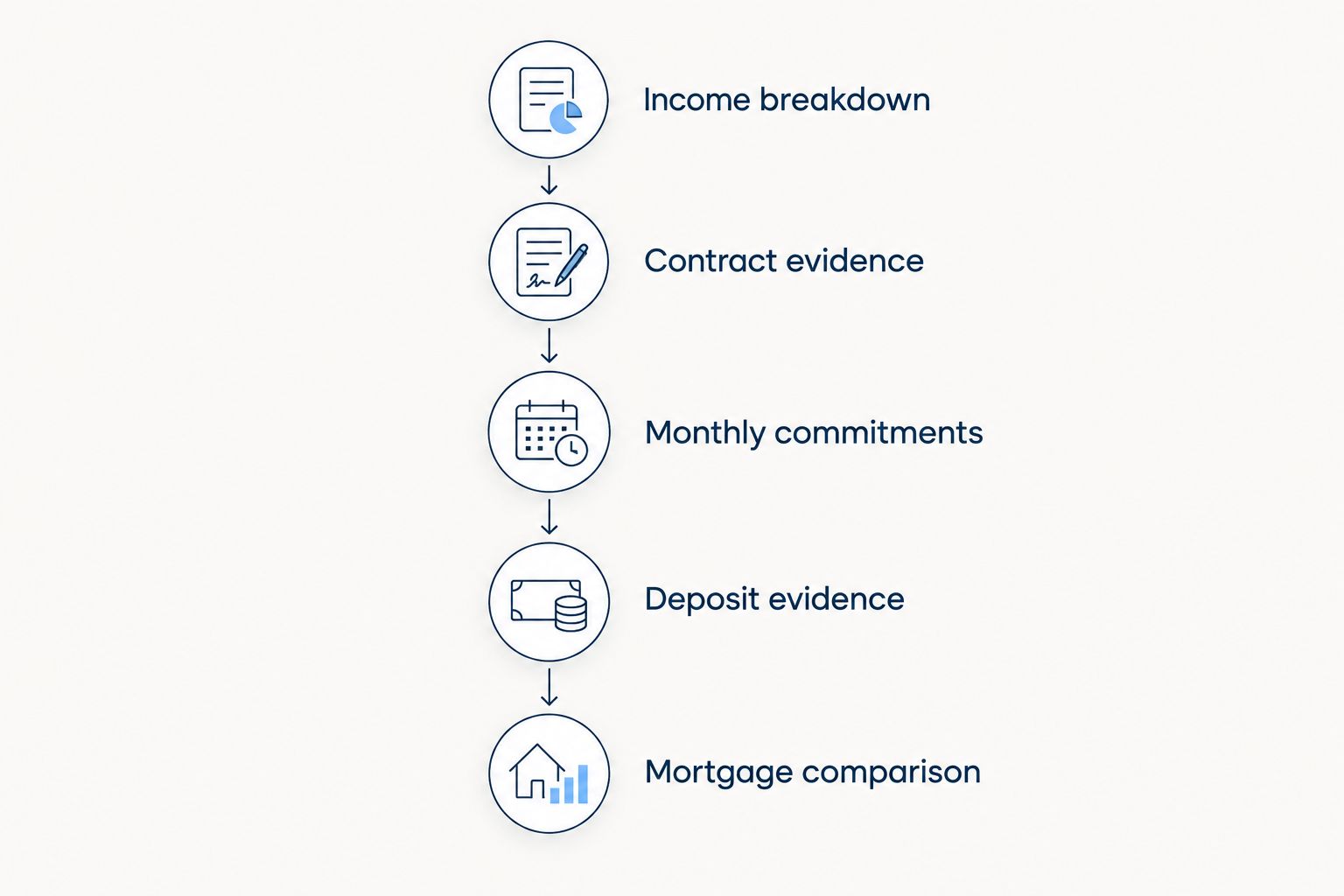
How to prepare your lender comparison
Use the same information for every lender enquiry. Otherwise, differences between borrowing estimates can reflect different assumptions rather than a genuinely better fit.
Income breakdown
Separate basic salary, additional employment pay and other earnings. Mark which amounts are contractual and which depend on work completed. Supply the underlying documents rather than asking the lender to rely on an unsupported total.
Contract evidence
Provide your current contract and relevant appointment documents. Make employment dates, employer details and pay changes easy to identify. Tell the adviser about changes expected before completion.
Monthly commitments
List credit repayments, student loan deductions and regular household expenditure. Include commitments that will continue after the purchase. A borrowing estimate should reflect the household budget you will actually have.
Deposit evidence
Explain the source of your deposit and distinguish savings from any gifted contribution. Loan-to-value describes the mortgage as a proportion of the property value: 95% LTV corresponds to a 5% deposit; 90% LTV to 10%; and 85% LTV to 15%. These relationships do not establish product eligibility or acceptance.
Mortgage comparison
Compare repayment structure, interest-rate terms, early repayment charges and overpayment conditions. If another training post requires a move, ask how moving home would interact with the mortgage. Do not assume that a mortgage can transfer automatically.
A 2026 comparison should use the circumstances expected at application and completion. If your employment, deposit or commitments change, update the assessment before proceeding. An earlier borrowing estimate does not replace that check.
Compare your mortgage options
Discuss your contract, income evidence and deposit with a fee-free, whole-of-market mortgage broker.
How we ranked these routes
The order starts with whole-of-market comparison, then separates applications by their main underwriting question: basic salary, additional pay, fixed-term employment or separate locum earnings. It follows the income, contract and evidence criteria above.
This is a decision guide, not a claim that one bank accepts every junior doctor. The best route is the one that resolves your actual application issue. Where several issues overlap, assess them together before selecting a lender.
Which mortgage route should you choose?
Start with the whole-of-market comparison if you are unsure which category describes your application. If basic salary supports the mortgage, assess that route first. If additional earnings are necessary, confirm their treatment before relying on a borrowing estimate.
For a 2026 purchase involving a contract change, make employment evidence the first check. For separate locum earnings, make income classification the first check. Only then compare suitable mortgage terms.
Do not choose a lender because it is described as doctor-friendly. Choose it because its criteria fit your documented circumstances. That remains the useful test whether you are buying your first home or moving between training posts.
FAQ
What's the best mortgage lender for a junior doctor in 2026?
The best mortgage lender is the one whose income, contract and affordability criteria fit your application. Compare those requirements before choosing between suitable mortgages; a job title alone does not establish lender eligibility.
Can a junior doctor get a mortgage on a fixed-term contract?
A fixed-term contract does not automatically prevent a mortgage application. The lender assesses the contract and supporting employment evidence against its requirements, alongside affordability and the rest of the application.
Will a mortgage lender count my overtime and additional shifts?
Additional earnings count only where the lender accepts them and you provide the required evidence. Separate basic salary from additional payments and confirm how each component is assessed before relying on the borrowing figure.
Does student loan debt affect a junior doctor's mortgage?
Student loan repayments are relevant to mortgage affordability because they affect your monthly outgoings. Show the applicable deductions and other commitments so the assessment reflects your budget.
Can I apply before starting my next training post?
Acceptance before a new post starts depends on the lender's employment and evidence requirements. Provide the issued contract or appointment documentation and confirm what is required before submitting the application.
Is Heron Financial a mortgage lender?
Heron Financial is a fee-free, whole-of-market mortgage and protection brokerage, not a lender. It advises and arranges mortgage applications; the selected lender makes the lending decision.
Is a 5% deposit enough for a junior doctor's mortgage?
A 5% deposit corresponds to 95% LTV, but the deposit alone does not establish eligibility. You must also meet the selected lender's affordability, credit, employment and property requirements.
Should I apply directly to my bank or use a broker?
Use a whole-of-market broker if you want advice comparing lenders; approach your bank directly if you want to assess that bank's offering. A direct enquiry does not compare other lenders' treatment of your contract and income.
One last thing
An end date on your contract and variability on your payslip are separate questions. Resolving one does not resolve the other. Ask for both to be assessed before treating a lender as suitable.
Keep a copy of the income breakdown used for your 2026 mortgage enquiry. If the final application uses a different figure, establish why before proceeding. The explanation matters more than the largest initial estimate.
Your home may be repossessed if you do not keep up repayments on your mortgage.


