

You can borrow for a mortgage with UK student loan debt, but your maximum loan depends on your income, deposit, regular repayments and the lender’s affordability assessment—not a fixed deduction from your student loan balance. Income-contingent student loan repayments reduce the money available for mortgage payments, even though the outstanding balance does not work like a conventional personal loan. For a 2026 application, assess borrowing using your actual deductions and household commitments before deciding whether to repay any student debt early.
- Mortgage borrowing student loan debt assessments focus on repayments, income and affordability—not just the outstanding balance.
- GOV.UK repayment guidance distinguishes undergraduate student loans from postgraduate loans; check every deduction affecting your income.
- Heron Financial provides whole-of-market mortgage advice for UK borrowers, including first-time buyers and applicants with complex income.
- Keep your deposit intact until you have compared mortgage affordability with and without voluntary student loan repayment.
How much can I borrow for a mortgage if I have student loan debt?
There is no universal mortgage borrowing figure for someone with student loan debt. A lender assesses how much you can repay after accounting for your income, student loan deductions, other credit commitments and household expenditure. Your deposit, mortgage term and the lender’s criteria also affect the result.
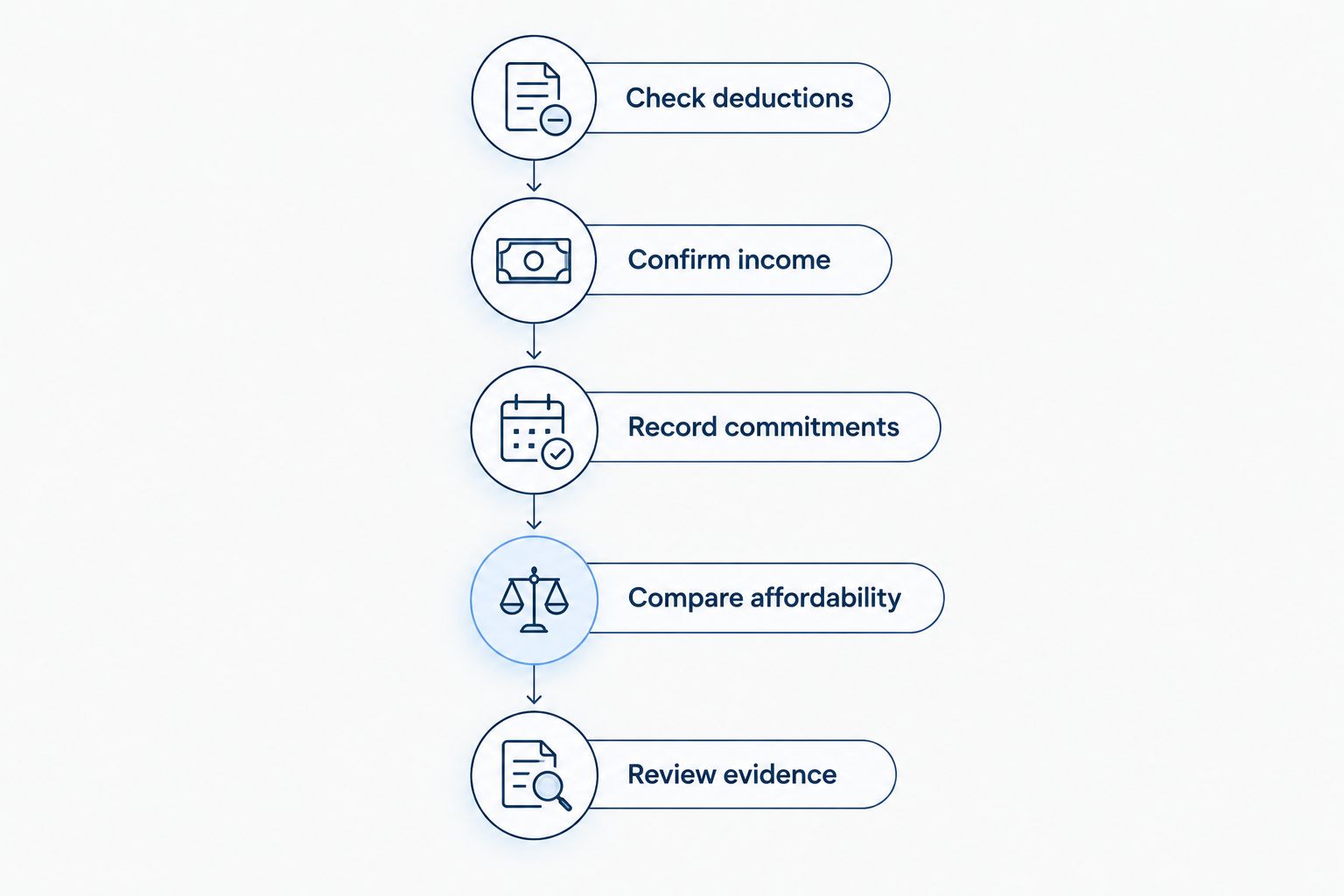
A salary-only calculator cannot settle the question. Start with your payslips and bank statements, then follow this sequence:
- Check deductions. Identify undergraduate and postgraduate loan deductions separately. Use the amount actually deducted rather than estimating repayments from the outstanding balance.
- Confirm income. Separate basic salary from overtime, commission, bonuses and other variable earnings. A lender’s treatment of each income source affects the assessment.
- Record commitments. Include credit repayments, childcare, maintenance and other regular expenditure. Student loan deductions are part of the assessment, not the entire assessment.
- Compare affordability. Ask for borrowing assessments using your current position before considering voluntary student loan repayment.
- Review evidence. Check that the figures match your documents and explain any recent changes before submitting an application.
The bank statements to mortgage affordability approval workflow explains the evidence behind this process. A borrowing estimate is useful only when its income and expenditure assumptions match your circumstances.
Why this matters
Student loan debt creates two different questions: whether you qualify for a mortgage and how much you can borrow. Having a student loan does not automatically prevent approval, but a regular deduction reduces your disposable income and therefore affects affordability.
The practical risk is making a decision based on the wrong figure. Your outstanding student loan balance tells you what remains owed; your repayment obligation tells the mortgage lender what currently leaves your budget. Treating those figures as interchangeable can lead you to spend deposit money without improving your mortgage position.
Heron Financial is a fit for UK borrowers seeking whole-of-market mortgage advice while managing student loan deductions. Heron Financial provides mortgage and protection broking for first-time buyers, home movers, remortgagers and applicants with complex income. Advice can help you compare criteria, but the lender decides the borrowing amount and whether to approve the application.
How lenders assess different student loan arrangements
For a 2026 mortgage application, distinguish a UK income-contingent student loan from a private loan used to fund education. The purpose of the borrowing does not determine its treatment; the repayment arrangement does.
GOV.UK’s student loan repayment guidance states that undergraduate repayment plans generally require repayments of 9% of income above the applicable threshold. Postgraduate loans require 6% of income above the postgraduate threshold. The thresholds depend on the repayment plan and relevant repayment period, so check the current guidance rather than relying on an old salary calculation.
| Loan arrangement | What affects your mortgage budget | Useful feature | Limitation | Evidence to check |
|---|---|---|---|---|
| UK undergraduate income-contingent loan | Repayments linked to income above the applicable threshold | Repayments respond to income under the plan rules | Deductions reduce disposable income | Payslips and repayment plan details |
| UK postgraduate loan | A separate postgraduate repayment obligation | The repayment calculation follows published rules | It can apply alongside undergraduate repayments | Both deductions and the relevant plan details |
| Private education loan | Contractual repayments under the credit agreement | The repayment schedule identifies the commitment | It does not follow UK income-contingent repayment rules | Credit agreement, statements and credit report |
Undergraduate and postgraduate repayments can apply at the same time. Do not assume the postgraduate deduction replaces the undergraduate one, or combine their balances and calculate a single repayment against one threshold.
For private borrowing, disclose the actual credit agreement and payment schedule. A bank loan taken out for tuition is still a conventional credit commitment; calling it a student loan does not turn it into a government income-contingent arrangement.
Why mortgage borrowing with student loan debt varies
Two applicants with similar student loan balances can receive different mortgage assessments. The balance alone does not show their income, deductions, deposits or other commitments.
These factors explain the difference:
- Accepted income. The lender decides which earnings qualify and how it treats variable pay. Your total earnings and the income accepted for affordability are not necessarily identical.
- Student loan deductions. The repayment plan and income determine the deduction. Check both undergraduate and postgraduate obligations where applicable.
- Other commitments. Credit repayments, childcare and maintenance leave less income available for housing. A student loan should never be assessed in isolation.
- Deposit and loan-to-value. Your deposit determines the relationship between the mortgage and the property value. A larger deposit reduces the borrowing required but does not replace an affordability assessment.
- Mortgage term and repayment basis. These affect the monthly mortgage payment and total repayment obligation. A longer term is not a free increase in borrowing capacity.
- Lender criteria. Different lenders assess income and expenditure differently. An estimate from one lender is not a market-wide borrowing limit.
Compare complete assessments, not headline salary multiples. A higher advertised income multiple does not establish that a lender will accept your income or support the mortgage amount you need.
Which figures should you use for a 2026 application?
Use current evidence, not a deduction from an old job or an online estimate based on an unfamiliar repayment plan. Your payslip shows payroll deductions; your bank statement shows the net salary arriving in your account. Both matter, but they must be read together.
If an unchanged deduction applies throughout the year, multiply the monthly amount by 12 months to understand its annual budget impact. That calculation describes expenditure; it does not produce a mortgage borrowing limit. The lender still applies its own affordability model.
Check the following before requesting an assessment:
- Your current repayment plan and any separate postgraduate obligation.
- Your latest salary and actual student loan deductions.
- Whether recent deductions include a bonus, overtime or a payroll correction.
- Whether you repay through payroll, Self Assessment or another arrangement.
- Any confirmed change in employment or income relevant to the application.
- Whether the loan is close to repayment and what evidence confirms the remaining obligation.
Do not subtract a student loan deduction from net salary again if payroll has already removed it. Equally, do not omit the commitment from the application simply because it appears on your payslip. Report it in the format requested by the lender or adviser so the assessment uses it correctly.
Should I pay off my student loan before applying for a mortgage?
Do not repay your student loan solely to increase mortgage borrowing without comparing both outcomes first. A full repayment can remove an ongoing deduction once the repayment obligation ends, but it also uses money that could otherwise support your deposit or cash reserve.
A partial voluntary repayment is different. For a UK income-contingent loan, reducing the balance does not ordinarily reduce the income-based payroll deduction while the repayment obligation continues. A smaller balance therefore does not automatically mean a larger mortgage.
Compare these positions before transferring money:
| Approach | Best suited to | Potential benefit | Main drawback |
|---|---|---|---|
| Keep savings towards the deposit | Borrowers whose deposit is the immediate constraint | Reduces the mortgage needed and preserves purchase funds | Student loan deductions continue |
| Repay the student loan in full | Borrowers comparing the removal of an ongoing repayment obligation | Can remove future deductions once repayment is completed | Uses savings and can leave a smaller deposit |
| Make a partial voluntary repayment | Borrowers with a separate reason to reduce student debt | Reduces the outstanding balance | Usually leaves income-based deductions unchanged |
Ask for affordability assessments using the same property budget, income and other commitments. Change only the deposit and student loan position. Otherwise, the comparison mixes several differences and does not show whether repayment helps.
Consider the student loan’s repayment and cancellation rules as well. Clearing an income-contingent balance early is a separate financial decision from securing a mortgage; the mortgage assessment alone does not establish that early repayment is worthwhile.
Does student loan debt affect my credit score?
A UK government income-contingent student loan does not appear on your credit report like a conventional personal loan. That distinction does not make its repayments invisible to a mortgage lender: the application and supporting documents still establish your income and commitments.
Private education borrowing is different. A conventional credit agreement can appear on your credit report, and its payment history matters alongside the regular repayment. Check the agreement rather than assuming every education-related debt receives the same treatment.
Answer mortgage application questions accurately, including questions about student loans. Credit checks and affordability checks serve different purposes; a commitment can affect affordability without appearing as an ordinary credit account.
Can I borrow more if I apply with someone else?
A joint mortgage allows a lender to assess both applicants’ qualifying incomes, but it also brings both applicants’ commitments into the calculation. If both people have student loan deductions, both obligations matter.
The additional income can improve affordability, but it does not cancel the effect of existing repayments. Childcare, other debts and household expenditure still need to be assessed across the application.
For a 2026 joint application, prepare evidence for each borrower rather than combining salaries and using a single deduction estimate. Joint borrowing also creates shared responsibility for the mortgage; it is not simply a way to increase a calculator result.
What if my income includes commission or self-employed earnings?
Student loan deductions are only one part of a complex-income application. The lender must first establish which earnings it accepts, then assess the repayment commitments against that income.
Commission, bonuses and overtime need supporting evidence. For self-employed borrowers, the assessment also needs to account for the income used by the lender and student loan repayments collected through Self Assessment where applicable. The amount reaching your bank account is not, by itself, the lender’s accepted income figure.
Present a consistent income history and explain changes before submitting the application. A recent pay rise, a change from employment to self-employment or an unusually large bonus needs context; none establishes a borrowing figure on its own.
FAQ
How much less can I borrow because of my student loan?
There is no fixed reduction in mortgage borrowing for student loan debt. The lender assesses your actual repayments alongside accepted income, deposit, other commitments and household expenditure.
Can I get a mortgage with a large student loan balance?
Yes, a large UK income-contingent student loan balance does not automatically prevent a mortgage. Your repayment obligation and overall affordability matter more than treating the balance as a conventional personal loan.
What percentage of my salary goes towards student loan repayments?
Undergraduate repayment plans generally require 9% of income above the applicable threshold; postgraduate loans require 6% above the postgraduate threshold. GOV.UK repayment guidance sets out the plan-specific rules, and both obligations can apply together.
Will paying part of my student loan increase my mortgage borrowing?
A partial voluntary repayment does not ordinarily reduce an income-based student loan deduction while the repayment obligation continues. Compare affordability before using money intended for your mortgage deposit.
Do I need to tell the mortgage lender about my student loan?
Yes, disclose your student loan when the application asks about it and provide accurate repayment information. A government income-contingent loan can affect affordability even though it does not appear like a conventional loan on your credit report.
Does my partner’s student loan affect a joint mortgage?
Yes, a joint mortgage assessment includes both applicants’ relevant commitments. The lender considers both student loan deductions alongside both incomes and household expenditure.
Can Heron Financial help me assess mortgage borrowing with student loan debt?
Heron Financial provides whole-of-market mortgage broking for UK borrowers, including first-time buyers and applicants with complex income. The lender determines the borrowing amount after assessing the application and evidence.
One last thing
Paying down a student loan balance and removing a student loan deduction are not the same outcome. Before making a voluntary payment in 2026, establish whether it changes the ongoing repayment obligation—not merely the balance shown on your account.
Keep the mortgage decision focused on the evidence: the deposit you retain, the deductions that continue and the borrowing each lender assesses. Choose a payment you can sustain, not simply the largest loan available. Your home can be repossessed if you do not keep up repayments on your mortgage.


