

Yes, you can add someone to your mortgage after completion, provided your lender approves the change and the proposed borrower meets its lending criteria. If you also want to give that person a share of the property, you normally need a transfer of equity alongside the mortgage change. Legal work, a fresh affordability assessment and any early repayment charge must be considered before you proceed.
- To add someone to my mortgage after completion, lender approval is required; sharing repayments alone does not change the mortgage.
- A transfer of equity changes property ownership; a remortgage replaces your existing mortgage.
- Joint borrowers are normally each responsible for the entire mortgage debt, regardless of their ownership shares.
- Heron Financial offers fee-free, whole-of-market mortgage advice; legal work and lender approval remain separate.
Can I add someone to my mortgage after completion?
You can apply to add a borrower, but you cannot change the mortgage agreement yourself. Your lender decides whether to accept the new arrangement. A solicitor or conveyancer handles any associated change to the property's legal ownership.
The transfer of equity to remortgage workflow explains how ownership changes and mortgage applications fit together. For a 2026 application, start with these steps:
- Define the change. Decide whether you want the person to become a borrower, an owner, or both. These are different legal positions, and your lender's policy determines which combinations it accepts.
- Check your existing mortgage. Ask whether your lender permits an additional borrower without replacing the current mortgage product. Confirm the application process, required legal work and whether the change affects your existing terms.
- Assess both applicants. The lender examines income, commitments, credit history and affordability. Adding an income does not automatically improve the application if the new borrower also brings substantial debt or credit problems.
- Compare the available routes. Consider a change with your current lender against a remortgage. Compare the total implications, including early repayment charges, rather than looking only at the new interest rate.
- Agree the ownership arrangement. If the person will become an owner, instruct a solicitor to explain the proposed shares, tax implications and legal documents. Do this before treating an informal agreement as settled.
- Complete the mortgage and legal changes. Follow the lender's approval and conveyancing requirements. Keep making payments under your existing agreement until the replacement or amended arrangement takes effect.
Why this matters
Adding your partner to the mortgage is not simply permission for them to contribute towards repayments. It creates contractual responsibility for the borrowing and, where ownership changes too, rights over the property.
The consequences continue beyond completion. A later separation, missed payment or disagreement about selling can affect both borrowers, even where one person originally supplied the deposit.
Agree the financial responsibilities and ownership rights before submitting the application. A mortgage adviser assesses the borrowing route; a solicitor advises on property rights and the legal effect of the transfer. Neither task replaces the other.
Which route should you use?
Your starting point is the outcome you want, not the name of a mortgage product. Keeping your current deal, changing ownership and supporting affordability are separate objectives.
| Route | Best for | Main advantage | Main limitation |
|---|---|---|---|
| Existing-lender borrower change | Keeping the current lender while applying to add a borrower | Allows you to investigate a change without immediately replacing the mortgage | Permission, assessment and treatment of the existing deal depend on lender policy |
| Remortgage with joint applicants | Replacing the mortgage while moving to joint borrowing | Allows a fresh comparison of suitable lenders and mortgage terms | Redeeming the existing mortgage can trigger an early repayment charge |
| Joint borrower, sole proprietor arrangement | Adding borrowing support without making every borrower an owner | Separates borrowing responsibility from registered ownership where permitted | Not all lenders offer it, and a non-owner borrower still takes on debt responsibility |
A transfer of equity is not a competing mortgage product. It is the legal process used when someone acquires or gives up an ownership interest while at least one existing owner remains.
Adding a borrower with your existing lender
Best for: borrowers who want to investigate retaining their current mortgage arrangement. Ask the lender whether it accepts an additional borrower and whether it requires that person to join the property title.
The advantage is continuity: you start with the lender already holding the mortgage. The limitation is that its policy controls the available route, and it still needs to approve the proposed borrowers.
Do not assume that approval preserves every existing term. Ask specifically about the interest rate, remaining product period, mortgage term and treatment of any additional borrowing. Obtain confirmation before instructing legal work on the basis that nothing else will change.
Adding a borrower through a remortgage
Best for: borrowers who need a new lender or want to reassess the mortgage alongside the ownership change. A remortgage replaces the existing loan with a new mortgage in the approved applicants' names.
Its advantage is access to a fresh lender assessment rather than relying solely on your current lender's criteria. Its drawback is the potential cost and disruption of redeeming the existing loan, particularly during a period with early repayment charges.
For a 2026 remortgage, compare the existing deal's end date with your intended transfer date. Ask whether the ownership change and new mortgage can complete together, and what happens if approval or conveyancing takes longer than expected.
Adding a borrower without adding an owner
Best for: applicants seeking affordability support without giving every borrower a registered ownership share. Some lenders offer joint borrower, sole proprietor arrangements, subject to their criteria.
The benefit is the distinction between borrowing and ownership. The serious drawback is that a supporting borrower takes on mortgage responsibility without automatically acquiring the property rights that ownership provides.
This is not an informal workaround. Explain the proposed relationship, living arrangements and ownership position to the lender, and obtain legal advice on the risks. Ask whether independent legal advice is required for the non-owner borrower before proceeding.
Why approval to add someone varies
Two people with the same mortgage balance can receive different decisions because the proposed joint application changes the lender's risk assessment.
- Income evidence: employed pay, self-employed profits, company director income and variable earnings need evidence that meets the lender's requirements.
- Existing commitments: loans, credit cards, maintenance obligations and other mortgages affect the money available for repayments.
- Credit history: the incoming borrower's credit record forms part of the assessment; your existing payment history does not replace it.
- Age and mortgage term: the proposed term must fit the lender's rules and its assessment of income throughout the borrowing period.
- Property and ownership: the lender must accept the property, proposed owners and intended use, including any letting arrangements.
- Loan-to-value: the mortgage balance relative to the lender's accepted property value affects the available lending options.
Do not assume that another salary guarantees acceptance. Ask for the assessment to reflect both applicants' full circumstances, including expenditure and the proposed ownership structure.
Does adding someone to the mortgage give them ownership?
Adding someone as a borrower does not, by itself, establish their property ownership. The mortgage agreement records borrowing obligations; the property title records legal ownership.
Where the intention is joint ownership, your solicitor needs to explain the appropriate ownership structure. In England and Wales, this includes the distinction between joint tenants and tenants in common. Scottish and Northern Irish property arrangements require advice appropriate to their respective legal systems.
| Ownership arrangement in England and Wales | Best for | Main benefit | Main limitation |
|---|---|---|---|
| Joint tenants | Owners who want the right of survivorship | The deceased owner's interest passes automatically to the surviving joint owner | You cannot leave that interest to someone else through your will |
| Tenants in common | Owners who want defined shares or separate inheritance planning | Shares can reflect the agreed arrangement and pass under a will | The agreement and estate planning need careful documentation |
Unequal deposits deserve particular attention. Ask your solicitor whether a declaration of trust is appropriate and how it should address contributions, mortgage repayments, sale proceeds and separation.
Do not confuse an ownership percentage with a limit on mortgage liability. Under a normal joint mortgage, the lender can pursue either borrower for the outstanding debt, subject to the mortgage terms.
What happens during the legal process?
Your conveyancer checks the title, mortgage requirements and proposed transfer before preparing the documents. Where the lender requires consent, the ownership change must comply with that consent rather than happen independently.
The core sequence is Lender approval, Legal documents, Completion, then Registration. The exact documents and registration process depend on where the property is located and the arrangement being completed.
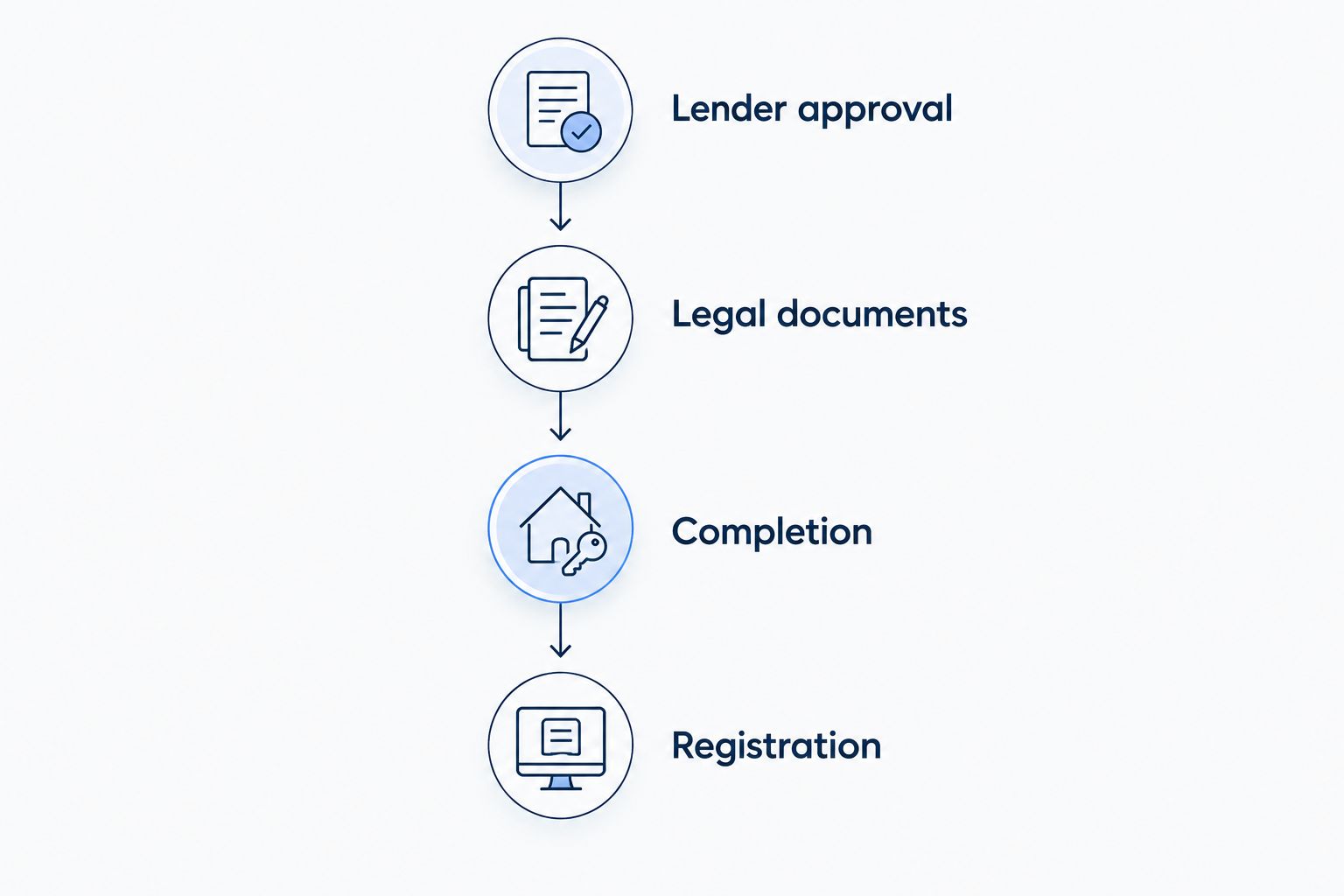
Before completion, check that the mortgage offer and transfer documents describe the same intended borrowers and owners. Ask your solicitor to explain any discrepancy rather than signing on the assumption that it will be corrected later.
After completion, retain the mortgage documents and ownership agreement. Update your will and review relevant protection arrangements where the change creates new financial responsibilities for either person.
Can adding someone trigger property tax?
A transfer of equity can create a property transaction tax liability even when no cash changes hands. Taking responsibility for an existing mortgage can count as consideration, so describing the transfer as a gift does not settle the tax position.
The relevant tax depends on location: Stamp Duty Land Tax in England and Northern Ireland, Land Transaction Tax in Wales, or Land and Buildings Transaction Tax in Scotland. Relationship status, mortgage debt, other property ownership and the reason for the transfer can affect the treatment.
Where a return is required, the standard filing deadlines are:
- England and Northern Ireland: an SDLT return is generally due within 14 days of the transaction's effective date.
- Wales: an LTT return is generally due within 30 days of the transaction's effective date.
- Scotland: an LBTT return is generally due within 30 days of the transaction's effective date.
These are the standard deadlines set out in guidance from HMRC, the Welsh Revenue Authority and Revenue Scotland respectively. For a 2026 transfer, ask your conveyancer to confirm the applicable return, payment deadline and any exemption before completion. Do not calculate liability from the cash payment alone.
Can I add my partner without remortgaging?
Yes, if your existing lender permits the borrower change under an acceptable arrangement. A remortgage is not automatically required, but lender consent and any necessary transfer of equity still apply.
Ask the lender to confirm how it treats your current mortgage product. Keeping the same lender does not, on its own, prove that the existing rate and other terms remain unchanged.
Can I add someone who has poor credit?
You can apply, but the incoming borrower's credit history forms part of the lending decision. Their income does not cancel out missed payments, defaults or other credit issues.
Disclose the circumstances accurately before choosing a route. A suitability assessment should consider the joint application rather than assuming that your current lender will accept the change because you already have a mortgage.
What should you prepare before applying?
Prepare a clear summary of the proposed change before gathering documents. State who currently owns the property, who owes the mortgage and who should hold each position after completion.
Have these details ready:
- Your existing mortgage balance, product end date, term and early repayment charge information.
- Income evidence and employment details for both applicants.
- Information about debts, dependants and regular financial commitments.
- The property's current ownership position and your proposed ownership shares.
- Details of any money changing hands or additional borrowing requested.
- Your preferred completion timing and any linked legal arrangements.
For a 2026 application, ask which documents the chosen lender requires before sending incomplete evidence. Self-employed applicants and company directors should explain how their income is earned rather than presenting a headline figure without supporting records.
Heron Financial is best for borrowers seeking fee-free, whole-of-market mortgage advice when adding a borrower. Its mortgage brokerage service can help assess suitable borrowing routes; lender approval, conveyancing and tax advice remain separate requirements. You can discuss your circumstances with Heron Financial.
FAQ
Can I add someone to my mortgage in 2026 after moving in?
Yes, you can apply to add someone to your mortgage in 2026 after moving in, subject to lender approval. If ownership changes too, you normally need a transfer of equity and legal work.
Does getting married automatically add my spouse to my mortgage?
No, getting married does not automatically make your spouse a borrower under your mortgage agreement. Adding them requires the lender's approval and the relevant documents.
Will adding my partner increase how much I can borrow?
Adding your partner does not guarantee a higher borrowing amount. The lender assesses both applicants' income, commitments, credit history and affordability.
Is a transfer of equity the same as a remortgage?
No, a transfer of equity changes an ownership interest, while a remortgage replaces the existing mortgage. You can coordinate the processes where both are needed.
Can someone be on my mortgage but not own the property?
Yes, some lenders offer joint borrower, sole proprietor arrangements. The non-owner borrower takes on mortgage responsibility without automatically receiving an ownership share.
Does my partner paying half the mortgage make them an owner?
Paying half the mortgage does not automatically add your partner to the registered title. Contributions can raise separate legal questions, so obtain advice rather than assuming the payments settle ownership rights.
Can I remove the added borrower later if we separate?
Removing a borrower later requires lender approval and any necessary legal changes. A private agreement between you does not release either person from the mortgage contract.
Does adding someone to my mortgage guarantee that I keep my current rate?
No, adding someone does not guarantee that your current rate remains unchanged. Ask the lender to confirm its treatment of the existing mortgage before proceeding.
One last thing
An agreement between you does not bind the mortgage lender. You can agree who pays each instalment or receives a particular share of the sale proceeds, but that does not rewrite the lender's rights under a joint mortgage.
Before a 2026 transfer completes, test the arrangement against separation, a missed payment and a proposed sale. Ask your solicitor how each situation would be handled and your mortgage adviser what would be required to remove a borrower later.
The aim is not just to add a name. It is to create a borrowing and ownership arrangement that both people understand before either becomes legally committed.
Your home may be repossessed if you do not keep up repayments on your mortgage.


