

Yes, you can get a first-time buyer mortgage with a 5% deposit, provided you meet the lender’s affordability, credit and property requirements. Your deposit does not cover every buying expense, so keep money aside for legal work, surveys, moving and any applicable tax rather than committing all your savings to the purchase.
- A 5 percent deposit mortgage first time buyer application needs affordable repayments, acceptable credit and a suitable property.
- A 5% deposit means 95% loan-to-value when the purchase price and lender’s valuation match.
- Heron Financial suits first-time buyers seeking fee-free, whole-of-market mortgage advice.
- Keep a separate buying-cost budget; your deposit is not your entire cash requirement.
Can I get a mortgage as a first-time buyer with only a 5% deposit?
Yes. A 5% deposit is a possible route into home ownership, not an automatic mortgage approval. The lender still needs to establish that you can afford the borrowing and that the property provides acceptable security.
For a purchase assessed at the agreed price, your 5% contribution leaves the mortgage covering 95%. This is described as 95% loan-to-value, or 95% LTV. Your income must support that borrowing; having the deposit does not establish your maximum purchase budget.
When comparing first-time buyer mortgage deals, assess eligibility before focusing on the headline interest rate. For a 2026 application, use the lender’s current criteria rather than an old comparison or a previous agreement in principle.
| Deposit position | Mortgage LTV* | Best for | Main advantage | Main limitation |
|---|---|---|---|---|
| 5% deposit | 95% LTV | Buyers whose savings cover a smaller deposit and separate buying expenses | Requires less deposit saving | Leaves more borrowing and a smaller equity cushion |
| 10% deposit | 90% LTV | Buyers who can contribute more without exhausting their cash reserve | Reduces borrowing against the same property | Requires a larger cash contribution |
These relationships assume the lender’s valuation matches the purchase price and the deposit is applied entirely towards that price.
Neither position is automatically the better choice. Choose the deposit level that supports affordable borrowing while leaving you able to complete the purchase and manage the home.
Why this matters
A small deposit answers only one part of the buying question. You also need enough accepted income, manageable financial commitments and a property the lender will accept.
For your 2026 purchase, distinguish between being able to apply and being ready to proceed. An application that overlooks childcare, credit repayments or an unsuitable property can fail even when the deposit is already saved.
Start with an affordability assessment, then set your property-search budget. Working backwards from an asking price risks creating a deposit target for borrowing that your income cannot support.
A 5% deposit: 95% LTV
A 95% LTV mortgage gives you a smaller initial equity stake than a mortgage at a lower LTV. That makes changes in property value particularly relevant when you later sell or remortgage.
Your outstanding mortgage does not fall simply because the property loses value. If the balance exceeds the property’s value, you are in negative equity; selling then requires you to address the shortfall rather than assuming the sale proceeds will clear the loan.
Best for: first-time buyers whose income supports the required mortgage and whose savings cover both the deposit and separate purchase expenses.
The benefit is the smaller deposit requirement. The trade-off is greater borrowing against the same property, less initial equity and less room to absorb a lower valuation.
Do not assume a 95% LTV mortgage suits every property. Lenders assess construction, condition, tenure and other features, and their criteria can differ for flats and new-build homes.
A 10% deposit: 90% LTV
A 10% deposit reduces the mortgage to 90% LTV when the valuation and purchase price match. You borrow a smaller proportion of the same property’s value, but commit more of your own money at completion.
Best for: first-time buyers who can increase their deposit while retaining enough money for purchase expenses and a practical cash reserve.
The advantage is lower borrowing and a larger initial equity stake. The disadvantage is the additional saving requirement, particularly if increasing the deposit would leave you without money for essential work or unexpected expenses.
A larger deposit does not remove affordability checks or resolve every credit issue. Compare the actual mortgage terms and your remaining savings before treating a lower LTV as the deciding factor.
For a 2026 decision, ask for both deposit scenarios to be assessed against the same property budget. That makes the borrowing difference clear without assuming that every lender offers the same terms.
Why eligibility for a 5% deposit mortgage varies
Lenders assess the application as a whole. These factors explain why two first-time buyers with the same deposit percentage can receive different borrowing decisions:
- Accepted income: basic salary, overtime, bonuses and commission are not necessarily assessed in the same way. Self-employed income and company-director income require evidence that fits the lender’s criteria.
- Financial commitments: loans, credit cards, childcare, maintenance and other regular expenditure affect the income available for mortgage repayments.
- Credit history: missed payments, defaults and other adverse entries influence whether an application meets the lender’s rules.
- Deposit evidence: the lender and conveyancer need to understand where your contribution comes from, including any family gift.
- Property suitability: the valuation, construction, condition and tenure affect whether the property is acceptable security.
- Mortgage term: the repayment period affects monthly payments and total interest, while age and expected retirement income can affect the term accepted.
Assess these factors together, not as separate pass-or-fail shortcuts. A strong deposit history does not cancel out unaffordable borrowing, and a good salary does not make every property mortgageable.
How to prepare your application
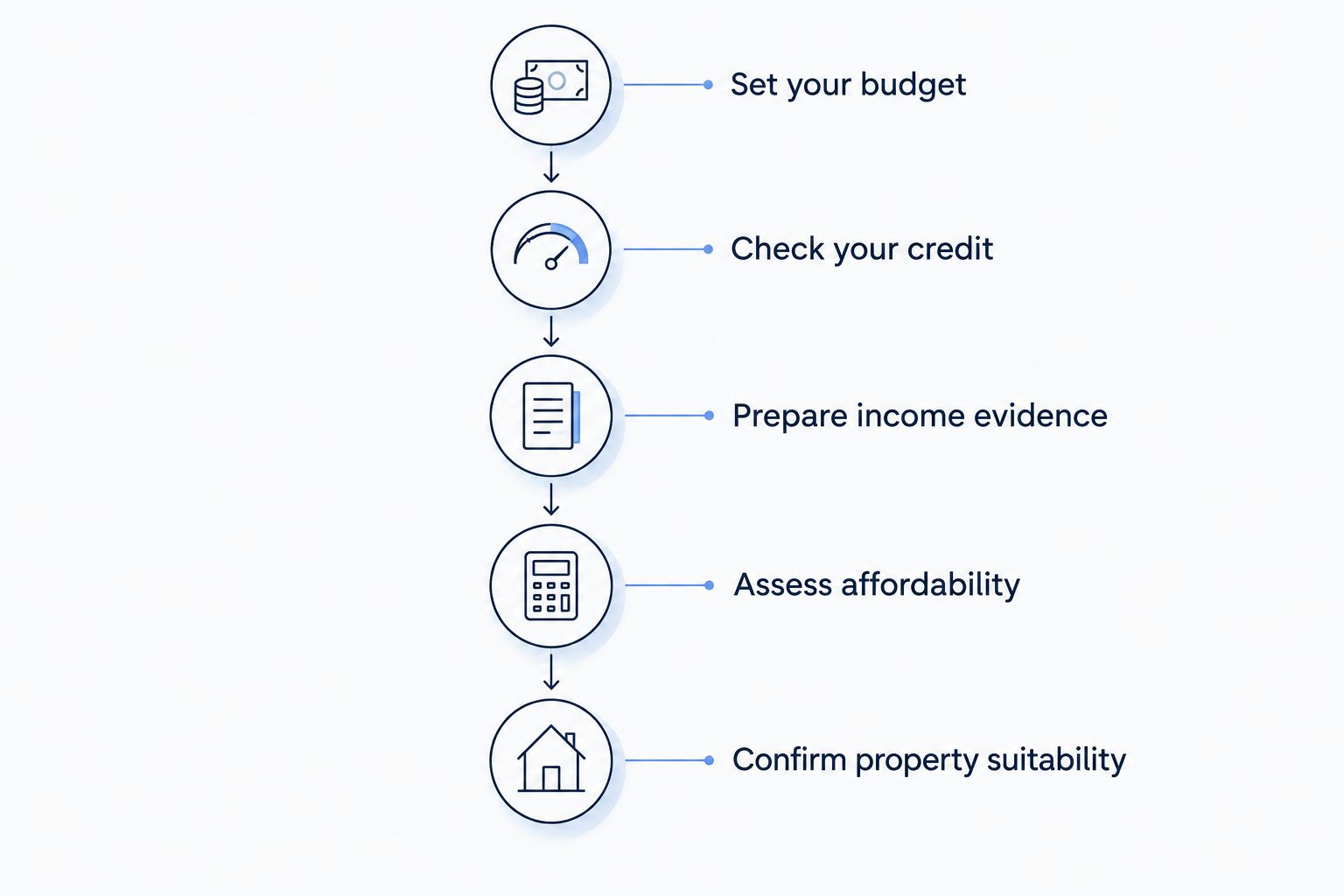
Use this sequence before making commitments based on an assumed mortgage amount. It separates your savings position from the lender’s assessment and helps you identify issues before submitting a full application.
1. Set your budget
List the money available for your deposit separately from the money needed to complete the purchase. Include legal work, surveys, moving and any applicable property tax, without assuming first-time buyer status removes every expense.
Keep a reserve for the period after completion. Owning the property brings responsibilities that do not appear in the mortgage repayment alone, including maintenance and, where relevant, service charges.
2. Check your credit
Review your credit reports for incorrect addresses, unfamiliar accounts and payment-history errors. Arrange corrections before applying where possible, and be ready to explain genuine adverse entries accurately.
Avoid treating a consumer credit score as a mortgage decision. A lender assesses the underlying information alongside its own policy, your income and the proposed borrowing.
3. Prepare income evidence
Gather payslips and bank statements, or the relevant tax and business documents if you are self-employed. The exact documents and assessment period depend on the lender and your circumstances.
Explain variable income at the outset. If your deposit is sufficient but the borrowing relies on bonuses, commission or company income, the lender’s treatment of that income is central to the application.
4. Assess affordability
Provide an accurate account of your regular expenditure and existing commitments. The lender’s affordability assessment is not simply a salary multiplied by a standard figure.
Discuss the mortgage term as well as the loan amount. A longer term spreads repayments over more time, but generally increases total interest when other mortgage terms remain the same.
5. Confirm property suitability
Check whether the proposed property fits the lender’s criteria before relying on a particular mortgage. Tell your adviser about leasehold tenure, unusual construction, significant defects or a new-build purchase.
A lender’s valuation assesses the property for lending purposes. It is not a substitute for choosing an appropriate survey to understand the property’s condition.
Once these checks are complete, an agreement in principle can help frame your property search. An agreement in principle is not a final mortgage offer: the full application, supporting evidence and property assessment still matter.
What happens if the lender values the property below your offer?
A lower lender valuation can change the deposit you need because the lender assesses its maximum advance against the value it accepts. Your agreed purchase price does not oblige the lender to lend against that same figure.
With a 5% deposit, there is less spare equity to absorb that difference. You must review the revised borrowing position rather than assuming the original deposit will still complete the purchase.
Discuss the valuation with your adviser and conveyancer before committing further. Depending on the circumstances, the next step is to reconsider the purchase price, your cash contribution or whether to proceed; increasing borrowing remains subject to the lender’s limits and affordability assessment.
Can I use a gifted deposit for a 5% deposit mortgage?
A 5% deposit can include a family gift if it meets the chosen lender’s requirements. The lender and conveyancer will need evidence of the funds and confirmation of the arrangement.
Be clear about whether the money is genuinely a gift. A repayable family loan creates a different financial obligation and must not be described as a gift simply to satisfy a deposit requirement.
Check the documentation before transferring money or submitting the application. Requirements concerning the donor, source of funds and any interest in the property differ between lenders.
Can I get a 95% LTV mortgage if I am self-employed?
A 95% LTV application is not ruled out solely because you are self-employed. Approval depends on the lender’s income assessment, your evidence, credit history, commitments and the property.
Your latest bank balance is not a substitute for the income documents the lender requires. Company directors should also explain how they receive income rather than assuming salary, dividends and retained profits receive identical treatment.
For a 2026 application, establish which income evidence a lender will accept before selecting a property budget. That is more useful than relying on a borrowing estimate based on turnover alone.
Should I apply now or save a larger deposit?
A 5% deposit supports an application only when the rest of your finances support the purchase. Saving more is sensible if your current plan leaves no reserve or requires borrowing you cannot comfortably manage.
| Approach | Best for | Benefit | Trade-off |
|---|---|---|---|
| Apply with your current deposit | Buyers with suitable income, evidence and a separate cash reserve | Lets you assess a purchase using your existing savings | Leaves higher borrowing against the same property |
| Save a larger deposit | Buyers who need more financial breathing room | Reduces the loan required for the same purchase price | Delays the purchase and requires further saving |
Do not use every available pound merely to reach a lower LTV. A mortgage decision should account for your position after completion, not just whether the application fits a deposit threshold.
Heron Financial is best for first-time buyers who want fee-free, whole-of-market mortgage advice. The brokerage can help you assess the borrowing route, but advice does not replace the lender’s approval or the property assessment.
Heron Financial’s first-time buyer mortgage service is relevant when you need your deposit, income and commitments considered together. Fee-free mortgage advice does not mean the purchase itself has no expenses.
Discuss your first mortgage
Review your deposit, income and mortgage needs with a fee-free, whole-of-market brokerage.
FAQ
Can I get a first-time buyer mortgage with a 5% deposit in 2026?
Yes, a 5% deposit can support a first-time buyer mortgage in 2026 if you meet the lender’s requirements. Approval also depends on affordability, credit history, deposit evidence and the property.
Does a 5% deposit mean a 95% mortgage?
A 5% deposit means a 95% LTV mortgage when the purchase price and lender’s valuation match. A lower valuation can change the amount you need to contribute.
Is a 10% deposit better than a 5% deposit?
A 10% deposit reduces borrowing against the same property compared with a 5% deposit. It is not automatically better if contributing more leaves you without money for purchase expenses and essential reserves.
Can I get a mortgage with a small deposit and bad credit?
A small deposit and adverse credit must be assessed together against lender criteria. The nature, timing and status of the credit issues matter; do not assume a 5% deposit guarantees an eligible lending route.
Does an agreement in principle guarantee my mortgage?
An agreement in principle does not guarantee a mortgage offer. The lender still assesses the full application, verifies evidence and checks the property.
Can my parents give me my mortgage deposit?
A family gift can form part of your deposit if the lender accepts the arrangement. You must provide the required evidence and disclose whether repayment is expected.
Can Heron Financial help with a first-time buyer mortgage?
Heron Financial provides fee-free, whole-of-market mortgage broking for first-time buyers across the UK. Mortgage approval remains subject to the lender’s assessment, and separate purchase expenses still need budgeting.
One last thing
Ask what your finances will look like immediately after completion, not just whether you can assemble a 5% deposit. A successful purchase leaves you able to meet the mortgage payment, manage ordinary household expenses and deal with the property’s responsibilities.
Before proceeding in 2026, confirm your accepted income, deposit evidence, property suitability and remaining cash reserve. Those checks turn a deposit percentage into a workable buying plan.


