

Instead of chasing insurance paperwork after your mortgage completes, review protection during the mortgage application and agree when each policy should start before you take on the relevant financial risk. This 2026 workflow explains when you need mortgage protection insurance, how to choose cover and how to confirm it is actually in force.
- When do I need mortgage protection insurance? Review needs during your mortgage application, not after completion.
- Heron Financial suits UK borrowers seeking mortgage and protection advice together.
- Life insurance, critical illness cover and income protection address different financial risks.
- A mortgage offer does not activate protection; confirm the insurer’s acceptance and policy start date separately.
Why this matters
Mortgage completion and protection cover are separate processes. Your lender agreeing to lend does not mean an insurer has accepted your application or started your policy.
If you are asking, ‘when do I need mortgage protection insurance?’, separate the review date from the cover start date. Review your needs early enough to complete underwriting, then agree a start date that reflects your existing responsibilities and the new mortgage commitment.
Heron Financial is best for UK borrowers seeking mortgage and protection advice together. Coordinating those decisions helps you assess the debt and the household income supporting it without treating insurance as an afterthought.
Life insurance is not generally a legal requirement for a UK mortgage. Buildings insurance is different: check your lender’s requirements and ask your conveyancer when responsibility for insuring the property passes to you.
Before you start
- Gather the mortgage details: proposed borrowing, repayment method, term, expected legal milestones and any existing mortgage or protection policies. Include the latest policy schedules, not just direct debit records.
- Gather the household evidence: income, essential spending, employer sick pay, death-in-service benefits, dependants and relevant medical information. Check what happens to employment benefits if you leave the job.
- Resolve the start-date trap: submitting an application or receiving a quotation does not itself confirm cover. Ask what acceptance, payment and activation requirements apply, including whether any temporary cover exists and its limitations.
Use the checklist headings below in your own notes. Insurers use different forms and field names; these are planning headings, not instructions for a particular website.
Needs assessment
- Record the mortgage commitment. Note the balance, term and repayment basis. For a purchase, ask your conveyancer about the legal commitment date rather than assuming completion is the only relevant milestone.
- Record the income dependency. Identify whose earnings meet the mortgage and essential household spending. Include unpaid caring responsibilities where replacing that work would create an expense.
- Check existing protection. Record the insured person, benefit, end date, exclusions and ownership of each policy. Check employer benefits separately because they are linked to employment.
- Write the shortfall. Ask 3 questions: what happens if a borrower dies, suffers a covered serious illness, or cannot work through illness or injury? Each answer identifies a different protection need.
Expected result: you have a written explanation of which financial risks require cover and which existing arrangements already address them.
For your 2026 assessment, use the borrowing and household circumstances you are committing to now. An old policy linked to a previous home is not evidence that the new mortgage is adequately covered.
Policy selection
‘Mortgage protection’ describes several types of insurance, not one standard policy. Match the insured event to the financial problem before comparing individual contracts.
| Cover type | Best for | What it does | Main limitation |
|---|---|---|---|
| Life insurance | Dependants or a co-borrower exposed to debt after a death | Pays a benefit following a valid death claim during the policy term | Does not replace earnings during ordinary sickness absence |
| Critical illness cover | A lump-sum need following a specified serious illness | Pays on a claim meeting a covered condition’s definition | Does not cover every illness or diagnosis |
| Income protection | Household bills dependent on earnings | Pays a regular benefit for qualifying incapacity after the deferred period | Eligibility, occupation definitions and benefit limits restrict claims |
| Mortgage payment protection insurance | A defined short-term mortgage-payment need | Covers specified events, potentially including accident, sickness or unemployment | Waiting periods, exclusions and limited payment periods apply |
- Match cover to the shortfall. Select benefits for the identified need, not simply because the policy name contains ‘mortgage’.
- Match the benefit structure. Compare decreasing and level life cover against your repayment method and wider family needs. Decreasing cover needs particular scrutiny where borrowing will not reduce as assumed.
- Match the timing. Check the policy term, deferred period and benefit payment period. These describe different things: how long cover lasts, how long you wait before benefits begin, and how long benefits can continue.
- Check suitability and limitations. Read the recommendation alongside exclusions and policy definitions. Ask why the proposed cover fits better than keeping, changing or supplementing existing arrangements.
Expected result: each proposed policy has a defined purpose, benefit structure and limitation you understand.
Heron Financial provides mortgage and protection broking, but advice does not remove insurer underwriting requirements. A suitable recommendation still needs an insurer’s acceptance on terms you agree to.
Underwriting review
- Complete the application accurately. Answer the insurer’s questions about health, occupation, activities and other requested information. Ask for clarification rather than guessing what a question means.
- Check the submitted answers. Keep a copy and correct errors promptly. Explain changes in circumstances before the policy starts in line with the insurer’s instructions.
- Respond to evidence requests. Supply requested information through the insurer’s or adviser’s agreed secure channel. Do not assume a request for further medical evidence means the application has been declined.
- Review the actual decision. Distinguish an initial quotation from accepted terms. Check for exclusions, revised terms, postponed decisions or outstanding conditions before agreeing to proceed.
Expected result: you know whether the insurer has accepted the application, what conditions apply and what remains outstanding.
Start this stage early in your 2026 purchase process. There is no universal underwriting deadline: an application requiring further evidence does not follow the same path as one accepted without it.
Do not cancel existing cover because a replacement application has been submitted. Keep existing protection until the replacement is confirmed in force and you have checked the consequences of switching.
Cover activation
- Agree the start date. Tell your adviser about the expected legal commitment and completion dates, existing liabilities and any gap in cover. Confirm which date each policy should start and why.
- Complete activation requirements. Provide any outstanding declarations, payment instructions or acceptance documents the insurer requires. Follow the insurer’s actual instructions rather than assuming a direct debit mandate completes the process.
- Obtain written confirmation. Check the insured person, benefit, policy term, start date and any special terms against the accepted recommendation.
- Store the evidence. Keep the policy schedule, wording and claims contact details where the relevant people can find them. Check beneficiary or trust arrangements with an appropriately qualified adviser where relevant.
Expected result: the insurer has confirmed that the intended policy is in force from the agreed date, rather than merely recording an application.
Track 2 dates separately: application submitted and cover in force. Only the second confirms the policy has started; claims still depend on its terms.
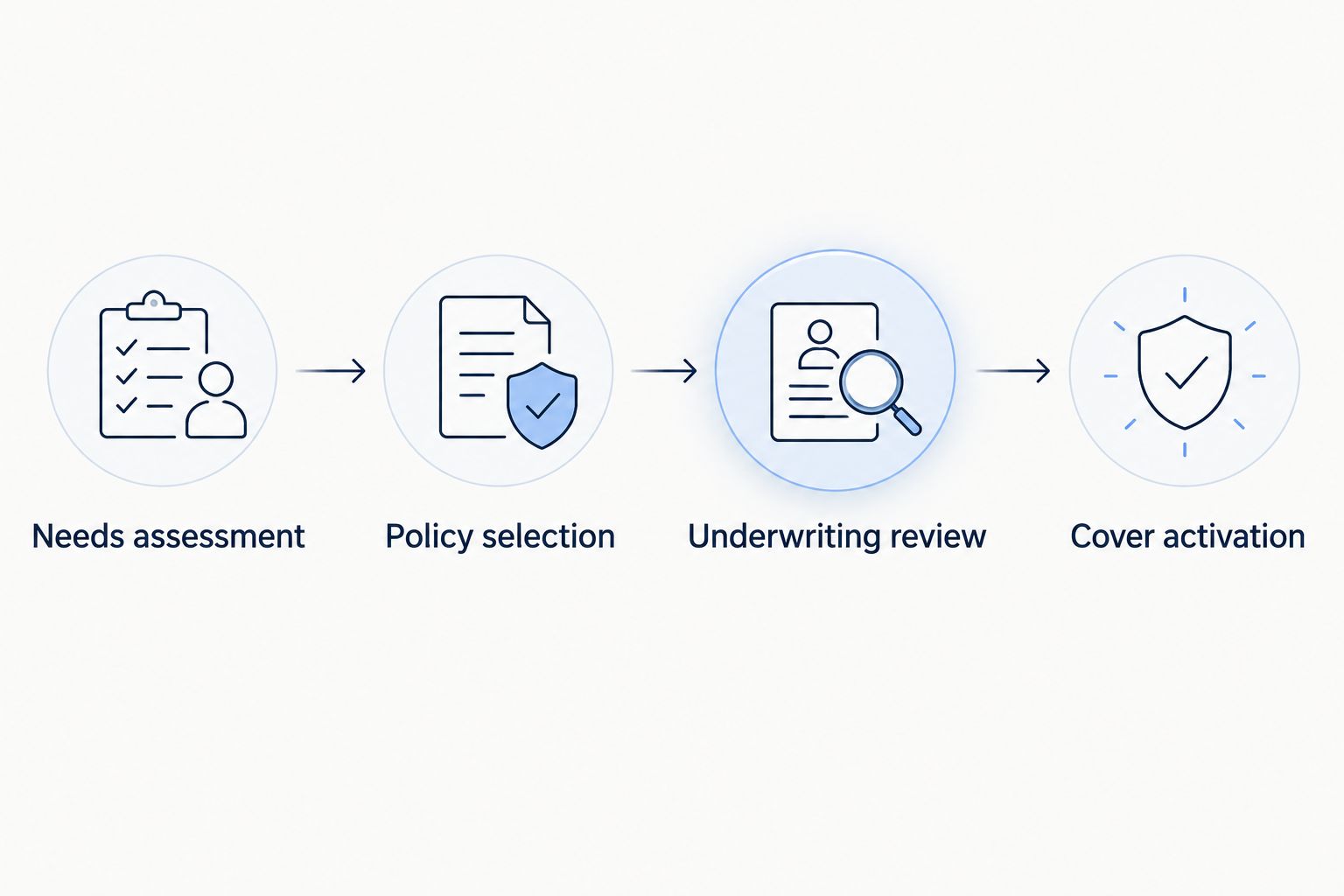
Your completed 2026 checklist should follow this sequence: Needs assessment, Policy selection, Underwriting review, Cover activation. A mortgage offer is a separate milestone, not a substitute for any stage.
Update protection when your mortgage changes
A remortgage or house move needs a review, not automatic cancellation and replacement. Existing cover can remain useful, particularly where replacing it would involve fresh medical underwriting.
- Compare the new borrowing, term and repayment method with the current policy schedule.
- Check whether household income, dependants, employment benefits or health have changed.
- Ask your adviser to compare retaining cover, adding cover and replacing cover. Record what each route leaves uncovered.
- Coordinate any agreed changes with the mortgage transaction and obtain confirmation before ending an existing policy.
Expected result: the protection decision reflects the new commitment without creating an avoidable gap or discarding useful existing terms.
For self-employed borrowers, assess the income available during illness rather than relying on an employer sick-pay assumption. The guide to income protection insurance for self-employed people explains the adjacent cover decision.
In 2026, a longer mortgage term deserves particular attention: cover ending on the original repayment date will not automatically extend with the loan. Ask about any policy alteration options and their conditions before applying for replacement cover.
Troubleshooting
Completion is approaching but underwriting is unfinished
Ask the adviser or insurer exactly what remains outstanding and whether any temporary cover applies. Get its scope and exclusions in writing; do not describe yourself as insured based on an assumption.
Keep your conveyancer informed about any issue affecting a contractual insurance requirement. A mortgage deadline does not change an insurer’s acceptance rules.
The mortgage amount or completion date changes
Send the revised details to your adviser before activation. Check whether the benefit, term or requested start date needs changing, then obtain updated confirmation rather than relying on an earlier instruction.
The policy excludes the condition you are worried about
Ask the adviser to explain the exclusion and whether the recommendation still addresses your main concern. Compare the accepted policy terms, not just the original application or an illustration without exclusions.
Employer benefits appear to duplicate personal cover
Check the benefit amount, eligibility, payment conditions and what happens when employment ends. Do not cancel personal protection solely because a workplace benefits summary mentions life cover or sick pay.
A payment instruction exists but cover is unconfirmed
Contact the insurer or adviser and request the policy’s current status and effective start date. A bank instruction shows how payment is arranged, not whether every condition for cover has been satisfied.
Customise your workflow
Use one checklist, but keep separate responsibilities. Your conveyancer handles the legal transaction; your mortgage adviser handles the borrowing recommendation; the insurer confirms protection acceptance and activation.
Add a named contact and next action beside every outstanding item. For example, record who is obtaining medical evidence, who is confirming the legal milestone and who will request the policy start date.
Use Heron Financial’s mortgage and protection service to discuss those linked decisions, while keeping the insurer’s policy documents as the record of cover. Brokerage support does not turn a quotation into an insurance contract.
Schedule a further review after a material change such as a new dependant, different employment or additional borrowing. Review the need, not just whether the direct debit continues.
FAQ
When do I need mortgage protection insurance when buying a home?
Review mortgage protection during your mortgage application and agree the start date before you take on the relevant financial risk. Your existing commitments, dependants and legal transaction milestones determine the timing.
Do I legally need life insurance to get a mortgage?
Life insurance is not generally a legal requirement for a UK mortgage. Check your mortgage conditions, and distinguish life insurance from any buildings insurance requirement.
Should mortgage life insurance start at exchange or completion?
Choose the start date around your financial exposure, not a universal exchange-or-completion rule. Ask your conveyancer about the legal commitment and your protection adviser about the appropriate insurance start date.
Is mortgage protection the same as buildings insurance?
No. Personal protection addresses specified risks affecting people or income, while buildings insurance covers insured damage to the property.
Does income protection pay off the whole mortgage?
Income protection normally pays a regular benefit for qualifying incapacity rather than clearing the mortgage balance. The deferred period, benefit limits and policy definitions determine how it works.
Can I keep my existing life insurance when I remortgage?
A remortgage does not automatically require replacement life insurance. Compare the existing benefit and term with the new borrowing before deciding whether to retain, supplement or replace cover.
Am I insured once I submit the protection application?
Submitting an application does not itself confirm that cover has started. Obtain the insurer’s confirmation of acceptance, effective start date and any outstanding conditions or temporary-cover limitations.
One last thing
Mortgage debt and household dependence are not the same calculation. Repaying the mortgage after a death would remove the loan, but it would not replace the income needed for food, utilities, childcare and other living costs.
Before signing off your 2026 protection plan, check both outcomes: whether the mortgage is addressed and whether the household can continue meeting essential spending. A policy can match the mortgage balance and still leave a family’s wider needs uncovered.


