

Yes, you can get a mortgage while on maternity leave or paternity leave in 2026, provided you meet the lender’s affordability and eligibility requirements. Some lenders assess your confirmed return-to-work salary rather than your temporarily reduced leave pay, but they need evidence of your plans and how you will cover repayments before returning. Childcare costs, reduced working hours and other household commitments still affect how much you can borrow.
- A mortgage while on maternity leave is possible; confirmed return-to-work income and household affordability determine eligibility.
- Paternity leave does not automatically prevent approval, but lenders still assess income and commitments.
- Heron Financial offers whole-of-market mortgage advice; approval remains the lender’s decision.
- Prepare employer confirmation, payslips, bank statements and a realistic childcare budget before applying.
Can I get a mortgage while on maternity or paternity leave?
Parental leave is not an automatic mortgage rejection. The central question is whether the lender accepts the income you want assessed and whether your household can afford the mortgage throughout the leave period and afterwards.
Heron Financial is a UK whole-of-market mortgage and protection brokerage. Whole-of-market advice helps you compare lender criteria, but it does not remove income checks or guarantee an offer.
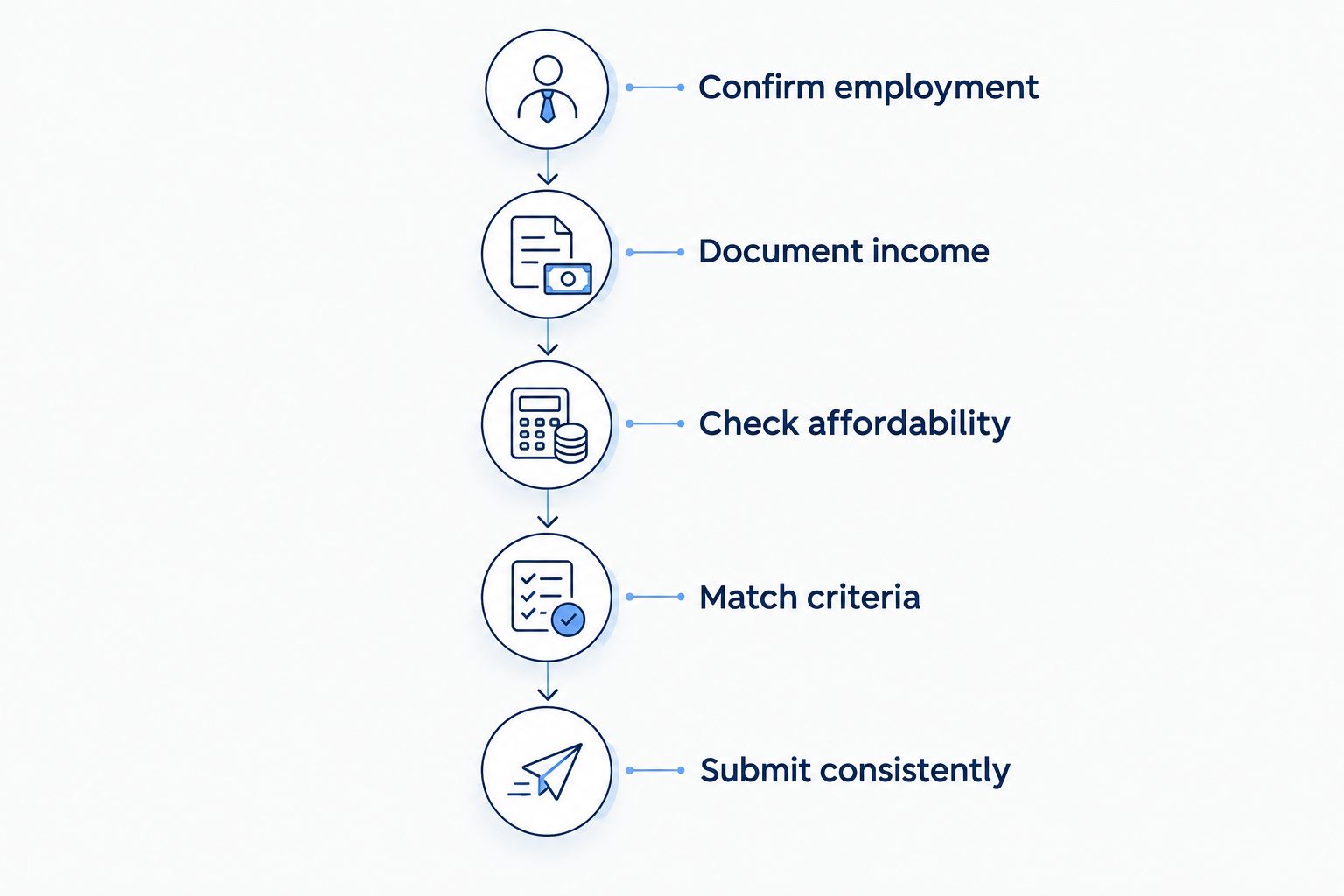
Start with this sequence before submitting a full application:
- Confirm employment. Establish your continuing employment, expected return date and planned working hours.
- Document income. Gather evidence of your salary before leave, current leave pay and salary on returning.
- Check affordability. Include childcare, credit commitments and the income gap during any unpaid leave.
- Match criteria. Check how the proposed lender treats parental leave and what evidence it requires.
- Submit consistently. Make sure the application, employer confirmation and supporting documents describe the same arrangements.
Your proposed borrowing should follow these checks, not precede them. An affordability estimate based on your former full-time salary is not a reliable starting point if you have already agreed to return part-time.
Why this matters
Your latest payslip can show a temporary reduction in earnings rather than a permanent change in earning capacity. A mortgage assessment needs to distinguish the two. Equally, your pre-leave salary does not describe your future finances if your hours or household spending will change.
For a 2026 application, separate the income the lender accepts from the money actually available each month. A lender accepting your return-to-work salary does not put that salary into your bank account during unpaid leave.
Passing a lender’s affordability calculation and maintaining a workable household budget are separate checks. You need both, particularly when a property purchase also uses savings for the deposit and transaction expenses.
Which income will the lender use?
Lenders have different parental-leave criteria. Some accept confirmed income on your return to work; others require additional evidence or assess the application using a different income basis. Check the criteria before relying on a borrowing estimate.
The following comparison explains the main income situations, rather than recommending a specific lender or mortgage product.
| Income situation | Best for | Supporting evidence | Advantage | Limitation |
|---|---|---|---|---|
| Confirmed return on existing salary | Applicants keeping their previous hours and salary | Employer confirmation and pre-leave payslips | Shows the temporary nature of reduced pay | Acceptance depends on the lender’s criteria |
| Confirmed return on reduced hours | Applicants with an agreed part-time arrangement | Revised hours and salary confirmation | Provides a realistic ongoing income figure | Lower earnings can reduce borrowing capacity |
| Current leave pay | Applicants whose leave income supports the proposed borrowing | Current payslips and leave-pay schedule | Documents income being received now | Temporary pay does not establish long-term affordability alone |
| Joint household income | Applicants applying with another borrower | Both applicants’ income and commitments | Allows accepted income to be assessed together | Both applicants’ debts and household expenses also count |
Use the salary attached to your actual return arrangement, not the salary you would prefer the lender to assess. If working hours remain undecided, settle that question before treating an affordability result as dependable.
Returning on your existing salary
An employer letter can establish that you remain employed and confirm your intended return date, salary and hours. Ask the proposed lender or adviser what wording and documents are needed before requesting it.
A letter supports the application; it does not replace every other check. The lender still assesses credit history, commitments, the property and the deposit alongside income.
Returning part-time or changing roles
Reduced hours change the ongoing income assessment. Provide the agreed new salary rather than presenting a full-time salary as though it will continue.
The same principle applies if you change roles or employers. Explain the change clearly and supply the relevant employment evidence so that the application reflects the arrangement you intend to follow.
Receiving bonus or commission income
Your basic salary and variable earnings need separate consideration. A previous bonus or commission payment is not proof that the same amount will continue during leave or immediately after returning.
For applicants with variable pay, the guide to getting a mortgage using commission income covers a related income-assessment question. Present parental leave and variable earnings together rather than assuming acceptance of one settles the other.
What documents should I prepare?
Build an evidence pack that explains the change in income from before leave through to your return. There is no universal document checklist that overrides an individual lender’s requirements.
Prepare the following where relevant:
- Pre-leave payslips: evidence of your normal salary and any separately recorded variable earnings.
- Current payslips: evidence of statutory pay, employer maternity or paternity pay, and deductions.
- Employer confirmation: your employment status, expected return date, intended hours and confirmed return salary.
- Leave-pay schedule: the dates on which employer pay, statutory pay or unpaid leave begins and ends.
- Bank statements: evidence of income received, regular expenditure and funds available during leave.
- Deposit evidence: the source of the deposit, including any gift documentation the lender requires.
- Household commitments: childcare arrangements, loan repayments, credit cards and other ongoing obligations.
For a 2026 application, check that documents reflect your current plans. An employer letter confirming full-time work conflicts with an application based on an agreed part-time return.
Do not request a generic letter saying only that you are employed. Ask for confirmation of the information relevant to the lender’s parental-leave assessment. Clear evidence reduces avoidable questions, although it does not guarantee approval or a completion date.
How do maternity leave and maternity pay affect the application?
Leave entitlement and pay entitlement are different. GOV.UK’s statutory maternity guidance, relevant to UK employment arrangements in 2026, describes up to 52 weeks of Statutory Maternity Leave, comprising 26 weeks of Ordinary Maternity Leave and 26 weeks of Additional Maternity Leave for eligible employees.
Statutory Maternity Pay can run for up to 39 weeks, subject to eligibility. An employer’s maternity-pay arrangement can differ from the statutory minimum, so use your own employer’s confirmed schedule when preparing the mortgage application.
These periods do not establish a mortgage lender’s acceptance rules. They explain why your employment can continue while the amount paid into your bank account changes substantially.
Check the unpaid part of your planned leave explicitly. If your mortgage starts before your normal salary resumes, your budget needs to show how you will meet repayments and household spending during that gap.
Savings used to cover that gap cannot also be treated as fully available for the deposit. Keep the deposit, transaction expenses and leave-period reserve separate when deciding what purchase is affordable.
Why mortgage eligibility varies during parental leave
The assessment depends on the full application, not simply whether you are on maternity or paternity leave. These factors explain the main differences:
- Return arrangements: confirmed dates, salary and hours give the lender a clearer basis for assessing ongoing income.
- Income during leave: the lender needs to understand reduced pay and any unpaid period before normal earnings resume.
- Childcare and dependants: ongoing household expenses affect affordability after you return, even when your salary is unchanged.
- Other borrowing: credit cards, loans and existing mortgage commitments affect the amount available for repayments.
- Deposit and loan-to-value: the deposit affects the proportion of the property value you need to borrow and the products you qualify for.
- Lender criteria: document requirements and treatment of return-to-work income differ between lenders.
For applications made in 2026, confirm the proposed lender’s current criteria rather than relying on someone else’s previous approval. Their employment arrangement, deposit and commitments do not establish eligibility for your application.
Is paternity leave treated differently from maternity leave?
Paternity leave does not automatically prevent a mortgage application. The lender still assesses accepted income, employment and expenditure; explain any temporary reduction in pay and confirm whether your normal salary and hours will resume.
A shorter income interruption does not remove the need to disclose changed circumstances. Include new household commitments even if your salary returns to its previous level soon after leave.
Can I apply before I return to work?
Yes, applying before returning to work is possible where the lender accepts your circumstances and evidence. You do not universally need to wait for a post-return payslip, but the proposed lender determines what proof is required.
Compare applying during leave with waiting until your income arrangements are settled. Applying now can suit a confirmed return plan; waiting provides clearer evidence where hours, salary or childcare arrangements remain unresolved. Neither route guarantees approval.
Do I need to tell the lender about maternity or paternity leave?
Yes, disclose parental leave and relevant changes to income, working hours or household commitments. The application must accurately describe your circumstances rather than allowing a pre-leave payslip to imply that your current pay is unchanged.
Tell your adviser or lender if arrangements change after submission. A mortgage offer is not a reason to withhold a material change before completion.
When whole-of-market advice is useful
Heron Financial is best suited to UK borrowers seeking whole-of-market mortgage advice without a broker fee. Its role is to assess your circumstances against lender criteria, not to decide the lender’s underwriting outcome.
For a parental-leave application, ask the adviser to explain the income figure used, the evidence required and how the leave-period funding gap is addressed. Those answers are more useful than a borrowing figure without its assumptions.
The benefit of advice is comparing criteria alongside the mortgage itself. The limitation is straightforward: advice does not guarantee acceptance, and a fee-free brokerage service does not mean the mortgage or property transaction has no other costs.
Discuss your parental-leave mortgage application
Explain your leave pay, return-to-work plans and household commitments before choosing a lender.
FAQ
Can I get a mortgage while on maternity leave in 2026?
Yes, a mortgage while on maternity leave is possible in 2026 if you meet the lender’s affordability and eligibility requirements. Some lenders accept confirmed return-to-work income, subject to their evidence requirements.
Will the lender use my maternity pay or my normal salary?
The income used depends on the lender’s criteria and your confirmed return arrangements. Provide evidence of current leave pay and your expected salary and hours after returning.
Can I get a mortgage while on unpaid maternity leave?
Unpaid maternity leave does not automatically rule out a mortgage. The lender needs acceptable evidence of ongoing income and an explanation of how you will cover repayments before paid work resumes.
Will going back part-time reduce how much I can borrow?
Returning part-time can reduce borrowing capacity because your ongoing salary changes. The lender also assesses other accepted household income and commitments, including childcare.
Can my partner’s income support a joint mortgage during my leave?
Your partner’s accepted income can support a joint mortgage application. The lender assesses both applicants’ income, debts and relevant household expenditure.
Do I need an employer letter for a mortgage on maternity leave?
An employer letter is commonly requested to confirm your return date, salary and hours. Check the proposed lender’s exact requirements rather than assuming the letter replaces payslips or bank statements.
Can Heron Financial advise me before I return to work?
Heron Financial provides whole-of-market mortgage advice to UK borrowers. Discuss your leave pay and confirmed return arrangements so the advice reflects your circumstances; mortgage approval remains the lender’s decision.
One last thing
An unchanged salary does not mean unchanged affordability. Returning to the same job on the same pay still leaves a different household budget if childcare and other commitments have increased.
Before applying, write down the month your normal pay resumes and the month childcare payments begin. Use that timeline to check both the leave-period budget and your ongoing budget. It exposes an income gap that an annual salary figure alone does not show.
Your home may be repossessed if you do not keep up repayments on your mortgage.


