

Yes, you can get a mortgage using commission income only in 2026 if a lender accepts your earnings as sustainable and your application meets its affordability and lending criteria. Having no basic salary does not automatically rule you out, but the lender’s treatment of variable income—not your strongest payslip—determines how much commission supports your application.
- A mortgage using commission income only is possible; acceptance depends on sustainable earnings, evidence and affordability.
- PAYE commission and self-employed commission require different evidence; establish your employment status before comparing lenders.
- Annual commission divided by 12 gives a monthly equivalent, not a lender-approved borrowing figure.
- Heron Financial offers fee-free, whole-of-market mortgage advice for UK borrowers, including self-employed applicants.
Can I get a mortgage using commission income only?
Yes. The key distinction is whether the lender accepts commission as your sole income, rather than merely allowing commission alongside a basic salary. When reviewing mortgage lenders for commission-based income, check that distinction before comparing mortgage products.
Your employment status determines how you present the application. Receiving commission does not, by itself, make you self-employed.
| Income arrangement | Best for | Evidence to prepare | Strength | Limitation |
|---|---|---|---|---|
| PAYE commission only | Employees paid entirely through commission | Payslips, P60s, bank statements and employment terms | Payroll records connect earnings to an employer | No guaranteed basic salary; variable-pay criteria remain relevant |
| Self-employed commission | Sole traders or partners earning commission through their business | Tax calculations, tax year overviews, accounts and bank statements, as requested | Tax and business records explain declared earnings | Business receipts are not necessarily personal income available for affordability |
| Company director receiving commission-related business revenue | Directors whose company earns commission | Company accounts and evidence of personal remuneration, as requested | Records distinguish business performance from personal earnings | Company turnover is not the same as the director’s income |
These are application routes, not approval categories. A lender still assesses your commitments, credit history, deposit, mortgage term and the property.
Why this matters
Commission creates a gap between what you earned and what a lender accepts for affordability. Your annual earnings can be substantial while the lender uses a different figure because its policy treats variable income differently from guaranteed salary.
For a 2026 application, establish the acceptable income figure before setting your property budget. An online calculator that treats every pound of commission as salary does not establish that a lender will do the same.
That also protects your own budget. Passing an affordability assessment does not remove the need to manage repayments during quieter earning periods.
PAYE commission only: show what your employer actually pays
If your employer pays commission through payroll, present it as employment income. Explain that your basic salary is absent, rather than describing the commission as a discretionary addition to salary.
Prepare the following documents, subject to the lender’s requirements:
- Payslips: show commission payments and deductions.
- P60s: provide a tax-year record of employment earnings.
- Bank statements: connect net payroll payments with money received.
- Employment terms: explain your role and commission arrangement.
- Employer confirmation: clarify payment terms or earnings where requested.
Separate money already paid from money you expect to earn. A sales pipeline, target or forecast is not the same evidence as completed payroll payments.
If a payslip contains an exceptional payment, identify it. A catch-up payment, arrears adjustment or unusually successful sales period needs an explanation so it is not mistaken for your normal monthly pattern.
The strength of the PAYE route is its documentary trail. Its limitation is that clear payslips do not override a lender’s policy on commission-only employment.
Self-employed commission only: distinguish revenue from income
If you trade independently and receive commission from clients or businesses, the application needs to reflect your self-employed status. Invoices and bank credits show receipts, but they do not establish profit after business expenses.
Prepare your tax calculations, corresponding tax year overviews and accounts where required. Keep business and personal bank records available so the figures can be explained consistently.
Do not present gross commission receipts as personal earnings when expenses must be deducted. The relevant income measure depends on your business structure and the lender’s criteria.
For example, a sole trader’s business profit and a company director’s salary and dividends are different measures. Some lenders assess company directors using other measures of company earnings, subject to their policy; there is no universal method to assume.
If your trading history is short, review the separate question of getting a mortgage with only one year of self-employed accounts. That issue sits alongside commission assessment rather than replacing it.
How is commission income calculated for a mortgage?
There is no single commission calculation that every UK mortgage lender follows. Establish both the evidence period and the treatment of variable earnings before using an income figure to estimate borrowing.
For your own document reconciliation, total the gross commission received over 12 months and divide by 12 to obtain a monthly equivalent. This is arithmetic, not a promise that a lender will accept that average.
A complete annual record contains 4 quarters, each covering 3 months. Quarterly payments therefore need to be understood across the payment cycle rather than compared directly with a monthly payslip.
Check these points with the lender or adviser:
- Does the lender accept commission without a basic salary?
- Which earnings period does it assess?
- Does it use an average, a recent figure or another measure?
- Does it accept all the eligible commission or apply an adjustment?
- How does it treat a decline, exceptional payment or changed commission scheme?
Gross income supports the income assessment; net income supports your household budget. Keep those calculations separate. Neither calculation alone gives you a mortgage limit, because existing commitments and the rest of the application still matter.
Why commission-only mortgage eligibility varies
For commission-only mortgages in 2026, the differences between applications concern evidence, sustainability and affordability. These factors explain why the same headline earnings do not produce the same outcome for every applicant:
- Employment status: PAYE, sole-trader and company-director income require different records and assessment methods.
- Earnings history: the evidence must show what you have earned over the period the lender requires.
- Income trend: rising, declining or uneven earnings need to be assessed rather than hidden by one annual total.
- Payment terms: payment frequency and the conditions attached to commission affect how the income is understood.
- Financial commitments: borrowing, dependants and regular expenditure affect affordability alongside earnings.
- Deposit and property: loan-to-value and the property’s suitability remain separate lending considerations.
A larger deposit reduces the proportion of the property’s value you need to borrow. It does not turn income that a lender excludes into acceptable income.
Similarly, strong earnings do not cancel out credit issues or an unsuitable property. Assess the application as a whole, not as an income document in isolation.
How do I prepare a commission-only mortgage application?
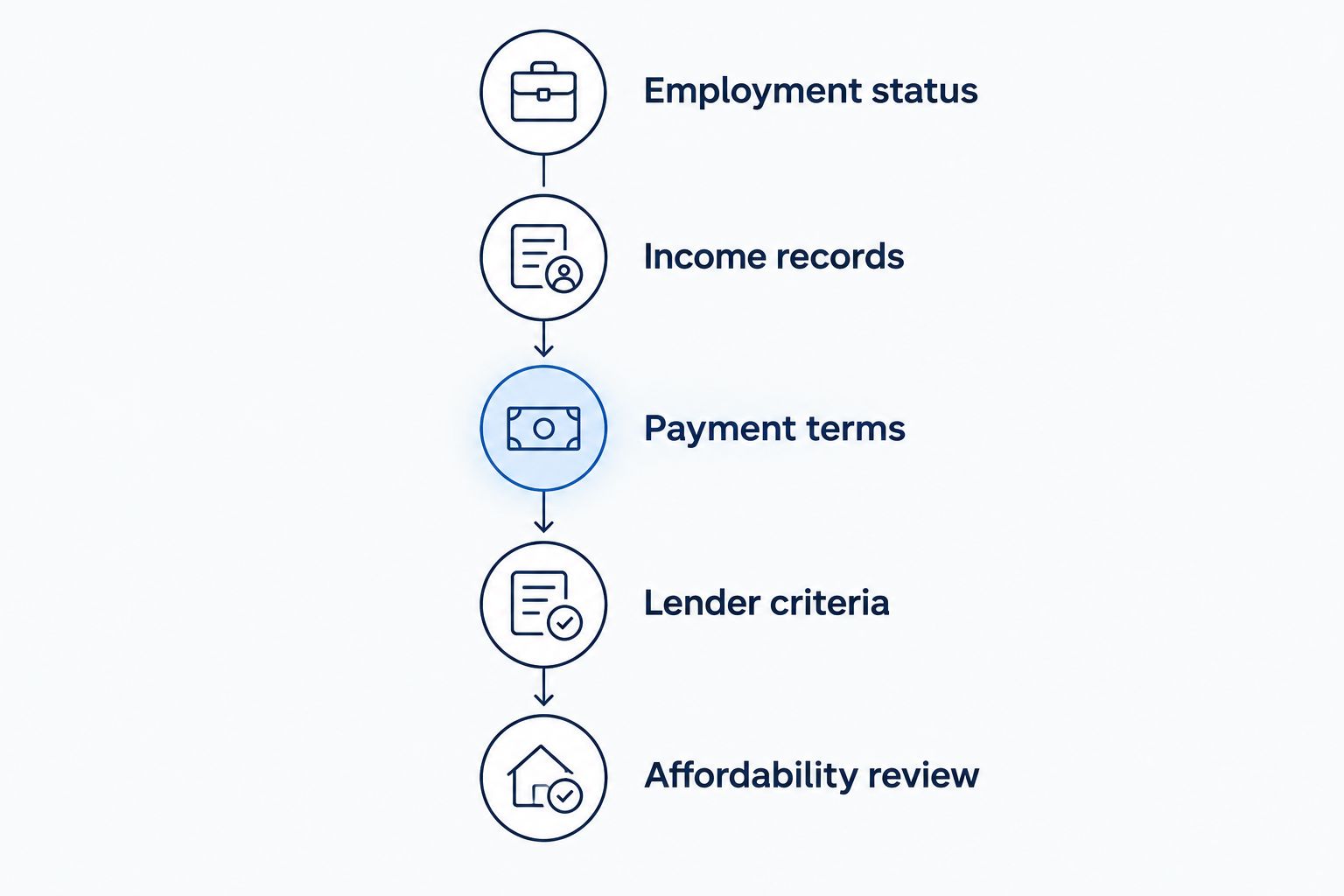
Use this sequence for a 2026 application before making a formal submission. The aim is to establish the income treatment first, then build a consistent evidence pack.
- Employment status: confirm whether you are an employee, sole trader, partner or company director. Use the status shown by your actual working and tax arrangements.
- Income records: assemble the requested payroll or business documents. Match the periods and explain differences between tax records, payslips and bank credits.
- Payment terms: provide the commission arrangement and identify exceptional payments, scheme changes or repayment obligations.
- Lender criteria: confirm that the lender considers commission-only income, then establish how it calculates the acceptable amount.
- Affordability review: assess the proposed borrowing alongside expenditure, credit commitments, deposit and mortgage term.
Keep a short explanation with the documents. State how you earn commission, when it is paid and what caused any material changes; avoid a long narrative that leaves the important figures unclear.
A decision in principle is not a final mortgage offer. The lender still needs to complete the checks required for the application, including income verification and its assessment of the property.
Where does mortgage advice fit?
Heron Financial is best suited to UK borrowers seeking fee-free, whole-of-market mortgage advice rather than a single lender’s product range. For commission-only income, the useful task is to establish which lender criteria fit the documented earnings before making an application.
Heron Financial provides mortgage and protection broking for UK borrowers, including self-employed applicants and company directors. Advice does not remove underwriting requirements or guarantee that a lender will accept your commission.
Bring the income records and payment terms to the discussion. Ask for the income figure used in the affordability assessment and the reason for that figure—not just the resulting borrowing estimate.
Discuss your commission income
Explain your employment status and earnings evidence before choosing a mortgage application route.
Can I get a mortgage if my commission has recently increased?
A recent increase does not automatically become the lender’s accepted annual income. The lender needs to assess the increase under its criteria and understand whether it reflects a sustained change or an exceptional payment.
Provide evidence of the reason: a changed role, revised commission terms or completed earnings records. Do not annualise your best month and treat that figure as approved income.
Can I get a mortgage if I have just changed commission-only jobs?
A job change does not automatically prevent a mortgage, but it changes the evidence available for the current income arrangement. Previous earnings explain your history; they do not establish what the new employer will pay.
Provide the new employment terms and current earnings evidence. Check the lender’s policy on the new role, employment history and any probationary period before applying.
Can I use a joint applicant’s salary alongside my commission?
A joint application can include another applicant’s acceptable income, subject to the lender’s assessment. It also brings that applicant’s expenditure, debts and credit history into the application.
Adding a salaried applicant does not make your commission automatically acceptable. Both applicants are responsible for the joint mortgage repayments, so assess the household budget together.
FAQ
Can I get a mortgage using commission income only in 2026?
Yes, a mortgage using commission income only is possible in 2026 if the lender accepts the earnings and the application meets its criteria. Confirm that its policy allows commission without a basic salary, not just commission added to salary.
How much commission will a mortgage lender count?
The amount depends on the lender’s variable-income criteria and your evidence. Annual commission divided by 12 gives a monthly equivalent, but it is not necessarily the figure the lender will use.
What documents do I need for a commission-only mortgage?
The documents depend on whether you receive commission through PAYE or self-employment. Prepare payroll and employment records for PAYE income, or tax and business records for self-employed income, alongside the bank statements requested.
Does earning commission mean I am self-employed?
No, commission is a payment arrangement, not an employment status. An employee receiving commission through payroll and a self-employed person invoicing for commission need different income evidence.
Can a first-time buyer get a commission-only mortgage?
Yes, being a first-time buyer does not automatically exclude commission income. The lender still assesses whether the earnings are acceptable, whether repayments are affordable and whether the application meets its other criteria.
Will a bigger deposit guarantee a commission-only mortgage?
No, a bigger deposit does not guarantee acceptance of commission income. It reduces loan-to-value, but income eligibility, affordability, credit checks and property assessment remain separate requirements.
Can Heron Financial help with a commission-income application?
Heron Financial offers fee-free, whole-of-market mortgage advice for UK borrowers, including self-employed applicants and company directors. Discuss your employment status and commission evidence so the advice addresses your actual income arrangement; lender approval is not guaranteed.
One last thing
A commission payment already in your bank account is not necessarily unconditional. Check whether your arrangement allows commission to be reclaimed after a cancelled sale, customer refund or another contractual event, and disclose any relevant repayment obligation.
For your 2026 planning, ask Heron Financial to distinguish the income accepted for underwriting from the money you can safely commit to repayments. You need both answers before treating a property budget as workable.


