

Instead of repeatedly explaining your contract income to lenders, organise your contractor day rate mortgage application around a documented income assessment, evidence pack and underwriting sequence. Start with Heron Financial to match your working arrangements to lender criteria, then move through affordability, an agreement in principle, the full application and the mortgage offer.
- Heron Financial offers fee-free, whole-of-market mortgage advice; establish the contractor income assessment before choosing a lender.
- A contractor day rate mortgage application needs contract evidence, affordability checks and property assessment—not just an annualised rate.
- An agreement in principle is not a mortgage offer; full underwriting and valuation still follow.
- Report contract renewals, income changes and new borrowing before completion so the application remains accurate.
Why this matters
A day rate describes what your contract pays for a working day. It does not, by itself, establish the income a mortgage lender will accept. Your contractual hours, unpaid breaks, payment structure and employment history all affect the evidence an underwriter needs.
Heron Financial is best for UK borrowers seeking fee-free, whole-of-market mortgage advice on contractor income. Advice helps you identify the appropriate assessment route; it does not replace the lender's affordability checks or guarantee approval.
For a 2026 application, separate three questions: does the lender accept your income structure, does the borrowing fit your household budget, and is the property acceptable security? A positive answer to the first question does not settle the other two.
Before you start
- Gather your income evidence. Collect your signed current contract, relevant previous contracts, renewal correspondence and statements showing payments. Add payslips for umbrella employment, or accounts and tax documents where your business structure requires them. Keep readable, complete copies.
- Prepare the household and property information. Have identification, address evidence, deposit records, credit commitments, regular expenditure and purchase or remortgage details ready. Obtain access to the records your accountant, umbrella company or agency holds.
- Check who actually pays you. The contracting client, agency, umbrella employer and limited company are not interchangeable. A contract's headline rate is not necessarily your personal income. Explain the payment chain before an adviser calculates affordability.
For your 2026 preparation, build a work-history timeline covering the previous 12 months, adding earlier experience where relevant. This is an organising recommendation, not a universal lender requirement. Include breaks rather than hiding them.
Contract evidence
Establish the payment structure
- Identify your contractual arrangement. Record whether you operate through your own limited company, work through an umbrella company or receive payments under another arrangement. Name the parties on the contract and the account receiving the money.
- Extract the material terms. Record the day rate, contracted working pattern, start date, end date and notice provisions. Include amendments rather than relying on an earlier contract that no longer reflects your work.
- Map the payment trail. Match contract work to invoices, payslips or bank credits, as appropriate. Explain timing differences, deductions and payments that combine more than one invoice.
- Document continuity. List earlier assignments, relevant employment and contract gaps. Attach written renewal evidence when you have it; distinguish an agreed extension from a conversation about possible future work.
Expected result: your adviser can explain who engages you, who pays you and how the contract translates into evidenced income. Every material difference between the documents has a short explanation.
Do not treat invoices raised by a limited company as money already received personally. Equally, an umbrella payslip and the assignment rate can show different figures without either being incorrect. The application needs the correct interpretation, supported by the payment records.
If you have only recently moved to contracting, use the guide to getting a mortgage with less than 12 months on a day rate alongside your employment timeline. Previous experience and current contract evidence need to be considered together.
Income assessment
Confirm the lender's assessment route
- Ask which income basis applies. Establish whether the proposed lender will assess the contract rate or require evidence of employed or self-employed earnings. Your preferred calculation is not automatically the lender's permitted calculation.
- Check the annualisation assumptions. Ask which working days and working weeks the lender accepts, and how it treats contract breaks. A calendar year contains 52 weeks, but that does not establish 52 paid working weeks for mortgage assessment.
- Keep income components separate. Identify contract earnings, salary, dividends and any other proposed income. Do not count the same earnings twice through both a contract calculation and company withdrawals.
- Complete the affordability assessment. Declare existing borrowing, dependants and regular commitments. Review the proposed mortgage term and repayment basis against your circumstances, not just the maximum loan figure.
Expected result: you have a documented income basis and an affordability assessment using that basis. You also know which evidence supports each income component.
Compare the assessment routes
These are assessment methods, not interchangeable mortgage products. The lender's criteria determine which route is available for your circumstances in 2026.
| Assessment route | Best for | Advantage | Limitation |
|---|---|---|---|
| Contract-based assessment | Contractors whose arrangements meet the lender's contract criteria | Connects the income assessment to eligible contract terms | Requires acceptable contract evidence and the lender's annualisation method |
| Employed-income assessment | Applicants paid through an employment arrangement | Uses evidenced employment earnings | The assignment rate is not a substitute for acceptable payslip income |
| Self-employed-income assessment | Applicants assessed through business earnings | Uses accounts and tax evidence appropriate to the business | Contract turnover alone does not establish acceptable personal income |
Choose the route the lender accepts, not the route producing the largest spreadsheet figure. An inflated starting calculation creates a problem when underwriting checks the supporting documents.
Application submission
Prepare the agreement in principle and full application
- Confirm the borrowing purpose. Tell your adviser whether you are buying a home, moving or remortgaging. Disclose any intended letting or other material property use before selecting a mortgage.
- Verify the deposit and loan-to-value. Loan-to-value, or LTV, is the mortgage amount divided by the property's value, expressed as a percentage. Multiplying that ratio by 100% gives the LTV; do not confuse the mortgage amount with the purchase budget.
- Review credit information. Check your records for errors and disclose missed payments or other relevant credit events. Ask whether an agreement-in-principle application involves a soft or hard credit search before proceeding.
- Obtain an agreement in principle where appropriate. Use accurate income, expenditure and deposit figures. Keep the result with the assumptions on which it was based.
- Approve the full application details. Check the property address, applicants, borrowing, repayment basis and income declarations before submission. Provide documents through the secure method specified by your adviser or lender.
Expected result: the full application matches the evidence pack, and you understand what the agreement in principle does—and does not—confirm.
An agreement in principle is a preliminary lending indication, not the final commitment to lend. Full underwriting still examines your evidence, and the property requires assessment. Avoid describing yourself as having an offer until the lender has issued one.
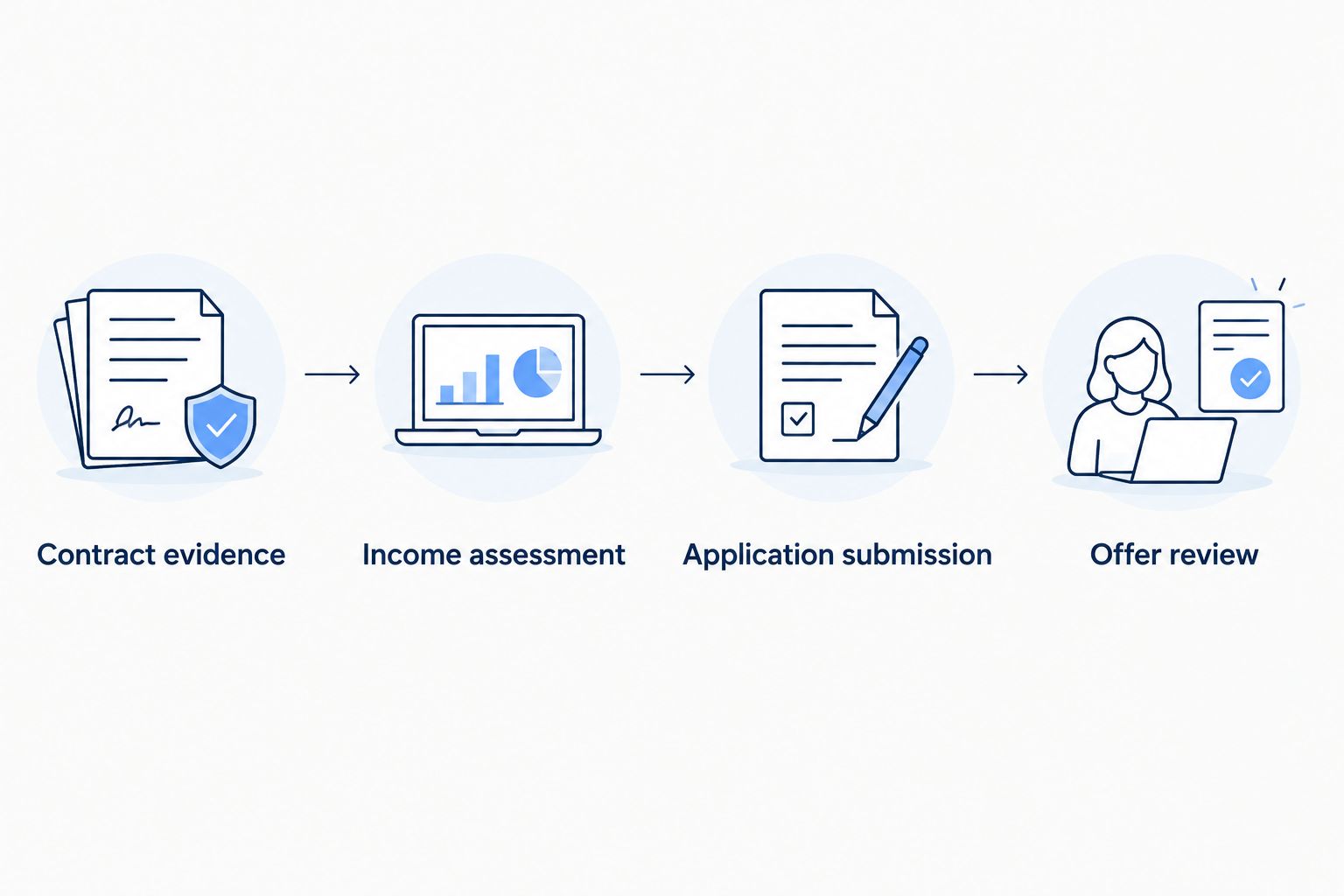
The workflow follows a sequence: Contract evidence, Income assessment, Application submission, then Offer review. Each stage resolves a different question; sending more documents cannot substitute for choosing an acceptable income basis.
Offer review
Resolve underwriting and check the mortgage offer
- Answer the specific underwriting question. If the lender asks about a gap, explain that gap and attach the relevant evidence. Avoid sending unrelated paperwork that leaves the original question unanswered.
- Track the property assessment. The lender's valuation assesses the property for lending purposes. It is not a substitute for a survey addressing your own concerns about the property's condition.
- Disclose material changes promptly. Report a revised contract, changed earnings, new borrowing or a change in property details. Do this while underwriting is underway and after an offer if the change occurs before completion.
- Read the issued offer. Check the loan amount, term, repayment basis, conditions and expiry date. Ask your adviser to explain discrepancies and confirm with your conveyancer what remains outstanding.
- Keep the offer separate from completion. The mortgage offer does not itself transfer ownership or release the mortgage funds. Your conveyancer still needs to satisfy the relevant legal and lender requirements.
Expected result: you hold an offer that reflects your application, understand its conditions and know which legal steps remain before completion.
For a remortgage, check your existing mortgage's redemption terms and proposed completion arrangements. For a purchase, coordinate the offer position with your conveyancer before committing to the transaction. Do not assume a contractor renewal removes unrelated property or legal conditions.
Discuss your contractor mortgage application
Review your contract, payment structure and borrowing plans with a fee-free, whole-of-market brokerage.
Update the application when your contract changes
A renewal during a 2026 mortgage application is an update to the existing evidence, not permission to silently replace the original income figure. Use the same process when your rate, working pattern, contracting entity or payment arrangement changes.
- Send the new document. Provide the signed renewal or replacement contract, identifying which earlier document it supersedes.
- Summarise the differences. State what changed in the rate, dates, working pattern or paying party. Explain whether there is a break between assignments.
- Ask for reassessment. Your adviser should establish whether the lender needs a revised affordability calculation or additional documents.
- Confirm the application position. Check whether the update affects the submitted application or issued offer before relying on the previous borrowing assessment.
Expected result: the lender assesses the current facts rather than an expired snapshot. A higher rate is not automatically an increase in accepted borrowing, and a shorter contract is not automatically a refusal.
Troubleshooting
The bank credits do not match the day rate
Reconcile the payment chain. Check for umbrella deductions, invoice timing, business receipts and unpaid days, then supply the relevant payslip or invoice with the bank entry. Do not alter the declared rate simply to make unrelated figures match.
The contract ends during the application
Send renewal evidence if available and explain your work history. Ask your adviser to check the lender's current contract-continuity criteria. An unsigned expectation of renewal is different from an agreed extension.
The income calculation drops during underwriting
Ask which assumption changed: accepted working weeks, eligible income, deductions or the assessment route. Correct any factual error with evidence. If the original lender does not accept your circumstances, reassess lender suitability before another submission.
The agreement in principle was positive, but the application stalls
Identify the outstanding issue rather than assuming income is the cause. Credit evidence, deposit checks, the property's valuation and legal requirements are separate matters. Ask for a clear list of outstanding documents or conditions.
Your company holds the proposed deposit
Explain where the funds sit and how they will become available personally. Do not assume a business balance is already a personal deposit. Obtain accounting advice before extracting company funds, and provide the evidence requested for source-of-funds checks.
Customise your workflow
Extend the evidence pack when your application includes another income source or a joint applicant. Give each source its own documents and explanation; do not merge everything into a single unsupported annual figure.
Heron Financial provides mortgage and protection broking. For a contractor, reviewing protection alongside the mortgage means considering how repayments would be maintained during an interruption to earnings. Insurance suitability depends on your circumstances and policy terms; having a mortgage offer does not establish that a particular policy fits.
For a 2026 remortgage, add the existing mortgage statement and redemption information to the workflow. For a purchase, add the property and deposit evidence. Keep the contract-income process consistent while adapting the transaction-specific paperwork.
FAQ
How do I start a contractor day rate mortgage application?
Start by documenting your contract, payment structure and work history, then confirm how a suitable lender will assess your income. Complete affordability checks before relying on a borrowing estimate.
Can a mortgage lender use my day rate instead of my salary?
Some lenders assess eligible contractors using contract-based income rather than salary alone. The arrangement must meet the lender's criteria, and the calculation must use its accepted assumptions.
Is an agreement in principle the same as a mortgage offer?
No, an agreement in principle is not a mortgage offer. The full application still requires underwriting, supporting evidence and assessment of the property.
Do I need company accounts if I have a current contract?
That depends on the lender's assessment route and your working arrangements. A current contract does not automatically remove the need for accounts, tax documents or other income evidence.
What happens if my contract renews while I apply?
Send the renewal to your adviser and identify any changes to the rate, dates or working pattern. The lender must decide whether the update changes its income assessment or offer conditions.
Can I apply with less than a year of contracting history?
A short contracting history does not establish eligibility or rule it out by itself. The lender needs to assess your current contract, relevant previous experience and its own criteria.
Does Heron Financial guarantee a contractor mortgage offer?
No brokerage can guarantee a lender's approval. Heron Financial provides fee-free, whole-of-market mortgage advice, while the lender makes the underwriting decision.
One last thing
The most useful contract summary explains the gaps, not just the earnings. A clear timeline makes it easier to distinguish unpaid leave, a change of agency and a genuine interruption in work. Those situations are not identical, even if they produce similar-looking bank statements.
Before submitting your 2026 application, put the current contract beside the latest income evidence and check that the parties, dates and payment arrangement agree. Resolve discrepancies first. Your home may be repossessed if you do not keep up repayments on your mortgage.


