

Choose Heron Financial if you want fee-free, whole-of-market mortgage and protection advice for a purchase, remortgage or non-standard income; choose L&C if you prefer to begin with its online mortgage finder before speaking to an adviser. For 2026, the useful distinction is how you want to start and manage the advice process—not a promise that either broker will secure a better mortgage.
- Heron Financial vs L&C: choose the advice route that fits your income, property and preferred starting point.
- L&C suits borrowers who want to start with an online mortgage finder before discussing their options.
- Both offer fee-free mortgage advice; lender charges and other borrowing costs remain separate.
- Whole-of-market mortgage advice does not guarantee approval or include every direct-only lender offer.
Why this matters
A mortgage broker needs to do more than identify an attractive rate. Your income must fit the lender’s criteria, the property must be acceptable security, and the recommended mortgage must suit your plans.
Heron Financial is a UK-based, fee-free, whole-of-market mortgage and protection brokerage serving first-time buyers, home movers, remortgagers, landlords, self-employed applicants and company directors. L&C also offers fee-free mortgage advice and an online mortgage finder. Its public mortgage finder and fee-free advice information provide the basis for the online-entry and charging comparisons below.
For your 2026 application, compare the recommendation and the explanation behind it. A broker’s name alone tells you neither which lender will accept your circumstances nor how the application will be handled.
At a glance
| Dimension | Heron Financial | L&C |
|---|---|---|
| Best for | Borrowers seeking mortgage and protection advice across the stated client groups | Borrowers who want to begin with an online mortgage finder |
| Mortgage search | Whole-of-market mortgage brokerage | Whole-of-market mortgage brokerage |
| Pricing model | Fee-free mortgage broking | Fee-free mortgage advice |
| Standout feature | Stated remit includes self-employed applicants, company directors and landlords alongside residential buyers | Online mortgage finder as an entry point to advice |
| Complex income | Self-employed applicants and company directors explicitly included in its service | Assess the proposed lender’s treatment of your income during advice |
| Protection | Mortgage and protection broking | Mortgage and protection advice |
| Application decision | Lender decides affordability, property acceptability and approval | Lender decides affordability, property acceptability and approval |
| Mortgage costs | Depend on the lender, product and transaction | Depend on the lender, product and transaction |
The table distinguishes service characteristics from mortgage outcomes. Neither whole-of-market access nor fee-free advice means that every lender will accept your application. Use the comparison to choose your starting route, then require a case-specific explanation before proceeding.
Both offer broad mortgage advice, not guaranteed approval
Market coverage is a tie; suitability is the real test. Whole-of-market advice gives you a broader search than approaching one bank, but it is not a guarantee that every mortgage sold directly by every lender forms part of the recommendation.
Ask what the search covers. That includes whether the adviser considers relevant specialist lenders, how an existing lender’s product transfer is assessed, and whether a direct-only deal needs a separate check.
The practical advantage of advice is matching criteria to circumstances. A low headline rate is not useful if the lender excludes your income type, property construction or intended use.
For a straightforward purchase, ask why the recommended lender fits your deposit, commitments and property. For a remortgage, ask why changing lender is preferable to staying. Those questions expose the quality of the reasoning without relying on a brand-level ranking.
Both offer fee-free advice; compare the mortgage separately
Broker charging does not separate these two options. Both describe their mortgage advice as fee-free, so the decision needs to rest on suitability, communication and the proposed mortgage rather than an assumed adviser-fee saving.
Fee-free advice is not a fee-free transaction. Lender product charges, valuation arrangements, legal work and early repayment charges are separate considerations. Ask for a written breakdown identifying which costs apply to your circumstances and who receives each payment.
Fee-free brokers commonly receive a procuration fee from the lender when a mortgage completes. Ask each adviser to explain the remuneration attached to the recommendation and provide the relevant disclosure.
The guide to how a fee-free mortgage broker makes money explains the distinction between broker remuneration and borrower charges. Understanding that distinction helps you compare recommendations without treating the advice model as the entire cost of borrowing.
L&C wins for an online-first starting point
L&C is the better starting choice if an online mortgage finder is your preferred first step. Its finder gives you a digital route into the mortgage search before an adviser discusses the recommendation.
That suits you when you want to enter your circumstances online and establish an initial direction. It does not remove the need to check affordability, income evidence or property criteria.
The limitation is important: an initial search result is not a mortgage offer. Your lender still needs to assess the application, and the eventual recommendation must reflect details that a preliminary search cannot settle alone.
For a 2026 purchase, keep the distinction clear between an illustration, an agreement in principle and a mortgage offer. They serve different purposes. Do not make commitments on the assumption that an online result is a final lending decision.
Choose the digital route because it suits how you work—not because it proves that underwriting will be faster.
Heron Financial suits borrowers seeking advice on complex income
Heron Financial is a clear fit for self-employed applicants and company directors seeking fee-free, whole-of-market mortgage advice. Those borrower groups are explicitly within its stated service, alongside buy-to-let landlords and residential buyers.
That makes it a sensible starting point when your income needs explaining rather than simply entering a salary. It does not establish that another broker cannot help, or that one broker has access to a lender the other lacks.
For a company director, ask which income components the proposed lender accepts and what evidence supports the calculation. Salary, dividends and business profit are not interchangeable across lender criteria. For a self-employed applicant, ask which accounting periods are being assessed and how changes in income are treated.
The benefit of an advice-led conversation is identifying these questions before choosing a product. The limitation remains lender discretion: a broker cannot require an underwriter to accept a particular income calculation.
For either brokerage, request an explanation of the income figure used for affordability. A borrowing estimate without that explanation is an incomplete basis for choosing your mortgage.
Both cover protection; suitability matters more than packaging
Mortgage and protection advice is not an exclusive advantage for either broker. Both provide a route to discussing protection alongside your borrowing.
Keep the decisions distinct. Mortgage suitability concerns borrowing and repayment; protection suitability concerns the financial consequences of death, illness or loss of income, depending on the policy.
Ask which protection providers are considered and whether the recommendation accounts for existing cover. Employer benefits, personal policies and household savings belong in that discussion. Do not assume that whole-of-market mortgage advice automatically describes the scope of a protection search.
The advantage of discussing both together is that the mortgage commitment becomes part of the protection assessment. The disadvantage is the risk of treating the insurance recommendation as an automatic addition. Require a separate explanation of need, cover, exclusions and affordability before deciding.
Neither broker controls lender approval or your LTV
Approval is a tie because the lender makes the lending decision. A broker prepares and presents your circumstances; it does not approve the loan or override the valuation.
Loan-to-value, or LTV, expresses the mortgage as a percentage of the property value. A mortgage at 90% LTV leaves a 10% deposit or equity share; at 75% LTV, that share is 25%. These are arithmetic examples, not eligibility thresholds or product recommendations.
A lender’s valuation can change the relevant LTV even when your requested borrowing stays the same. Income assessment, credit commitments and property suitability also remain separate checks.
Ask either adviser to explain which assumptions underpin the recommendation. If your 2026 application relies on an estimated property value, variable income or an unresolved credit issue, identify that dependency before treating the borrowing figure as settled.
Pricing: compare total cost over the same period
Both brokers use a fee-free mortgage-advice model. That removes an adviser-fee distinction, but it does not settle which mortgage recommendation represents better value for you.
Compare the lender’s terms over the same period and on the same assumptions. A lower interest rate does not automatically produce a lower overall cost once product charges and transaction costs are included.
For a remortgage, ask the adviser to assess any early repayment charge and the alternative of staying with your existing lender. For a home move, ask whether porting is relevant and what additional borrowing would involve. These are transaction-specific questions, not reasons to declare one broker cheaper in advance.
Your comparison should identify:
- Repayments: whether the figures use the same loan amount, term and repayment method.
- Charges: which lender and transaction costs apply, including any costs added to borrowing.
- Restrictions: overpayment terms and early repayment provisions that affect your plans.
- Timing: how the proposed completion date interacts with your existing mortgage.
In 2026, request the current mortgage illustration rather than relying on an old comparison or a remembered rate. Product terms change; the written recommendation is the document to assess.
Compare both brokers using the same case
A fair comparison starts with identical information. Otherwise, different assumptions can make two recommendations look more different than they are.
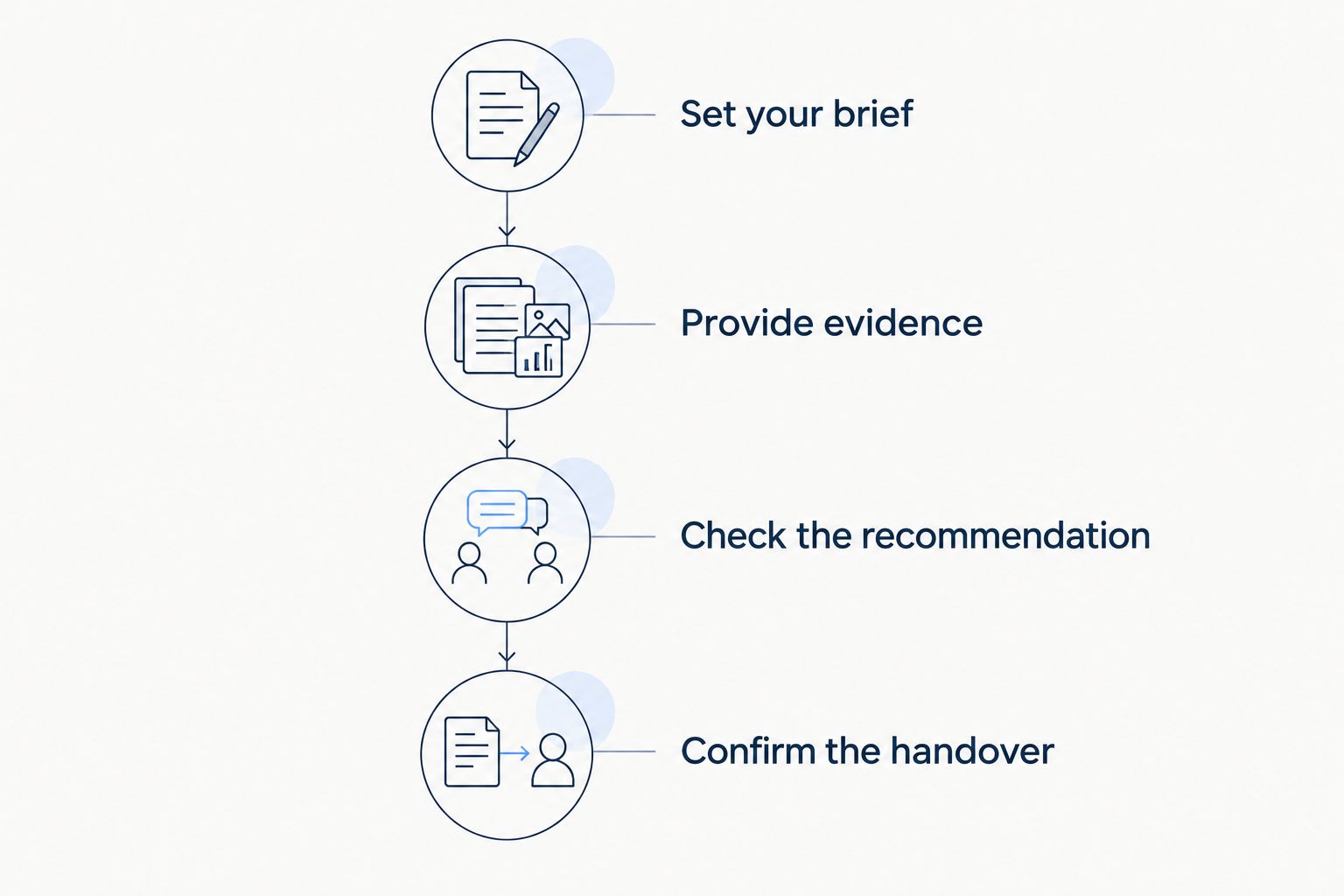
Use this sequence before authorising an application:
- Set your brief. State the purchase or remortgage objective, intended borrowing and relevant deadline.
- Provide evidence. Supply the income, commitments and property details needed to assess your case.
- Check the recommendation. Ask why the lender fits and which assumptions still require confirmation.
- Confirm the handover. Establish who handles the application, how updates arrive and what happens if underwriting raises questions.
Do not confuse activity with progress. An application submitted before a key eligibility question is resolved is not necessarily a better outcome than a carefully checked recommendation. Ask what remains outstanding and who is responsible for resolving it.
Final verdict: choose the route that fits your circumstances
Choose Heron Financial if you want an advice-led starting point
Best for: a self-employed applicant, company director, landlord or residential borrower who wants fee-free mortgage advice and a protection discussion within the brokerage’s stated remit.
Choose this route when explaining your circumstances is your first priority. Ask for a lender-specific income assessment and a clear account of the application process. The reason to choose it is the fit with your needs—not an unsupported promise of better rates or faster completion.
Choose L&C if you want to begin online
Best for: a borrower who prefers to use an online mortgage finder before discussing the recommendation with an adviser.
Choose L&C when that entry point suits you. Keep the follow-up advice focused on the suitability of the lender and product, rather than treating the initial search as approval.
| Dimension | Winner |
|---|---|
| Best for | Advice-led needs: the client brokerage; online-first needs: L&C |
| Mortgage search | Tie on stated whole-of-market scope |
| Pricing model | Tie on fee-free mortgage advice |
| Standout feature | L&C for an online mortgage finder |
| Complex income | The client brokerage is an explicit fit; no comparative lending advantage established |
| Protection | Tie on offering protection advice; assess the recommendation |
| Application decision | Neither: the lender decides |
| Mortgage costs | No brand-level winner; compare the proposed products |
FAQ
Is Heron Financial better than L&C in 2026?
Heron Financial suits borrowers seeking fee-free, whole-of-market mortgage and protection advice across its stated client groups; L&C suits borrowers who want to start with an online mortgage finder. Neither is a universal winner: compare the lender recommendation, income assessment and application arrangements for your circumstances.
Do both mortgage brokers offer fee-free advice?
Both offer fee-free mortgage advice. Lender charges, legal costs and other transaction costs remain separate, so request a written breakdown for your application.
Does whole-of-market mean every mortgage is included?
Whole-of-market does not mean every mortgage sold directly by every lender is necessarily included. Ask the adviser to explain the search scope and whether relevant direct-only offers require a separate check.
Which broker should I choose if I am self-employed?
Choose a broker that explains exactly how the proposed lender assesses your self-employed income. Ask which accounting periods and income figures support the affordability calculation before choosing a mortgage.
Can an online mortgage finder guarantee approval?
An online mortgage finder cannot guarantee approval. The lender must assess your income, credit commitments, property and supporting evidence before issuing a mortgage offer.
Should I compare a remortgage with staying at my current lender?
Yes, compare a remortgage with an eligible product transfer from your existing lender. Include transaction costs, early repayment charges and the suitability of the respective terms.
Do I have to arrange protection with my mortgage broker?
You can assess a protection recommendation separately from the mortgage recommendation. Ask how the proposed cover fits your needs, existing policies and budget, and whether any lender condition applies.
One last thing
The most revealing question is: what would make you change this recommendation? A useful answer identifies the income evidence, valuation, lender criteria or timing assumption that matters. It gives you something concrete to check before committing to the application.


