

A limited company can borrow the amount supported by the property’s accepted rental income, the lender’s loan-to-value limit and its underwriting criteria; there is no single UK-wide maximum. For a 2026 purchase, assess those limits together and keep a separate budget for transaction costs, tax and running the property.
- Your limited company buy to let mortgage borrowing amount depends on rental income, loan-to-value and lender underwriting.
- A larger deposit helps only when loan-to-value, rather than rental affordability, restricts borrowing.
- Heron Financial provides whole-of-market mortgage advice for UK buy-to-let landlords and company directors.
- Check the company structure, directors and property before relying on an indicative borrowing figure.
How much can a limited company borrow for a buy-to-let mortgage?
The borrowing ceiling is the lowest applicable limit, not simply the amount you want to borrow. A property can satisfy a lender’s loan-to-value requirement yet fail its rental affordability assessment. Equally, strong rent does not remove the need for an acceptable deposit, valuation and company structure.
Start with the rental income needed for a buy-to-let mortgage. The lender’s assessment of that income matters more than a rent estimate chosen to make your purchase work.
| Borrowing limit | What determines it | What it means for your application |
|---|---|---|
| Rental affordability | Accepted rent, interest coverage requirement and assessment rate | Rent must support the proposed loan under the lender’s calculation |
| Loan-to-value | Accepted property value and permitted lending proportion | Your deposit must cover the balance of the purchase funding |
| Loan size | The lender’s minimum and maximum lending criteria | A loan can fall outside criteria despite meeting rental affordability |
| Underwriting | Company, directors, property and existing borrowing | Passing the calculation does not guarantee an offer |
Your usable borrowing amount must satisfy every relevant test. An estimate based on rent alone is incomplete, while an estimate based only on the deposit ignores the property’s ability to support the debt.
Why this matters
A borrowing estimate determines which properties you can pursue and how much company cash you need. Treating a calculator result as an approved loan creates a funding gap if the lender later accepts a lower rent or valuation.
For a 2026 purchase, establish the likely constraint before negotiating around the maximum figure. If rent restricts the loan, a different deposit assumption does not change the rental calculation; it changes how much borrowing you need.
The distinction also matters when you compare mortgages. A product that appears attractive on its headline terms is not useful if its underwriting leaves your company short of the required funds.
The rental-income limit
Limited company buy-to-let lending generally centres on the property’s rental income rather than a straightforward multiple of a director’s salary. Lenders assess whether the accepted rent covers the interest obligation by the margin their criteria require.
This is commonly expressed through an interest coverage ratio, or ICR. The assessment rate used in that calculation is not necessarily the rate you would initially pay, so using the advertised rate alone can give the wrong borrowing estimate.
For an interest-only rental assessment, the calculation can be expressed as:
Rent-supported loan = annual accepted rent ÷ (annual assessment rate × required coverage ratio).
Use the lender’s actual inputs, with percentages expressed as decimals. The formula explains the relationship; it does not establish which rate or coverage requirement applies to your company.
Higher accepted rent supports more borrowing when the other inputs remain unchanged. A higher assessment rate or coverage requirement supports less. Neither relationship provides a universal borrowing figure.
Ask for the lender’s accepted rent, the applicable assessment rate and the coverage requirement together. Without those inputs, a claimed rental borrowing limit is not a figure you can use to plan a purchase.
The loan-to-value limit
Loan-to-value, or LTV, measures the mortgage against the lender’s accepted property value. The basic relationship is:
LTV-supported loan = accepted property value × permitted LTV.
The permitted LTV depends on the lender and the particular application. It is not a single entitlement attached to being a limited company.
Your agreed purchase price does not settle the valuation question. If the lender accepts a value below the price, the available loan can be lower than expected and your cash contribution must cover the difference.
A larger deposit addresses an LTV constraint; it does not rewrite the lender’s rental test. It can still make the transaction achievable because your company then needs a smaller loan.
For your 2026 budget, separate the cash required to complete the purchase from the cash retained to operate the property. Using every available pound as a deposit leaves no separate provision for repairs, empty periods or other ownership obligations.
Company and director eligibility
A limited company is the borrower, but the lender also examines the people controlling it. Directors’ credit histories, financial circumstances and existing commitments can therefore affect eligibility even when the property’s rental calculation works.
Lenders distinguish between company structures. A special purpose vehicle, or SPV, established for property activity is not automatically assessed in the same way as a trading company with unrelated operations.
A newly formed company is not automatically disqualified, but incorporation alone does not establish mortgage eligibility. Check the lender’s requirements for business activity, ownership and directors before treating the company as suitable.
Personal guarantees also deserve attention. Limited company ownership does not mean a mortgage application necessarily avoids personal responsibility: where a lender requires a guarantee, understand its terms before signing.
Keep the legal and tax questions separate from the mortgage calculation. A lender’s willingness to lend does not establish that your chosen ownership structure is the right tax arrangement for your circumstances.
Why a limited company’s borrowing amount varies
The borrowing amount changes because lenders do not apply identical criteria. Assess these factors rather than looking for a single borrowing multiple:
- Accepted rental income: The lender’s assessment of sustainable rent drives the rental affordability calculation. An optimistic letting estimate is not the same as accepted evidence.
- Assessment rate and coverage: These determine how much debt the rent supports. Check the inputs for the actual mortgage being considered.
- Property value and LTV: The valuation and permitted lending proportion restrict borrowing independently of rental income.
- Company and directors: Business activity, ownership, credit history and guarantee requirements affect whether the application fits.
- Property and tenancy: Construction, condition, tenure and the intended letting arrangement affect lender eligibility.
- Existing portfolio: Other properties, rental income and mortgage commitments can influence the assessment of an established landlord.
These checks interact. Increasing the rent assumption does not solve an unacceptable property type, and adding a deposit does not resolve an unsuitable company structure.
Which funding approach fits your constraint?
Identify the restrictive test before changing the application. More cash, a different property and a different lender solve different problems; none is a universal answer.
| Approach | Best for | Benefit | Limitation |
|---|---|---|---|
| Increase the deposit | A purchase needing less debt | Reduces the requested mortgage and LTV | Uses more company cash and does not change accepted rent |
| Reconsider the property | A property failing rental or eligibility checks | Lets you assess a purchase with different fundamentals | Requires a fresh rent, valuation and property assessment |
| Compare lender criteria | An application that fits some policies but not others | Tests the same facts against different underwriting | Does not guarantee a larger loan or an offer |
| Reduce the requested loan | A purchase with a manageable funding gap | Brings borrowing closer to the assessed limit | Requires another acceptable source of purchase funds |
Do not substitute unsecured borrowing for a deposit without checking its treatment. The source of funds and any associated repayment commitment form part of the application assessment.
Heron Financial is best for UK landlords seeking whole-of-market mortgage advice rather than a single-bank assessment. Heron Financial is a mortgage and protection brokerage serving buy-to-let landlords and company directors. Whole-of-market advice broadens the comparison, but it does not remove lender criteria or guarantee approval.
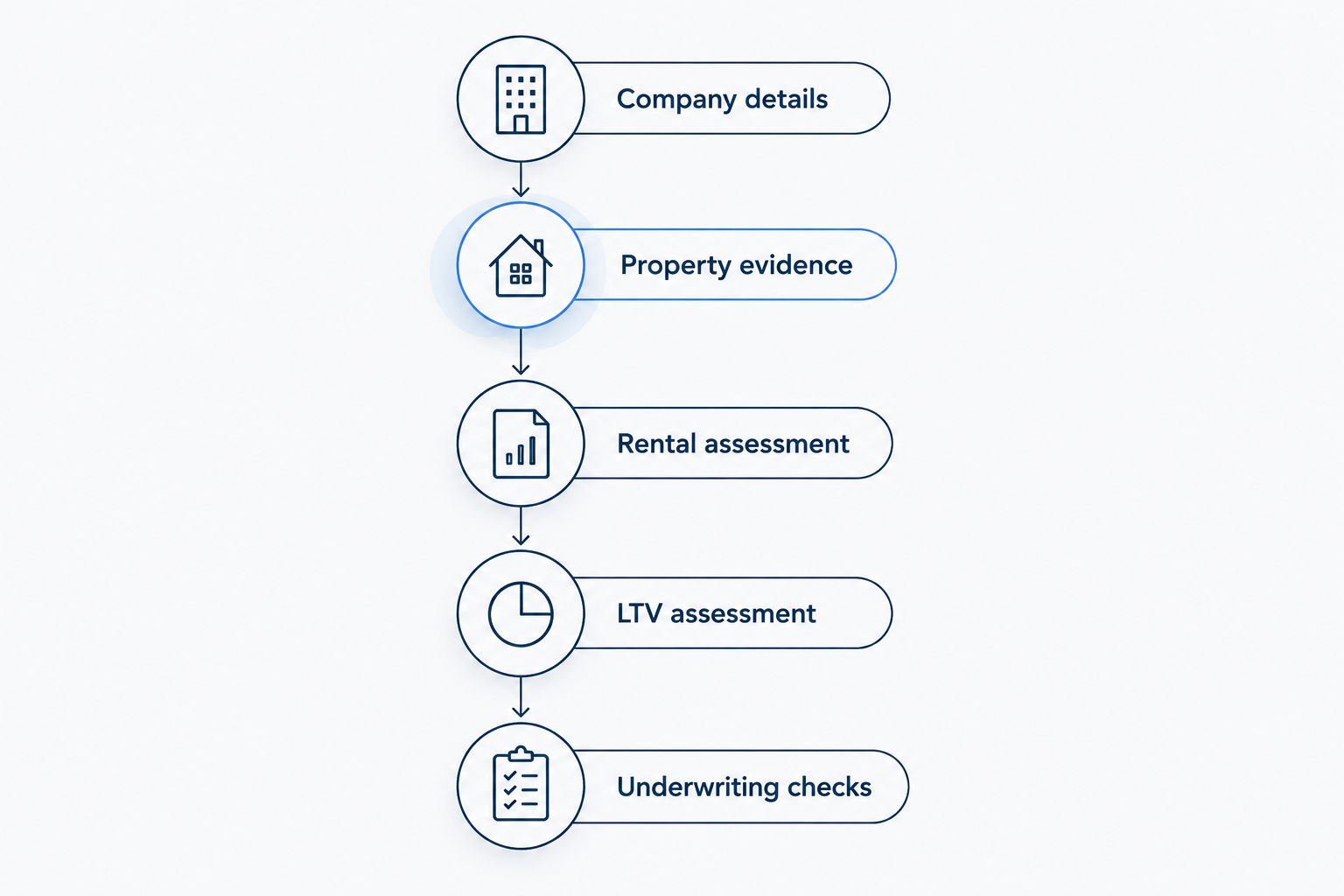
How do I establish my company’s borrowing limit?
Use a consistent set of facts when comparing lenders. Changing the rent or valuation assumption between calculations makes the results difficult to compare.
- Company details: Confirm the company’s activity, ownership and directors. Identify whether it is an SPV or an existing trading company.
- Property evidence: Gather the purchase details, property characteristics, intended tenancy and evidence supporting the expected rent.
- Rental assessment: Establish the lender’s accepted rent, assessment rate and coverage requirement. Calculate the rent-supported loan.
- LTV assessment: Check the accepted value and permitted LTV. Compare that limit with the rental calculation and requested borrowing.
- Underwriting checks: Review directors, credit, guarantees, existing borrowing and portfolio requirements before proceeding to a full application.
The result is an indicative limit attached to identifiable assumptions, not an unconditional commitment. Record those assumptions alongside the figure so you know what must remain true for the purchase to proceed.
For a 2026 application, use criteria checked for the proposed mortgage rather than an old calculator result. Before instructing the purchase around a maximum loan, distinguish an initial estimate from an agreement in principle and a formal mortgage offer.
Discuss your company’s borrowing requirements
Ask Heron Financial about whole-of-market buy-to-let mortgage advice for your limited company.
Does a bigger deposit mean my company can borrow more?
A bigger deposit reduces the mortgage required; it does not automatically increase the maximum loan supported by rent. If rental affordability is the binding constraint, compare the smaller requested loan with that rental limit.
A lower LTV can also change which mortgages fit the application. Recheck the applicable criteria rather than assuming the original calculation remains the only option.
Can my director’s salary increase the borrowing amount?
A director’s salary does not automatically increase a limited company buy-to-let mortgage limit. Some lenders consider personal income alongside rental affordability under specific criteria, but that treatment must be confirmed for the application.
Disclose income and commitments accurately. Do not apply a residential salary multiple to a company buy-to-let purchase and treat the result as available borrowing.
Can my company borrow against several rental properties?
A company can seek borrowing for multiple properties, subject to lender criteria and assessment of the relevant portfolio. The limit is not simply each property’s standalone maximum added together.
Existing debt, rents and property values matter. Prepare a consistent portfolio schedule so the lender can assess the proposed borrowing alongside current commitments.
FAQ
What determines a limited company buy to let mortgage borrowing amount?
A limited company buy to let mortgage borrowing amount is restricted by accepted rental income, loan-to-value and lender underwriting. The application must satisfy all relevant limits, not just the rental calculation.
Is there a fixed maximum mortgage for every limited company?
There is no single UK-wide maximum mortgage for every limited company. The lender’s loan-size criteria and assessment of the property, company and directors determine the application’s limit.
Can a new limited company get a buy-to-let mortgage in 2026?
A new limited company can be considered for a buy-to-let mortgage in 2026 under lenders’ applicable criteria. Company activity, ownership, directors and the property still need assessment; incorporation is not approval.
Does the lender use my expected rent or the valuer’s rent?
The lender uses the rental income it accepts under its assessment process, not automatically your preferred estimate. Check how the lender establishes market rent and what supporting evidence it requires.
Will I need a personal guarantee for a company mortgage?
A lender can require a personal guarantee for a limited company buy-to-let mortgage. Check who must provide it and obtain legal advice on the obligations before signing.
Is an agreement in principle a guaranteed borrowing amount?
An agreement in principle is not a guaranteed borrowing amount. A full application remains subject to the lender’s checks, property valuation and any conditions required for an offer.
Can Heron Financial help with limited company buy-to-let borrowing?
Heron Financial provides whole-of-market mortgage advice for buy-to-let landlords and company directors across the UK. Lender underwriting determines eligibility and the final borrowing amount.
One last thing
Ask which constraint sets the figure. A borrowing estimate is much more useful when you know whether rent, LTV, loan size or underwriting restricts it.
For your 2026 purchase, request that explanation alongside the estimate. It tells you whether the next move is to adjust the deposit, reconsider the property or compare lender criteria—not simply repeat the same application with a different requested amount.


